Improving your autism conversation skills doesn't have to feel like solving an impossible puzzle. We'll break conversations down into four clear phases: Preparation, Initiation, Maintenance, and Exiting. This isn't about masking; it's about providing concrete techniques that work with a neurodivergent brain. The goal is to reduce anxiety and build genuine confidence in social interactions. This guide offers actionable strategies to help you navigate conversations more effectively.
A Practical Framework for Conversation Skills
For many of us, conversations are exhausting. We're often told to just "make more eye contact" or "read the room," which is about as helpful as being told to "just relax" during a meltdown. It doesn't work.
A much better way is to see conversation as a process with distinct, predictable stages. When you do this, a chaotic, unpredictable social event turns into a sequence you can actually follow. It gives you a sense of control and seriously reduces the cognitive load of trying to figure everything out at once.
Instead of getting overwhelmed by the entire exchange, you can just focus on one part at a time. If you're interested in a wider perspective, there's a helpful general framework for improving conversational skills that can offer some complementary ideas to the neurodivergent-specific strategies we'll cover here.
The Four Phases of Interaction
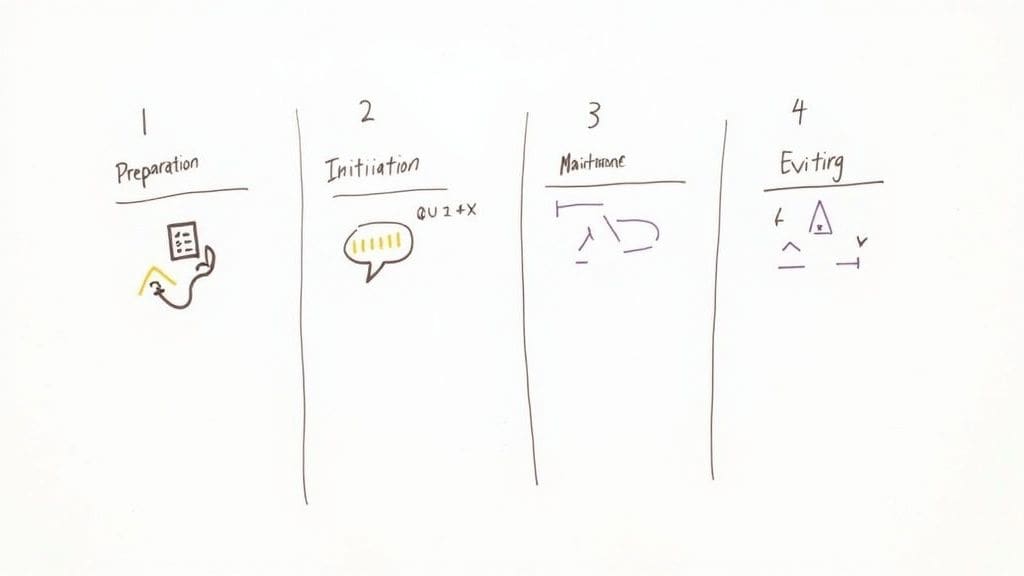
Thinking about a conversation in four chunks helps make the whole thing feel less intimidating. Each phase has its own goal and its own set of tools you can learn to use.
- Preparation: This is all the work you do *before* you even say hello. Think of it as setting the stage for success. It's about managing your sensory environment, having a few potential topics in your back pocket, and knowing your exit strategy from the start.
- Initiation: This is simply the act of getting the conversation started. The focus here is on using clear, low-risk opening lines that feel authentic and don't put too much pressure on you or the other person.
- Maintenance: Here's the back-and-forth part. The goal is to keep the dialogue moving without it feeling like an interrogation. We'll look at things like asking reciprocal questions and learning to be comfortable with natural pauses.
- Exiting: This is how you wrap things up without feeling rude or getting stuck. Having a few pre-planned closing lines is a game-changer for ending an interaction smoothly.
By breaking social interactions down this way, you can practice each component on its own. Rehearsing in private builds real skills and confidence without the stress of a live audience. This systematic approach is a cornerstone of improving your autism conversation skills.
To make this even clearer, here's a quick summary of how these phases work together.
The Four Phases of a Conversation
| Phase | Primary Goal | Example Action |
|---|---|---|
| Preparation | Reduce anxiety and feel ready | Deciding on one or two safe topics to bring up. |
| Initiation | Start the conversation smoothly | Using a simple opener like, "This is a great event, isn't it?" |
| Maintenance | Keep the dialogue going | Asking a follow-up question related to what they just said. |
| Exiting | End the interaction gracefully | Saying, "It was great chatting, I need to go grab a drink now." |
Looking at it like this transforms a vague social challenge into a series of achievable steps.
Why This Framework Works for Neurodivergent Minds
This kind of structured approach is a lifeline for autistic brains. It injects logic and predictability into social situations that often feel completely arbitrary. Instead of trying to decode a thousand tiny, ambiguous non-verbal cues, you have a clear process to rely on.
It also validates something many of us already know we need: preparation and rehearsal. You're not "weird" for wanting to plan what you'll say. It's a smart strategy.
You can use tools like the tonen app to practice your scripts and play around with different conversational tones in a totally private, no-pressure setting. This lets you build a personal toolkit of phrases and strategies that actually feel like you.
Ultimately, developing these foundational social skills for autistic adults is about creating a system that supports your natural communication style, not forcing you to be someone you're not. The aim is to make socialising less draining and, hopefully, a lot more meaningful.
How to Prepare for Social Interactions

The most successful conversations often start long before a single word is spoken. For many of us, showing up and hoping for the best is a recipe for anxiety.
Proactive preparation, on the other hand, can dramatically lower the stress of social events. It gives you a sense of control in what often feels like an unpredictable situation. This is where building effective autism conversation skills truly begins—with a solid foundation that helps you feel equipped, not just exposed.
Think of it as creating a personal 'conversation toolkit'. It's not about memorising a rigid script you have to follow perfectly. It's about having a safety net, a collection of options that reduces the mental load when you're in the moment.
Build Your Conversation Toolkit
Having a few pre-planned elements in your back pocket can make a world of difference. Your toolkit should feel like yours—customised to what makes you feel comfortable and ready to engage on your own terms.
A good toolkit might include:
- Go-To Topics: Have two or three 'safe' topics ready to go if things stall. This could be a recent film you enjoyed, a popular TV series, or something neutral and shared, like the event itself.
- Reliable Opening Questions: Keep a few easy, open-ended questions on hand. Instead of a flat "How are you?", you could try, "What's been the most interesting part of your week?" or "Anything you're looking forward to this weekend?"
- A Planned Exit Strategy: Knowing how you'll leave a conversation is just as important as knowing how to start one. A simple line like, "It was great to chat, I need to go find my friend now," removes the fear of getting trapped.
> A well-prepared toolkit turns a potentially overwhelming event into a series of manageable steps. It's about giving yourself the resources to navigate, not just endure, social interactions.
For a deeper dive into these fundamentals, exploring resources on building social bridges and fostering social skills in children can offer some surprisingly useful principles that apply at any age.
Conduct Social Reconnaissance
Another powerful strategy is what I like to call 'social reconnaissance'. It's simply the act of gathering information about a social event before you arrive. The more you know upfront, the less your brain has to process in a new, and potentially overstimulating, environment.
For instance, if you're heading to a work party, see who's on the guest list. You could skim the latest company newsletter to refresh your memory on current projects, giving you something relevant to talk about.
Going to a friend's birthday? Ask the host about the venue or the general vibe beforehand. Is it a loud bar or a quiet dinner? Knowing these details helps you prepare mentally. For more structured guidance on openers, you can find excellent advice on how to start a conversation to help script your initial approach.
Prepare Your Sensory Environment
Finally, never underestimate the importance of sensory preparation. This is a critical piece of managing your conversation skills. Social environments can be a minefield of sensory triggers—from loud music and clashing conversations to unpredictable lighting.
Take a moment to think about what you can control.
You could choose a spot in a quieter corner of the room, away from the speakers. It might also help to bring a discreet fidget tool to manage nervous energy. Even something as simple as wearing comfortable clothing without irritating seams or tags can make a huge difference in your ability to stay present and focused on the person you're talking to.
Want to improve conversation skills? tonen can help.
tonen offers conversation scripts, Reply Helper, Perspective Helper, Debrief, Phone Call Mode and Calm Kit. Start with 21 free scripts on iPhone. Optional Premium unlocks more features.
Download on the App StoreAvailable on iOS.
Keeping the Conversation Going
So, you've started a conversation. Now what? Keeping it alive is often where the real pressure kicks in. Instead of trying to decipher a million tiny social signals, it's much more effective to focus on repeatable, logical patterns you can rely on.
This section is all about those concrete strategies—the scripts and mechanics that help you maintain a dialogue without feeling like you're constantly improvising under a spotlight. The goal is to build a process you can trust, taking some of the exhausting guesswork out of the equation.
The Power of the Reciprocal Question
One of the most powerful tools in your conversational toolkit is the reciprocal question. It's beautifully simple. When someone asks you something, you answer their question and then lob a similar one back to them. It's a clear signal that you're engaged and interested in what they have to say, instantly making the conversation feel more balanced.
Here's what that looks like in practice:
- They ask: "Have you been to any good concerts lately?"
- You answer: "I haven't, but I've been listening to the new album from [Artist Name] a lot. How about you? Seen any live music recently?"
This simple answer-and-return rhythm creates a predictable back-and-forth. It's a reliable technique because it gives you a clear, logical next step every single time.
> By focusing on the simple structure of reciprocity, you can bypass the mental load of trying to guess what to say next. The conversation becomes less of an unpredictable maze and more of a logical sequence of turns.
If you're looking to build up a bank of go-to questions, checking out a guide on autism conversation starters is a great way to find ready-to-use examples for all sorts of situations.
What to Do When the Conversation Pauses
Silence isn't necessarily a bad thing, but it can feel incredibly awkward when you're already feeling anxious. Having a few pre-planned moves can make all the difference when a lull happens.
You could try one of these:
- Introduce a prepared topic: "That reminds me, I was just reading about [interesting, neutral topic]. What do you think about that?"
- Ask a broad, open-ended question: "So, what other projects are you working on at the moment?"
- Comment on your shared environment: "They've done a really nice job with the decorations for this event, haven't they?"
Think of these as conversational bridges. They gently steer the interaction back on track without any sense of panic, which helps you feel more in control.
Tune Into Language Patterns, Not Body Language
Trying to interpret non-verbal cues like facial expressions or body language is exhausting and, honestly, often unreliable. A much more dependable strategy is to focus on the actual words people are using. Listen for keywords in their sentences that you can grab onto.
For instance, if someone mentions they "spent the weekend gardening," you have a perfect opening. You can ask what kind of plants they have or if they have any tips. This technique, sometimes called keyword listening, helps you generate relevant follow-up questions based directly on what they've just said. It's a logic-based approach that helps you build and maintain a connection.
Troubleshooting Common Conversation Challenges
Even with the best prep work, conversations have a way of going off-script. Think of this section as your practical troubleshooting guide for those common hurdles that pop up when you're working on your social skills. We'll get into on-the-spot techniques for managing sensory overwhelm, dealing with misunderstandings, and handling interruptions—real tools for building resilience in real-world social situations.
Managing Sensory Overwhelm in the Moment
You know that feeling when your senses get completely overloaded mid-conversation? It can feel impossible to focus on a single word someone is saying. Instead of just pushing through until you hit a wall and shut down, try a subtle grounding technique to pull yourself back to the present.
The best part is that these can be done discreetly, without anyone even noticing.
- 5-4-3-2-1 Grounding: This is a classic for a reason. Silently name five things you can see, four things you can feel (like your feet on the floor or the texture of your sleeve), three things you can hear, two things you can smell, and one thing you can taste.
- Tactile Pressure: Gently press your thumb and forefinger together, or press your feet firmly into the ground. That little bit of physical sensation can be an anchor when your mind is spinning.
These small actions are often just enough to help regulate your nervous system so you can stay engaged.
What to Do When Misunderstandings Happen
Let's be clear: misinterpretations happen. They're a normal part of communication for everyone. Having a few simple, non-confrontational phrases in your back pocket can make these moments so much less stressful. There's no need to over-explain or get defensive.
Instead, try one of these calm, clarifying statements:
- "I think I might have misunderstood. Could you explain that in a different way?"
- "My apologies, I don't think I explained that clearly. What I meant was..."
- "Let me see if I've got this right. You're saying that...?"
> Having a script for clarification removes the panic of a misunderstanding. It turns a moment of potential conflict into a simple request for more information, preserving the connection you've built.
Recognising Your Social Battery Limits
One of the most important skills you can develop is learning to recognise when your social energy is getting low. Pushing yourself past your limit is a fast track to burnout and can make future interactions feel even more daunting. This is totally different from the pressure to fit in; you can learn more about what masking is in autism and how it differs from setting healthy boundaries for yourself.
Start paying attention to your internal cues. Are you starting to feel irritable? Is it getting harder and harder to focus on what the other person is saying? These are classic signs that your social battery is draining.
When you notice them, that's your signal. It's time to use one of your pre-planned exit strategies to end the conversation gracefully. You'll preserve your energy for next time, and that's a win.
How to End Conversations with Confidence

Knowing how to leave a conversation is just as important as knowing how to start one. We've all been there—the chat is fizzling out, but you're not sure how to make a clean exit. An awkward or abrupt ending can undo all the good connection you've just built, leaving you feeling flustered.
Mastering a graceful exit is a huge part of building solid autism conversation skills. It's about managing your social energy and never feeling trapped. Having a few go-to exit phrases in your back pocket means you can leave any interaction on your own terms, with confidence and poise.
Build Your Toolkit of Exit Phrases
Memorising a few simple, polite closing lines completely removes the in-the-moment panic of figuring out what to say. The goal here is to find options that feel natural and authentic to you, not like you're reading from a script.
You can tweak these phrases to fit any situation, from a quick chat with a colleague to making your escape from a noisy party.
- At work: "It was great to connect on this. I need to get back to my desk now, but let's talk again soon."
- At a social event: "I've had a lovely time chatting, but I need to go and find my friend. Hope you enjoy the rest of your evening!"
- A general-purpose out: "Well, I should let you go, but it was really nice talking with you."
> Having a planned exit strategy isn't rude; it's a smart way to manage your social battery. It lets you leave an interaction feeling positive and in control, rather than totally drained.
Use a Summary to Signal the End
A "summary statement" is a fantastic, low-key way to signal that the conversation is wrapping up. It's a simple trick that shows you were engaged and listening, while gently guiding the chat to a natural close.
All you do is briefly recap a key point from the conversation just before you deliver your exit line.
For example, you might say: "So, it sounds like you have a busy but exciting week ahead. It was great to hear about it, but I'd better get going now." This feels so much smoother and more considered than just suddenly turning to leave.
Rehearsing these phrases makes all the difference. Using an app like tonen gives you a private space to practise different exit lines and tones until they feel comfortable and automatic. Developing strong conversation skills means feeling just as confident ending a chat as you do starting one.
Still Have Questions About Autistic Communication?
It's completely normal to have a few lingering questions. The journey to feeling more confident in conversations is a personal one, filled with its own unique challenges and victories. Let's tackle some of the most common things people ask when they're working on their autism conversation skills.
How Can I Practise My Skills Without Feeling Judged?
This is a big one. The fear of getting it "wrong" in a real-time social situation can be a huge barrier. The key is to create a safe, private space where the stakes are low and you can experiment freely.
Think of it like a rehearsal before the main event. You could:
- Role-play with someone you trust. Grab a friend or family member who gets it. Ask them to run through a specific scenario you're worried about, like making small talk at a party or asking a colleague for help.
- Use a supportive app. This is where a tool like tonen comes in handy. It's a private space on your phone to rehearse scripts, play around with different tones of voice, and save your go-to phrases without any social pressure at all.
- Practise in front of a mirror. It might feel a bit strange at first, but saying your opening lines or exit phrases out loud to yourself really helps build muscle memory. This makes the words feel more natural when you actually need them.
The whole point is to build familiarity and confidence on your own terms, long before you step into a real conversation.
What if I'm Non-Verbal or Have Limited Speech?
Communication is so much more than just spoken words. Many autistic people communicate brilliantly using Augmentative and Alternative Communication (AAC), and it's a vital part of building communication skills for many of us.
Effective AAC methods can include things like:
- Picture Exchange Communication Systems (PECS): A system that uses picture cards to build sentences and get your point across.
- Speech-generating devices or apps: These tools let you type out exactly what you want to say, and then the device speaks it aloud for you.
> The goal of communication is always connection and understanding. The method you use is far less important than your ability to express yourself clearly.
If you're looking to explore different options, our guide on autism communication tools is a great place to start. It can help you find a system that feels right for you.
Is It Okay to Be Direct About My Communication Needs?
Yes. A hundred times, yes! Self-advocacy is one of the most powerful skills you can develop. It can feel really intimidating at first, but being open about your communication style can head off so many misunderstandings before they even start.
You don't ever have to disclose that you're autistic unless you feel comfortable doing so. Instead, you can just state your needs simply and clearly.
For example, you could say something like:
- "I sometimes take a moment to process what you've said, so I appreciate your patience."
- "Just so you know, I communicate best with direct language, as I can sometimes miss subtle hints."
Being upfront isn't an inconvenience to others. It's an invitation for them to understand you better, and it lays the groundwork for more genuine, connected relationships.
tonen is available on iOS with 21 free scripts, Box Breathing and 5-4-3-2-1 Grounding, plus one free request each in Reply Helper, Perspective Helper and Debrief. Optional Premium adds the full script library, Phone Call Mode, Body Scan and Safe Place, and 50 requests per week shared across the three helpers. Check the App Store purchase screen for your local price and any eligible trial.