Effective scripts for setting boundaries are ready-to-use phrases that help you communicate your limits clearly, kindly, and confidently, which is a critical skill for protecting your energy, time, and mental well-being. These pre-planned statements are the most direct way to remove the in-the-moment anxiety of figuring out what to say, preventing misunderstandings across work, family, and social situations. Whether you need to decline extra work, manage intrusive questions, or protect your personal time, having a toolbox of reliable phrases can be a game-changer.
This guide provides a detailed roundup of practical, ready-to-use scripts for 8 common scenarios. We move beyond generic advice to offer specific language you can adapt and use immediately. You'll find concrete examples for everything from declining extra work without guilt and managing intrusive family questions to navigating mismatched emotional labor in friendships.
Our focus is on actionable communication. For those who find social cues and verbal articulation challenging, especially neurodivergent individuals, having a toolbox of reliable phrases can be a game-changer. The scripts are structured to support directness while maintaining respect — if you also worry about coming across as blunt, our guide on how to not sound rude pairs well with the scripts here. This helps you build healthier relationships and reclaim your peace of mind. For a deeper dive into the foundational principles of personal well-being and effective interaction, consider learning more about how to set healthy boundaries.
Here, you will find a collection of scripts for setting boundaries that work in real life, complete with notes on tone and delivery. Whether you need to manage digital communication overload or address a conflict with a romantic partner, these examples will equip you with the precise words to express your needs.
1. Workplace Boundary Scripts: Declining Extra Work & Managing Workload
Effectively communicating limits at work is a common challenge, but having ready-to-use scripts for setting boundaries makes it significantly easier to manage your workload without creating conflict. These scripts are particularly helpful for declining extra tasks when you're at capacity, allowing you to protect your time and energy while maintaining professional relationships. They shift the focus from a personal "no" to a practical discussion about priorities and quality, a strategy especially beneficial for neurodivergent professionals who may find direct refusal stressful.

This approach, championed by thought leaders like Brené Brown and burnout researchers, reframes boundaries as a tool for producing high-quality work, not a sign of unwillingness. For individuals with ADHD or autism, who may struggle with executive functioning or interpreting social cues, having a clear, pre-planned response removes the anxiety of in-the-moment negotiation.
How to Use These Scripts
The core idea is to present your capacity as a finite resource and frame the conversation around managing team priorities. Instead of a simple rejection, you offer a choice or a data-driven reality check. This collaborative approach makes your manager an ally in solving the problem of limited resources.
Example Scenarios:
* When asked to take on a new project: "I want to give this the attention it deserves. Right now, I'm focused on finishing the Q3 report. Taking this on would mean delaying the report by a week. Can we discuss which is the higher priority?"
* When a coworker asks for "quick" help: "I'm at capacity right now and can't switch gears. I can take a look after 3 PM or perhaps [another colleague] has the bandwidth to help you sooner."
* To proactively manage expectations: "To be transparent about my timeline, completing this request to a high standard will take until Friday. If it's needed sooner, we'll need to adjust the scope."
Actionable Tips for Implementation
To make these scripts work for you, consider the following steps:
1. Be Data-Informed: Keep a clear list of your current tasks and deadlines. Saying, "My plate is full with projects A, B, and C" is more concrete than "I'm busy."
2. Practice Your Tone: Your delivery matters. Use a tool like the tonen app to rehearse your script. A warm, collaborative tone often works best, but a firmer tone might be necessary with a consistently neglectful manager.
3. Offer Solutions, Not Problems: Always pair your "no" with a constructive alternative. Suggest a different timeline, a different person, or a reprioritization of your current work. For a deeper dive into phrasing, you can explore different ways to politely decline a request to find what fits your style.
4. Focus on Shared Goals: Frame your boundary as a commitment to quality. "I want to do excellent work on this, and my current workload won't allow that" shows you care about the outcome.
2. Family Boundary Scripts: Managing Unsolicited Advice & Intrusive Questions
Navigating family dynamics often requires a delicate balance between connection and self-preservation. Having effective scripts for setting boundaries is essential for managing unsolicited advice and intrusive questions without damaging relationships. These prepared statements help you protect your personal autonomy and reduce the need to over-explain your life choices, a common point of stress for many neurodivergent adults who find spontaneous social negotiation draining. They provide a clear, kind, and firm way to communicate your limits.
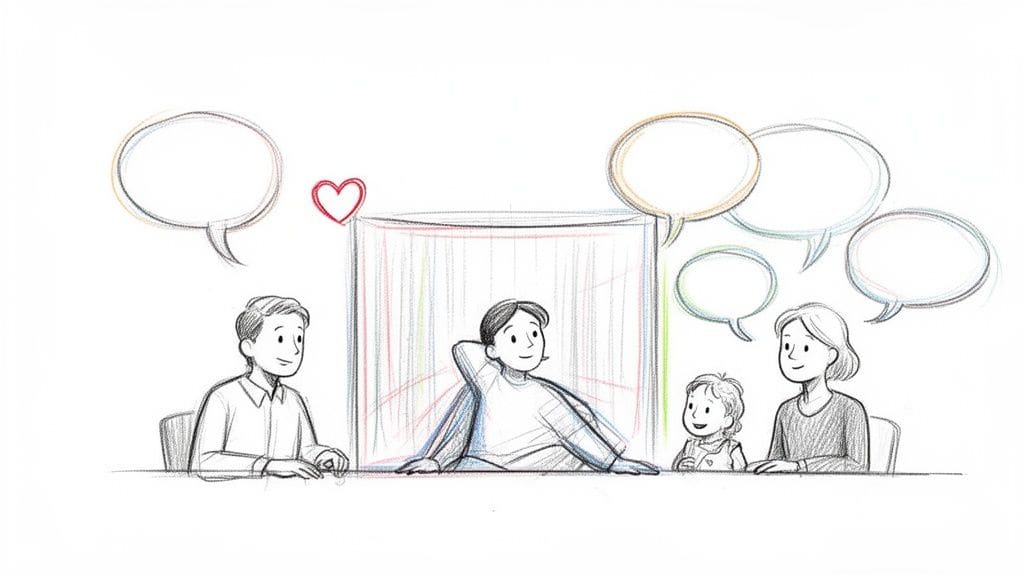
This approach is supported by the work of experts like Harriet Lerner and Nedra Glover Tawwab, who emphasize that healthy boundaries are a cornerstone of functional family systems. For autistic individuals and others who value direct communication, scripts remove the guesswork from difficult conversations. They shift the interaction from a defensive reaction to a calm, pre-planned response that upholds both respect and personal space.
How to Use These Scripts
The goal is to validate the other person's intention (e.g., "I know you care") while firmly holding your ground on the decision or topic. This method avoids escalating conflict by acknowledging their perspective before redirecting the conversation. It makes it clear that while you value the relationship, certain topics are not open for discussion or debate.
Example Scenarios:
* When a relative gives unsolicited parenting or career advice: "I appreciate you care. I've thought this through, and this is what works for me right now."
* For intrusive questions about finances or relationships: "That's a thoughtful perspective. I'm going to stick with my decision on this one, but thank you."
* To stop a line of questioning gracefully: "I'm not looking for advice on this topic right now, but I'd love to hear about your recent trip."
Actionable Tips for Implementation
To make these scripts feel natural and effective, consider these steps:
1. Prepare a Redirect: Always have a neutral, positive topic ready to pivot to. This smoothly moves the conversation away from the intrusive subject without creating an awkward silence.
2. Practice Your Tone: Your tone is critical. Use an app like tonen to rehearse with different tones. A Softer tone may be best for sensitive family members, while a Firmer tone can be used for relatives who repeatedly ignore your boundaries.
3. Validate First, Then State Your Boundary: Begin with a phrase that acknowledges their concern, like "I know you want the best for me..." This disarms defensiveness before you deliver your boundary.
4. Consider Written Communication: For very difficult family members, sending your boundary in a text or email can reduce the pressure of a real-time confrontation. This is also a helpful strategy for anyone needing more time to process and respond. To learn more, see these tips on how to handle difficult conversations.
3. Friendship Boundary Scripts: Managing Unequal Emotional Labor & Mismatched Effort
Navigating friendships with imbalanced effort requires clear communication, and having specific scripts for setting boundaries can help you address unequal emotional labor without resorting to blame. These scripts are designed to recalibrate relationships where you consistently initiate contact, provide support, or invest time that isn't reciprocated. For neurodivergent individuals who may find social dynamics and confrontation particularly draining, these templates offer a structured way to express needs and protect personal energy.

This approach, highlighted by experts like Nedra Glover Tawwab and Rachel Wilkerson Miller, views boundaries not as ultimatums but as essential information about what you need for a friendship to be sustainable. For people with autism or ADHD, who may experience social exhaustion from masking, having a pre-planned script reduces the anxiety of expressing complex feelings and prevents burnout from one-sided relationships.
How to Use These Scripts
The goal is to open a conversation about the dynamic of the friendship, focusing on your feelings and needs rather than accusing the other person. Instead of letting resentment build, you present your observations and offer a path forward, whether that's adjusting the friendship's intensity or discussing what mutual support looks like. This turns a potentially confrontational moment into a collaborative check-in.
Example Scenarios:
* When you notice you're always the one reaching out: "I really value our friendship, and I've noticed I'm usually the one to initiate our plans. I'd love for our connection to feel more mutual. How are things on your end?"
* When you need to reduce your availability to listen: "I need to scale back how much emotional energy I can offer right now. I care about you, but I also need to protect my own well-being."
* To address a long-term imbalance directly: "I've realized I'm doing most of the emotional work in our friendship, and that's not sustainable for me. Can we talk about what a more balanced friendship looks like going forward?"
Actionable Tips for Implementation
To effectively use these scripts in friendships, consider these steps:
1. Be Specific About the Imbalance: Clearly identify what "unequal effort" means to you. Is it initiating all contact, being the default listener, or making all the travel accommodations? Having concrete examples makes the conversation clearer.
2. Practice Your Tone: A warm, relational tone is crucial to avoid sounding accusatory. You can use a tool like the tonen app to rehearse, ensuring your delivery is compassionate yet firm. The goal is to invite dialogue, not issue a verdict.
Need the exact words for a boundary conversation? tonen can help.
tonen gives you 188+ conversation scripts, tone guidance and calming tools — designed for autistic adults, ADHD and social anxiety. Try it free for 7 days.
Download on the App StoreiOS only. Android coming soon.
3. Offer a Concrete Change: Propose a tangible adjustment. Saying, "I can check in once a month instead of weekly," shows you want to maintain the connection but at a level that works for you. Learning how to phrase things carefully can prevent misunderstandings.
4. Accept Any Outcome: This conversation is also a way to gather information. Your friend's reaction will tell you a lot about their capacity or willingness to meet your needs. Be prepared for the friendship to shift, which can be a healthy outcome.
4. Romantic Relationship Boundary Scripts: Communicating Needs & Managing Conflict
Navigating emotional needs and conflict in romantic relationships requires clear, gentle communication. Using scripts for setting boundaries helps you express your needs, limits, and sensory sensitivities without escalating tension, fostering a foundation of mutual respect and understanding. These templates are especially useful for neurodivergent individuals who may need to communicate their processing time or de-escalation needs explicitly, turning potential misunderstandings into moments of connection.
This approach draws from frameworks like the Gottman Method, which emphasizes gentle startups and repair attempts, and Brené Brown's work on vulnerability. For autistic people or those with ADHD, pre-planned scripts reduce the cognitive load of formulating a response during an emotionally charged moment. It shifts the dynamic from accusation to a collaborative effort to meet each other's needs.
How to Use These Scripts
The goal is to communicate your internal experience without blaming your partner, making it easier for them to hear and respond constructively. By framing your need as a personal requirement for well-being rather than a criticism of their behavior, you invite empathy and teamwork. This method helps maintain connection even during difficult conversations.
Example Scenarios:
* When you need space to recharge: "I need some quiet time to recharge, not because of anything you did. Can we plan time apart tomorrow so I can be more present with you later?"
* When a conversation becomes overwhelming: "I'm feeling overwhelmed by this conversation. Can we take a 20-minute break and come back to it with calmer nervous systems?"
* To address a specific behavior and its impact: "When you [specific behavior], I feel [emotion]. I need [specific request]. Can we work on this together?"
* To communicate an emotional trigger: "I want to be present with you, and I'm noticing I'm getting triggered. This is about my stuff, not you. Can I take space right now?"
Actionable Tips for Implementation
To make these scripts effective in your relationship, follow these steps:
1. Use a Warm, Connecting Tone: Vulnerable conversations are best received with warmth. Practice your script using a tool like the tonen app to ensure your delivery matches your intention of seeking connection, not conflict.
2. Normalize Differing Needs: Clearly state that your needs, such as a need for more alone time, are a part of who you are and not a reflection of your love for your partner. This prevents them from personalizing your boundary.
3. Establish a Break Signal: Agree on a non-verbal signal or a simple code word that either of you can use when a conversation becomes dysregulating. This allows for a pause without blame. For more strategies on navigating disagreements, explore different ways to handle conflict in relationships.
4. Focus on "I" Statements: Center the conversation on your feelings and needs ("I feel," "I need"). This approach is less likely to make your partner feel defensive and keeps the focus on finding a solution together.
5. Parenting Boundary Scripts: Setting Limits While Maintaining Connection
Parenting often requires a delicate balance between setting firm limits and nurturing a strong emotional connection, and effective scripts for setting boundaries can make this possible. These scripts help parents manage challenging behaviors, resistance to transitions, and negotiations while maintaining warmth. This approach is especially supportive for neurodivergent parents and parents of neurodivergent children, as it focuses on teaching emotional regulation rather than shaming or punishing.
This method is rooted in respectful parenting frameworks, championed by figures like Janet Lansbury and Dr. Daniel Siegel, and aligns with polyvagal theory's emphasis on co-regulation. It is also a core principle within the neurodivergent parenting community, where acceptance-based discipline and gentle parenting are valued for creating a safe, predictable environment for children who may struggle with emotional dysregulation.
How to Use These Scripts
The primary goal is to validate your child's feelings while holding firm on the boundary. You acknowledge their emotional reality ("I see you're upset") without giving in to the demand ("but we are still leaving"). This separates the emotion from the behavior, teaching children that their feelings are acceptable even when their actions are not. It transforms a power struggle into a moment of connection and learning.
Example Scenarios:
* During a difficult transition: "I see you're upset about leaving the park. I understand that's hard. We're leaving in 5 minutes. What do you need to feel ready?"
* When delivering a firm "no": "I love you and the answer is no. This is to keep you safe. Here's what we can do instead: [offer an acceptable alternative]."
* When your child is dysregulated: "You're so angry right now and that's okay. We can talk about this when you've calmed down. I'm here when you're ready."
* When you need a moment: "I need to step away for 5 minutes because I'm getting frustrated. I'll be back and we'll figure this out together."
Actionable Tips for Implementation
To successfully use these scripts, focus on your own regulation first.
1. Validate Emotions, Hold the Limit: Always pair the boundary with validation. Clearly separate the two: "I know you want another cookie, and it's okay to feel disappointed. The kitchen is closed for the night." This acknowledges their desire without changing the rule.
2. Practice in Advance: Emotional moments are not the time to invent new language. Use a tool's Practice Mode to rehearse difficult transition scripts or use tonen's Calm Kit to regulate yourself before a tough conversation.
3. Model Self-Care: Be honest about your own capacity. Saying, "Mommy needs a quiet minute right now because my brain feels too loud" models healthy self-regulation and teaches children that everyone has limits. Navigating family dynamics can be complex at every stage; for a specific guide on navigating relationships with older family members, consider learning how to set boundaries with aging parents.
4. Maintain a Warm Tone: Your delivery is crucial. Use a tool like the tonen app to practice a Softer or Warm tone, which helps maintain connection and reduces the child's defensive response, making them more receptive to the limit you're setting.
6. Digital Communication Boundary Scripts: Text, Email, and Social Media
Managing digital interactions requires clear communication to prevent burnout and anxiety from the pressure of constant availability. Having ready-to-use scripts for setting boundaries for texts, emails, and social media helps manage expectations around response times and digital intrusions. These scripts are especially beneficial for neurodivergent individuals who may experience text anxiety or sensitivity to notifications, allowing for more controlled and comfortable asynchronous communication.
This approach, supported by digital wellness advocates and remote work culture experts, reframes response delays not as neglect but as a deliberate practice for mental health and focus. For individuals with ADHD or autism, who might find the ambiguity and immediacy of digital chats overwhelming, these pre-planned statements reduce the cognitive load of navigating unspoken social rules.
How to Use These Scripts
The goal is to proactively define your communication style and availability, preventing misunderstandings before they start. Instead of letting others' expectations dictate your digital life, you establish your own rules of engagement. This turns a potentially anxious interaction into a straightforward statement of personal practice, helping others understand how you communicate best.
Example Scenarios:
* When a friend expects an instant text response: "I check my texts on my own schedule, not in real-time. I'll get back to you, usually within a few hours."
* To step back from an overwhelming group chat: "The group chat notifications are a bit much for me right now. I'm muting it to focus, but I'm not stepping away from our friendship. Feel free to message me directly."
* To separate work and personal time: "I don't check work messages after 6 PM or on weekends. If it's an emergency, please call me. Otherwise, I will see it on Monday morning."
* To address neurodivergent communication differences: "I communicate differently online than in person. I might be brief or take time to respond, but I care about this conversation."
Actionable Tips for Implementation
To successfully apply these scripts in your digital life, follow these steps:
1. State Preferences Upfront: When connecting with new people, be direct. A simple "FYI, I'm a slow texter" or "Email is the best way to reach me for non-urgent things" sets clear expectations from the start.
2. Use Automation: Employ email autoresponders or "Do Not Disturb" messages on your phone. A message like "Checking messages twice daily to focus on deep work" informs others of your routine without manual effort.
3. Use Written Formats for Important Boundaries: Setting a significant boundary via text or email gives you the space to edit and review your words, ensuring you communicate clearly and confidently without the pressure of an in-the-moment conversation.
4. Give Yourself Permission to Mute: You are not obligated to be available to every notification. Mute group chats and non-essential apps without guilt. Protecting your focus is a valid and necessary act of self-care.
7. Neighbor Boundary Scripts: Managing Noise, Space, and Unexpected Visits
Setting boundaries with neighbors can feel awkward, but having ready-to-use scripts for setting boundaries is key to protecting your personal space and peace without damaging community relationships. These scripts provide a clear, friendly way to address common issues like noise, unexpected visits, and shared space conflicts. They are especially helpful for neurodivergent individuals who may experience heightened sensory sensitivities or social anxiety when confronting neighbors directly.
This approach is supported by conflict resolution specialists who advocate for early, calm intervention in neighbor disputes. It reframes a complaint as a collaborative request for a mutually agreeable solution, turning a potential conflict into a conversation. For those with sensory processing differences, having a pre-planned script removes the stress of finding the right words on the spot.
How to Use These Scripts
The goal is to state your needs clearly and respectfully, focusing on the specific behavior and its impact rather than making personal accusations. This method opens a dialogue for finding a solution together, which preserves the neighborly relationship. Instead of letting resentment build, you address the issue proactively and constructively.
Example Scenarios:
* To address recurring noise: "Hi, I wanted to let you know that noise after 10 PM is really difficult for me. Could we work out a quiet time after then on weeknights?"
* For unexpected drop-ins: "I appreciate the friendly gesture, but I'm pretty private. I enjoy our brief hellos but I'm not usually available for unannounced visits."
* When a specific activity is disruptive: "Your music has been creating a lot of noise that comes through our shared wall. Can we talk about solutions? Here's what I'm experiencing: the bass makes it hard for me to focus on my work."
Actionable Tips for Implementation
To make these scripts effective, consider these steps:
1. Start with a Warm Tone: Approach your neighbor with friendliness first. A positive and open tone makes them more receptive to your request. Use an app like tonen to rehearse and ensure your delivery sounds collaborative, not accusatory.
2. Be Specific, Not General: Vague complaints like "you're too loud" are unhelpful. Instead, say, "The band practice on Tuesdays between 8 and 10 PM is very loud in my apartment." Specifics give your neighbor a clear problem to solve.
3. Offer Solutions, Not Just Complaints: Frame your request with a potential solution. For example, "Could you try moving the speakers away from the shared wall?" or "Would you be open to using headphones after 10 PM?"
4. Document If Necessary: If initial friendly requests are ignored, start documenting the time, date, and nature of repeated issues. This information is crucial if you need to involve a landlord or HOA later on. These documented instances provide concrete evidence for your case.
8. Emotional Labor & Support Request Boundary Scripts: Asking For & Declining Help
Navigating the delicate balance of emotional support in relationships is a common challenge, but having clear scripts for setting boundaries can protect your mental energy. These scripts help you decline one-sided emotional labor and also build the confidence to ask for the support you need. This is especially vital for neurodivergent individuals, like those with autism, who may be socialized to provide support without seeing it as a two-way street, leading to burnout.
This approach, informed by the work of researchers like Arlie Russell Hochschild on emotional labor and authors like Nedra Glover Tawwab, reframes boundaries as essential for healthy, reciprocal relationships. Instead of seeing a "no" as a rejection, these scripts position it as an honest statement of personal capacity, preserving the connection while protecting your well-being.
How to Use These Scripts
The primary goal is to use "I" statements that focus on your capacity, not the other person's needs. This shifts the conversation from blame ("You're too needy") to a non-judgmental reality ("I'm emotionally depleted"). By clearly stating what you can and cannot offer, you provide clarity and kindness, even when declining a request.
Example Scenarios:
* When a friend asks for support you can't provide: "I care about you, and I'm not able to be in that support role for you right now. I can listen for 15 minutes, or I can check in with you next week."
* To address an imbalance in a relationship: "I've been feeling like I give a lot of emotional energy in our friendship, and I'm not feeling that reciprocated. Can we talk about creating more balance?"
* When you need to ask for help: "I'm going through a tough time and I need support with [specific need]. Would you be able to help?"
Actionable Tips for Implementation
To effectively use these scripts, consider these steps:
1. Be Specific About What You Can Offer: A hard "no" can feel rejecting. Instead, offer a specific, limited alternative. This shows you still care while respecting your limits.
2. Use a Softer Tone: Your delivery is key. Rehearse your script with a tool like the tonen app to ensure your tone is warm and compassionate, not cold or dismissive.
3. Practice in Low-Stakes Situations: Build your confidence by first asking for small, low-risk help. This makes it easier to ask for support when the stakes are higher. For more guidance, you can explore different ways to say no without feeling guilty.
4. Reframe Guilt: Remember that people who truly care will respect your limits. Your capacity is not infinite, and protecting it is necessary for your health and the longevity of your relationships.
8-Context Boundary Script Comparison
| Script Type | 🔄 Implementation Complexity | ⚡ Resource Requirements | ⭐📊 Expected Outcomes | 📊 Ideal Use Cases | 💡 Key Tips |
|---|---|---|---|---|---|
| Workplace Boundary Scripts: Declining Extra Work & Managing Workload | 🔄 Moderate — requires tone adaptation for hierarchies | ⚡ Moderate — prep, practice mode, data (task lists) | ⭐⭐⭐ — reduces burnout and role confusion; improves prioritization | High-pressure jobs, autistic/ADHD employees, supervisor interactions | 💡 Prepare responses, use objective data, test tones to match culture |
| Family Boundary Scripts: Managing Unsolicited Advice & Intrusive Questions | 🔄 Moderate — must account for history and emotion | ⚡ Low–Moderate — rehearsal, possible repeated conversations | ⭐⭐ — increases autonomy and reduces over-explaining; may need persistence | Family gatherings, cultural/generational pushback, adult-child independence | 💡 Validate feelings first, use redirect topics, consider written messages |
| Friendship Boundary Scripts: Managing Unequal Emotional Labor & Mismatched Effort | 🔄 Low–Moderate — straightforward language, relational sensitivity | ⚡ Low — planning, Calm Kit for anxiety management | ⭐⭐ — prevents resentment and clarifies reciprocity; may change relationship | One-sided friendships, emotional labor imbalance, recalibration conversations | 💡 Use "I" statements, be specific about behaviors, offer concrete changes |
| Romantic Relationship Boundary Scripts: Communicating Needs & Managing Conflict | 🔄 Moderate–High — emotionally sensitive; needs partner buy-in | ⚡ Moderate — practice, Calm Kit, Perspective Helper | ⭐⭐⭐ — can deepen connection and reduce masking if partner receptive | Early dating and established relationships, sensory/processing needs, conflict de-escalation | 💡 Use Warm tone, set break signals, normalize different needs |
| Parenting Boundary Scripts: Setting Limits While Maintaining Connection | 🔄 High — requires consistency across developmental stages | ⚡ High — energy, repetition, self-regulation tools for parent and child | ⭐⭐ — models healthy limits and reduces shame; effective with consistency | Bedtime/transition resistance, neurodivergent children, teaching limits kindly | 💡 Pair limits with validation, rehearse phrases, regulate before responding |
| Digital Communication Boundary Scripts: Text, Email, and Social Media | 🔄 Low — templates easy to adopt but risk misinterpretation | ⚡ Low — status messages, autoresponders, clear templates | ⭐⭐⭐ — clarifies expectations and reduces text-anxiety and off-hours pressure | Remote work, group chats, notification sensitivity, text-anxious individuals | 💡 State preferences upfront, use autoresponders, edit messages before sending |
| Neighbor Boundary Scripts: Managing Noise, Space, and Unexpected Visits | 🔄 Moderate — balances directness with neighborly tone | ⚡ Low–Moderate — in-person approach, documentation if repeated | ⭐⭐ — improves coexistence and honors sensory needs; may need escalation | Noise complaints, unsolicited visits, shared-space conflicts in housing | 💡 Be specific about times/behaviors, offer solutions, document repeated issues |
| Emotional Labor & Support Request Scripts: Asking For & Declining Help | 🔄 Moderate — sensitive dynamics, requires careful framing | ⚡ Moderate — practice asking, Perspective Helper, gradual implementation | ⭐⭐ — prevents burnout and clarifies reciprocity; may expose unsustainable ties | Caregiver overload, people-pleasers, requesting/declining emotional support | 💡 Offer alternatives, use "I" capacity statements, practice low-stakes asks |
Putting Your Scripts into Practice
You now have a robust collection of scripts for setting boundaries covering everything from the workplace and family gatherings to digital communication and friendships. Having these phrases is a powerful start, but true confidence comes from integrating them into your life. The core takeaway is that setting boundaries isn't about conflict; it's about clarity. It's the essential practice of defining your limits to protect your well-being, manage your energy, and build relationships founded on mutual respect rather than assumption.
Remember, the goal is not to become a rigid or unapproachable person. It's to become an honest one. Each script we explored, from declining extra work to managing intrusive family questions, is a tool for self-advocacy. By communicating your needs directly and kindly, you prevent resentment from building and create space for more genuine connection.
Your Action Plan for Implementing Boundary Scripts
Moving from reading to doing can feel like a big leap. Instead of trying to overhaul every relationship at once, focus on incremental progress. Consistent, small steps build lasting skills and confidence.
Here is a simple, actionable plan to get started:
1. Identify Your Priority Area: Which category from this article resonates most strongly right now? Is it managing your workload, navigating a difficult friendship, or protecting your downtime from digital interruptions? Pick just one area to focus on first.
2. Select and Personalize Your Script: Choose one or two scripts from that section that feel the most natural for you. Tweak the wording to match your voice. You might prefer a softer "I'm not able to take that on right now" over a more direct "No." Authenticity is key.
3. Rehearse, Rehearse, Rehearse: Practice saying the words out loud. Say them to yourself in the mirror, record a voice memo, or role-play with a trusted friend. For neurodivergent individuals or anyone with social anxiety, this step is especially important. It helps move the script from your intellectual brain to your muscle memory, making it easier to access under pressure.
4. Start with a Low-Stakes Situation: Don't make your first attempt a high-conflict conversation with your boss or a difficult relative. Try it in a lower-risk scenario first. For example, use a script to decline a social invitation when you need a quiet night in, or set a limit on a text conversation that's going on too long.
5. Observe and Adjust: After you use a script, take a moment to reflect. How did it feel? How did the other person respond? Don't judge the outcome as a simple "success" or "failure." Every interaction is data. Maybe the tone was a little off, or perhaps a different phrase would have landed better. This is all part of the learning process.
The Long-Term Value of Consistent Boundaries
Mastering the art of setting boundaries is a foundational life skill with far-reaching benefits. It directly impacts your mental health by reducing burnout, anxiety, and the emotional toll of resentment. When you consistently communicate your limits, you teach people how to treat you, fostering healthier, more balanced dynamics in all your relationships.
This practice is also an act of self-respect. It sends a powerful message to yourself and others that your time, energy, and well-being are valuable. Over time, you'll find that the people who respect your boundaries are the ones who truly belong in your life. The initial discomfort of setting a new limit is a small price to pay for the long-term peace and authenticity it brings. Keep this collection of scripts for setting boundaries handy, give yourself grace, and celebrate every small step you take toward a more empowered and balanced life.
Ready to move from reading scripts to mastering your delivery? The tonen app is designed to help you practice these exact conversations in a private, judgment-free space. With a vast Scripts Library and AI-powered feedback on your tone, tonen helps you find the right words and say them with confidence, making it an essential tool for anyone serious about improving their communication and setting healthy boundaries.
Frequently asked questions
The simplest boundary script follows three parts: acknowledge the request, state your limit, and optionally offer an alternative. For example: "I understand you need help with this. I'm not able to take it on right now. I can revisit it next week if that works." You do not need to justify or apologise.