Securing the right autism help boils down to two things: figuring out what you actually need, and knowing who to ask. It's a mix of official steps, like getting a diagnosis, and the softer side of things, like building a support network of friends and family. The best support is always personal—a unique blend of therapies, accommodations, and resources that clicks with an individual's strengths and challenges.
Your First Steps to Securing Autism Help
Starting the journey to find support can feel like you've been dropped into a maze with no map. Whether you're an autistic adult trying to find your footing, a parent fighting for your child, or a teacher looking for better strategies, that first step is always the hardest. This initial phase is all about getting to know the key players and the landscape of help available to you.
Try not to think of it as one giant leap. Instead, see it as a series of small, manageable actions. Every step—from that first GP visit to a quick call with a local charity—builds on the one before it, creating a solid foundation for long-term support and well-being. This guide is here to turn that confusing maze into a clear, step-by-step plan.
Identifying Your Primary Points of Contact
Who you speak to first can shape your entire support journey. These people are often the gatekeepers to assessments, therapies, and funding, so knowing who to approach and what to ask is crucial to getting things moving.
Navigating the initial contacts can be confusing, so here's a quick guide to who does what.
Key Contacts for Initial Autism Support
This table breaks down the main people and organisations you'll want to connect with at the start.
| Type of Help | Who to Contact | What They Do For You |
|---|---|---|
| Medical Referral | General Practitioner (GP) | Your GP is the first stop for an NHS referral. They'll listen to your concerns and get you on the path to a specialist diagnostic team. |
| Child & Education | Health Visitor or School SENCO | For parents, a health visitor (for young children) or a school's Special Educational Needs Coordinator (SENCO) can kickstart educational support. |
| Immediate Advice | Local Autism Charities | These organisations are brilliant for advice, support groups, and pointing you to local services while you're waiting for formal assessments. |
These initial conversations are your first, best chance to get the ball rolling.
The journey to securing support often begins with a single conversation. Coming prepared with specific examples of behaviours, communication differences, or sensory needs can make these initial chats far more effective and often lead to quicker referrals.
Understanding the Scope of Support
Autism support isn't a one-size-fits-all package. It's a huge spectrum of services designed to help with different parts of life. Realising this helps you piece together a support system that genuinely works for you or your loved one.
In the UK, autism is a legally recognised disability, which opens doors to certain services and protections. The National Autistic Society points out that over one in 100 people are on the autism spectrum, which shows just how vital these support structures are. It's also worth noting that many autistic people see things through the 'social model' of disability—the idea that it's society's barriers, not their autism, that create the biggest challenges.
This whole process can be draining, and looking after your own mental health is non-negotiable. If you're struggling with the stress of it all, you might find our guide on grounding techniques for anxiety helpful for staying calm.
Ultimately, the aim is to find the right combination of support that empowers the individual, whether that's through therapy, adjustments at work, or simply finding a community. This first phase is all about gathering your information and making those first, crucial connections.
Navigating the Autism Diagnosis Pathway
For many, a formal diagnosis is the key that unlocks the door to specialised autism help, from support plans at school to therapies and financial aid. But let's be honest, the path to getting that diagnosis in the UK can feel bewildering and incredibly slow.
Knowing what to expect—from your first GP chat to the final assessment—gives you the power to advocate for yourself or your child. This section will break the whole thing down into clear, manageable steps.
The journey almost always starts with a visit to your General Practitioner (GP). Think of them as the gatekeeper for an NHS referral.
Before you go, it's a really good idea to gather as much information as you can. You're essentially building a case file. Jot down specific examples of communication differences, social interaction challenges, sensory sensitivities, and repetitive behaviours. If it's for your child, bring in observations from their school or nursery.
The Initial GP Consultation
At your appointment, you'll talk through your concerns and share the notes you've prepared. Based on this, the GP decides whether to refer you or your child to a specialist team for a formal assessment. This team is usually made up of different professionals, like paediatricians, psychologists, and speech and language therapists.
Getting the referral is a huge first step. It's also where many people hit their first major roadblock: the waiting lists. Demand for assessments is sky-high, so being prepared for a long wait is, unfortunately, a realistic necessity. Acknowledging this from the get-go can help manage expectations. It's also worth comparing NHS vs private care for adult autism diagnosis in the UK to understand all your options.
> The process of seeking a diagnosis can be emotionally draining. It's important to remember that this journey is a marathon, not a sprint. Patience and self-advocacy are your most powerful tools.
NHS vs Private Diagnostic Routes
Once you have that referral, you're officially on the diagnostic pathway. In the UK, you have two main choices: stick with the NHS or go for a private diagnosis. Each has its pros and cons.
The NHS Pathway:
* Cost: Completely free.
* Waiting Times: This is the big one. Waiting lists can be incredibly long, often stretching for months or even years, depending on where you live.
* Recognition: An NHS diagnosis is the gold standard. It's accepted everywhere—by local authorities, schools, and for benefits like PIP or DLA.
The Private Pathway:
* Cost: Can be very expensive, often running into thousands of pounds.
* Waiting Times: Much, much faster. You can often get an assessment within a few months.
* Recognition: Most are accepted, but be aware that some local authorities or schools might want the diagnosis confirmed by an NHS team, especially if you need an Education, Health and Care Plan (EHCP).
The strain on the NHS is undeniable. By late last year, over 204,000 people in England were waiting for an autism assessment, with a staggering 89% waiting more than the 13-week target. This backlog highlights the massive challenge in providing timely support.
That waiting period can be a really tough and uncertain time. It's a good opportunity to look for community resources or peer support groups. If the stress of it all gets to be too much, our article on managing social anxiety through NHS services has some related advice that might help.
Ultimately, choosing between the NHS and private care is a personal decision, weighing up your finances against your urgency. But understanding both paths is the first step to getting that crucial autism help.
Understanding Therapies and Interventions That Work
Once an autism diagnosis is in place, the world of therapies and interventions can feel both vast and overwhelming. But think of this as opening a toolkit. The goal of support isn't to change who a person is; it's about finding the right tools and strategies to navigate a world that isn't always built with neurodiversity in mind.
The best support plans enhance skills, build confidence, and ultimately improve a person's quality of life. In the UK, this usually means exploring a few key evidence-based approaches, often combining different therapies to create a support system that feels truly personal and respectful.
Looking for autism support? tonen can help.
tonen gives you 188+ conversation scripts, tone guidance and calming tools — designed for autistic adults, ADHD and social anxiety. Try it free for 7 days.
Download on the App StoreiOS only. Android coming soon.
Speech and Language Therapy for Clearer Communication
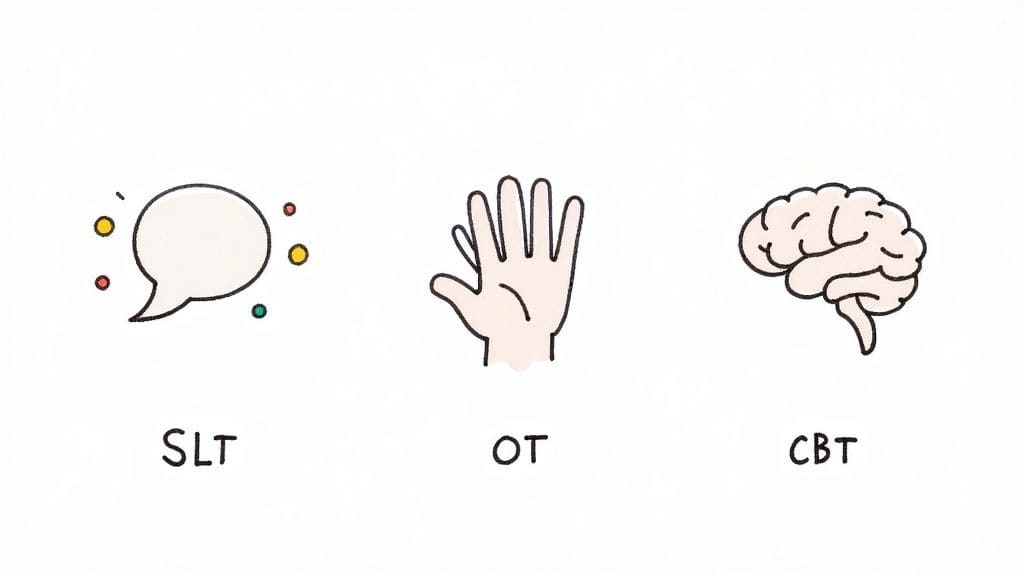
Speech and Language Therapy (SLT) goes way beyond just learning to speak. A Speech and Language Therapist is a bit like a communication coach, supporting every facet of how we connect with others, both verbally and non-verbally. This makes it a vital form of autism help for anyone who finds the back-and-forth of social interaction a bit of a minefield.
They might help someone crack the code of social cues, interpret body language, or find brilliant alternative ways to express their thoughts and feelings. This could involve using communication aids or simply learning how to manage the rhythm and flow of a conversation. Tools like apps designed to assist with autism communication can also be fantastic complements to formal therapy.
Occupational Therapy for Daily Living Skills
Occupational Therapy (OT) is all about helping people participate in the activities—or "occupations"—that make up everyday life. For many autistic people, this means getting a handle on sensory sensitivities and building practical life skills.
An Occupational Therapist acts as a personal strategist, helping to build a bespoke 'life skills toolkit'. They might work on the fine motor skills needed for writing, come up with a game plan for navigating the sensory chaos of a busy supermarket, or help design a morning routine that feels calm and predictable. The focus is always on boosting independence and making daily life feel less draining.
> The heart of any effective therapy is personalisation. A strategy that's a game-changer for one person might not click for another. The best support is always flexible, goal-oriented, and centred on the individual's unique strengths and preferences.
Autism-Adapted CBT for Emotional Wellbeing
Cognitive Behavioural Therapy (CBT) is a well-known talking therapy that helps people manage difficulties by changing the way they think and act. When it's adapted for autism, it becomes an incredibly powerful tool for navigating co-occurring conditions like anxiety and depression, which are very common in the autistic community.
Autism-adapted CBT understands and respects neurodivergent thinking styles. A therapist might use more visual aids, break down big concepts into smaller, more manageable steps, and explicitly teach emotional recognition skills that neurotypical people might pick up intuitively. It's a structured, practical approach that gives people solid strategies for coping when emotions feel overwhelming.
Choosing the Right Autism Therapy
Finding the right support for yourself or your child is a journey, not a destination. It's about matching the right intervention to the individual's specific needs, and very often, a blend of therapies works best. The key is to find professionals who respect the person's identity and are ready to work collaboratively towards their goals for a fulfilling life.
To get you started, here's a simple breakdown of what each therapy focuses on.
| Therapy Type | Primary Focus | Best For Individuals Who |
|---|---|---|
| Speech and Language Therapy | Enhancing verbal and non-verbal communication, understanding social cues, and expressing needs effectively. | Need support with conversation skills, interpreting figurative language, or using augmentative communication aids. |
| Occupational Therapy | Developing practical daily living skills, managing sensory processing differences, and improving motor coordination. | Experience sensory overload, struggle with executive functioning tasks like organisation, or need help with self-care routines. |
| Autism-Adapted CBT | Managing co-occurring mental health conditions like anxiety, depression, or OCD by adapting thoughts and behaviours. | Are looking for structured, practical strategies to cope with overwhelming emotions and challenging social situations. |
Ultimately, finding the right support is a collaborative process. It involves the individual, their family, and a team of professionals who are all on the same page, working together.
How to Secure School and Workplace Accommodations
Meaningful autism help isn't something that only happens in a therapist's office. It truly comes to life in the everyday spaces where we learn and work. Getting the right accommodations in a school or workplace is all about understanding your rights and advocating for what you need.
It's about turning a classroom or an office from a place of high stress into an environment where an autistic person can genuinely thrive. For many, this starts with formal support plans that legally require these places to make the necessary changes. When you understand these frameworks, you can confidently ask for what's needed.
Demystifying the Education Health and Care Plan
An Education, Health and Care Plan (EHCP) is a vital legal document for children and young people up to the age of 25. It comes into play when someone needs more support than their school can typically provide through its standard special educational needs budget.
Think of an EHCP not just as a piece of paper, but as a legally binding roadmap for a child's entire educational journey. To get one, a child's needs have to be significant enough that the school can't meet them with its existing resources. The process involves a deep dive into the child's educational, health, and social care needs to make sure nothing is missed.
And the need is growing. Recent data from Northern Ireland, for instance, shows that the prevalence of autism among school-aged children has hit 5.9%. Of these children, a staggering 63% were identified as needing a formal Statement of SEN (the equivalent of an EHCP). This really underscores how critical these plans are for providing structured support in schools.
Practical Classroom Adjustments That Make a Difference
Even with an EHCP, it's often the small, practical changes that have the biggest impact on a daily basis. These adjustments are usually about creating a sense of predictability and dialling down the sensory overload. For anyone on this journey, it's also well worth exploring all the resources for studying with Special Educational Needs and Disabilities (SEND).
Here are a few simple but powerful examples:
* Visual Timetables: Showing the day's schedule with pictures or words. This predictability is brilliant for reducing anxiety around what's coming next.
* Sensory-Friendly Spaces: A quiet corner with soft lighting, comfy seating, or noise-cancelling headphones can be a lifeline—a safe place to retreat from overstimulation.
* Clear and Concise Instructions: Breaking tasks into small, manageable chunks and putting instructions in writing can make a world of difference for comprehension and focus.
* Movement Breaks: Building in short, structured breaks for a bit of physical activity helps with self-regulation and makes it easier to stay focused throughout the day.
These aren't about giving an unfair advantage. They're about levelling the playing field so every student gets a fair shot at learning.
Workplace Support Through Reasonable Adjustments
The same principles apply in the workplace. Under the Equality Act 2010, employers have a legal duty to make 'reasonable adjustments' for disabled employees, and this absolutely includes autistic people. It's a key part of ensuring autistic adults aren't put at a disadvantage at work.
> "Reasonable adjustments are about removing barriers. They're not special treatment, but the necessary changes that enable an autistic employee to perform their job to the best of their ability, just like anyone else."
What's 'reasonable' can look very different depending on the person and their role. It might mean allowing flexible working hours, providing written instructions, offering a quieter workspace, or adapting the interview process. For a closer look at this, our article on navigating autism and job interviews has some really practical tips.
The government's 'Access to Work' scheme can also help by providing grants to cover the cost of specialised equipment or support workers. This makes it much easier for employers to implement meaningful changes and provide genuine support.
Getting Financial Help and Funding for Support

Let's be honest: the cost of therapies, equipment, and specialist care can be a huge worry. It should never be the reason someone goes without the autism help they need.
Figuring out what financial support you're entitled to can feel like trying to solve a puzzle, but it's the first step toward making everything more manageable. Think of this as your guide to the key financial help available in the UK, breaking down the application process into clear, simple steps.
Our aim here is to make the whole process of securing funding feel a lot less intimidating. We'll walk through the main benefits for autistic people and their families, giving you the information you need to build a solid application.
Understanding the Key Disability Benefits
In the UK, the main financial support for disabled people comes through specific benefits. These are designed to help with the extra costs that come with having a long-term health condition or disability. For autistic children and adults, the two most important ones to know about are Disability Living Allowance (DLA) and Personal Independence Payment (PIP).
Crucially, these benefits aren't means-tested. That means your income or savings don't affect whether you can get them. They're awarded based on how a person's condition affects them day-to-day, not on the diagnosis itself.
Disability Living Allowance (DLA) for Children
Disability Living Allowance, or DLA, is for children under the age of 16. It's there to help with the extra costs of looking after a child who needs significantly more care and attention than a non-disabled child of the same age.
DLA is split into two parts:
* The Care Component: This covers help with personal care—things like washing, dressing, or navigating intense emotions and tricky social situations.
* The Mobility Component: This is for help with getting around, especially if a child has difficulty walking or needs close guidance and supervision when they're outdoors.
When you're applying, the key is to give detailed, real-world examples of the support your child needs every single day. You need to paint a clear picture of their specific challenges and the extra support they require compared to their friends.
Personal Independence Payment (PIP) for Adults
Once someone turns 16, they transition from DLA to Personal Independence Payment (PIP). PIP is for adults aged 16 up to State Pension age and, like DLA, is made up of two parts: a daily living component and a mobility component.
The application process for PIP has a reputation for being tough. You'll have to fill out a very detailed form and will likely be invited to an assessment.
> When you're filling out the PIP form, be completely honest and describe what your most difficult days look like. An assessment is just a brief snapshot in time, so that form is your best chance to explain the full, ongoing impact being autistic has on your daily life.
Carer's Allowance for Unpaid Carers
If you spend at least 35 hours a week looking after someone who gets DLA (the middle or highest care rate) or PIP (either of the daily living rates), you might be able to claim Carer's Allowance. It offers a bit of financial recognition for the incredibly important job unpaid carers do. Just be sure to check the earnings limit, as you can't claim it if you earn over a certain amount each week.
Other Places to Look for Funding
Beyond government benefits, there are other places that can offer valuable support. Your local authority might be able to provide funding for social care after they carry out a needs assessment.
There are also many charities that give grants for specific things like sensory equipment, therapies, or educational resources. A bit of research into organisations like the Family Fund can open up extra support that's a perfect fit for your family's unique situation.
Building Your Personal Support Network
Formal therapies and services are a huge piece of the puzzle, but they're not the whole story when it comes to autism help. Real, day-to-day resilience comes from having a solid community of people who get you, accept you, and have your back. Building this personal support network is what helps you move from just surviving to actually thriving.
It's about more than just having people to call in a crisis. It's about creating a circle of trust that makes daily life feel richer and more connected, offering the kind of emotional backup that professional services just can't.
Finding Your Community in Support Groups
Connecting with a support group, whether it's local or online, can be an absolute game-changer. These communities offer this brilliant mix of peer advice, emotional validation, and shared resources that can make you feel so much less alone. They're a place where you can ask the 'silly' questions, celebrate the small wins, and figure out challenges with people who genuinely understand.
When you're looking for a group, try to find one that's well-moderated with a welcoming, non-judgemental vibe. The best ones are often run by and for autistic people, as they tend to offer the most authentic and empowering perspectives.
* Local Groups: Check with charities like the National Autistic Society or other local disability organisations. They often run their own groups or keep a list of ones in your area.
* Online Communities: Social media is full of groups, but be selective. Look for ones with clear rules and active moderators to make sure it's a safe and genuinely supportive space.
The Power of Peer Mentoring
Peer mentoring is an incredibly powerful form of support. It's where one autistic adult guides and supports another. Having a mentor who has already navigated similar life stuff—from university to the workplace—can give you insights and strategies that are both practical and deeply relatable.
The whole relationship is built on mutual respect and understanding, moving way beyond a clinical checklist to offer real-world advice. It's a fantastic way to build confidence, learn to advocate for yourself, and feel a stronger sense of belonging.
Educating Friends and Family for True Understanding
Your immediate circle—your friends and family—can be your strongest allies, but they often need a bit of a roadmap to give the right kind of support. Genuine understanding doesn't just happen on its own; it takes open conversations and a real willingness to learn.
> Fostering genuine understanding is about more than just listing facts about autism. It's about explaining what support looks like for you. What helps you feel calm? What triggers sensory overload? How can they be a reliable, compassionate presence in your life?
Share resources that resonate with you, talk openly about your experiences, and be clear about what you need. Helping them 'get it' can turn well-meaning but unhelpful gestures into truly meaningful support. Working on these bonds is crucial, and you can explore more on navigating these conversations by learning about social skills for autistic adults. Pulling together, this collective effort builds a robust network that provides consistent support and makes every day that little bit easier.
Got Questions About Finding Autism Help?
Diving into the world of autism help can feel like you've been handed a map written in another language. There are so many new terms and processes, and it's natural to have a lot of questions. Getting clear, simple answers is the first step towards feeling in control and making the right choices for yourself or your family.
This section is all about tackling those common questions. My goal is to cut through the jargon and give you practical answers you can actually use to find your way forward in the UK.
Your First Steps and Getting a Diagnosis
What's the very first thing I should do if I think my child is autistic?
Your GP or health visitor is your starting point. They hold the key to getting a referral for a formal assessment, so book an appointment. Before you go, jot down specific examples of your child's behaviour, how they communicate, and how they interact with others. It makes a huge difference if you can also bring along some observations from their nursery or school – it builds a much stronger picture.
Can we get any help without a formal diagnosis?
Yes, you absolutely can, and you shouldn't wait. Schools have a legal duty to support any child with special educational needs, whether they have a diagnosis or not. You'll also find that many local and national autism charities offer things like parent support groups and activities that don't require a diagnosis to join. That said, a formal diagnosis is crucial for accessing an Education, Health and Care Plan (EHCP) and some disability benefits down the line.
Support for Autistic Adults
I'm an autistic adult. How do I find support for myself?
For adults, the journey also starts with your GP, who can refer you for a diagnosis. Beyond that, organisations like the National Autistic Society are a brilliant resource, with helplines and local groups. If you need support at work, look into the government's 'Access to Work' scheme – it can help fund adjustments to make your job more manageable. And honestly, don't underestimate the power of peer support. Look for online groups or local meetups run by and for autistic adults. They can be an incredible source of advice and shared understanding.
> Finding your community is a powerful form of support. Connecting with other autistic adults who share similar experiences can provide validation, practical tips, and a sense of belonging that is difficult to find elsewhere.
Understanding the Process
How long does an autism assessment take in the UK?
This is the million-dollar question, and the answer varies wildly depending on where you live and whether you go through the NHS or privately. NHS waiting lists can be brutally long – in many places, you could be waiting well over a year. Going private is much faster, often just a few months, but it costs a lot. The best thing you can do is ask your GP about the current waiting times in your specific NHS trust. It helps you manage your expectations and decide if you need to explore other routes for support.
Managing social conversations can be one of the most draining parts of daily life. At tonen, we've created a mobile app to help you feel more prepared and less stressed. With a library of scripts for real-life situations, a Perspective Helper to reframe interactions, and a Calm Kit for when you feel overwhelmed, tonen gives you the tools to communicate with confidence. Download it today and start your 7-day free trial at https://usetonen.com.
Frequently asked questions
This guide covers a practical guide to finding autism help in the uk with practical, neurodivergent-friendly strategies—clear steps, scripts where useful, and ways to reduce anxiety or overload rather than vague "be confident" advice.