Successfully navigating autism and job interviews isn't about masking or pretending. It's about preparation—deep preparation that goes way beyond the usual advice you find online. It's about understanding the company, planning for your sensory needs, and figuring out how to let your autistic strengths shine.
Building Your Foundation for Interview Success
Real success in a job interview starts long before you walk in the door. For us, it means creating a solid, personalised strategy that tackles potential communication snags and sensory issues head-on.
The stats paint a pretty stark picture. Here in the UK, only about 30% of autistic adults are in paid employment. That's a huge gap when you compare it to the 53% of all disabled people and 83% of non-disabled people who have jobs. It shows just how many barriers are baked into the traditional hiring process, which makes getting your prep right even more crucial.
Deconstruct the Job Description
Don't just read the job description; treat it like a puzzle you need to solve. Pull it apart, piece by piece. Look at every single duty and requirement, and use them to predict the questions they'll likely ask. This simple shift turns a vague list of tasks into a concrete set of topics you can actually prepare for.
For instance, if the description mentions "strong organisational skills," your brain should immediately start searching for examples. How do you manage your projects? How do you organise data or structure your day? Thinking this through helps you build a library of real, specific stories that prove you have that skill. You're moving from just saying you're organised to showing them.
Plan for Your Sensory Needs
An interview environment can be a sensory minefield. Planning for your own comfort isn't self-indulgent; it's a non-negotiable part of setting yourself up to perform at your best. Getting this right can make all the difference.
Here are a few practical things to think about:
* Your Outfit: Pick something professional that's also sensory-friendly. That means no scratchy tags, tight collars, or weird fabrics. A comfortable outfit removes one massive potential distraction right away.
Pre-Interview Routine: What calms you down? Figure out a solid routine for the hour before the interview. Maybe it's listening to a specific album, diving into a special interest for a few minutes, or using some grounding techniques. The goal is to regulate your nervous system before* the pressure hits.
* Travel Logistics: If it's an in-person interview, map out your journey in detail. Think about traffic, public transport weirdness, and the sensory chaos of the trip itself. A dry run a day or two before can slash your anxiety on the day.
> Your pre-interview plan is your first line of defence against overwhelm. By controlling the little things you can, you free up so much mental energy to focus on what actually matters: showing them how great you are for the job.
Deciding if, when, and how to disclose that you're autistic is a huge, personal choice. There's no single right answer. Some people prefer to disclose early to arrange accommodations, while others wait until they have a job offer. Take some time to think about what feels right for you and the vibe you get from the company.
Getting comfortable and clear when stating your needs is an incredibly useful skill, and our guide on social skills training for adults has more resources that can help.
Communicating Your Strengths Authentically
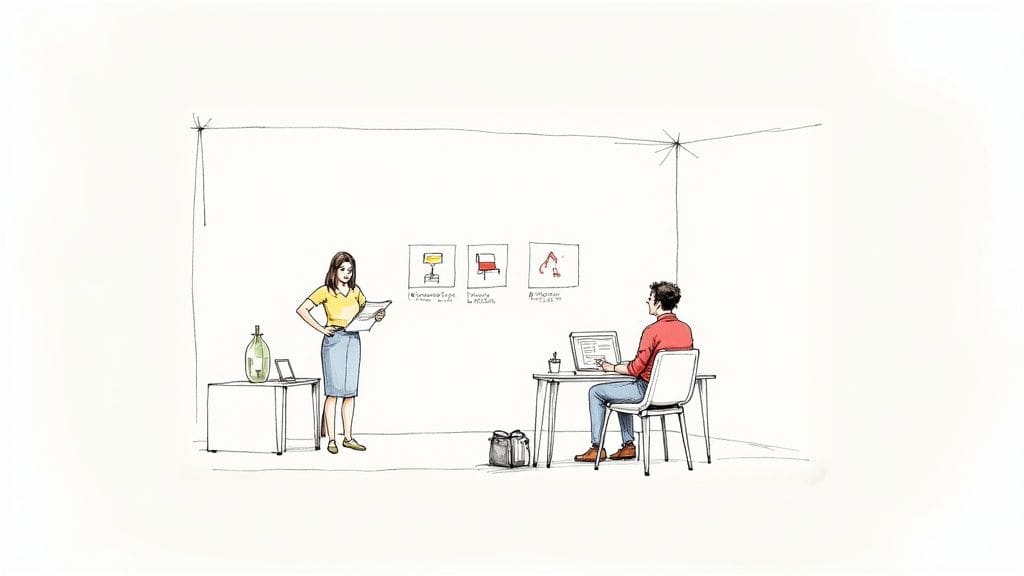
The interview room isn't a stage, and you're not an actor. The real goal is to show them what you can do—your genuine skills and expertise—not to perform a version of yourself that leaves you completely drained. Successfully navigating autism and job interviews is all about finding a way to communicate that feels authentic to you.
This starts with letting go of the enormous pressure to mask. Many of us feel we have to hide our natural communication style to fit in, which is exhausting and often doesn't even work. If you want to dive deeper into this, you can learn more about what masking in autism involves and its impact. Instead of trying to be someone you're not, let's focus on clear, structured communication that lets your value shine through.
Frame Your Answers with a Simple Structure
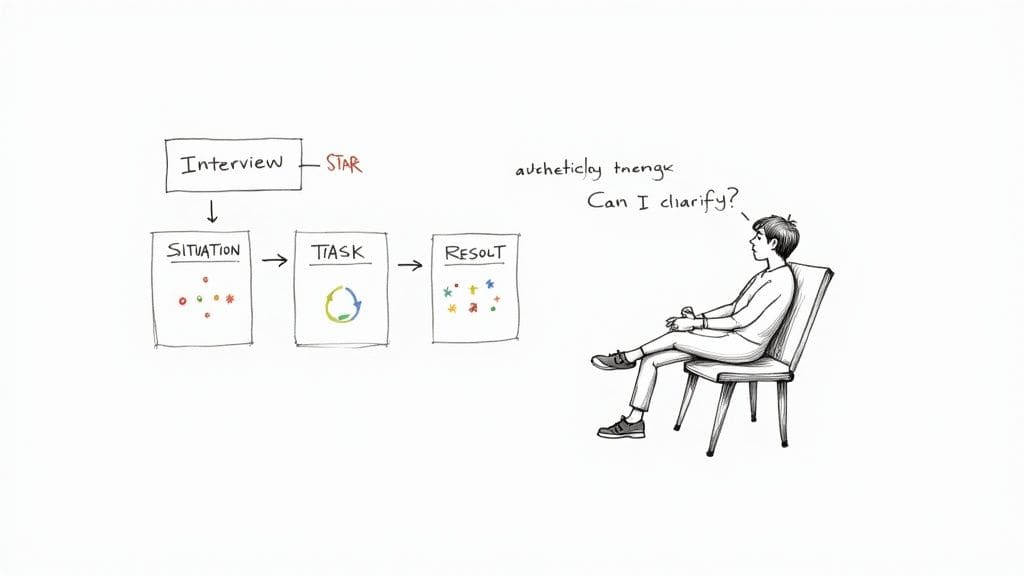
You've probably heard of the STAR method (Situation, Task, Action, Result). It's standard interview advice, but it can feel incredibly rigid and unnatural.
A better way to think of it is as a simple story structure: "Here was the problem, here's what I did about it, and here's how it all turned out."
Let's break it down with a common question: "Tell me about a time you worked on a team."
* Situation: "In my last job, our team had to sort out a huge client database that was riddled with errors." (Just the basic context).
* Task: "My specific role was to go through and fix all the entries for clients in the North West." (Your direct responsibility).
Action: "I created a systematic checklist to cross-reference every entry with our sales records. Doing this, I found and corrected over 400 inconsistencies." (The specific action you* took).
* Result: "Cleaning up that data led to a 15% drop in bounced marketing emails and made our whole team more efficient." (The positive outcome).
This simple framework gives your answer a clear beginning, middle, and end. It makes it easy for the interviewer to follow your logic, without you having to perform a bunch of neurotypical social cues.
Handling Unexpected Questions
Let's be honest, abstract or out-of-the-blue questions can throw anyone off. It is completely okay to pause, take a moment to think, or ask for the question to be rephrased. You have every right to process information in a way that works for you.
> Don't be afraid to say, "That's an interesting question. Could you clarify what you mean by 'synergy'?" or "Could you give me an example of what you're looking for?" This shows you're engaged and thoughtful, not that you're struggling.
Another great strategy is to turn an abstract question into a concrete one. If they ask something vague like, "How do you handle workplace conflict?", you can ground it in your own way of thinking.
Try something like this: "I haven't been in a major conflict, but my approach is to focus on the facts and find a logical solution. For example, if two colleagues disagreed over project data, I would suggest we..."
This tactic puts you back in control. It lets you answer based on your actual strengths—logic, fairness, and systematic thinking. If you want more tips on articulating your thoughts, resources to Master Communication Skills for Interviews can be really helpful.
Managing Sensory and Social Demands in Real Time
The interview room itself can be a minefield of sensory and social stress—unfamiliar lighting, weird background noises, and the sheer intensity of being the centre of attention. Honestly, navigating autism and job interviews often comes down to what you can do in the moment to manage overwhelm before it takes over. The goal isn't to erase stress entirely, but to have a toolkit ready so you can stay present and focused.
This is a huge deal, especially when you look at the employment gap autistic people face. In the UK, it's a tough reality that only around 16% of autistic adults are in full-time employment. The sensory and social hurdles of interviews are a big part of that problem, which makes these real-time strategies so important. You can read more about the recent findings on autism employment to understand the work being done to tackle these barriers.
Preparing for job interviews as an autistic person? tonen can help.
tonen gives you 188+ conversation scripts, tone guidance and calming tools — designed for autistic adults, ADHD and social anxiety. Try it free for 7 days.
Download on the App StoreiOS only. Android coming soon.
Discreet Self-Regulation Techniques
You don't need to do anything obvious to self-regulate. The best techniques are the ones nobody else even notices, allowing you to find your centre without disrupting the conversation.
Here are a few that work well:
* Tactile Tools: A small, silent fidget ring or a smooth stone you can keep in your pocket provides grounding sensory input. The trick is to find something quiet that you can use with one hand.
* Controlled Breathing: Try "box breathing." It's simple: breathe in for four seconds, hold for four, breathe out for four, and hold for four. It's a silent, calming rhythm for your nervous system.
* Subtle Stimming: Gentle, repetitive movements can work wonders. Think about tapping your fingers on your leg under the table or quietly wiggling your toes inside your shoes.
For many of us, having the right sensory tools is a game-changer for managing the world. If you're looking for more ideas, you can explore effective sensory tools for autism and find what might work for you.
Recognising Your Early Warning Signs
Learning to spot the very first signs of overload is a superpower. Does your leg start to bounce? Do your thoughts begin to race? Does the room suddenly feel ten degrees warmer?
> Knowing your personal cues allows you to act before you're completely overwhelmed. It's the difference between steering a car back on course and trying to recover from a full spin-out.
The moment you notice one of these signs, use a small, polite interruption to recalibrate. Asking for a glass of water is completely normal. Requesting a moment to think ("That's a great question, may I have a moment to think about it?") is a sign of a thoughtful candidate. These tiny pauses can be just enough to give your nervous system the reset it needs.
If your mind is racing, you can also use grounding techniques right there in your chair. Press your feet firmly into the floor. Focus on the texture of the chair against your back. Silently count five things you can see. You can also explore other grounding techniques for anxiety that are easy to adapt for a high-pressure interview.
How to Ask for Interview Accommodations

Asking for accommodations isn't about getting an unfair advantage. It's about levelling the playing field so you can actually show them what you can do, without the interview process itself becoming the main obstacle. Knowing your rights and how to ask for what you need is a massive act of self-advocacy.
In the UK, the Equality Act 2010 is on your side. It places a legal duty on employers to make "reasonable adjustments" for disabled candidates, and yes, that absolutely covers the interview. The whole point is to remove or reduce any barriers you might face.
Common and Impactful Adjustments
The best adjustments are always going to be personal to you, but there are a few common requests that can make a world of difference. The aim here is simple: create an environment where your skills shine, not your stress levels.
Here are a few ideas you might want to consider:
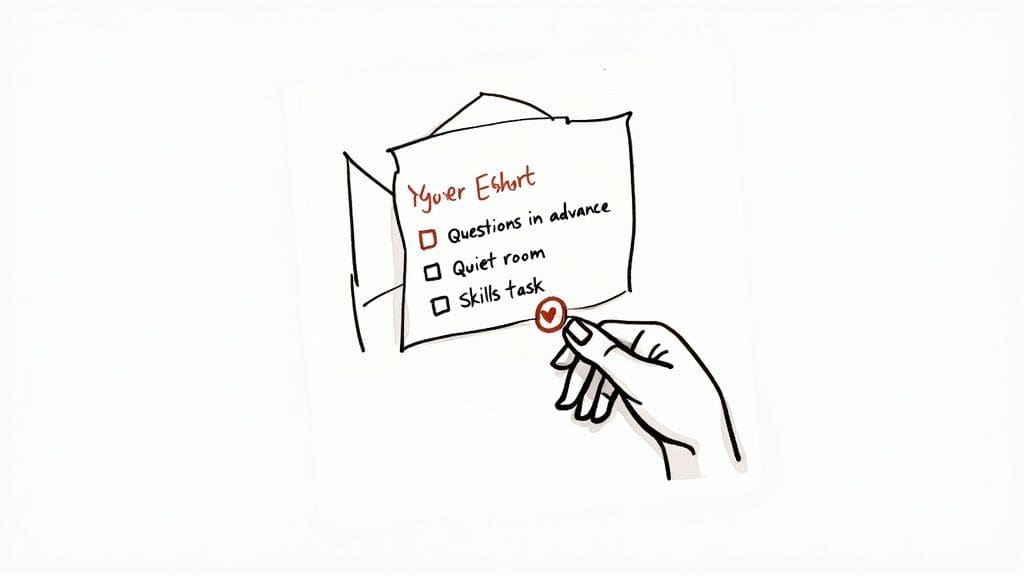
* Getting questions in advance: This is a big one. Even getting a few key questions 24 hours beforehand gives you vital processing time to pull together your best, most thoughtful answers.
* A skills-based task: Instead of relying entirely on a traditional Q&A, you could suggest a practical task. This is perfect for roles where your actual abilities matter far more than your social fluency.
* A quiet waiting area: That busy, loud reception? It can completely throw you off before you've even started. Asking for a quiet spot to wait can help you stay regulated and focused.
* Clear, literal communication: You have every right to ask the interviewer to stick to concrete questions about your experience and avoid those vague, hypothetical ones that can be so tricky to decode.
To help you think through what might work for you, here's a quick breakdown of some common requests.
Common Interview Accommodations and Their Benefits
| Accommodation Request | What It Means | How It Helps |
|---|---|---|
| Questions in Advance | Receiving some or all of the interview questions 24-48 hours before the meeting. | Reduces anxiety and allows time to process and formulate comprehensive answers, rather than relying on quick recall under pressure. |
| Skills-Based Assessment | A practical task or test that demonstrates your abilities for the role (e.g., a coding challenge, writing sample, or data analysis task). | Lets you prove your skills directly, moving the focus from verbal communication to tangible competence. |
| Longer Interview Time | Extending the scheduled slot by 15-30 minutes. | Provides a buffer to ensure you don't feel rushed, allowing for more considered responses and reducing time-based pressure. |
| Quiet Waiting Area | A separate, low-sensory room to wait in before the interview, away from a busy reception area. | Minimises sensory overload from noise, light, and movement, helping you stay calm and centred before the interview begins. |
| Breaks During Interview | The ability to ask for a short, 5-minute break if you start to feel overwhelmed. | Offers a chance to reset and regulate your sensory system, preventing burnout and helping you maintain focus throughout. |
| Written Instructions | For multi-part questions or tasks, having them provided in writing. | Supports working memory and ensures you understand every part of the prompt without having to hold complex verbal instructions in your head. |
Remember, this isn't an exhaustive list. The best adjustments are the ones that directly address your specific needs.
When and How to Make the Request
So, when's the right time to bring this up? I've found the sweet spot is after you've been offered the interview but before you've locked in a time. This gives the employer a heads-up and shows you're organised.
An email is usually the easiest way to do it. You want to be clear, brief, and positive. You don't need to disclose your diagnosis or share your life story—just state what you need and why it will help.
> Here's a script you could adapt: "Thank you for inviting me to interview for the [Job Title] position. I'm really looking forward to discussing my skills with you. To help me perform at my best, I'd like to request a couple of reasonable adjustments. Would it be possible to receive the main interview questions in advance and have a quiet space to wait beforehand? This will allow me to process things more effectively and give you more focused answers."
This approach frames your request as a tool for mutual success. Advocating for your needs is a huge part of managing your mental health at work, and it starts right here. Getting comfortable with this is a massive step towards acing those interviews.
Following Up After the Interview
So, the interview is done. But you're not quite finished yet. What you do next can reinforce all the great work you did in the room and leave a fantastic lasting impression. This final step is crucial when we're talking about autism and job interviews.
It's just as important to know how to handle the outcome, whether it's good news or just a learning experience for the next time around.
Sending a Simple Thank-You Note
A quick thank-you email within 24 hours is a simple professional courtesy. Don't overthink it—it doesn't need to be an essay. The goal is to be polite, confirm you're still keen, and mention something specific that stuck with you. It's a small detail that shows you were genuinely engaged.
Nailing the Thank-You Email
Keep your email direct and to the point. If super formal language doesn't feel like you, don't force it. A simple, clear structure is all you need to get the job done without adding extra stress.
Here's a straightforward template you can make your own:
* Subject Line: Thank you - Interview for [Job Title]
* Greeting: Dear [Interviewer's Name],
* Opening: Thank you for your time today to discuss the [Job Title] role.
* A Specific Point: I especially enjoyed our conversation about [mention a specific project or topic]. It was really interesting to hear how your team tackles [a specific challenge].
* Closing: I'm still very interested in this opportunity and look forward to hearing from you.
* Sign-off: Best regards, [Your Name]
This simple format ticks all the boxes. It's a low-effort move with a high impact.
How to Ask For (and Handle) Feedback
Not getting the job stings. It's easy to feel disheartened. But try to see it as a chance to collect some really useful data for your next interview. Asking for feedback can feel a bit awkward, but it's a completely professional request that shows you're serious about your growth.
> Rejection isn't a judgement on your worth; it's a data point. Use it to fine-tune your approach for the next opportunity, turning a setback into a stepping stone.
Wait about a week after hearing the news, then send a short, polite email. You could write something like, "Thank you again for the opportunity to interview. I'm always looking for ways to improve, and I was wondering if you might be willing to share any brief feedback from my interview that could help me in my job search."
Be prepared that some companies have a policy against giving feedback, so don't be discouraged if they don't reply. If you do get some constructive criticism, do your best to look at it objectively. I know this can be tough. It might be helpful to review some practical advice on how to handle difficult conversations so you can process the information without it getting you down.
That period of waiting for a decision is brutal. The anxiety is real. A good tactic is to redirect your focus by applying for other roles or diving into a special interest. When you reframe this post-interview time as a period for learning and moving forward, you start building the resilience you need for the whole job-seeking journey.
A Few Common Questions About Autism and Job Interviews
Even with the best prep in the world, you'll probably still have some lingering questions about handling the whole interview process. It's only natural. Let's tackle some of the most common worries and tricky situations that pop up.
Should I Disclose I'm Autistic on My CV?
This is a big one, and honestly, there's no single "right" answer. It's a deeply personal choice.
Putting it on your CV or cover letter right from the start can be a great way to get the accommodations you need from day one. But let's be real, some people worry about unconscious bias, and that's a valid concern.
A popular middle-ground strategy is to wait until you've secured the interview. That way, you can request specific adjustments for the interview itself—often the most critical and nerve-wracking part—without any preconceived notions getting in the way.
If you do decide to disclose on your CV, my advice is to frame it as a strength. You could mention skills often associated with autism, like an incredible eye for detail, deep-seated loyalty, or a uniquely methodical approach to solving problems.
What if I Get a Really Confusing Question?
First off, it is completely okay to ask for clarification. It doesn't make you look unprofessional; it makes you look thoughtful. When you're hit with an abstract or hypothetical question, it's smart to take a beat.
You can use simple, direct phrases to give yourself a moment to process. Try one of these:
* "Could you please rephrase that for me?"
* "Just so I'm sure I understand, are you asking about a time when I...?"
* "That's a great question. Can I take a moment to think about the best example?"
Another solid technique is to break the question down yourself. If they ask something like, "Where do you see yourself in five years?", you don't have to invent a specific job title. Instead, you can talk about the kinds of skills you want to build. That shows ambition and a plan, which is what they're really looking for.
Are Video Interviews a Good Option?
Video interviews can be a real mixed bag. On the one hand, being in your own space, where you control the lighting and sound, can be a game-changer for reducing sensory overload. Plus, you can have notes just off-camera to keep you on track. Total lifesaver.
On the other hand, trying to read non-verbal cues through a screen is tough, and the ever-present threat of a tech glitch just adds another layer of stress you don't need.
> If you're offered a video interview, do a full tech rehearsal. Test your camera and mic, make sure your background is tidy, and don't be shy about asking for accommodations. A great one is to ask if they can pop the questions into the chat so you can process them visually.
These challenges are especially real when you look at the bigger picture. A 2025 UK government report found that nearly half (47.7%) of disabled people who identify as autistic are between 16 and 24. On top of that, 20.5% of this group have no formal qualifications, making the interview process feel even more intimidating. You can explore the full government report on the employment of disabled people to get more context on these numbers.
How Can I Explain a Gap in My Employment History?
Keep it honest, but brief. You absolutely do not need to share your entire life story. The goal is to frame the gap in a positive, proactive way that shows you were still being productive.
For instance, you could say, "I took a planned career break to focus on my well-being, and I'm now feeling re-energised and excited to get back to work." Or, you could try something like, "I took some time away to develop my skills in [mention a relevant skill] through some online courses." That turns a potential red flag into a sign of initiative and a commitment to your own growth.
Trying to navigate these conversations can feel like a lot. If you need a little help with scripts, figuring out your tone, or even just some calming strategies you can use right on your phone, check out the tonen app. It's designed to help you communicate more clearly and with a lot less stress. Learn more and start your free trial at usetonen.com.
Frequently asked questions
This guide covers a guide to autism and job interviews with practical, neurodivergent-friendly strategies—clear steps, scripts where useful, and ways to reduce anxiety or overload rather than vague "be confident" advice.