Building your personalized toolkit for coping with social anxiety is the first step toward feeling more in control. It's about knowing your triggers, having a few simple scripts ready, and learning discreet calming techniques for when you feel overwhelmed. This guide skips vague advice and focuses on concrete, actionable steps to create a reliable plan that takes the pressure off and makes engaging with people feel more doable. Let's get straight into the strategies you can use before, during, and after social events.
Your Toolkit For Managing Social Anxiety
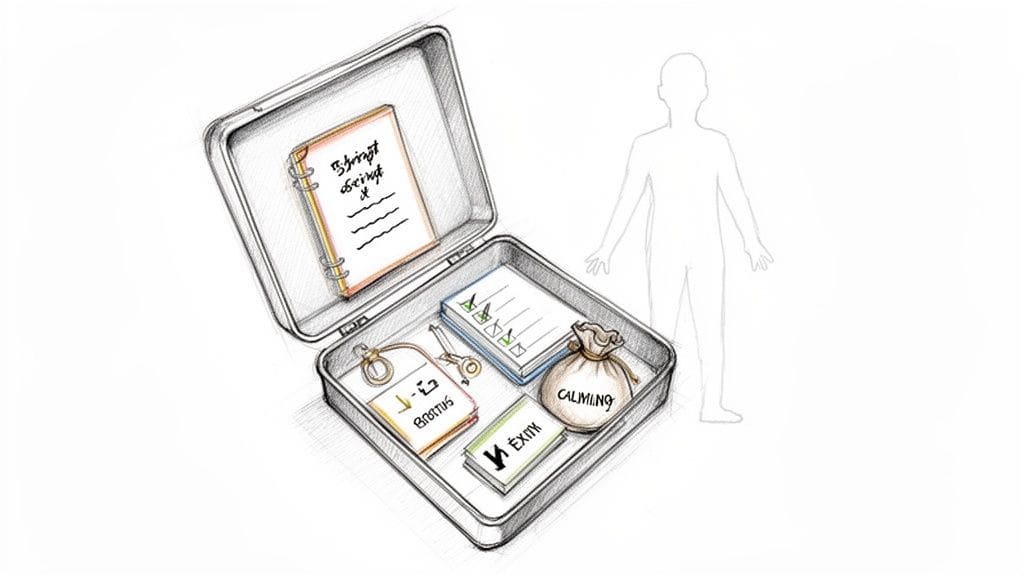
Managing social anxiety isn't about becoming a different person. It's about arming yourself with the right tools to navigate situations that feel tough. This kind of practical approach is especially helpful for neurodivergent folks because it focuses on lowering the mental load, not on forcing you into social norms that just don't feel natural.
This guide skips the vague advice. Instead, we're focusing on concrete, actionable steps you can actually use. Think of it as building a mental toolkit you can carry with you anywhere. These strategies are designed to be practical and discreet enough for any real-world scenario, from a big work meeting to a casual family get-together.
The Three Pillars of Your Anxiety Toolkit
To make this even clearer, most effective management strategies rest on a few core principles. When you understand these pillars, it helps frame your whole approach to coping with social anxiety. They give you a solid foundation to build from.
Here's a quick summary of how these strategies work together.
Three Pillars of Social Anxiety Management
| Strategy Area | What It Involves | Why It Helps |
|---|---|---|
| Preparation | Identifying your triggers, creating simple scripts for small talk, and mentally rehearsing interactions. | This seriously reduces uncertainty and the sheer mental effort of trying to improvise everything on the spot. |
| In-the-Moment Regulation | Using grounding exercises, simple breathing techniques, and quick body scans to stay present. | These actions calm your nervous system and pull your focus away from anxious, spiraling thoughts. |
| Post-Event Care | Having a go-to routine to decompress and process the experience without judgment. | This helps prevent you from overthinking every little detail and recharges your social battery for next time. |
By focusing on these three areas, you're creating a comprehensive system for yourself—one that supports you before, during, and after social interactions.
You Are Not Alone in This Experience
These numbers tell a clear story: there's a critical need for accessible, practical strategies for coping with social anxiety.
> The feeling of being constantly watched or judged is a core part of social anxiety. This fear isn't just "being shy"—it's a powerful and often debilitating response that requires a strategic, compassionate approach to manage effectively.
For a broader set of proven methods, it's worth exploring this practical guide to coping with anxiety disorder. Many people also find support through technology, so you might find our guide on the best social anxiety apps helpful. These resources can offer extra structure as you build your personal toolkit.
How to Prepare Before a Social Event
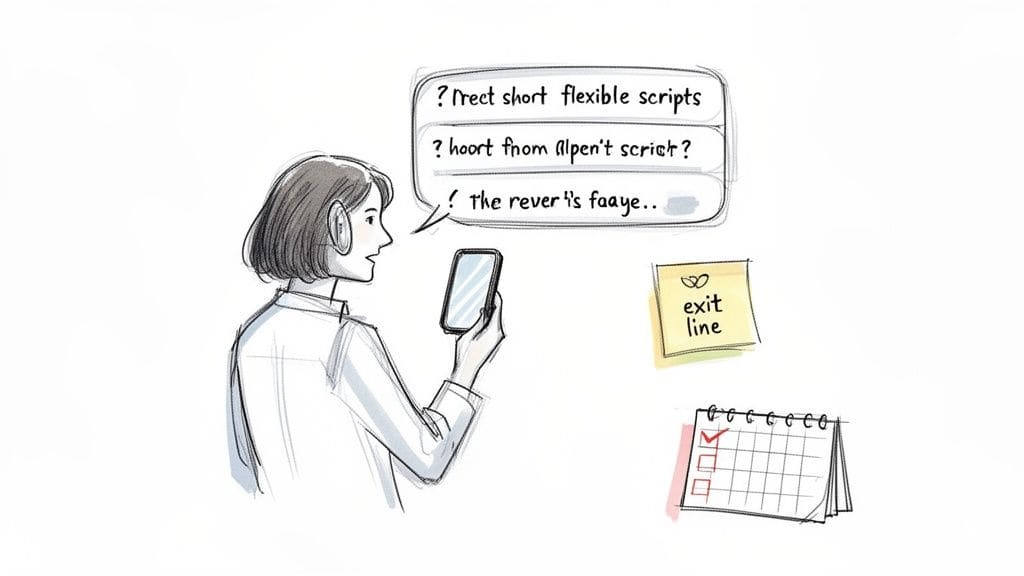
One of the most powerful ways to start coping with social anxiety is to get ahead of it. Proactive preparation can make a world of difference. When you reduce the number of unknowns before you even walk into a room, you lower your cognitive load and give yourself a much-needed sense of control.
This isn't about becoming a robot or masking your true self. It's about building a solid foundation so you can feel grounded enough to engage more authentically. The work starts with a few simple, flexible scripts for the most common interactions. Just thinking through what you might say ahead of time can defuse the intense pressure of having to improvise in a high-stress moment.
Craft Your Go-To Scripts
Scripts are just short, pre-planned lines for those predictable social moments. Think of them as a safety net, giving your brain something solid to grab onto when you feel put on the spot. The secret is to keep them general enough that they can fit a bunch of different situations.
For instance, a huge trigger for many of us is simply not knowing what to say when you first meet someone. Our guide on how to start a conversation has some fantastic, practical frameworks for this exact scenario.
You might want to create a few scripts for these key moments:
- Introductions: "Hi, I'm [Your Name]. I'm in the [Department] here. It's really nice to meet you."
- Small Talk Starters: "This is a great venue. Have you been here before?" or "What's been keeping you busy at work these days?"
- Asking for Clarification: "That's a really interesting point. Could you tell me a bit more about [Topic]?"
> A well-crafted script is not a rigid performance. Think of it as a set of conversational building blocks you can arrange and adapt as needed, freeing up your mental energy to actually listen and connect.
Develop Your Graceful Exit Lines
Just as important as knowing how to start a conversation is knowing how to leave one. Feeling trapped in a conversation can send anxiety levels soaring. Having a few "exit lines" ready to go empowers you to protect your social battery without feeling rude or abrupt.
These lines should be polite, brief, and final. You never need to over-explain yourself.
- At a party: "It was great chatting with you! I'm going to go grab a drink/find my friend."
- In a work setting: "I have to get back to my desk, but let's connect on this later. It was good talking."
- When feeling overwhelmed: "Excuse me, I just need to step away for a moment."
These simple phrases are your opt-outs. They give you permission to take a step back when you need to, which is a vital part of coping with social anxiety effectively.
The Power of Rehearsal
Once you have a few scripts and exit lines, practice them. I know, it might feel a bit strange at first, but rehearsal is what builds muscle memory. Saying the words out loud—even just to yourself in the mirror—makes them so much easier to access when you're under pressure.
When you rehearse, you're doing more than just memorizing words. You're familiarizing your brain with the rhythm and feel of the conversation. This process makes the phrases feel more natural and seriously reduces the fear of freezing up in the moment. This practice is your secret weapon against that "blank mind" feeling that so often comes with social anxiety.
In-the-Moment Techniques to Stay Grounded
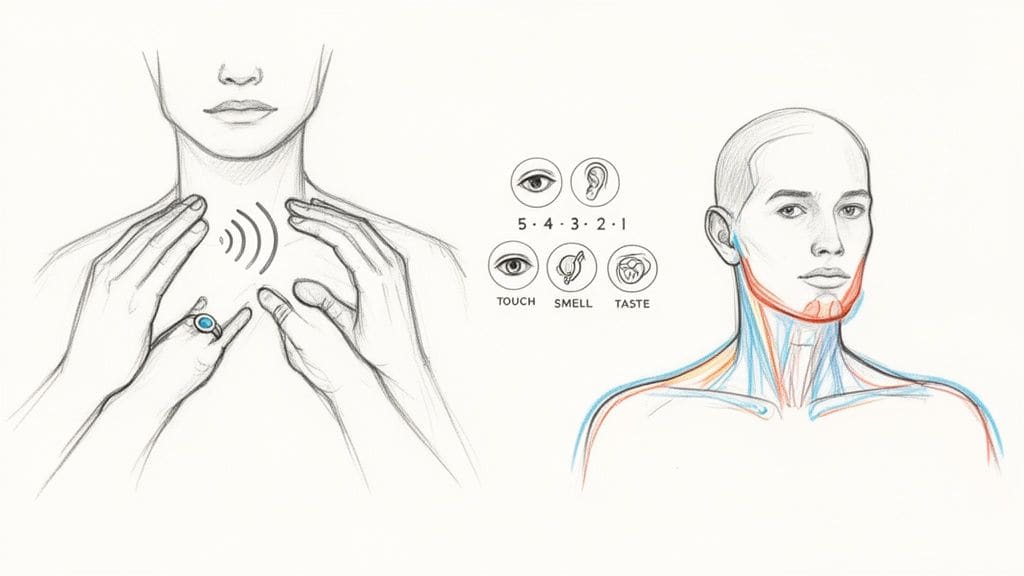
All the preparation in the world can feel a million miles away when your heart starts pounding mid-conversation. In those moments, you need something immediate. You need discreet tools that can pull you back from the edge of overwhelm without anyone even noticing.
Think of these techniques as your mental "Calm Kit." They aren't just distractions; they are physiological interventions designed to regulate your nervous system when it flips into fight-or-flight mode. Mastering these is a powerful part of coping with social anxiety because they directly address your body's physical stress response, allowing you to stay present.
Looking for ways to cope with social anxiety? tonen can help.
tonen offers conversation scripts, Reply Helper, Perspective Helper, Debrief, Phone Call Mode and Calm Kit. Start with 21 free scripts on iPhone. Optional Premium unlocks more features.
Download on the App StoreAvailable on iOS.
Use Your Senses to Ground Yourself
When anxious thoughts start to spiral, grounding is the skill that reconnects you to the present moment through your physical senses. It works by pulling your focus away from the internal storm of fear and anchoring it to the solid, tangible world around you. This simple shift can immediately dial down the intensity of your anxiety.
The 5-4-3-2-1 method is a classic for a reason. It's incredibly effective and you can do it silently, anywhere you are.
- 5 Things You Can See: Look around the room and mentally name five distinct objects. Don't just list them; notice a detail. "I see the blue pen with the chewed cap," or "I see the wood grain on that table."
- 4 Things You Can Feel: Shift your attention to physical sensations. It could be the solid feeling of your feet flat on the floor, the texture of your shirt against your skin, or the cool surface of a glass in your hand.
- 3 Things You Can Hear: Tune in to three specific sounds. Maybe it's the low hum of the air conditioner, the faint sound of traffic outside, or the murmur of a conversation across the room.
- 2 Things You Can Smell: Try to identify two distinct scents. This could be the smell of coffee brewing, soap from when you washed your hands, or even the subtle scent of paper from a notepad.
- 1 Thing You Can Taste: Focus on one thing you can taste. This might be the lingering flavor of your last drink, or just the neutral taste inside your mouth.
> Grounding isn't about ignoring your anxiety; it's about anchoring yourself in reality so the anxiety doesn't sweep you away. It reminds your brain that you are physically safe, right here, right now.
For more ideas, our article on grounding techniques for anxiety offers a bunch of other exercises you can add to your mental toolkit.
Regulate Your Breathing
Anxiety has a distinct physical signature: shallow, rapid breathing. This pattern actually fuels the physical symptoms of panic, creating a vicious cycle. When you intentionally slow your breath, you send a powerful signal to your nervous system that the danger has passed.
A simple and completely unnoticeable technique is box breathing.
Inhale slowly for a count of four, hold your breath for four, exhale slowly for four, and then hold again for four. Repeat this cycle a few times. This rhythmic, predictable pattern is incredibly effective at restoring a sense of calm. For many of us, effective coping with social anxiety starts right here, with the breath.
Communicating Your Boundaries with Confidence
Setting boundaries is a game-changer for managing your social energy, but it can feel incredibly confrontational and uncomfortable. A huge part of coping with social anxiety is learning how to protect your own well-being by communicating your needs—clearly and kindly.
This isn't about building walls. It's about creating a safe, manageable space for yourself within a social setting. When you know you have a way to protect your limits, you can actually stay in situations longer and engage more genuinely. It reframes boundary-setting from a scary conflict into a necessary act of self-care.
Finding the Right Tone for Your Message
Your tone of voice can completely change how a boundary is received. You can be direct yet warm, or firm yet gentle, depending on what the situation calls for. The goal is to find a style that feels authentic to you, which makes it a whole lot easier to speak up when you need to.
Practicing different tones helps you get ready for the real world. For example, saying "I need a quiet moment" can sound demanding or like a gentle request based entirely on your delivery. To get more comfortable with this, it's always a good idea to improve your general communication skills, as they are the foundation for expressing yourself clearly.
Picking the right tone for the right situation is a skill you can build. Sometimes you need to be soft and gentle, other times a more direct approach is necessary. Here's a quick breakdown to help you match your phrasing to the moment.
Choosing Your Communication Tone
| Tone | Example Phrasing | Best Used When... |
|---|---|---|
| Gentle & Warm | "I'm feeling a little overwhelmed, so I'm just going to step away for a bit. Thanks for understanding!" | You're with trusted friends or family who are likely to be supportive. |
| Clear & Direct | "I'm not able to talk about that topic right now, but I appreciate you sharing." | The situation is more formal, or you need to be unambiguous without escalating things. |
| Firm & Neutral | "I need to end this conversation now." | Previous, softer attempts have been ignored and you need to state a non-negotiable limit. |
Ultimately, finding a tone that feels like you is what matters most. It makes the words easier to say and more likely to be heard.
> Setting a boundary is simply telling someone what you need. It doesn't have to be a big, dramatic announcement. Often, the simplest and kindest phrasing is the most effective.
Remember, you don't owe anyone a long-winded explanation. A simple, clear statement is almost always enough. For more examples, especially when dealing with friendships, check out our guide on how to set boundaries with friends.
Practical Phrases for Setting Boundaries
Having a few pre-planned phrases can make a world of difference. It takes away the pressure of trying to find the "perfect" words in a stressful moment. The key is to state your need without blaming or accusing the other person.
Here are a few real-world examples you can adapt:
- When you need space: "I'm feeling a bit overstimulated and just need to take a few minutes for myself."
- When a topic is too much: "I appreciate you sharing, but I'm not able to talk about that right now."
- When you need to end a conversation: "It was really good to catch up! I need to step away now, but let's talk again soon."
- When you need to decline an invitation: "Thank you so much for thinking of me, but I won't be able to make it this time."
Each of these is polite, clear, and respects both your needs and the other person's feelings. This direct yet gentle approach is a cornerstone of successfully coping with social anxiety.
Creating Your Personal Social Safety Plan
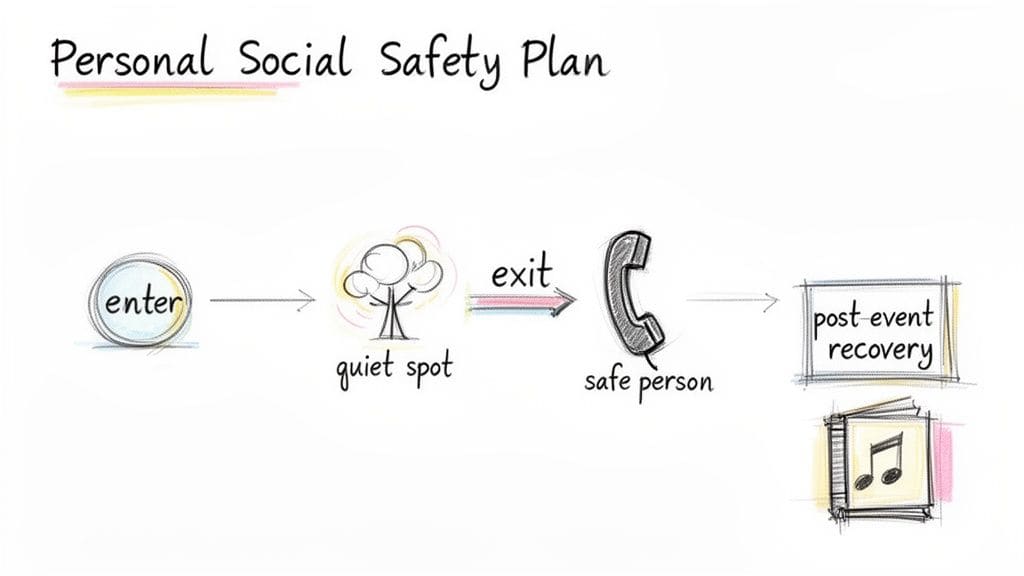
A social safety plan is your personal roadmap for handling overwhelming moments. Think of it as a pre-planned strategy that lays out exactly what you can do when things get difficult, so you don't have to make panicked decisions on the fly.
Having a clear course of action gives you a powerful sense of control in what can often feel like an unpredictable environment. This isn't just a vague idea; it's a concrete tool you build for yourself. When you know your options ahead of time, you free up the mental energy that would otherwise be spent worrying.
Identify Your In-the-Moment Resources
The first part of your plan is all about identifying your immediate lifelines during a social event. These are your first line of defense when you start to feel your anxiety creeping up. Just knowing they exist can make a huge difference.
Your list of resources might look something like this:
- A Safe Person: Pinpoint one person at the event you can text or signal for support. This might be a friend, a partner, or a trusted colleague who gets what you're going through.
- A Quiet Spot: Before you even arrive, or as soon as you get there, scope out a quiet place you can retreat to. This could be a less-crowded hallway, an outdoor patio, or even just a bathroom where you can take a few minutes to reset.
- A Pre-Planned Reason to Leave: Have a simple, believable reason ready for why you might need to head out early. Something as straightforward as "I have an early start tomorrow" works perfectly and takes the pressure off having to invent an excuse on the spot.
> Your safety plan is a form of self-advocacy. It acknowledges that your well-being matters and gives you tangible steps to protect it, which is a crucial aspect of managing social anxiety.
Design Your Post-Event Recovery Routine
How you decompress after an event is just as critical as how you manage things during it. A solid post-event routine helps you process the experience without getting stuck in a rumination spiral—that endless loop of replaying every tiny detail and perceived mistake.
This is your dedicated time to recharge your social battery, and it should be comforting and low-demand.
- Engage a Special Interest: Spend some quality time with a hobby that you find completely absorbing and calming.
- Sensory Comfort: Listen to a favorite playlist, wrap up in a weighted blanket, or have a warm, soothing drink.
- Mindful Journaling: Jot down three things that went well, no matter how small they seem. This little exercise helps counteract the brain's natural tendency to focus only on the negative parts of an interaction.
By building this structured plan, you're creating a reliable system that supports you before, during, and after social challenges. It makes the entire process of coping with social anxiety feel much more manageable.
Recognizing When to Seek Professional Support
While all the strategies we've talked about are powerful, sometimes they aren't quite enough. And that's okay. Knowing when to reach for professional support is a critical step, especially if social anxiety is consistently getting in the way of your life.
If you find yourself constantly sidestepping opportunities at school, work, or in your personal life because of that deep-seated fear, it might be time to connect with a therapist. This isn't a sign of failure; it's a brave act of self-advocacy. It's about adding an expert to your team.
Signs It Might Be Time for Help
Figuring out the line between "I'm just anxious" and "I need some help with this" can be tricky. It might be time to reach out if you're experiencing things like:
- Persistent Avoidance: You're consistently saying no to things that could help you grow—like a promotion, a new class, or even just building friendships—all because of social fear.
- Intense Physical Symptoms: You're frequently hit with panic attacks, nausea, or severe trembling when you have to be in a social setting.
- Significant Distress: The anxiety is causing major disruptions to your daily life, your routines, and your overall sense of well-being.
> Acknowledging that you could use some support is a true sign of strength. It means you're taking your well-being seriously and are ready to find strategies that lead to real, lasting relief.
Finding the Right Therapeutic Approach
Different kinds of therapy can help, but Cognitive Behavioral Therapy (CBT) is one of the most effective and well-researched approaches for social anxiety. It's designed to help you identify, challenge, and reframe the negative thought patterns that fuel the fear cycle. You can learn more about how it works in our deep dive on using Cognitive Behavioral Therapy for social anxiety.
The thing is, way too many people who could benefit from this never get help. The World Health Organization reports that, globally, only about 1 in 4 people with an anxiety disorder ever receive any form of treatment. You can discover more insights about global mental health treatment gaps on who.int.
That statistic really highlights how important it is to recognize when self-help needs a boost. Making the decision to bring in a professional is a crucial part of coping with social anxiety for the long haul.
Still Have Questions?
It's completely normal to have a few lingering questions as you start putting these strategies into practice. Let's tackle some of the most common things people ask when they're figuring out how to manage social anxiety.
What If I'm Just Having a Really Bad Day?
On days when your social battery is already in the red, it's not just okay to scale back—it's essential. This isn't about failure; it's about smart energy management.
Instead of forcing yourself through a big, draining event, give yourself permission to downshift. Maybe that means swapping the party for a short, low-stakes text exchange with a trusted friend. This is the perfect time to use those opt-out scripts you prepared. And remember to focus on your post-event recovery plan, even if the "event" was just a five-minute phone call.
Isn't This Just Being Shy? What's the Difference?
While they can look similar from the outside, they're worlds apart internally. Shyness is a personality trait. It's that feeling of being a bit reserved or timid in a new situation, but it doesn't typically flood your system with intense, persistent fear.
Social anxiety, on the other hand, involves a debilitating fear of being judged, scrutinized, or humiliated. That fear is so powerful it often leads to avoiding social situations entirely just to feel safe.
> A huge part of coping with social anxiety is recognizing that it's more than just shyness. It's a significant fear response that requires specific, compassionate strategies to manage, not just "getting over it."
Can I Use These Strategies for Online Stuff, Too?
Absolutely. The digital world has its own set of social pressures, and these tools are just as relevant there.
Protecting your energy is crucial, whether you're online or off. You can prepare short scripts for a video call, set clear boundaries around your response times for messages, and use grounding techniques if you start feeling overwhelmed during a virtual meeting. The environment changes, but the need to feel safe and in control doesn't.
tonen is available on iOS with 21 free scripts, Box Breathing and 5-4-3-2-1 Grounding, plus one free request each in Reply Helper, Perspective Helper and Debrief. Optional Premium adds the full script library, Phone Call Mode, Body Scan and Safe Place, and 50 requests per week shared across the three helpers. Check the App Store purchase screen for your local price and any eligible trial.