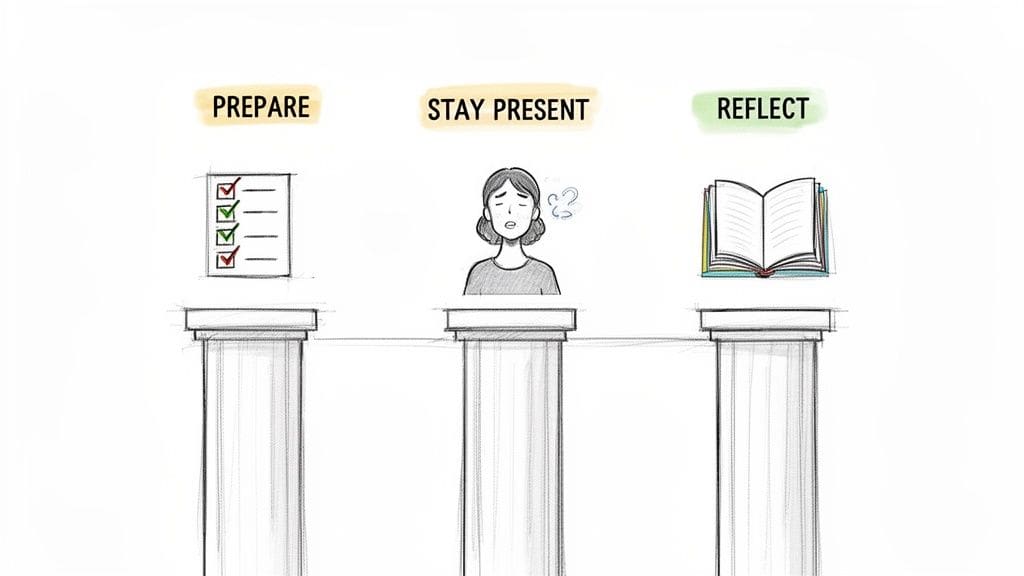
Do you get stuck in a loop of replaying conversations or spiraling into "what-if" scenarios before a party? The most effective way to get help with overthinking events is to break the process down into three distinct stages: proactive preparation, in-the-moment management, and mindful post-event reflection. This framework provides a clear action plan, allowing you to prepare beforehand, stay grounded during the event, and process the experience constructively afterward. Instead of just worrying, you'll have tangible tools to break the exhausting cycle of rumination.
This guide will walk you through this three-stage approach, giving you actionable techniques to build confidence and reduce anxiety. It's about shifting from abstract worry to concrete action, so you can start to change your relationship with social gatherings for the better.
Why You Get Trapped in the Overthinking Cycle
The tendency to overthink social situations almost always boils down to two things: replaying the past (rumination) and dreading the future (worry). Rumination is that mental highlight reel of every awkward pause or clumsy word, where you keep asking yourself, "Why on earth did I say that?" Worry, on the other hand, is all about catastrophizing what might happen with an endless stream of worst-case scenarios.
These mental loops feel like you're trying to solve a problem, to regain a sense of control when you feel anxious. But they don't work. Instead of bringing clarity, overthinking just amps up the anxiety and leaves you feeling completely drained before the event even begins.
You Are Not Alone in This Struggle
> Key Takeaway: Overthinking isn't a personal failing; it's a common (and exhausting) response to feeling anxious and uncertain. The first step to breaking free is simply recognizing the pattern for what it is.
Shifting from Overthinking to Action
The best way to quiet a noisy mind is to replace abstract worry with concrete action. This guide is built to help you do just that. We'll move beyond vague advice and give you specific, practical techniques you can use at every stage of a social event.
- Before the Event: We'll cover how to set small, achievable goals instead of chasing some impossible standard of social perfection.
- During the Event: You'll learn discreet grounding techniques to pull yourself back to the present moment and manage anxiety as it rises.
- After the Event: We'll explore structured reflection methods to help you process the experience constructively and—most importantly—let it go.
This approach gives you a sense of agency again. For those whose stress is tied specifically to social interactions, exploring strategies for coping with social anxiety can offer even more targeted support. By equipping yourself with these tools, you can start to change your relationship with social gatherings, one small, manageable step at a time.
To help you visualize this approach, here's a quick breakdown of the framework.
The Three-Stage Framework for Managing Event Overthinking
This table summarizes the core strategies to tackle overthinking before, during, and after a social event, turning a vague sense of dread into a clear, actionable plan.
| Stage | Objective | Example Tactic |
|---|---|---|
| 1. Preparation | Reduce anticipatory anxiety and feel equipped. | Decide on one "safe" topic to bring up if a conversation stalls. |
| 2. In-the-Moment | Stay grounded and manage rising stress. | Silently name 3 things you can see and 2 things you can hear. |
| 3. Reflection | Process the event constructively and let go of rumination. | Write down one positive or neutral interaction that happened. |
By focusing on one stage at a time, the entire process becomes far less intimidating. Instead of facing a huge, undefined social challenge, you're just tackling one small, achievable step.
Proactive Preparation Before the Event
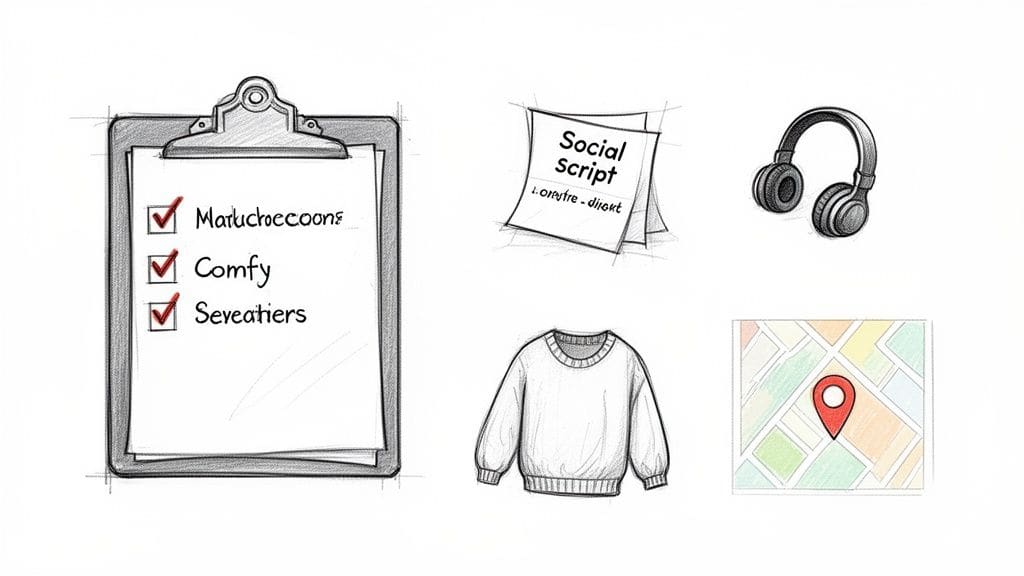
The battle against event anxiety is often decided long before you walk out the door. The best help with overthinking events comes from doing the prep work. This shifts your mindset from dread to a sense of control.
This isn't about transforming into the life of the party overnight. It's about equipping yourself with a plan that makes the whole experience feel more manageable. By focusing on tangible, small steps, you can dial down that pre-event stress and walk into any room feeling prepared instead of panicked.
This process boils down to setting realistic goals, planning for your sensory needs, and having a few conversational scripts in your back pocket. It's a practical approach that builds a solid foundation for a less stressful social life.
Set Achievable Social Goals
A huge trigger for overthinking is the crushing pressure to be perfectly witty, charming, and constantly engaged. We build up this idea of a flawless social performance in our heads, and the fear of not measuring up just fuels the anxiety.
The solution? Ditch that impossible standard. Instead, set small, realistic, and genuinely achievable goals for yourself.
Instead of a vague goal like "be more social," redefine what success looks like for you. Maybe your goal is just to have one meaningful (or even just pleasant) conversation. This simple shift reframes the event from a performance being judged to an opportunity for a small, positive connection.
Here are a few examples of goals you can actually hit:
- Learn something new: Make it your mission to ask one person about their job or a recent trip they took.
- Share a small win: Find a moment to mention a project you're proud of or a new hobby you're enjoying.
- Stay for a set time: Decide you'll stay for one hour. That's it. You can give yourself permission to leave guilt-free afterward.
> By setting a small, specific intention, you give your brain a clear task to focus on. This targeted approach is much more effective than the vague, overwhelming command to "be good at socializing."
Craft a Social Script
One of the biggest sources of pre-event anxiety is the fear of not knowing what to say. Your mind starts racing through a dozen awkward scenarios. What if you get stuck? What if the conversation dies? What if someone asks a personal question you really don't want to answer?
A social script is your antidote to this spiral.
This just means pre-planning a few lines for common situations. Having these "back-pocket phrases" ready provides an immense sense of security. You don't have to use them, but just knowing they're there can quiet the "what if" loop in your head. A good script includes starters, pivots, and exits.
Practicing is a great way to build your confidence here. For more ideas on getting a discussion rolling, check out our guide on how to start a conversation with anyone.
Plan for Your Sensory Comfort
For many of us, especially autistic and ADHD individuals, sensory overload is a massive factor in social exhaustion. The noise, the lights, the crowds, and even uncomfortable clothes can drain your energy and crank up your anxiety.
Sensory planning is a crucial part of managing social event stress. It directly tackles these physical and environmental stressors head-on.
Clothing and Appearance
Deciding what to wear can easily become a huge source of rumination. To head off anxiety around your appearance, having a clear outfit idea is a game-changer. You can consult a helpful guide to what to wear for a party to feel prepared and confident. Most importantly, prioritize comfort—choose fabrics and fits that won't distract or irritate you.
Venue and Travel
- Scout the location online: Use Google Maps or the venue's website to look at photos. Try to spot potential quiet corners, a patio, or less-crowded areas where you can take a breather.
- Plan your travel: Decide how you'll get there and back *before* the day of the event. Knowing your transportation is sorted out removes a huge logistical worry from your plate.
- Pack a small comfort kit: This could include noise-reducing earplugs, a familiar fidget tool, or a calming scent on a handkerchief. These small items can be discreet grounding tools when you need them.
By managing your sensory environment, you conserve your mental energy for the social stuff. This makes the entire experience less draining and provides a powerful way to manage overthinking, turning a potentially chaotic environment into a much more predictable one.
In-the-Moment Tactics to Stay Grounded
Even with the best preparation, there will be moments when your anxiety flares up and your thoughts start to spiral. This is where having a few discreet, in-the-moment tactics becomes a total lifesaver. Effective help for overthinking isn't just about what you do beforehand; it's about having a toolkit to pull yourself back to the present when your mind starts racing.
These strategies are designed to be subtle. They let you regulate your nervous system and find your footing again without drawing any attention to yourself. From simple sensory exercises to pre-planned conversation pivots, these techniques put you back in control.
Replaying events over and over in your head? tonen can help.
tonen offers conversation scripts, Reply Helper, Perspective Helper, Debrief, Phone Call Mode and Calm Kit. Start with 21 free scripts on iPhone. Optional Premium unlocks more features.
Download on the App StoreAvailable on iOS.
Use Subtle Grounding Exercises
When you feel your mind detaching from the present and drifting into a worry spiral, the fastest way to stop it is to reconnect with your physical senses. Grounding exercises yank your focus away from the internal chaos and anchor you in the here and now.
The best part? You can do them anywhere, anytime, without anyone knowing.
- The 5-4-3-2-1 Method: This one is a classic for a reason. Silently name 5 things you can see, 4 things you can feel (like your feet on the floor or the texture of your sleeve), 3 things you can hear, 2 things you can smell, and 1 thing you can taste.
- Tactile Anchoring: Discreetly focus on a physical sensation. Press your thumb and index finger together, feel the coolness of a glass in your hand, or trace the seam of your pants with your finger. The goal is to give your brain a concrete, neutral sensation to focus on instead of abstract worries.
These simple actions are incredibly effective. For more ways to anchor yourself, you can explore other powerful grounding techniques for anxiety that are perfect for these situations. It's a practical form of in-the-moment support you can use instantly.
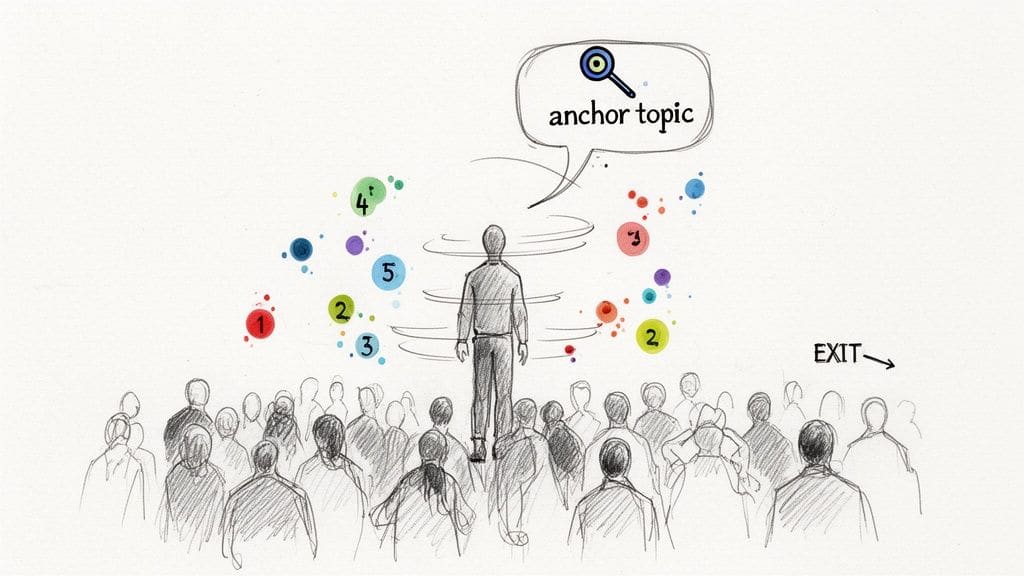
Deploy Your Anchor Topics
Just like you prepped some exit lines, having "anchor topics" ready can save you from that dreaded feeling of a conversation stalling and your mind going blank. An anchor topic is simply a safe, comfortable subject you know well and can talk about with ease.
Think of it as your conversational home base. When you feel lost or put on the spot, you can gently steer things toward one of these subjects.
> Example in Action:
> Someone asks, "So, what's new with you?" and your mind goes completely blank. Instead of panicking, you pivot to your anchor topic.
>
> "Not a whole lot on my end, but I did just finish a really fascinating documentary about deep-sea exploration. Have you seen it?"
This simple move shifts the pressure off of you and onto a topic you're actually prepared to discuss. Your anchor topics could be a recent movie you saw, a favorite podcast, a new recipe you tried, or a project you're excited about. The key is that it's low-stakes and genuinely interesting to you.
Take Strategic Resets
Feeling overwhelmed is a signal that you need a short break—not a sign that you've failed. Reframe these moments as strategic resets, not escapes. Giving yourself just a few minutes of quiet can be all it takes to prevent your social battery from draining completely.
A quick trip to the bathroom, stepping outside for a breath of "fresh air," or offering to help the host grab something from another room are all socially acceptable ways to get a moment to yourself.
Use this time to:
- Do a quick grounding exercise.
- Take a few slow, deep breaths.
- Remind yourself of your small, achievable goal for the event.
This intentional pause is an essential tool. It's important to remember that the need for such strategies is widespread. Anxiety disorders are among the most prevalent mental health challenges globally, affecting millions of people. Yet, they often go untreated, so developing personal coping mechanisms is vital.
Control Your Tone to Calm Your Nerves
The way you sound has a powerful effect not just on others, but on yourself. When you feel anxious, your voice might become quiet, rushed, or high-pitched, which can reinforce your internal feeling of panic.
You can actually trick your own nervous system into settling down by consciously choosing a calmer, more measured tone of voice. Speak a little more slowly than you normally would, and keep your pitch in a comfortable, lower register.
This doesn't mean being fake; it means being intentional. Using a warm yet confident tone when you set a boundary ("I'm actually going to head out soon, but it was great chatting!") or express a need makes the interaction feel smoother and less confrontational for everyone, especially you. This technique provides immediate, actionable support, giving you a direct way to influence your own emotional state in real time.
Mindful Reflection and Post-Event Recovery
The event is over, but for many of us, the mental gymnastics are just getting started. This is often the hardest part—the post-event replay where every interaction gets scrutinized.
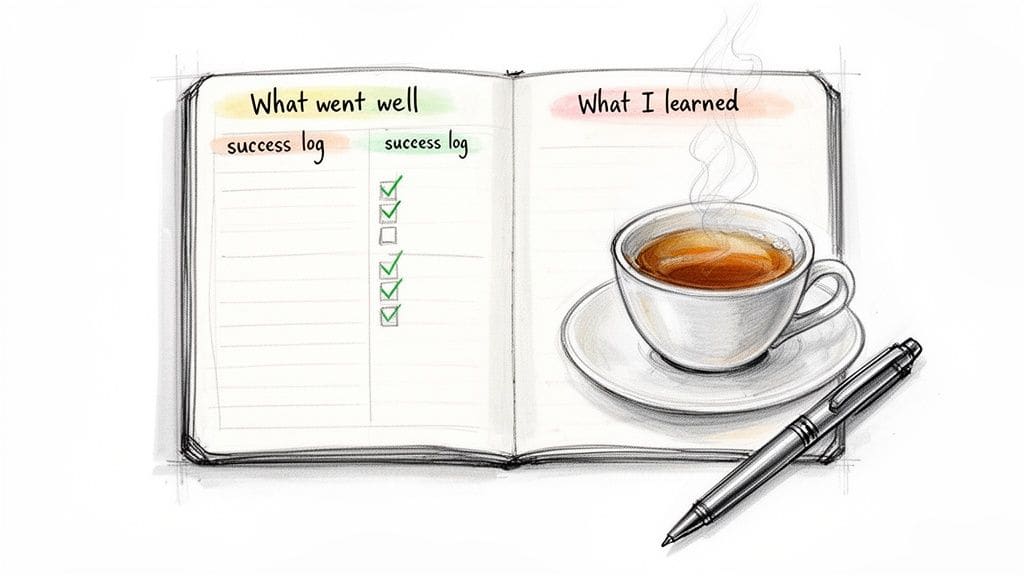
The way out of this exhausting rumination loop is through compassionate and constructive self-review. It means firing your harsh inner critic and, instead, using structured journaling and success logging to reframe the experience. This is how you create powerful help with overthinking events for the future.
This whole process is about changing how you process social memories. You shift from focusing on perceived slip-ups to spotting genuine wins and learning opportunities. Instead of endlessly replaying a conversation and judging every word, you learn to ask, "What actually went well?" and "What's one thing I can learn for next time?"
This deliberate, mindful reflection is the key to finally letting the event go and getting your mental peace back.
Challenge Your Inner Critic with Cognitive Reframing
After a social event, it's common for your brain to switch into "mistake-scanner" mode, hunting for every awkward pause or clumsy phrase. That habit is called rumination, and it's a huge source of anxiety. The first step to stopping it is to notice the pattern and actively push back with cognitive reframing.
Instead of just accepting your negative thoughts as gospel, treat them like theories to be tested. This isn't about toxic positivity or pretending everything was perfect. It's about letting a more balanced and realistic perspective into the room.
> Key Insight: Your initial, anxiety-fueled story of what happened is just one possible version of events. Reframing is your chance to write other, kinder narratives that are often much closer to the truth.
This mental shift is critical, especially when you realize how many people are in the same boat. You can see more data on these anxiety trends from the Mental Health Foundation, which show that high anxiety is a widespread struggle. These numbers underscore the importance of having personal tools to manage it.
Start a Structured Journaling Practice
To make reframing a real habit, try a simple, structured journaling exercise after each event. Just grab a notebook and answer three specific questions. This steers your mind away from pointless worry and toward productive reflection.
Post-Event Journal Prompts:
1. What is one thing that went well or felt okay? This doesn't need to be a massive victory. Maybe you used a conversation starter you planned, you actually liked the food, or you simply made it through the first hour, just like you intended.
2. What is a specific negative thought I'm having? Write it down, word for word. Something like, "I was so awkward when I talked to Sarah." Getting it out of your head and onto the page robs it of some of its power.
3. What is a more balanced or compassionate way to see it? Now, challenge that thought. For example: "I felt a bit awkward, but we did have a nice chat for a few minutes. Awkward moments happen to everyone, and she probably isn't thinking about it at all."
This simple three-step exercise gives you concrete tools for managing your thoughts by building a new mental pathway. It trains your brain to look for evidence of positive and neutral outcomes, not just negative ones. The emotional toll of constant rumination is huge; if you often feel drained after social events, it may be helpful to recognize the symptoms of emotional exhaustion.
Create a "Success Log" to Build Evidence
Our brains have a strong negativity bias, which makes it incredibly easy to forget small wins and fixate on what we think went wrong. A "success log" is your secret weapon against this. It's a dedicated space—a small notebook or a note on your phone—where you document only the positive or neutral moments from social events.
This isn't about ego. It's about building a bank of cold, hard evidence to deploy against your inner critic. Over time, this log becomes an undeniable record of your progress and your social competence.
What to Include in Your Success Log:
- A compliment someone gave you.
- A conversation that felt comfortable or easy.
- A time you successfully used one of your pre-planned exit lines.
- The simple fact that you went to the event, even when you felt anxious.
Before your next social gathering, take a minute to read through your success log. This simple act can give you a much-needed confidence boost, reminding you of what you're capable of. It offers tangible support by grounding you in your past successes, not your future fears.
Build Your Social Confidence Toolkit
Okay, let's get practical. All this advice about managing social overthinking is great in theory, but how do you actually use it when you're stressed? The key is to stop thinking of these strategies as abstract ideas and start building them into a concrete system you can rely on.
This is where modern tools, like apps on your phone, can be a game-changer. They help you create a personalized support system that lives right in your pocket. Instead of trying to remember some breathing technique you read about weeks ago, you have an organized toolkit ready to go.
By weaving these digital resources into the three stages—preparation, in-the-moment management, and post-event reflection—you create a reliable blueprint for self-support. It makes practice consistent and accessible, which is exactly what you need to build real, lasting confidence.
Keep a Library of Scripts
One of the fastest ways to slash pre-event anxiety is feeling prepared for the actual conversations. A digital script library, like the one inside the tonen app, takes this idea and makes it incredibly practical.
After all, you wouldn't talk the same way at a formal wedding as you would at a casual work happy hour. A script library lets you build out and save specific phrases for all sorts of different scenarios, so you're not starting from scratch every time.
- For a work conference: "That's an interesting point. How do you see that applying in the [X] industry?"
- For a friend's party: "This is such a great get-together! How do you know [the host]?"
- For a family gathering: "It's so good to see everyone. I was just telling Mom about [a recent, neutral life update]."
Having these organized and ready to review gives you an immediate confidence boost. You can just scan the relevant scripts before you head out, reinforcing the fact that you have a plan.
Rehearsing wording before a conversation
Knowing what you want to say is one thing. Feeling comfortable enough to actually say it is another beast entirely. For rehearsal, choose a script, adapt the words and read them aloud yourself if that is useful. You can also practise with someone you trust.
Rehearsing your scripts in private helps build conversational muscle memory. It seriously cuts down on the uncertainty that fuels so much of our overthinking. This isn't about memorizing lines like an actor. It's about internalizing the flow of a conversation so it feels more natural when you're in the moment.
> By practicing your opening lines, your pivots, and your exit phrases, you're not just preparing for a conversation—you're training your brain to feel less panicked when you're actually in one. It turns a high-stakes social interaction into a low-stakes, rehearsed skill.
As you get more comfortable, you might also want to refine how you deliver your words. Learning to overcome a monotone voice and speak with impact can make a huge difference in how present and self-assured you feel during a chat.
Have a Calm Kit for Instant Relief
Even with the best preparation in the world, you might have moments where you feel completely overwhelmed. When your nervous system goes into overdrive, trying to remember a complex grounding technique can feel impossible.
This is where an on-demand "calm kit" provides critical support. It gives you immediate access to simple, guided exercises designed to regulate your nervous system quickly and discreetly.
What to Look for in a Calm Kit:
- Breathing Exercises: Short, guided audio to help slow your heart rate.
- Grounding Tools: Simple prompts that pull your focus back to your senses.
- Body Scans: Exercises to release physical tension you might not even realize you're holding.
- Visualization: A quick "safe place" meditation to give your mind a momentary escape.
Having these tools ready at the tap of a button means you don't have to rely on memory when you're already stressed. It's a practical safety net that makes facing social situations feel much less daunting. These techniques are often rooted in well-established methods, and if you want to understand the science behind them, you can learn more about how they connect to broader strategies like cognitive behavioural therapy for social anxiety. A digital toolkit like this can turn self-support into a consistent, reliable habit.
Still Have Questions About Social Events?
It's completely normal to have a few lingering questions. We've covered a lot of ground on how to prepare for events, stay grounded in the moment, and reflect afterward.
Let's tackle some of the most common things people ask when they're trying to get a handle on overthinking.
What's the Real Difference Between Normal Worrying and Overthinking?
This is a great question. The core difference is whether your thoughts are moving toward a solution or just going in circles.
Normal worrying is brief and productive. It's a temporary thought that solves a problem. For example, "What should I wear? Oh, right, I'll wear my blue shirt." Done. Problem solved.
Overthinking, which is often called rumination, is the opposite. It's a destructive cycle where you replay past blunders or imagine a thousand future "what-ifs" without ever landing on a solution. You get stuck on a hamster wheel of self-criticism and worst-case scenarios, which just drains your energy and makes you more anxious. If it feels like you're spiraling, you're probably overthinking.
Can I Use These Strategies if I'm Not Neurodivergent?
Absolutely. While these strategies are especially powerful for autistic and ADHD minds, they are universal.
The principles here—preparation, grounding yourself in the moment, and mindful reflection—are foundational to cognitive behavioral therapy (CBT). They work for anyone dealing with social anxiety, introversion, or just general stress around social events. Things like conversation scripts and tone practice can help anyone feel more confident and less stressed when they talk to people.
How Can I Support a Friend Who Overthinks Events?
The most helpful thing you can do is start with validation. Please avoid saying things like, "Just don't worry about it" or "It'll be fine!" It can feel really dismissive.
> Instead, try something like, "It sounds like this is really stressful for you. How can I help?" This shows you're actually listening without passing judgment.
Here are a few other concrete ways to offer support:
- Offer to be their "safe person." Be the one they can find and check in with if they start to feel overwhelmed at the event.
- Help them get ready beforehand. You could run through a few conversation starters together or help them figure out their "getaway" plan for when their social battery runs low.
- Check in with them after. A simple, "How are you feeling after that?" can make a huge difference. If they need to talk it out, be a non-judgmental ear. You can also gently help them see the small wins, instead of letting them focus only on what they think went wrong.
How Long Does It Take for These Techniques to Work?
Some of these tools give you immediate relief. In-the-moment techniques like the grounding exercises or taking a strategic bathroom break are designed to calm your nervous system in just a few minutes.
But changing the deep-rooted habit of overthinking is like building a muscle. It takes consistent practice. The first few times you try to reframe negative thoughts after an event, it might feel a little awkward or forced. That's normal.
Consistency is everything. Using a practice tool like an app can speed this up, making it easier to rehearse these new mental and conversational habits until they feel like second nature. It's that repetition that provides lasting help with overthinking events.
*
tonen is available on iOS with 21 free scripts, Box Breathing and 5-4-3-2-1 Grounding, plus one free request each in Reply Helper, Perspective Helper and Debrief. Optional Premium adds the full script library, Phone Call Mode, Body Scan and Safe Place, and 50 requests per week shared across the three helpers. Check the App Store purchase screen for your local price and any eligible trial.