Learning how to be engaging in a conversation requires mastering one core skill above all others: being fully present. It's about consciously shifting your focus away from your own internal chatter and onto the person speaking, making them feel genuinely heard and seen. This guide will get straight into the practical steps you can take to make your conversations more meaningful and memorable, helping you connect better with the people around you.
Mastering Presence and Active Listening
True engagement isn't about having the wittiest comeback or the most amazing story. It all starts with the simple—but surprisingly difficult—act of active listening. This means you're not just politely waiting for your turn to speak. You're actively absorbing, processing, and acknowledging everything the other person is communicating, both with their words and their body language.
When you get this right, a conversation transforms from a series of back-and-forth statements into a shared experience. When someone feels truly listened to, they naturally open up, share more, and leave the interaction feeling positive. It's the absolute foundation for being more engaging.
Silence Your Inner Monologue
Let's be honest, one of the biggest hurdles to listening is our own brain. We're often busy formulating our response, judging what's being said, or getting sidetracked by a random thought. It's a constant battle.
A powerful technique I've found is the 'mental spotlight' method. Picture a single spotlight in your mind and deliberately aim it at the speaker. Every time you notice your thoughts drifting—and they will—just gently guide that spotlight back to them. It's not about forcing your mind to be empty; it's about consistently redirecting your focus.
Think of it as a muscle. Developing this skill takes practice, much like any other aspect of social skills training for adults.
Show You Are Tuned In
You can prove you're engaged without saying a single word. Your body language often speaks louder than your voice, reinforcing that you're paying full attention.
* Maintain comfortable eye contact: This shows you're focused and interested, not staring into space.
* Keep your posture open: Try to avoid crossing your arms, which can make you look closed off or defensive.
* Nod and use facial expressions: A simple nod or a raised eyebrow confirms you're following along and reacting to their story in real-time.
> Active listening is the art of making the other person feel like they are, for that moment, the most important person in the world. It's less about what you say and more about how you make them feel.
Sidestep Common Listening Traps
Even with the best intentions, it's easy to slip into bad habits. A classic trap is "rehearsing"—you're so busy planning your brilliant next sentence that you completely miss what they're saying right now. Another is "filtering," where you only tune in for things that are directly relevant to you, missing the speaker's wider point.
Recognising these habits is the first step. The goal is to catch yourself in the act and bring your focus back to the speaker.
Just to put this into perspective, think about how much we value real human connection. A TCN survey in the UK found that 42% of British consumers would rather speak with a live agent than a bot. Even more telling, 52% feel more comfortable sharing sensitive information with an actual person. The data is clear: being present, responsive, and genuinely human is what makes an interaction feel valuable.
To make this clearer, let's break down what active listening really looks like compared to just passively hearing someone.
Active vs Passive Listening: A Quick Comparison
The difference between simply hearing words and truly listening is huge. This table breaks down the key behaviours to help you spot the difference in yourself and others.
| Characteristic | Passive Listening (What to Avoid) | Active Listening (What to Practise) |
|---|---|---|
| Focus | Internal – thinking about what to say next. | External – focused entirely on the speaker. |
| Goal | To respond, reply, or state your own opinion. | To understand the speaker's perspective and feelings. |
| Body Language | Distracted, arms crossed, minimal eye contact. | Open posture, nodding, maintaining eye contact. |
| Questions | Asks questions to redirect the topic to oneself. | Asks clarifying and open-ended questions. |
| Interruptions | Finishes the speaker's sentences or interrupts. | Allows the speaker to finish without interruption. |
| Feedback | Offers unsolicited advice or quick judgements. | Paraphrases and summarises to confirm understanding. |
Moving from the "avoid" column to the "practise" column takes conscious effort, but it's where the magic of real engagement happens. It's about making a deliberate choice to prioritise understanding over responding.
Asking Questions That Spark Real Dialogue
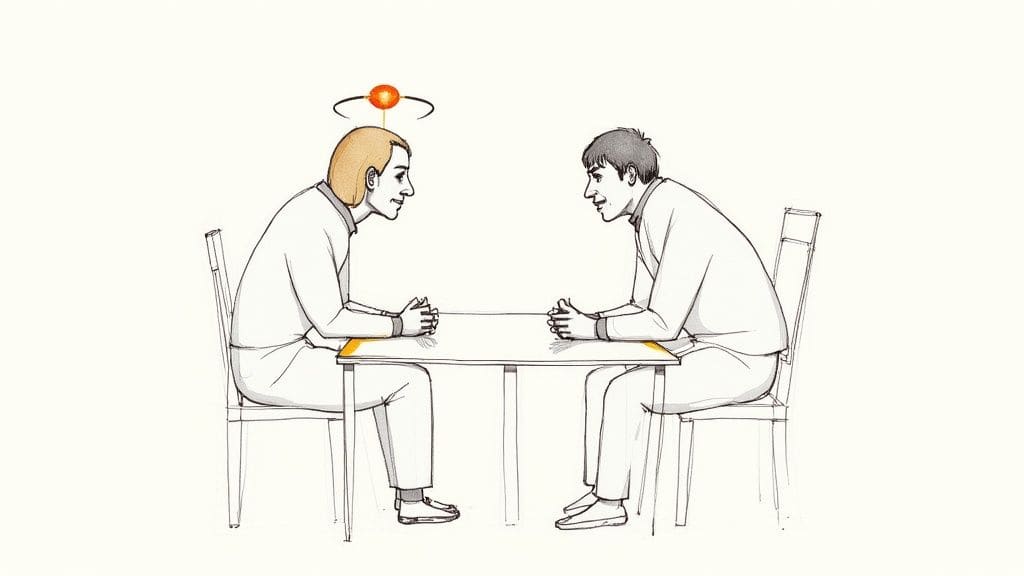
If you really want to learn how to be engaging in a conversation, you have to get curious. Genuinely curious. The best chats I've ever had weren't built on witty statements or clever anecdotes. They grew from questions that invited stories, not just simple answers.
It's a small but powerful shift away from autopilot small talk. Instead of just filling the silence, you start asking questions that show you're actually interested in the other person's world. This is where simple exchanges become shared explorations, and that's the bedrock of any real connection.
Move Beyond Closed Questions
The single biggest conversation-killer is the closed question—the kind that gets a simple "yes" or "no." We're all guilty of it. Think about the difference between "Did you have a good weekend?" and "What was the most interesting part of your weekend?" One is a dead end; the other is an open door.
Your goal is to invite detail, emotion, and maybe even a little narrative. So, instead of asking if someone likes their job, try asking what surprised them most about their industry when they first started. It's a question that goes beyond facts to uncover their personal story.
If this feels a bit unnatural at first, getting ideas from a list of conversation starters for introverts can give you some great prompts to work with.
> The quality of your questions determines the quality of your conversations. An engaging question shows you're not just trying to fill silence—you're trying to understand the person in front of you.
This mindset is everything. It's so powerful that even the principles of conversational marketing borrow from it, trying to make automated interactions feel more human and spark genuine dialogue.
Practise the Art of the Follow-Up
Okay, so you've asked a great opening question. That's a fantastic start, but it's only half the job. The real magic, the thing that makes someone feel truly heard, happens in the follow-up. This is how you peel back the layers of a topic and prove you were actually listening.
Let's say someone mentions they went hiking over the weekend. Your next move decides where the conversation goes from here.
* Weak Follow-Up: "Oh, cool." (Annnnd the conversation is over.)
* Good Follow-Up: "Where did you go?" (This is better; it gathers a fact.)
Want to be more engaging in conversations? tonen can help.
tonen gives you 188+ conversation scripts, tone guidance and calming tools — designed for autistic adults, ADHD and social anxiety. Try it free for 7 days.
Download on the App StoreiOS only. Android coming soon.
Engaging Follow-Up: "What made you choose that trail specifically?" (Now we're talking! This invites motivation, a story, a reason*.)
By digging just a little deeper, you send a clear signal: I care about the details of your experience. This one technique is absolutely fundamental. It validates what the other person is sharing and makes them want to tell you more, simply because your interest feels authentic, not like you're just following a script.
Using Body Language to Build Connection

We often focus so much on what to say that we forget our bodies are talking, too. Long before you've finished your first sentence, your non-verbal cues are sending powerful signals about your interest and openness.
Mastering this silent language is a huge part of learning how to be more engaging. An open, attentive posture can create an atmosphere of trust and make someone feel completely heard.
On the flip side, closed-off body language can sabotage your best efforts. You could be asking the most brilliant questions, but if your posture screams "I'm not interested," that's the message they'll receive.
Adopt an Open and Welcoming Stance
Think of your posture as an open door. The way you hold your body can either invite someone in or put up an invisible wall. An open stance makes you seem physically and psychologically accessible, which helps the other person relax and open up.
It's all about small, conscious adjustments.
* Uncross Your Arms: This is the classic defensive pose. It's a habit for many, but it can make you seem unapproachable. Try keeping your arms relaxed at your sides instead.
* Angle Your Body Towards Them: When you physically turn to face someone, you're non-verbally telling them they have your complete focus.
* Keep Your Hands Visible: It might sound strange, but hiding your hands can subconsciously signal that you're hiding something. Resting them on the table or using them for natural gestures builds a sense of trust.
These little shifts work together to create a feeling of safety, which is the foundation of any truly engaging conversation.
Use Mirroring to Build Rapport
Mirroring is a subtle but incredibly powerful way to build a connection. It's not about becoming a perfect copy of the other person—that would be weird. Instead, you gently reflect their body language to create a sense of similarity.
If they lean in while telling a story, you might lean in slightly, too. If they use a particular hand gesture, you might use a similar one a few moments later.
This works because our brains are wired to feel more comfortable with people who seem like us. When you mirror someone effectively, you build rapport on an unconscious level. It makes them feel seen and understood without them even realising why.
> Non-verbal communication is an unspoken dialogue that runs parallel to your verbal one. When both are aligned, your message of engagement becomes incredibly powerful and authentic.
Be Aware of Silent Conversation Killers
Just as positive body language can draw someone in, certain habits can shut a conversation down in an instant. The worst part? We often do them without even thinking.
Today's number one culprit is the mobile phone. A quick glance at your screen sends a clear message: "Whatever is on this phone is more important than you." It immediately breaks the connection.
Other silent killers include fidgeting nervously, constantly scanning the room, or wearing a tense, blank expression. Becoming aware of these habits is the first step to fixing them.
For those who find interpreting and using non-verbal signals especially tricky, exploring structured autism communication strategies can offer some incredibly helpful and practical frameworks for building these skills.
Sharing Stories That Connect, Not Dominate
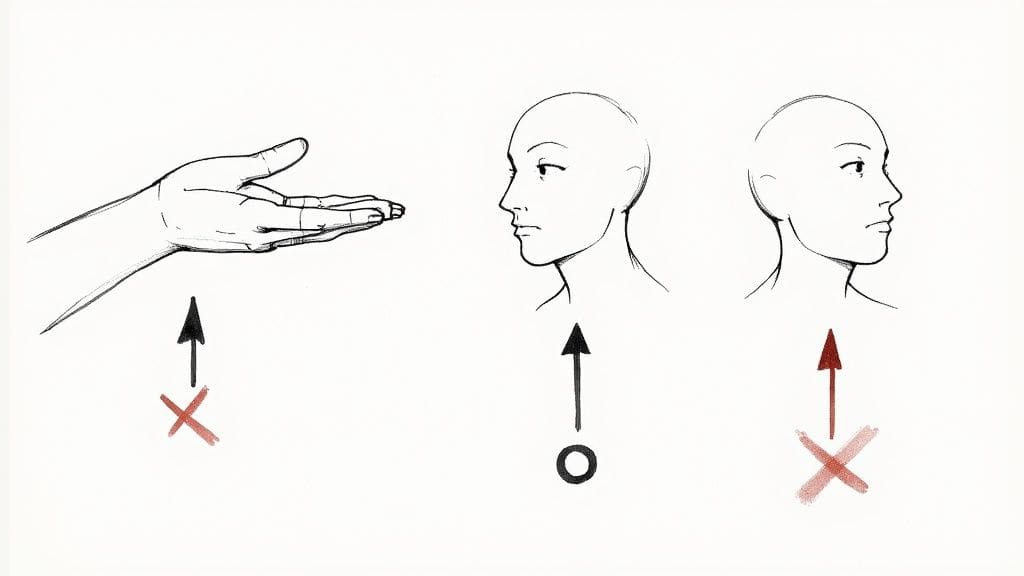
Shared experiences are the glue that turns polite small talk into a real connection. A big part of learning how to be engaging in a conversation isn't just about listening—it's about sharing parts of yourself. This is where storytelling comes in, but there's a massive difference between sharing an anecdote that connects and launching into a monologue that takes over.
Think of your story as a bridge, not a destination. It's there to add something valuable, show you get it, or create a moment of shared understanding before you hand the conversational baton right back.
Frame Your Anecdotes for Impact
When someone shares something, it's natural to want to jump in with a detailed story of your own. The real skill is keeping your contribution short and sweet, making sure it supports their point rather than completely hijacking the conversation.
Here's a simple framework I use to keep my stories brief and on-point. Before I start talking, I quickly think through:
* The Point: What's the one key message I'm trying to get across? (Maybe it's just, "I understand that feeling of being overwhelmed.")
* The Context: What's the absolute minimum background someone needs to get it?
The Punchline: What's the core moment or feeling that links back to their* story?
This little mental check stops me from rambling and makes sure my anecdote actually adds to the conversation instead of derailing it.
Find and Build on Common Ground
Actively listening for common ground is one of the most powerful things you can do to build a bond. I'm talking about those shared interests, weird quirks, or past experiences that make someone feel like you get them. It's the difference between saying "That's interesting" and "I completely know what you mean; I had a similar feeling when..."
You're basically listening for threads of similarity. Maybe you both grew up in the same area, have the same obscure hobby, or feel the same way about a recent event.
> When you find common ground, you're not just having a conversation; you're building a foundation for a relationship. It communicates, "You're not alone in this," which is one of the most connecting messages you can send.
Once you spot a potential connection, gently build on it. Don't just state the similarity—ask a question to explore it further. This shows you're actually interested in their side of the shared experience, not just talking about your own. Finding the right words to kick things off can be tricky, but exploring different ways of learning how to start a conversation can give you useful phrases to have in your back pocket.
By weaving in short, relevant stories and always looking for that common ground, you create a balanced dialogue. It's this give-and-take that makes both people feel seen and comfortable. You're no longer just exchanging words; you're partners, building something meaningful together.
Finding Your Conversational Rhythm
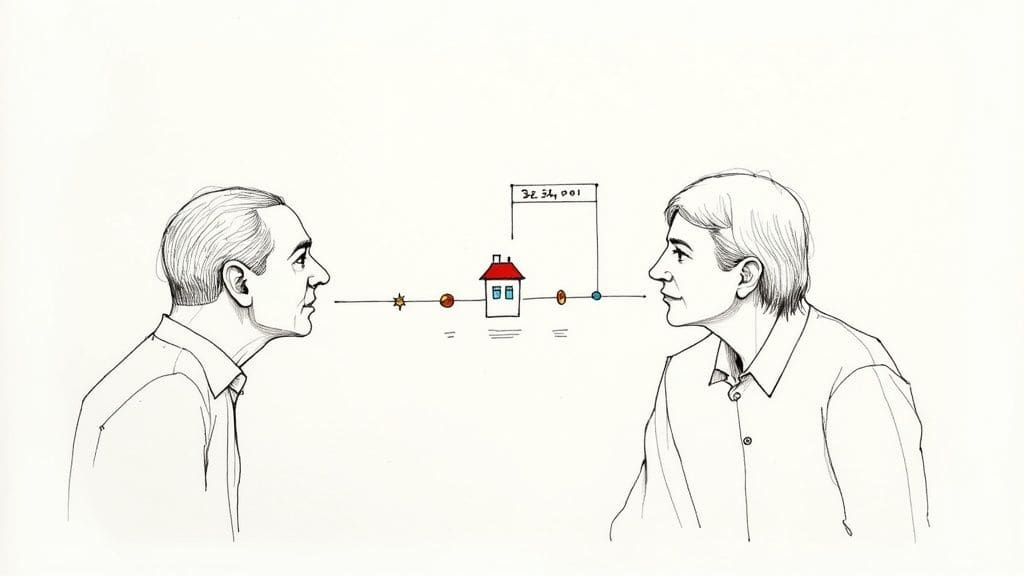
A truly great conversation isn't a rigid interview or a one-sided speech. It's more like a dance. There's a natural rhythm, a give-and-take that makes both people feel heard and valued. Learning to sense that rhythm is a huge part of being more engaging.
It all comes down to knowing when to step forward and when to step back. The biggest conversational trip-ups happen when one person hogs the spotlight or cuts the other off. When you master the balance, every chat feels less like a task and more like a shared experience.
Don't Fear the Pause
We're so conditioned to dread awkward silences that we rush to fill every gap with noise. But a well-placed pause can be one of the most powerful tools in your conversational toolkit.
A moment of silence gives the other person space to process what you've said and formulate their own thoughts. It also shows you're genuinely considering their words, not just waiting for your turn to talk. Think of it as a moment to breathe, not a conversational failure. It signals comfort and confidence.
Master the Art of Turn-Taking
Conversational turn-taking is that seamless back-and-forth that keeps the dialogue alive. The most obvious way to shatter this flow is by interrupting—it sends a clear message that what you have to say is more important.
But there's a quieter, equally damaging habit: the monologue. This is when you take the floor and simply forget to give it back. The aim should always be a balanced exchange, like a relaxed game of catch. Watch for the subtle cues that someone is done speaking, like a slight drop in their tone or a natural end to their sentence.
This isn't just an in-person skill. With 54.8 million social media users in the UK, responsive digital communication is absolutely vital. Research has found that 73% of users would switch to a competitor if a brand fails to respond quickly online. This just goes to show how deeply we value timely, respectful turn-taking in every part of our lives.
> An engaging conversation is a partnership. It's not about winning a debate or delivering a performance; it's about co-creating an experience where both people feel equally involved and respected.
To help you get the hang of this, here's a quick guide on what to do—and what to avoid—to keep your conversations flowing smoothly.
Conversation Pacing Do's and Don'ts
| Pacing Strategy | Do (Engaging Behaviour) | Don't (Disengaging Behaviour) |
|---|---|---|
| Active Listening | Let them finish their thought completely. | Formulate your reply while they're still talking. |
| Asking Questions | Ask open-ended questions to invite longer responses. | Fire off a series of rapid, closed questions. |
| Using Pauses | Allow for a few seconds of silence for reflection. | Jump in immediately to fill any perceived silence. |
| Sharing the Floor | Aim for a rough 50/50 split in talking time. | Monologue without giving them a chance to speak. |
| Signalling Your Turn | Use subtle cues like leaning in or making eye contact. | Interrupt mid-sentence. |
Remember, this isn't a rigid set of rules, but a set of principles to guide you toward more balanced and rewarding interactions.
How to End on a High Note
Knowing how to gracefully end a conversation is just as important as starting one. A fumbled exit can sour an otherwise great chat. The goal is to be warm, clear, and appreciative, leaving them with a positive feeling.
A quick summary or a nod to the future works perfectly. Try something like, "It was so great catching up and hearing about your new project. Let's talk again next week." It's a simple, positive close that leaves the door open.
Of course, some conversations are trickier and require more than a simple goodbye. For those moments, knowing how to handle difficult conversations is an invaluable skill. And if you're looking to really elevate your professional interactions, investing in executive communication skills training can give you the advanced strategies needed to navigate any dialogue with confidence. Getting the rhythm right is what turns a simple talk into a genuine connection.
Got Questions? We've Got Answers
Even when you're armed with the best strategies, trying to be more engaging in conversations can stir up some pretty common anxieties and awkward moments. Let's tackle some of the most frequent hurdles people run into, with some practical advice you can actually use.
What's the Best Way to Handle an Awkward Silence?
First things first, take a breath. A pause isn't a catastrophe. Honestly, those silences almost always feel ten times longer to you than they do to anyone else. The key is to resist that panicked urge to just blurt something—anything—out.
Instead, use that moment to calmly steer things back to something you were already discussing. A simple, "You know, something you mentioned earlier about [topic] was really interesting. Could you tell me more about that?" works wonders. It shows you were genuinely listening and gets the conversational ball rolling again without making a big deal out of the pause.
Another great trick is to just make an observation about your shared surroundings. It could be anything—the music, the weird art on the wall, the event itself. Shifting the focus to something external takes the pressure off both of you and gives you a new, neutral starting point.
How Can I Engage Someone Who Is Shy or Reserved?
When you're talking to someone who's a bit quiet, you need to change your game plan. Firing off a bunch of energetic questions can feel more like an interrogation than a chat. The real goal is to create a comfortable, low-pressure space where they feel safe enough to open up on their own terms.
* Try observations, not questions. Instead of asking, "So, what do you think of this party?" try something like, "This place has a really chill vibe." It's a simple statement they can agree with or build on without feeling put on the spot.
* Share a little something about yourself. A quick, relatable comment can make you seem way more approachable. For instance, "I always feel a bit overwhelmed at big gatherings like this at first." It helps normalise any shyness they might be feeling and builds a little connection.
* Use scaled questions. Instead of a huge "what" or "why" question, try a "how much" one. Something like, "How much have you been following the recent news about X?" invites a shorter, less demanding answer.
> The point isn't to try and turn a shy person into an extrovert. It's about making the conversation feel safe and inviting enough for them to just be themselves. Patience and genuine warmth will get you much further than any clever tactic.
What Should I Do if I Feel Drained in a Long Conversation?
It's completely normal. Social fatigue is a real thing, especially during marathon chats. The most important thing is to recognise your limits and manage your energy. If you feel your focus slipping, it's far better to address it gracefully than to fake it—people can usually tell.
A great strategy is to suggest a small change of scenery or activity. Something as simple as, "Would you mind if we grabbed some fresh air for a minute?" or "I'm going to get another drink, want to come?" can break the monotony and give your brain a quick reset. That little shift can be all it takes to bring new energy to the conversation.
If you know you're hitting your social wall and just need to leave, do it politely. Frame your exit around your own needs, not as a reflection of the conversation. A simple, "I've really enjoyed talking with you, but I need to start heading out," is perfectly fine. Knowing how to be engaging in a conversation also means knowing how to end one well, keeping that connection you've built intact.
If social conversations often feel stressful or unpredictable, tonen can help. Our app provides you with ready-to-use scripts, tone choices, and calming tools designed to make communication clearer and less overwhelming. Reduce your anxiety and build your confidence by trying it for free. Download tonen from the App Store and start your 7-day trial today.
Frequently asked questions
This guide covers how to be engaging in a conversation with practical, neurodivergent-friendly strategies—clear steps, scripts where useful, and ways to reduce anxiety or overload rather than vague "be confident" advice.