Figuring out how to improve conversation skills is much easier with a solid framework. Forget vague advice—let's break it down into four manageable parts: preparation, opening lines, turn-taking, and tone selection. Getting a handle on these creates a reliable roadmap for any interaction. For neurodivergent people especially, this structure can be a game-changer, helping to lower anxiety and make communication feel a lot less like guesswork. This guide provides actionable steps to help you master these components and build confidence.
Your Framework for Better Conversations
It's a common myth that great conversationalists are just born that way. The truth is, effective communication is a skill, and like any skill, it can be learned and practised.
For neurodivergent individuals, who often process social cues differently, having a structured approach isn't just nice to have—it's essential. It provides a clear, reliable system for navigating social situations that might otherwise feel chaotic or overwhelming.
Instead of just telling you to "be yourself," this guide will dig into the mechanics of what makes a conversation flow. We'll cover actionable strategies that build a strong foundation, so you can feel more in control and less exhausted by socialising. This kind of structured learning is at the heart of effective social skills training for adults, focusing on practical abilities you can use in the real world.
Core Conversation Components at a Glance
Before we dive deep, let's get a quick overview of the fundamental building blocks. These components work together to create a smooth, reciprocal exchange. Think of them as the pillars supporting every good conversation.
| Skill Component | Why It Matters | Simple First Step |
|---|---|---|
| Mental Preparation | Reduces anxiety by setting realistic expectations and grounding you before the conversation starts. | Decide on just one small goal for the chat, like learning one new thing about the other person. |
| Simple Opening Lines | Takes the pressure off starting a conversation by having a few go-to phrases ready. | Think of one open-ended question you can ask anyone (e.g., "What's been the best part of your week?"). |
| Turn-Taking & Pacing | Keeps the conversation balanced and prevents one person from dominating the chat. | Practise listening for a natural pause before you jump in with your own thoughts. |
| Tone Selection | Ensures your message is received the way you intend, preventing misunderstandings. | Before speaking, ask yourself: "Do I want to sound curious, friendly, or serious here?" |
Mastering these basics provides a predictable structure that makes any social interaction feel much more manageable. You know what to expect and what your role is at each stage.
If you're interested in other powerful frameworks for understanding human behaviour and communication, it's also worth exploring Neuro-Linguistic Programming (NLP).
How to Mentally Prepare for Social Interactions

Walking into a social setting can feel like stepping onto a stage without a script. But the real work of having a good conversation starts long before you even say hello. It's all in the mental prep.
This isn't about trying to control every little detail. Instead, it's about shifting from a reactive state of worry to a proactive state of readiness. That simple switch helps you feel more in control, turning that fear of the unknown into a quiet sense of preparedness.
This is especially true if you find these situations draining or anxiety-inducing. For many, conditions like social anxiety disorder make this preparation an absolute necessity, not just a nice-to-have.
Set Small, Achievable Goals
One of the biggest traps we fall into is thinking we have to be the life of the party. That pressure is immense and often just leads to us avoiding the situation altogether.
So, let's lower the bar. A lot. Before you even arrive, set one or two tiny, totally achievable goals for yourself.
Here are a few ideas you can steal or adapt:
- The Listener Goal: Aim to learn just one interesting thing about one person.
- The Time Goal: Decide you'll stay for 30 minutes. After that, you have full permission to leave without guilt.
- The Single Exchange Goal: Just focus on having one proper back-and-forth exchange, even if it's short.
When you set a small, concrete goal, you get to define what "success" looks like on your own terms. Anything more than that is a bonus, not a requirement. It reframes the entire night from a terrifying performance review into a simple, low-stakes activity.
> Here's the key: release yourself from the expectation of perfection. The goal is connection, not performance. When you give yourself permission to be imperfect, it's so much easier to just show up and be yourself.
Calm Your Nerves Before You Go
Your nervous system doesn't really distinguish between an actual threat (like a tiger) and a perceived one (like making small talk). It just reacts. So, if you want to calm your mind, you first have to calm your body.
You can't just tell your brain to stop being anxious—you have to show it that everything is okay.
This is where simple grounding exercises work wonders. They are small, physical actions that pull your attention back to the present moment and away from those racing "what if" thoughts. We have a whole guide with some powerful grounding techniques for anxiety if you want to build a little pre-event routine.
Even just a few minutes of focused breathing or a quick body-scan meditation before you head out the door can make a world of difference. It helps lower your baseline stress levels, giving you more mental and emotional bandwidth to handle the social energy when you arrive.
Practice Exercises That Actually Build Confidence
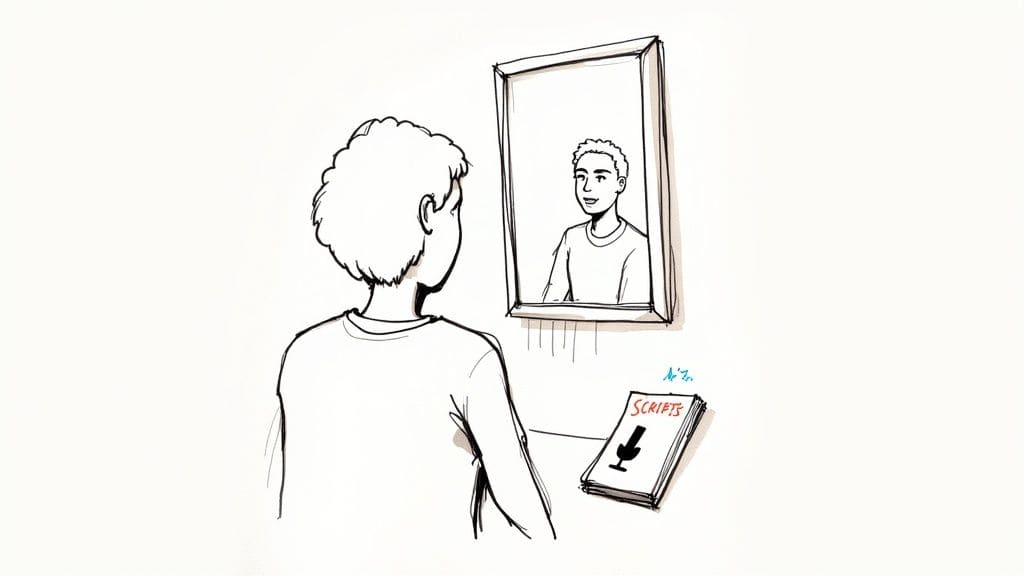
Here's a secret that great conversationalists know: they weren't born that way. Their skills were built, not gifted. The key is consistent practice in low-stakes, private settings where you can build conversational muscle and genuine confidence.
This isn't about awkward role-playing with a friend. In fact, the most powerful work often happens when you're on your own, free from the pressure of an audience. Solo practice gives you the freedom to experiment, make mistakes, and figure out what works for you without any social risk.
Build a Personal Script Library
One of the smartest ways to get ready for those conversations that tie you in knots is to have a few lines ready to go. Think of a personal script library as your private collection of phrases for situations that trigger anxiety, like setting a boundary or asking for something you need.
A tool like tonen's Scripts Library can be a game-changer here. It lets you browse hundreds of prompts and save the ones that feel right.
- Customise your tone: You can hear how a phrase sounds when you say it in a Warm, Direct, Firmer, or Softer tone.
- Prepare your exit strategies: Every script comes with an "opt-out" line, giving you a graceful way to leave a conversation that's becoming too much.
- Have support phrases ready: You'll also find simple, clear ways to ask for help when you need it.
When you've got these scripts ready, you're no longer inventing the perfect words under pressure. You've already done the hard work.
Rehearsing wording before a conversation
Once you've found some scripts you like, it's time to rehearse. Saying the words out loud is a completely different experience from just reading them in your head. It helps you find a natural rhythm and pinpoint which phrases actually feel like you.
> Rehearsing isn't about becoming a robot; it's about clearing the mental clutter. When you're not scrambling for words, you have more brainpower available to actively listen and connect with the other person.
Want to improve your conversation skills? tonen can help.
tonen offers conversation scripts, Reply Helper, Perspective Helper, Debrief, Phone Call Mode and Calm Kit. Start with 21 free scripts on iPhone. Optional Premium unlocks more features.
Download on the App StoreAvailable on iOS.
Narrate Your Day to Improve Fluency
Here's a surprisingly simple but powerful solo exercise: narrate your daily tasks out loud. As you make your morning coffee, just describe what you're doing. "Okay, grinding the beans now," or "Pouring the hot water over the grounds."
It might feel a bit silly at first, but it delivers two huge benefits.
1. It closes the gap between your thoughts and your words, helping you express yourself more smoothly.
2. It improves your verbal fluency and pacing, making your speech sound more natural and confident.
This kind of continuous, low-pressure talking keeps your speaking skills warmed up. Many of these ideas can also be adapted for younger people; we've got more tips in our guide to social skills activities for teens.
Your Weekly Practice Routine
To make this all feel less abstract, here's a simple weekly routine. Just 15 minutes a day is enough to start building real momentum and seeing tangible improvements in how you feel about conversation.
Weekly Conversation Practice Routine
| Day | Exercise (15 minutes) | Focus Skill |
|---|---|---|
| Monday | Find and save one new script for a tricky situation (e.g., disagreeing politely). | Preparation |
| Tuesday | Rehearse Monday's script aloud in Read prepared wording aloud yourself, trying three different tones. | Tone Control |
| Wednesday | Narrate a simple 15-minute task, like cooking or tidying up. | Fluency |
| Thursday | Pick a favourite script and rehearse it again until it feels completely natural. | Muscle Memory |
| Friday | Think of a recent conversation. What went well? What would a script have helped with? | Self-Reflection |
| Saturday | Narrate a short walk outside, describing what you see. | Spontaneity |
| Sunday | Review your saved scripts. Are there any you want to adjust or remove? | Refinement |
This structured approach takes the guesswork out of it. By focusing on one small thing each day, you're steadily building a foundation of skills that will serve you in every conversation you have.
Navigating Conversations in Real Time

Okay, you've done the prep work and now you're in the conversation. This is where it all comes together. The real secret to getting through the back-and-forth isn't about performing perfectly—it's about genuinely connecting.
Try to shift your focus. Instead of worrying about saying the "right" thing, just concentrate on hearing what the other person is actually saying. That simple change can take a huge weight off your shoulders and make the whole interaction feel less like a test.
Success isn't about steering the conversation; it's about feeling comfortable enough to go with its flow.
Become an Active Listener, Not Just a Question-Asker
We're often told to ask questions to show we're interested, but sometimes that can backfire and feel more like an interview. Real active listening is a completely different skill. It's not just about waiting for your turn to talk; it's about absorbing their words, their tone, and what's going on behind the words.
Ask yourself this: are you actually listening, or are you just reloading your next comment? Taking a beat to really think about what they've said before you jump in shows you're truly engaged. It's a game-changer.
Master the Art of Open-Ended Questions
When it is your turn to speak, the kind of question you ask makes all the difference. Closed questions—the ones that get a simple "yes" or "no"—are conversation killers. Open-ended questions are an invitation for the other person to share something real.
Think about the difference:
- Instead of, "Did you have a good weekend?" try, "What was the best part of your weekend?"
- Instead of, "Do you like your job?" ask, "What's the most interesting project you're working on at the moment?"
These can't be answered with one word. They gently nudge the conversation into more interesting places. If you need a few more ideas, these conversation starters for introverts are a great source of inspiration.
> A conversation is meant to either share information or build a connection. Thoughtful, open-ended questions do both, showing you care more about their perspective than about your own airtime.
Manage Overwhelm with a Mental Calm Kit
For many neurodivergent people, the biggest hurdle in any conversation is managing sensory or social overwhelm. Once your brain hits its limit, it's almost impossible to listen, let alone think of a response. This is where having a pre-planned "Calm Kit" becomes your lifeline.
Your Calm Kit is a set of quiet, discreet techniques you can pull out to ground yourself without anyone else noticing. The trick is to have them ready before you're in the thick of it.
Your Go-To Calming Techniques
| Technique | How to Do It Discreetly | Why It Works |
|---|---|---|
| Mindful Breathing | Slowly breathe in through your nose for four counts, hold for four, and breathe out through your mouth for six. No one will even notice. | This kicks your parasympathetic nervous system into gear, sending a "you're safe" signal to your body. |
| Grounding Object | Keep a small, smooth stone or a textured object in your pocket. When you feel overwhelmed, focus on how it feels in your hand. | It pulls your attention out of your anxious thoughts and into a physical sensation, rooting you in the present. |
| Graceful Exit Line | Have a simple phrase ready to go, like, "It was lovely chatting, I'm just going to grab a drink." | Just knowing you have an escape route can remove the feeling of being trapped, which dials down the anxiety a lot. |
Troubleshooting Common Conversation Hurdles
Even with the best game plan, conversations can sometimes hit a wall. It happens. The real skill isn't in avoiding every single awkward moment, but in knowing how to steer through them when they pop up.
Think of it as building your conversational resilience. If you have a few simple strategies tucked away, you won't freeze when your mind goes blank or a topic fizzles out. You can just gently guide the chat back on track or bring it to a natural, polite close.
When Your Mind Goes Blank
We've all been there. You're mid-sentence, and poof—the words are just gone. The most important thing is not to panic. Trust me, that brief pause feels way longer to you than it does to anyone else.
Instead of getting flustered, try using a simple, honest phrase to buy yourself a second.
- "Sorry, I just lost my train of thought for a moment."
- "Hang on, let me think about the best way to put that."
- "That's a really good point. Just give me a second to process it."
These little phrases signal that you're still engaged; you just need a beat. It's so much better than forcing out words that don't quite fit. Having these recovery scripts ready is a brilliant, practical way to handle the pressure.
Reviving a Dying Conversation
So, what do you do when the dreaded awkward silence finally arrives? The easiest fix is to pivot to a new, low-stakes topic. Most people are quite happy to talk about their own experiences or what they like.
A handy little tool for this is the "FOR" method:
- Family: "Do you have any siblings?" or "Are you from around here originally?"
- Occupation: "What's the most interesting project you're working on at the moment?"
- Recreation: "Seen any good films lately?" or "Are you working on any fun hobbies?"
These are open-ended questions, which means they invite more than a yes/no answer and can breathe life back into a stalled chat. For anyone navigating social anxiety, having these go-to topics can be a massive relief. You can find more strategies for managing these tricky moments in our guide on cognitive behavioural therapy for social anxiety.
> Don't feel like you have to carry the whole conversation on your shoulders. A good chat is a team sport. Sometimes a silence is just a natural pause, not a sign that you've done something wrong.
Making a Graceful Exit
Knowing how to politely leave a conversation is just as crucial as knowing how to start one. If you wait around for the "perfect" moment to leave, you can end up feeling trapped and completely drained. The trick is to have a few simple exit lines ready to go.
- "It's been so lovely chatting with you, but I need to go find my friend."
- "Well, I should let you get on, but it was great to catch up."
- "I'm just going to grab another drink. It was a pleasure talking to you!"
Making It Stick: Turning Practice into Progress
Real, lasting change in your conversation skills happens when you start weaving these strategies into your everyday life. This isn't about a quick fix or a one-time effort. It's about building a sustainable practice that feels genuine and comfortable for you, turning conscious effort into second nature.
This whole process relies on two things: reflection and a very generous dose of self-compassion. It's so easy to walk away from a chat and zoom in on every tiny thing that went wrong. Instead, I want you to try and notice what went right, no matter how small it seems.
Reflect Without the Criticism
After a social event, find a few quiet moments to just think about how it went. The goal here isn't to pick apart your performance but to gently gather some data for next time. This kind of mindful reflection is how you'll actually see your progress over time.
Ask yourself a few gentle questions:
- What went well? Did you manage to use that opening line you prepared? Did you ask a really good follow-up question? Maybe you just successfully excused yourself when you felt your social battery draining.
- What felt tough? Was there a moment your mind just went completely blank? Did you get tangled up trying to find the right tone for a joke?
- What might you try differently next time? Perhaps you'll prep a few more conversation topics, or have an exit line ready to go a little earlier.
This isn't about judging yourself. It's about spotting patterns and finding little opportunities to grow. That's the secret to making this whole thing feel less daunting.
> Celebrate every small win. Seriously. Nailing a two-minute chat with the barista at the coffee shop is a genuine victory. Acknowledging these little successes builds the momentum you need to walk into bigger social situations with a bit more confidence.
Build a Practice You Can Actually Keep Up With
True improvement comes from consistency, not cramming. You don't have to suddenly become a social butterfly. The real key is creating a simple way to track your progress and set new, gentle goals for yourself. This turns the vague idea of "getting better at talking" into a concrete and manageable project.
You could even create a simple log in a notebook or a notes app. It doesn't need to be fancy.
| Date | Interaction | One Thing That Went Well | One Thing to Try Next Time |
|---|---|---|---|
| Monday | Chat with a colleague | I asked an open-ended question about their weekend. | Ask whether I understood the main point. |
| Wednesday | Phone call with a relative | I used a script to politely set a boundary. | Feel less pressured to fill every silence. |
| Friday | Party with friends | I left before I was completely wiped out. | Prepare one interesting story to share beforehand. |
Just the simple act of writing it down builds your self-awareness and keeps you focused on moving forward. It breaks the overwhelming task of improving your conversation skills into a series of small, achievable steps, helping you build real confidence and connection, one chat at a time.
Got Questions? Let's Talk Through Them
When you're working on your conversation skills, a few common worries tend to pop up again and again. It's totally normal. Moving past memorised lines to a place where chats feel more natural is a real journey. This section is here to tackle some of those nagging questions with some straightforward, practical advice.
Think of these as extra tools for your communication toolkit. They're designed to help you tweak your approach, build some genuine confidence, and feel a bit more ready for those tricky moments in social situations.
How Can I Stop Overthinking Every Single Word?
Ah, the classic analysis paralysis. Overthinking is usually a sign that you're stuck in 'performance mode' instead of 'connection mode'. The big secret? Shift your focus from trying to say the "perfect" thing to just being present and actually listening to the other person.
When you feel your mind starting to spin out, give this a try:
- Tune into their words: Make a real effort to hear what they're saying, instead of spending that time planning your brilliant reply while they're still talking.
- Just breathe: Before you respond, take a slow, quiet breath. That tiny pause is just enough to ground you and stops you from rushing into a jumbled sentence.
- What's the point? Remember, a conversation is about sharing or connecting, not winning a gold medal for eloquence.
Making this mental shift can really help to quieten that harsh inner critic, which frees you up to engage more authentically. You'll find that as you practise just being in the moment, the right words start to come more easily because you're responding to what's happening right now, not to some script you have in your head.
What If I Genuinely Have Nothing Interesting to Say?
This is such a common fear, and it's almost always built on a shaky foundation. You really don't need to be a world-class storyteller to have a good conversation. In fact, some of the most engaging people are simply the best listeners.
So, instead of worrying about being interesting, try focusing on being interested.
> The most powerful tool you have in any conversation isn't your own stash of witty anecdotes; it's your curiosity about the person in front of you. A thoughtful question will almost always land better than a perfectly crafted story.
If you feel your mind go blank, just fall back on asking a good open-ended question that gets them to share. For instance, instead of panicking with, "I have no cool hobbies to talk about," you could ask, "What's something you're looking forward to this month?" It takes all the pressure off you and puts the focus back where it should be—on the shared exchange. Learning how to improve conversation skills is often about mastering this simple pivot.
Ready to handle conversations with less stress and more confidence? tonen is a mobile app designed by neurodivergent makers to help you prepare for social interactions, manage overwhelm, and communicate more clearly. For rehearsal, choose a script, adapt the words and read them aloud yourself if that is useful. You can also practise with someone you trust.