Figuring out how to reduce social anxiety is most effective with a mix of solid preparation, in-the-moment coping skills, and gentle, consistent practice. The goal is to build a toolkit that makes social situations feel more predictable and less scary. A great starting point is creating simple scripts for common interactions and rehearsing them on your own. This guide will walk you through practical, evidence-based steps to build your confidence, manage anxious thoughts, and gradually reclaim the social situations that feel overwhelming right now.
Your Action Plan for Reducing Social Anxiety
Tackling social anxiety isn't like flipping a switch. It's about building a reliable system that has your back. For many of us, especially neurodivergent people who often thrive on structure, having a clear roadmap makes the entire process feel achievable instead of completely overwhelming. The goal here is to systematically lower the stakes of social interaction, letting you build confidence one small win at a time.
This whole approach is grounded in therapeutic methods that are proven to work. It breaks down into three core pillars: proactive preparation, managing anxiety in the moment, and long-term practice. Each part works together to handle both the mental and physical sides of anxiety.
The Three Pillars of Your Strategy
A solid plan for feeling more confident in social settings really rests on a few key ideas. Think of them like the legs of a stool—you need all of them for stable, long-term support.
Here's a look at how these pillars work in practice:
* Preparation: This is your preemptive strike against anxiety. It's all about creating scripts for everyday situations, rehearsing conversations, and setting realistic, manageable goals for social events. Good preparation removes the element of surprise that so often kicks off a fear response.
* Coping Skills: These are the tools you pull out when anxiety spikes in real time. Techniques like controlled breathing and grounding exercises help regulate your nervous system, pulling you out of a panic spiral and back into the present moment.
* Gradual Practice: This is where the lasting change happens. By intentionally and slowly exposing yourself to the situations you fear—a practice known as graded exposure—you actually teach your brain that these scenarios aren't as threatening as they feel.
To make this even clearer, here's a quick summary of how these pillars support each other.
Three Pillars of Social Anxiety Reduction
| Strategy Pillar | What It Involves | Why It Works |
|---|---|---|
| Preparation | Creating scripts, rehearsing conversations, and setting small, achievable goals before a social event. | Reduces uncertainty and cognitive load, giving you a sense of control and lowering anticipatory anxiety. |
| In-the-Moment Coping | Using grounding techniques, controlled breathing, and mindful awareness to manage physical anxiety symptoms. | Directly regulates the nervous system's fight-or-flight response, helping you stay present and calm. |
| Gradual Practice (Exposure) | Systematically and slowly facing feared social situations, starting with the least intimidating ones. | Rewires the brain's fear response through experience, proving that the feared outcome is unlikely and manageable. |
This methodical approach is incredibly effective because it directly challenges the avoidance behaviors that keep social anxiety going. When you avoid something you fear, your brain gets a quick hit of relief, which only reinforces the idea that the situation was truly dangerous.
> By gently facing your fears instead of running from them, you break this cycle. Each small, successful exposure rewires your neural pathways, chipping away at the fear response over time and building genuine self-confidence.
Why This Method Works
This strategy is deeply rooted in cognitive-behavioral therapy (CBT), which is considered the gold-standard treatment for anxiety disorders. The idea is simple: our thoughts, feelings, and behaviors are all connected. By changing your behaviors (like practicing social skills) and your thoughts (challenging anxious beliefs), you can fundamentally change how you feel.
Exposure therapy, a core technique in CBT, tackles these fears head-on by gradually facing social situations you've been avoiding. The research fully backs this up. Meta-analyses show that CBT, including exposure, has success rates of 50-75% in reducing symptoms after just 12-16 weeks. It's common for people to report 40-60% drops in their social anxiety scores.
Making It Practical and Personal
The real key to making this work is to make the plan your own. You don't need to tackle your biggest fear tomorrow. You start with something that feels just a tiny bit outside your comfort zone. Maybe that's making a phone call you've been putting off, or maybe it's just asking a cashier how their day is going.
As you move through this guide, you'll learn exactly how to build your own toolkit, with specific scripts, breathing exercises, and a personalized exposure plan. Many people find that using dedicated tools can make this process feel a lot more manageable. Take a look at our guide on helpful apps for social anxiety to see what resources might be a good fit. Knowing how to reduce social anxiety is all about finding the right strategies and support systems that actually work for you.
Prepare for Success with Scripts and Rehearsal
Preparation is a powerful antidote to the uncertainty that fuels social anxiety. When you don't know what to say, your brain can spiral into worst-case scenarios. Having a plan beforehand gives you a solid foundation of control. For anyone figuring out how to feel more confident socially, scripting is a game-changing first step because it turns an unpredictable event into a manageable one.
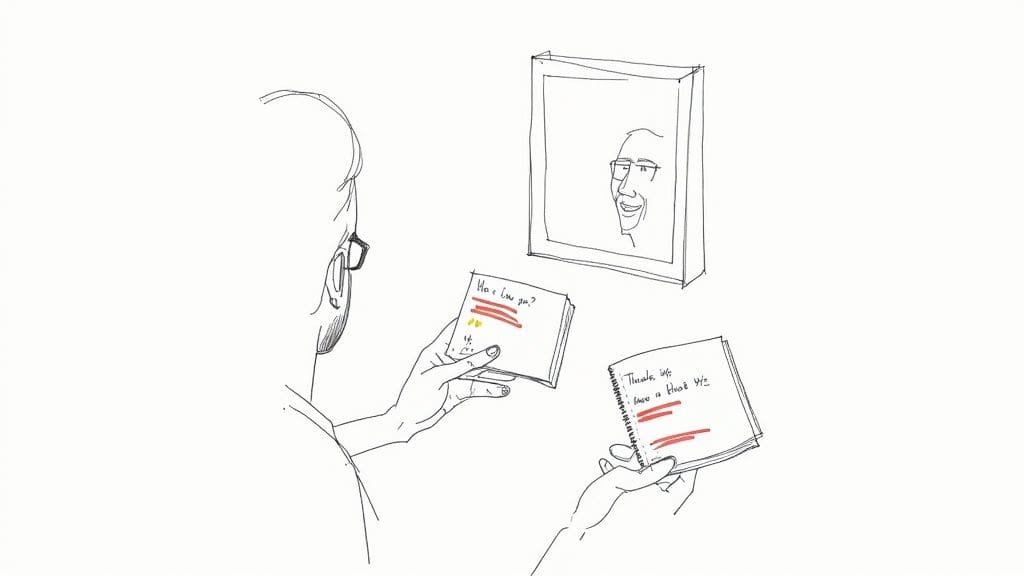
This process isn't about becoming robotic or inauthentic. It's about reducing the cognitive load in the moment so your real personality can shine through. You're simply creating a menu of options to pull from when you feel stuck.
Identify Your Trigger Situations
Before you can write a script, you need to know which stage you're preparing for. Start by identifying the specific, recurring situations that reliably cause you stress.
Think about your daily and weekly routines. Does your anxiety spike when you:
* Have to make small talk with coworkers in the breakroom?
* Need to ask a store employee for help finding something?
* Must make a phone call to schedule an appointment?
* Join a video call and have to greet everyone?
Jot down three to five of these scenarios. Being specific is key. "Talking to people" is way too broad, but "starting a conversation with a new person at a party" is a perfect, concrete starting point.
Crafting Your Flexible Social Scripts
Once you've zeroed in on a trigger situation, you can build a simple, flexible script. A good script isn't a long monologue. It's a collection of short, easy-to-remember phrases covering the essential parts of an interaction.
A strong script framework includes three core parts:
1. An Opener: A simple line to kick things off.
2. A Follow-Up Question: Something to keep the conversation moving.
3. An Exit Line: A polite way to end the interaction when you're ready.
Let's apply this to a common workplace scenario: making small talk at the coffee machine.
| Script Component | Example Phrases |
|---|---|
| Opener | "Morning! That coffee smells amazing." or "Looking forward to the weekend?" |
| Follow-Up Question | "Working on anything interesting today?" or "Got any fun plans?" |
| Exit Line | "Well, I should get back to my desk. Good talking with you!" or "Enjoy your coffee!" |
This structure provides a predictable flow, which is a core strategy for feeling more in control. It gives you a beginning, a middle, and a clear end, removing the fear of getting trapped in a conversation you don't know how to leave. For more ideas on structuring your words, our guide on how to speak to people offers additional useful frameworks.
The Power of Rehearsal
Writing the script is only half the battle. Rehearsal is what builds the muscle memory. The goal is to make your lines feel natural and automatic, so you don't have to scramble for them under pressure.
Start by practicing alone. Say the lines out loud in front of a mirror. Pay attention to your tone and body language. Does it sound like you? If not, tweak the wording until it feels authentic.
> Rehearsal isn't about achieving perfection. It's about building familiarity. Each time you practice, you create a stronger neural pathway, making it easier to access the words when you need them most. This reduces in-the-moment panic and frees up mental energy to actually listen and respond.
Once you're comfortable practicing solo, try rehearsing with a trusted friend or family member. This adds a layer of realism and helps you get used to saying the words to another person in a low-stakes environment. You can ask for feedback, but the main benefit is simply getting the reps in. This step is crucial for anyone serious about learning how to reduce social anxiety for the long term.
Beyond specific scripts, generally improving your communication abilities can significantly boost your confidence. Consider exploring resources on executive communication skills training to enhance your clarity and presence in any interaction. Building these foundational skills provides a strong base that makes every social situation feel less daunting.
In-the-Moment Skills to Calm Your Nervous System
Even with the best game plan, anxiety can still show up uninvited and leave you feeling completely overwhelmed. That's why knowing how to manage anxiety in the moment is such a critical skill—it puts the controls back in your hands.
Want practical ways to reduce social anxiety? tonen can help.
tonen gives you 188+ conversation scripts, tone guidance and calming tools — designed for autistic adults, ADHD and social anxiety. Try it free for 7 days.
Download on the App StoreiOS only. Android coming soon.
When your heart starts hammering or your thoughts begin to spiral, having a few discreet, practical techniques to calm your nervous system can change everything. These aren't about pretending the anxiety isn't there; they're about managing the physical tidal wave so you can stay present and engaged.
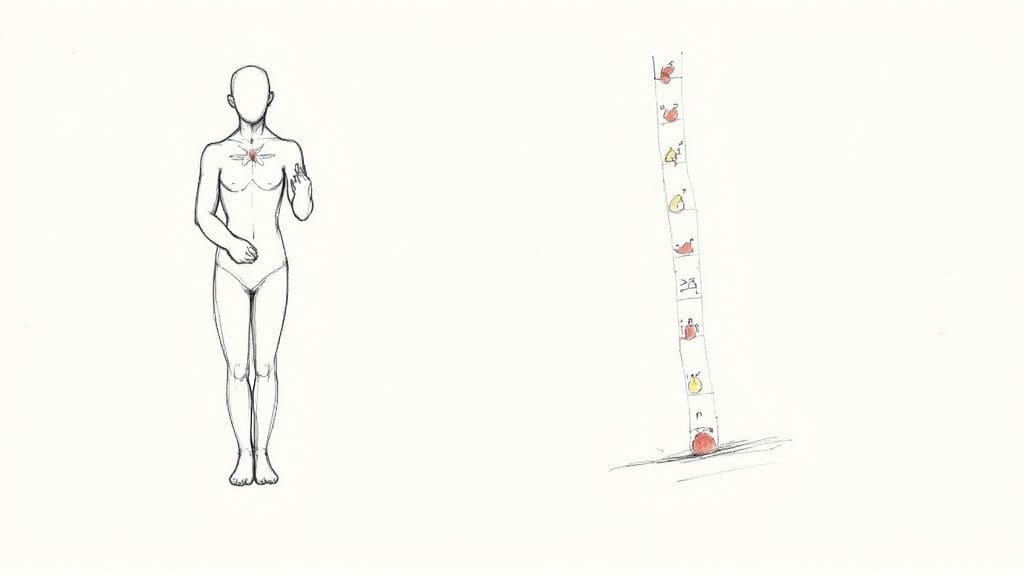
The trick is to pull your focus away from the internal storm of anxious thoughts and onto something tangible and sensory. This simple act can interrupt the panic cycle and send a powerful signal to your body that you're actually safe.
Use Grounding to Reconnect with the Present
When anxiety hits hard, it can feel like you're untethered from reality. Grounding techniques are powerful tools that anchor you right back to the present moment using your five senses. One of the most effective and subtle methods is the 5-4-3-2-1 technique.
You can do this anywhere, and no one will have a clue.
* 5 Things You Can See: Silently name five objects around you. Notice their color, shape, and texture. (e.g., the blue pen on the table, the wood grain of the desk, a light fixture on the ceiling).
* 4 Things You Can Feel: Tune into four physical sensations. It could be the solid feeling of your feet on the floor, the texture of your shirt against your skin, or the cool surface of a glass.
* 3 Things You Can Hear: Listen for three distinct sounds. Maybe it's the quiet hum of a computer, distant chatter from another room, or your own breathing.
* 2 Things You Can Smell: Try to identify two scents in the air. This might be coffee brewing, the soap from the restroom, or just the neutral smell of the room itself.
* 1 Thing You Can Taste: Focus on one thing you can taste. You could take a sip of water or simply notice the current taste in your mouth.
This exercise forces your brain to switch from abstract worry to concrete sensory input, effectively short-circuiting an anxiety spiral. If you're looking for more ways to stay centered, you can find a variety of grounding techniques for anxiety that are easy to practice anytime.
Master Your Breath to Regulate Your Body
Your breath is directly wired to your nervous system. Short, shallow breathing screams panic to your brain, while slow, deep breathing signals calm. Box breathing is a simple yet incredibly powerful technique to activate your body's natural relaxation response.
Just imagine drawing a box with your breath:
1. Breathe in slowly through your nose for a count of four.
2. Hold your breath for a count of four.
3. Exhale slowly through your mouth for a count of four.
4. Hold your breath for a count of four.
Repeat this cycle three to five times. This rhythmic, predictable pattern helps regulate your heart rate and tells your brain it's okay to relax.
> When you intentionally slow your breathing, you're sending a direct message to your parasympathetic nervous system—the body's "rest and digest" system. This counteracts the fight-or-flight response that social anxiety triggers, providing immediate physical relief.
Make Small Physical Adjustments
Your posture and vocal tone don't just send messages to others; they send them straight back to your own brain. Making small, intentional adjustments can have a surprising impact on how you feel internally, helping you feel more grounded and confident.
Try these subtle shifts:
* Posture: Gently pull your shoulders back and lift your chin slightly. Adopting a more open posture can actually trick your brain into feeling more self-assured.
* Vocal Tone: When anxiety creeps in, your voice might get higher-pitched or shaky. Try speaking from your diaphragm, aiming for a slightly lower, steadier tone. It can create a feeling of stability from the inside out.
These physical tweaks create a positive feedback loop, helping you manage the physical side of anxiety. Mindfulness and self-help strategies like these offer a potent, accessible way to manage social anxiety, with some research indicating they can reduce symptoms by 30-50%.
Studies show that regular practice can even rewire the brain to reduce rumination and fear of being judged. In fact, fMRI scans have revealed significantly decreased activity in the amygdala—the brain's fear center—after consistent practice. You can discover more insights about these findings from the Mental Health America organization. Learning these skills is about having a full toolkit, and these in-the-moment strategies are absolutely indispensable.
Design Your Own Graded Exposure Plan
If you've ever dodged a social event, you know the short-term relief that comes with avoidance. But in the long run, that's the very thing that keeps social anxiety in charge. Graded exposure is a powerful, evidence-based way to gently and systematically face those fears, starting small and building real confidence with every step.
It's one of the most effective long-term strategies for feeling less anxious socially because it literally retrains your brain's fear response. You're not just toughing it out; you're creating new neural pathways.
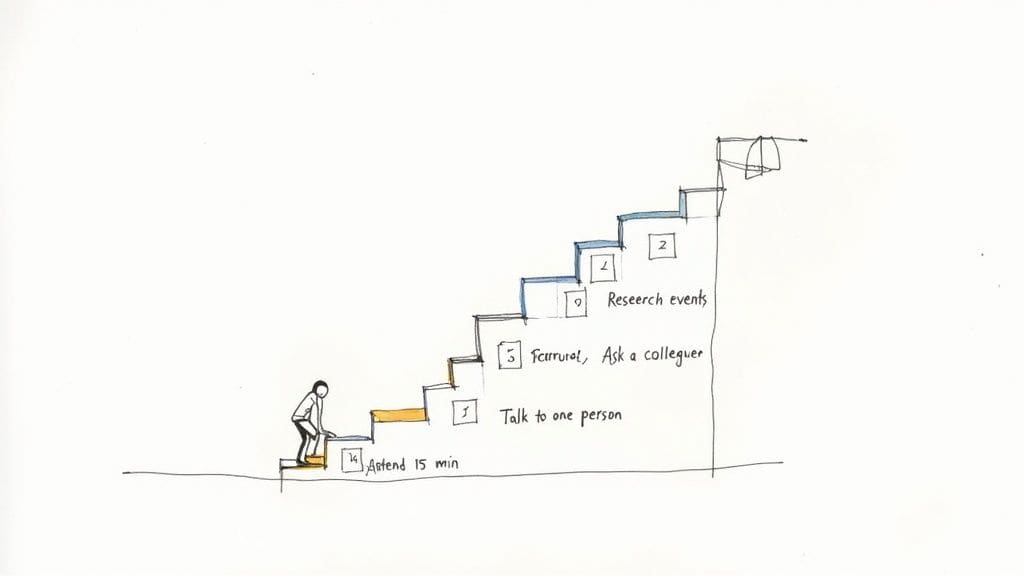
The whole process revolves around creating a personalized "fear ladder." Instead of trying to leap from the ground to the top floor, you'll build a staircase, breaking down a big fear into tiny, manageable steps. This prevents that awful feeling of overwhelm and proves to you, with each small win, that you can handle more than you thought.
Brainstorm and Rank Your Social Fears
First things first, pick a specific, meaningful social goal you've been putting off. Maybe it's finally going to that industry networking event, joining a book club, or even just feeling less terrified on a first date.
The skills you build here are surprisingly versatile. You can adapt them to just about any scenario, including figuring out how to navigate dating with social anxiety more confidently.
Once your goal is set, just let yourself brainstorm all the tiny actions related to it. Don't filter or judge anything yet; just get it all down on paper.
Next, you'll turn that list into your fear ladder by ranking each item. Use a simple scale from 1 (not scary at all) to 10 (completely intimidating). The goal is to create a gentle, gradual slope—not a sheer cliff you're expected to scale.
Build Your Fear Ladder
Let's make this concrete. Imagine your ultimate goal is to attend a professional networking event and have one brief conversation. That might feel like a 10 right now, but we can break it down.
Here's a sample fear ladder to show how you can deconstruct that big goal into a series of achievable wins.
#### Sample Graded Exposure Fear Ladder for Networking
| Step Number | Fear Rating (1-10) | Actionable Step |
|---|---|---|
| 1 | 2 | Research local networking events online for 15 minutes. |
| 2 | 3 | Ask a trusted colleague about their experience at a networking event. |
| 3 | 4 | Drive to the venue of an event a day before to see where it is. |
| 4 | 5 | Register online for a low-key, free event. |
| 5 | 6 | Go to the event and stay for just 15 minutes without any pressure to talk. |
| 6 | 7 | Attend an event and make eye contact and smile at three different people. |
| 7 | 8 | Attend an event and ask one person a simple question (e.g., "Is this seat taken?"). |
| 8 | 9 | Attend an event and have a brief, scripted conversation with one person. |
See how that works? The final step feels so much less daunting when you see the clear, logical path leading up to it. Each rung you climb is a small victory that builds momentum.
Put Your Plan into Action
With your ladder built, it's time to start climbing. The two most important things to bring with you are consistency and self-compassion.
* Start at the Bottom: Seriously, begin with the lowest-rated item on your ladder. Don't skip ahead, no matter how tempting it seems. The point is to build a solid foundation of confidence.
* Stay Until the Anxiety Drops: When you're doing a step, try to stay in the situation until that initial spike of anxiety starts to naturally come down on its own. This is how you teach your brain that the feeling is temporary and survivable.
* Repeat and Master: Don't move to the next rung until you can complete the current one with only mild anxiety. It's perfectly okay to repeat a step three, four, or five times. That's not failure; that's practice.
> This process isn't about getting rid of fear completely. It's about learning to tolerate the discomfort and act anyway. Each time you complete a step, you're giving your brain new evidence that contradicts its anxious predictions—a core part of managing anxiety.
And please, remember to celebrate your progress. Every single rung you climb is a huge achievement. This slow, steady exposure is what actually rewires your brain, making social situations feel less threatening over time and opening up parts of your life that anxiety had walled off.
Rewire Anxious Thoughts with Cognitive Reframing
Social anxiety isn't just a vague feeling of dread; it's actively fueled by an inner monologue that's often working against you. It's the voice that assumes everyone is judging you the moment you walk into a room. The only way to really learn how to manage these feelings for the long haul is to get in there and directly challenge those automatic thought patterns.
This is where cognitive reframing comes in. Think of it as a practical skill you can learn—a way to identify, question, and ultimately change the unhelpful beliefs that keep anxiety on a loop. By spotting the common mental shortcuts your brain takes, you start to weaken their power and build a more accurate, balanced internal narrative.
Become a Thought Detective
Your first move is to simply start noticing your anxious thoughts without judging them. Think of yourself as a detective gathering clues. When you feel that familiar spike of social anxiety, just pause and ask yourself: "What story am I telling myself right now?"
You're on the lookout for common cognitive distortions—basically, flawed patterns of thinking that feel true but aren't based in reality. For neurodivergent folks dealing with social anxiety, two of the biggest culprits are:
Mind-Reading: This is when you assume you know what other people are thinking, and you're convinced it's negative. For example: "Everyone at this party thinks I'm awkward and boring."*
Catastrophizing: This is where your brain jumps to the absolute worst-case scenario. For instance: "If I stumble over my words during this presentation, my career is over."*
Just identifying the thought and slapping a label on it can create some much-needed distance. It's a powerful reminder that a thought is just a thought—not a fact.
Put Your Anxious Thoughts on Trial
Once you've caught a negative thought, it's time to put it on the stand. I'm a big fan of what's called the "courtroom technique." You act as the judge, your anxious thought is the defendant, and your job is to examine the evidence from a neutral perspective.
Ask yourself these questions to build your case:
* What is the cold, hard evidence that supports this thought? (And be honest—are we talking about actual facts or just strong feelings?)
* What is the evidence that contradicts this thought? (Think about past times the thing you feared didn't actually happen.)
* What is a more balanced or realistic way to look at this situation?
* What would I tell a friend if they came to me with this exact same thought?
Let's say your thought is, "No one wants to talk to me." The evidence against it might be, "Well, someone did smile at me when I walked in, and my friend invited me to this event in the first place." Systematically questioning your thoughts like this is one of the most effective ways to feel more in control.
> This isn't about forced positivity or trying to convince yourself "everything is fine!" when it doesn't feel that way. The real goal of cognitive reframing is to shift from a distorted, negative viewpoint to one that is simply more realistic and balanced. This process lowers the emotional volume and gives you back a sense of control.
This is especially critical because these anxious thought patterns often start early and become deeply ingrained habits. In fact, over 75% of social anxiety cases spark in childhood or the early teens, with the median onset age being just 13. An early start can solidify these negative beliefs, and untreated social anxiety actually doubles the risk of developing depression later on. The Mental Health America organization has some great resources on why addressing these cognitive habits is so important. Consistently challenging your thoughts is a crucial skill for managing this long-term.
Knowing When to Seek Professional Support
While the self-help strategies we've covered are incredibly powerful, there are times when they just aren't enough. Learning to spot the difference and knowing when to call in professional support is a huge act of self-care. It's not a sign of failure; it's a sign of strength.
So, when is it time? If you feel like social anxiety is consistently boxing you in—stopping you from going after a job, building the relationships you want, or even just feeling comfortable leaving the house—that's a major sign.
Constant, intense distress that gets in the way of your day-to-day life is your cue. You absolutely don't have to push through that on your own.
Finding the Right Therapeutic Approach
When it comes to therapy for social anxiety, one approach stands head and shoulders above the rest in terms of research and results: Cognitive Behavioral Therapy (CBT).
CBT is all about getting practical. It focuses on identifying and changing the specific thought patterns and behaviors that are fueling the anxiety. A good therapist acts as a guide, helping you work through things like graded exposure and cognitive reframing in a structured, supportive way that doesn't feel overwhelming. We break this down in more detail in our guide on how Cognitive Behavioral Therapy helps with social anxiety.
When you're looking for a therapist, a key phrase to search for is "neurodiversity-affirming." This is a big deal. It means you'll be working with someone who gets that your brain operates differently and will help you build strategies that work with your neurotype, not against it.
The Role of Medication in Treatment
For some people, therapy is the whole solution. For many others, medication can be an absolute game-changer. It can help turn down the volume on the physical symptoms of anxiety, making it much easier to actually engage with and benefit from the therapeutic work you're doing.
> The gold-standard treatment for social anxiety is actually a combination of CBT and medication. The National Institute of Mental Health (NIMH) reports a 70-80% improvement rate for this combined approach, which is significantly higher than using either one on its own.
Medications like SSRIs can reduce social anxiety symptoms by 50% in many people within 12 weeks. When you pair that with the skills you learn in therapy, you're creating a powerful path forward. If you're serious about figuring out how to reduce social anxiety, this combination is worth exploring. You can read more about these global anxiety disorder treatment findings.
Taking that step to get professional help is a massive investment in your own well-being. It's one of the best things you can do for yourself.
Got Questions About Social Anxiety? Let's Clear Things Up.
When you start digging into how to manage social anxiety, a lot of questions pop up. It's totally normal. Knowing what to expect, what's "normal," and which tools can genuinely help is a huge part of feeling like you're in the driver's seat.
Let's tackle some of the most common ones I hear.
One of the first things people worry about are the physical symptoms. That feeling of your heart hammering in your chest can be terrifying. A lot of people ask if anxiety can cause heart palpitations or other intense reactions. Just knowing that this is a common, physical response to anxiety—and not something more dangerous—can take a huge weight off your shoulders.
How Long Does It Take to See Results?
This varies for everyone, but with consistent effort using strategies like graded exposure and cognitive reframing, most people start to notice small wins within a few weeks. Big, lasting changes? That usually takes a few months of steady practice.
For more structured approaches like Cognitive Behavioral Therapy (CBT), studies have shown a noticeable drop in symptoms in as little as 12-16 weeks. The real secret is consistency, not intensity. Little bits of practice, done often, add up.
Can I Overcome Social Anxiety Completely?
The goal here is management, not total elimination. Let's be real—almost everyone gets a bit nervous in some social situations. The aim is to get your anxiety down to a level where it's no longer calling the shots or stopping you from living the life you want.
You'll learn to spot the anxious feelings, pull out your coping tools, and step into social situations even with a bit of discomfort. Over time, that discomfort gets a lot quieter.
> A core part of learning how to manage your anxiety is accepting that the objective is progress, not perfection. Success means anxiety no longer holds the veto power over your life choices.
Are Tools Like Scripting Apps Actually Effective?
For many people, yes—especially if you're someone who thrives with a bit of structure and preparation. Tools that let you script and rehearse conversations are incredibly helpful because they take the planning process out of your head. This lowers your cognitive load and gives you a private, judgment-free space to practice.
They make the fundamental principles of CBT—like preparation and gradual exposure—way more accessible and easier to weave into your daily life. That's a massive step forward in feeling more confident for good.
*
Ready to put these strategies into action with a tool built for you? tonen is a mobile app designed to help you prepare for conversations, manage overwhelm, and communicate with more confidence. With a library of ready-to-use scripts, a Perspective Helper, and a Calm Kit, it's like having a social anxiety toolkit in your pocket. Start your free trial and feel more prepared for your next conversation. Explore how tonen can help you today.
Frequently asked questions
This guide covers how to reduce social anxiety: practical ways to feel more confident with practical, neurodivergent-friendly strategies—clear steps, scripts where useful, and ways to reduce anxiety or overload rather than vague "be confident" advice.