Reframing negative thoughts works best as a 3-part process: identify the automatic thought, test it gently against evidence, and replace it with a more accurate, balanced thought. It isn't about pretending everything is fine. It's about getting more precise when your brain is making a fast, emotionally loaded interpretation.
If you're reading this while stuck in a spiral, start smaller than "change your mindset." Write the exact thought down. Pause. Then ask, "What do I know right now?" That's the core of how to reframe negative thoughts, and it's useful precisely because it lowers the pressure to be upbeat, eloquent, or profoundly insightful on demand. For autistic people, people with ADHD, and anyone who loses verbal processing under stress, that matters.
The Skill of Changing Your Mind
Negative thoughts often arrive as if they are reports, not reactions. "They hate me." "I ruined it." "I'm going to mess this up." When the thought lands hard enough, your body treats it like settled truth.
That's why reframing is a skill, not a personality trait. You don't need to be naturally optimistic. You need a repeatable way to catch a thought before it becomes your whole reality.
What reframing actually is
A technically sound CBT-style approach uses 3 moves: identify the automatic negative thought, test it against evidence, and generate a more accurate replacement thought. Major health guidance also recommends stress-testing the thought with structured questions such as how likely the feared outcome is, whether there is good evidence for it, whether there are alternative explanations, and what you'd tell a friend in the same situation, as described in this CBT reframing video overview.
The important part is what reframing is not. It is not "just think positive." It is not "everything happens for a reason." It is not forcing a cheerful sentence onto a distressed nervous system.
> Practical rule: A good reframe should feel more believable, not more impressive.
If your original thought is "I'm terrible at my job," a useful reframe usually isn't "I'm amazing at everything." It's closer to, "I'm stressed, and I made one mistake. I need to check what happened before I draw conclusions."
Why this helps
Many people want to know how to reframe negative thoughts because they're exhausted by their own inner commentary, not because they want to become unrealistically positive. Reframing helps when your brain has collapsed a whole situation into one harsh meaning.
Common distortions can make feelings feel factual. If you feel ashamed, you may conclude you've failed. If you feel anxious, you may conclude danger is certain. Learning to separate feeling from evidence gives you room to respond, instead of only react.
Spotting Common Thought Traps
Before you can shift a thought, you need to notice the pattern it's following. Most automatic negative thoughts are fast, familiar, and repetitive. They sound personal, but they're often built from a handful of common distortions.
For neurodivergent people, these traps can have extra force. A delayed text can turn into certainty about rejection. A short email can feel like proof that you've broken an unspoken rule. Social ambiguity leaves space for your brain to fill in the worst possible story.
A field guide for common patterns
Here's a simple reference point you can scan when a thought feels intense but slippery.
| Thought Trap | What It Means | What It Sounds Like |
|---|---|---|
| Catastrophizing | Jumping from a problem to the worst possible outcome | "I got that one detail wrong. This is going to become a disaster." |
| Overgeneralizing | Treating one event as a permanent pattern | "That conversation went badly. I always mess things up." |
| Filtering for negatives | Noticing only what went wrong and ignoring anything neutral or good | "They thanked me, but they paused first, so they must have meant it sarcastically." |
| Black-and-white thinking | Seeing only total success or total failure | "If I'm not calm and articulate, I shouldn't say anything at all." |
| Mind-reading | Assuming you know what someone else thinks without checking | "They were quiet, so they definitely think I'm annoying." |
| Emotional reasoning | Treating a feeling as proof | "I feel ashamed, so I must have done something awful." |
What to look for in real life
These thoughts usually have tells. They often include words like always, never, everyone, no one, or definitely. They also tend to flatten uncertainty into certainty.
> When a thought sounds absolute during a messy human situation, slow down. Absolute thoughts often arrive before accurate ones.
A useful way to practice awareness is to catch the thought in its original wording, not a cleaned-up summary. "I'm worried they're upset" is different from "They think I'm incompetent." The second thought is more specific, and that makes it easier to examine.
If overthinking is part of the problem, this short read on how to tell if you're overthinking a situation can help you spot when your brain has moved from observation into interpretation.
Don't pathologize every negative thought
Not every negative thought is distorted. Some are incomplete. Some are guesses. Some are warnings. At this stage, the goal isn't to argue with yourself. It's to identify the shape of the thought accurately enough that you can work with it.
That awareness is the first real point of influence.
A Practical Method to Reframe Thoughts
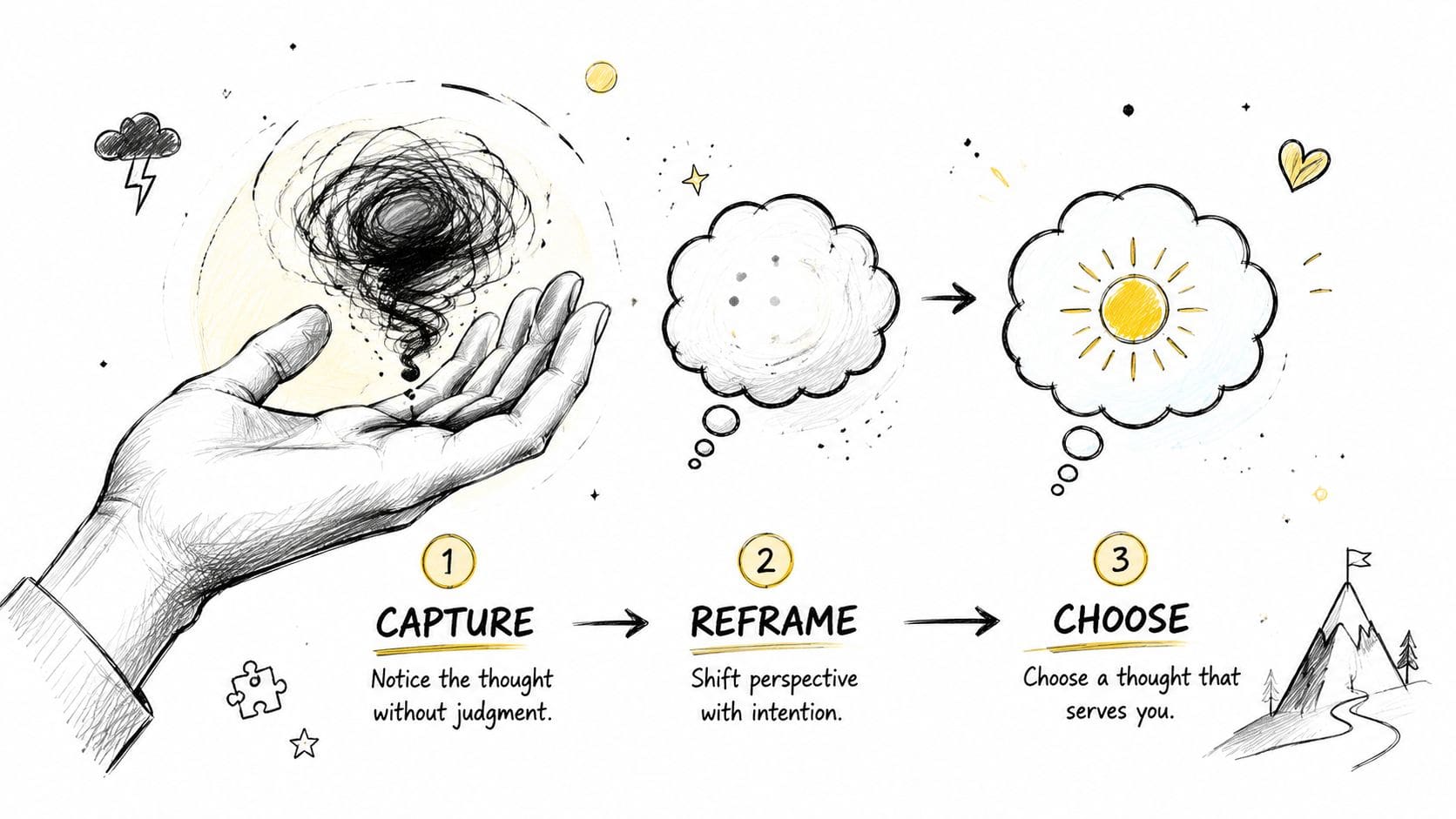
The most reliable method I've seen is also the least glamorous. Capture, examine, replace. Evidence-based guides describe a repeatable micro-protocol: capture the trigger, write the exact thought down, pause to reduce emotional escalation, examine supporting versus contradicting evidence, then replace the thought with a more accurate reframe. That stepwise sequence is outlined in this evidence-based reframing guide from St. Bonaventure University.
Capture the exact thought
Don't write a polished version. Write what flashed through your mind.
Stuck in a negative thought spiral? tonen can help.
tonen gives you 188+ conversation scripts, tone guidance and calming tools — designed for autistic adults, ADHD and social anxiety. Try it free for 7 days.
Download on the App StoreiOS only. Android coming soon.
Examples:
- After a vague Slack message: "I'm in trouble."
- After forgetting something: "I can't handle basic things."
- After a quiet social interaction: "They regret inviting me."
Reframing a blur is impossible. You need the sentence your nervous system is reacting to.
If writing feels difficult, use a note app and keep it short:
1. Trigger
"Boss said, 'Can we talk later?'"
2. Thought
"I must have done something wrong."
3. Feeling
"Panicky. Ashamed."
Examine without becoming a lawyer against yourself
This part often gets taught badly. People hear "challenge the thought" and start cross-examining themselves aggressively. That usually backfires.
Use gentler questions:
- What evidence supports this thought?
- What evidence doesn't support it?
- What else could explain this?
- How likely is the feared outcome, based on what I know?
- What would I say to a friend in the same situation?
You are not trying to "win" against the thought. You are trying to get closer to reality.
> "More accurate" is the target. Not "more positive."
If self-criticism is the main pattern, this guide to stop negative self-talk is a useful companion because it focuses on interrupting the inner critic without turning everything into fake reassurance.
For people whose spirals are strongly social, this explainer on CBT for social anxiety can help connect thought patterns to everyday interactions.
Replace with a balanced thought
A replacement thought should pass one simple test: can you believe it enough to use it?
Try this format:
- Original thought: "I embarrassed myself. They all noticed."
- Balanced reframe: "I feel embarrassed, but I don't know what others noticed. One awkward moment doesn't define the whole interaction."
- Original thought: "I'm failing."
- Balanced reframe: "I'm overloaded, and my capacity is lower right now. That's different from failing."
- Original thought: "This proves I can't do this."
- Balanced reframe: "This shows I need more support, a clearer system, or a different pace."
Sometimes the best reframe also includes an action:
- "I don't have enough information yet, so I'll ask a clarifying question."
- "I'm activated right now, so I'll wait before replying."
- "I made a mistake, and I can fix the next step."
That's the practical heart of how to reframe negative thoughts. Not a motivational speech. A cleaner sentence, followed by a workable move.
What to Do When You Are Too Overwhelmed to Think
Sometimes the problem isn't that you don't know the reframing steps. The problem is that your brain has gone offline. You're flooded, overstimulated, panicking, or locked into an ADHD shame spiral. In that state, "examine the evidence" can feel impossible.
Standard advice often falls short. Most reframing guidance assumes a purely cognitive process, but that can break down when emotional intensity is high or working memory drops under stress. For autistic adults and people with ADHD, overwhelm can make traditional CBT-style disputing inaccessible in the moment. As a result, just-in-time support, such as scripts or sensory grounding, can be a faster, lower-effort interruption, as discussed by tonen's approach to in-the-moment support.

Regulate first, reframe second
If your heart is racing or your head feels crowded, lower the intensity before you try to reason with the thought.
Try:
- Sensory grounding: Name things you can see, feel, hear, smell, or taste. The point isn't elegance. The point is contact with the present.
- Body-based interruption: Press your feet into the floor, hold a cold drink, wrap yourself in a weighted blanket, or step into a quieter room.
- A script instead of analysis: "I'm overwhelmed. I need ten minutes before I respond." That is often more useful than trying to generate insight while flooded.
Use low-load reframes
When thinking is hard, keep reframes short and plain:
- "This is a stress reaction, not the full story."
- "I don't need to solve this right now."
- "Confused isn't the same as unsafe."
- "I can pause before I decide what this means."
> If you can't access a balanced thought yet, borrow a stabilizing one.
That might sound small, but it often creates enough space to stop the spiral from gaining speed. If overwhelm is frequent, this resource on what to do when feeling overwhelmed can help you build a sequence you can use under pressure.
When a Negative Thought Is a Signal Not a Distortion
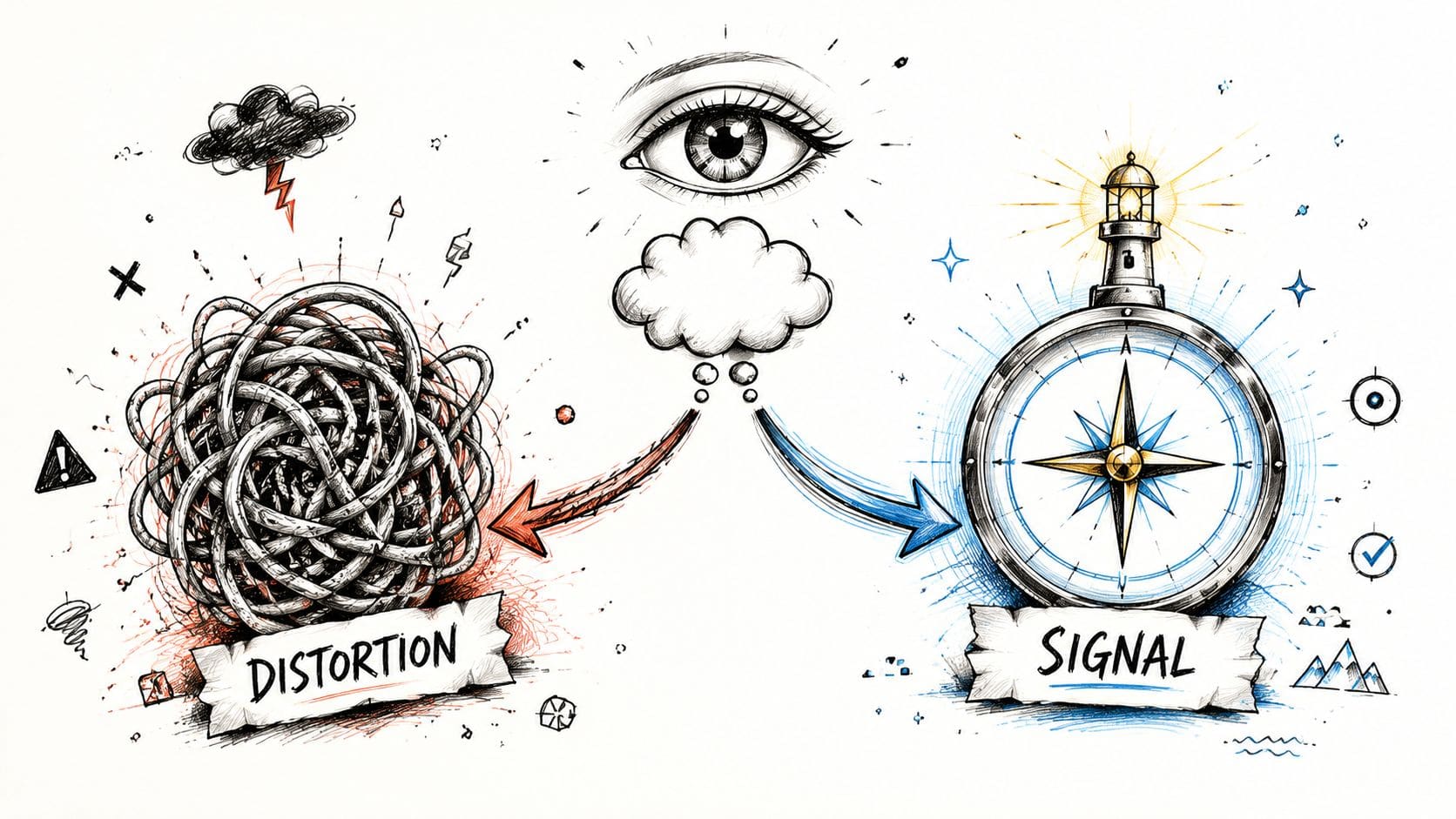
One of the biggest mistakes in mental health advice is treating every painful thought as if it needs reframing. Sometimes a negative thought is distorted. Sometimes it is an alert.
If you're dealing with workplace conflict, exclusion, chronic stress, discrimination, or an unstable relationship, an upbeat reframe can become self-erasure. There is a critical difference between healthy reframing and invalidating positive thinking. Overly upbeat reframes can backfire and increase shame, especially when someone needs action rather than reassurance.
Use the reframe, verify, or respond test
When a thought feels bad, ask which category fits best.
#### Reframe
Use this when the thought is clearly shaped by fear, mind-reading, or all-or-nothing thinking.
Example: "They took longer to reply, so they must be angry with me."
#### Verify
Use this when the thought might be true, but you don't have enough information.
Example: "My manager seems frustrated with me."
A next step could be checking facts, asking a clarifying question, or reviewing what was said.
#### Respond
Use this when the thought points to a real issue.
Example: "My boundaries keep getting ignored."
That may call for boundary-setting, asking for support, documenting a pattern, or leaving the situation.
> You are not gaslighting yourself when you validate a real problem. You are using your thoughts as data.
This distinction matters a lot for neurodivergent people who may already have a history of being told they're overreacting or misreading things. If you're running on empty, signs of burnout can make every situation harder to interpret. This piece on symptoms of emotional exhaustion may help you separate depletion from danger.
Building Your Reframing Habit
Reframing gets easier through repetition, especially when the routine is small enough to use on low-capacity days. For many neurodivergent people, that matters more than having insight. A method you can still do while tired, overstimulated, or scattered will help more than a perfect system you avoid.
Keep the practice light and predictable. The goal is recognition speed. Over time, your brain starts catching the thought earlier and treating it as something to examine, not something to obey.
Keep the practice small
Try one of these:
- Two-minute check-in: End the day with one stressful moment, the thought you had, and one more balanced alternative. If you want structure, this [mood check-in routine](https://usetonen.com/blog/mood-check-in) keeps the prompt simple.
- A saved note: Keep a short list of reframes that work for your usual spirals, especially scripts you can borrow when words disappear.
- A compassion cue: Add one line that lowers shame, such as "I'm having a hard moment" or "This is a stress response, not proof."
What helps here is consistency, not intensity. Brief, repeated practice tends to work better than long reflection sessions that ask too much from an already overloaded brain. Pairing reframing with self-compassion also reduces the common swing into fake positivity or self-criticism.
Know when to get support
Some thoughts need more than a worksheet or a saved script. If your inner voice is relentlessly harsh, if your thoughts are disrupting sleep or daily functioning, or if every reframe turns into an argument with yourself, outside support can make the process easier and safer.
A good therapist does more than challenge distorted thinking. They can help you sort out whether a thought is fear, pattern recognition, trauma learning, or a real signal that needs action. That distinction matters a lot if you have ADHD or autism and traditional advice has left you feeling like you were supposed to out-think overload.
For a broader day-to-day support framework, this holistic mental wellbeing guide is a helpful complement to thought work because it looks beyond cognition alone.
Learning how to reframe negative thoughts will not stop them from showing up. It gives you a steadier way to meet them, with less shame and less effort.
If you want help in the moment, especially when your brain is overloaded and words are hard to find, tonen offers concise scripts, gentle reframes, and grounding tools designed for neurodivergent people. It's built to lower cognitive load when you need support fast, not after you've already burned out.