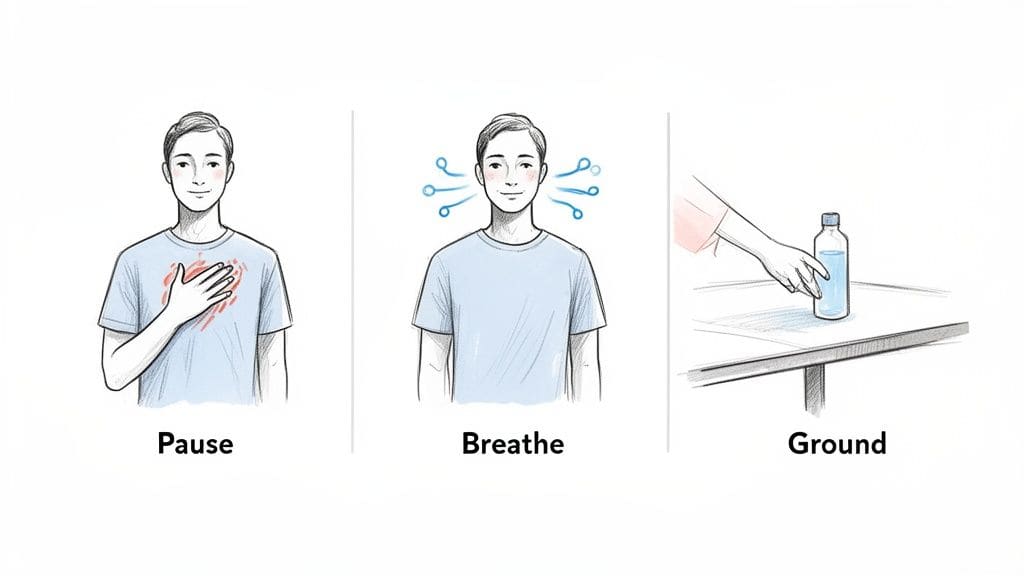
When you're trying to figure out what to do when feeling overwhelmed, the most effective first step is to stop everything. In that moment when your thoughts are racing, the immediate goal isn't to solve the problem causing the stress, but to create enough mental space to breathe. To do this, pause, focus on your breathing (like a simple box breathing exercise), and use a grounding technique, such as focusing on a physical sensation like a cold water bottle in your hand.
This approach interrupts the stress response before it spirals. It's not about fixing what's wrong; it's about regulating your body and mind so you can eventually think clearly enough to tackle the actual problem. Learning these immediate coping strategies is a critical first-aid response for your nervous system.
Your First Move When Overwhelm Hits
We've all been there. That sudden wave of panic where the to-do list feels endless, the social demands are too much, or the sensory input is just… unbearable. Learning effective strategies to calm down fast isn't just a nice skill to have; it's a critical first-aid response for your nervous system.
The key is to interrupt the stress response before it spirals out of control. This isn't about fixing whatever is overwhelming you. It's about regulating your body and mind so you can eventually think clearly enough to tackle the actual problem.
Why Pausing Is So Powerful
That deliberate pause is your secret weapon. It breaks the feedback loop of anxious thoughts that fuel the overwhelm. For just a second, you stop feeding the chaos.
This brief disengagement gives the logical part of your brain (the prefrontal cortex) a fighting chance to catch up with your brain's alarm system (the amygdala), which is likely screaming that everything is an emergency.
This feeling is far from an isolated incident. Over a billion people globally are living with mental health conditions. For many neurodivergent people, this feeling can be a constant companion, especially in social situations that others might find trivial. The numbers are a stark reminder that we all need better tools for these moments.
> Your immediate goal isn't to fix everything. It's to create just enough inner calm to figure out the very next manageable step.
Simple Steps for an Immediate Reset
When you feel that wave of overwhelm rising—whether you're at your desk or in a crowded store—you need a strategy that's quick, discreet, and effective. Here's a simple process you can use absolutely anywhere.
- Pause & Name It: Stop what you're doing. Silently say to yourself, "Okay, I am feeling overwhelmed." Just acknowledging the feeling without judgment can immediately reduce its power.
- Box Breathing: Inhale slowly through your nose for a count of four. Hold your breath for four. Exhale slowly through your mouth for a count of six. The slightly longer exhale is key—it helps activate the part of your nervous system that tells your body to calm down. Repeat this 3-5 times.
- Ground Yourself: Bring your attention to a single physical sensation. Grip a cold water bottle and notice the condensation. Press your feet firmly into the floor and feel the solid ground beneath you. Pinch the fabric of your jeans between your thumb and forefinger. This anchors you to the present moment and pulls you out of the storm in your head.
For many of us, especially neurodivergent folks, trying to remember these steps in the middle of a stressful moment is a huge challenge. This is where a tool like the tonen Calm Kit can be a lifesaver, providing guided exercises right on your phone when you need them most.
For more strategies tailored to professional settings, explore our guide on how to cope with feeling overwhelmed at work.
Here is a quick-reference table to help you remember these actions in the moment.
Immediate Overwhelm Response
| Action | Why It Works | Example |
|---|---|---|
| Pause & Name It | Acknowledging the emotion reduces its intensity by engaging the logical brain. | Silently thinking, "I'm overwhelmed right now, and that's okay." |
| Box Breathing | A longer exhale activates the parasympathetic nervous system, calming your body's stress response. | Inhale for 4, hold for 4, exhale for 6. Repeat 3 times. |
| Grounding | Focusing on a physical sensation anchors you in the present, interrupting anxious thought loops. | Firmly gripping your phone or feeling the texture of your desk. |
Having this simple, three-part plan ready to go can make the difference between a full-blown shutdown and a moment of manageable stress.
Grounding Techniques That Actually Work
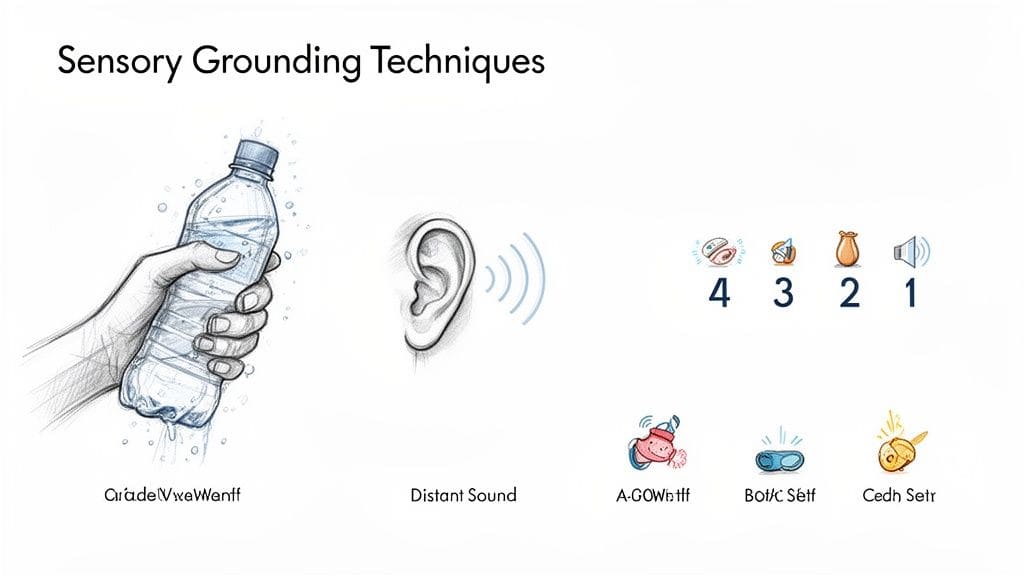
When your thoughts are spiraling, grounding techniques are the emergency brake. They yank you out of the internal chaos of emotions and plant you firmly back in the present moment. They work by forcing your attention away from the storm in your head and onto the physical world around you—a powerful circuit breaker for a frantic nervous system.
Instead of just telling yourself to "calm down" (which almost never works), grounding gives your brain a specific, tangible task. This is a game-changer for neurodivergent folks because it bypasses the need for complex emotional processing and focuses on concrete, sensory input. Think of it as switching the channel in your brain from a chaotic news feed to a quiet nature documentary.
Engage Your Senses with the 5-4-3-2-1 Method
One of the most reliable grounding exercises out there is the 5-4-3-2-1 method. It's discreet, requires zero equipment, and you can do it anywhere—from a tense meeting to a loud café. The whole point is to methodically engage each of your senses to root you in your current environment.
Here's the breakdown:
- 5 Things You Can See: Look around and silently name five objects. Don't just list them; notice the details—the crack in the ceiling, the way light reflects off your phone screen, the texture of the carpet.
- 4 Things You Can Feel: Bring your awareness to the sense of touch. This could be the feeling of your feet flat on the floor, the texture of your shirt against your skin, the cool surface of a table, or the weight of your keys in your hand.
- 3 Things You Can Hear: Listen carefully and identify three distinct sounds. It might be the distant hum of a refrigerator, birds chirping outside, or the soft sound of your own breathing.
- 2 Things You Can Smell: What can you pick up in the air? Maybe it's the faint scent of coffee, hand sanitizer, or rain on the pavement.
- 1 Thing You Can Taste: Focus on one thing you can taste. This could be the lingering flavor of your morning tea, the mint from your gum, or just the neutral taste inside your mouth.
> Overwhelm pulls you into a whirlwind of "what ifs" and "shoulds." Grounding yanks you back into the solid reality of "what is"—right here, right now.
Other Powerful Sensory Anchors
Beyond the 5-4-3-2-1 method, you can use individual senses as quick, powerful anchors to pull yourself back from the edge.
For a more tactile approach, some people find it incredibly effective to hold onto something solid. Exploring tools like the best crystals for grounding and stability can give you something tangible to focus on when everything else feels chaotic.
Other simple but effective techniques include:
- Tactile Grounding: Clutching a cold water bottle, running your hands under cool water, or holding a piece of ice can provide a sharp, immediate sensation that cuts right through the mental noise.
- Auditory Grounding: Put in headphones and try to focus entirely on one instrument in a song. Or, try to isolate the most distant sound you can hear. This kind of focused listening redirects your brain's resources away from the spiral.
If you're looking for more structured guidance, check out our deep dive into more grounding techniques specifically designed for anxiety. For those moments when you need immediate support right on your phone, the tonen Calm Kit offers on-demand tools like body scan meditations, which have been shown to reduce perceived stress and bring you back to your body.
Feeling completely overwhelmed? tonen can help.
tonen offers conversation scripts, Reply Helper, Perspective Helper, Debrief, Phone Call Mode and Calm Kit. Start with 21 free scripts on iPhone. Optional Premium unlocks more features.
Download on the App StoreAvailable on iOS.
Using Words to Create Space and Set Boundaries

Sometimes, the wave of overwhelm isn't triggered by your to-do list, but by social pressure. A conversation suddenly gets too intense, a surprise request puts you on the spot, or your social battery just hits zero and you feel completely trapped.
Knowing what to do when feeling overwhelmed in these moments means having the right words ready to go. It's about creating the space you need to breathe.
The trick is learning how to communicate your needs clearly and kindly, without tripping over guilt or making up flimsy excuses. Having a few phrases planned out ahead of time removes the massive mental effort of trying to find the perfect words when your brain is already maxed out. This is about setting boundaries that protect your peace.
Simple Scripts to Ask for a Moment
You don't always need to leave a situation entirely. Sometimes, just a few minutes to reset can make all the difference.
Having a go-to phrase to pause a conversation is an incredibly powerful tool. This one small action gives you a chance to breathe, ground yourself, and come back with a much clearer head.
Here are a few you can make your own:
- "Could you give me a moment to think about that? My brain needs to catch up."
- "I'm feeling a bit scrambled right now. Can we pause this for five minutes?"
- "I just need a quick breather. I'll be right back."
The goal is to be direct but polite. These work because they're about your needs, not a rejection of the other person.
Declining Requests Without Guilt
Saying "no" can be one of the hardest things to do, especially when you hate the thought of disappointing someone. But protecting your own energy is absolutely essential if you want to avoid burnout.
> Having a boundary isn't about shutting people out. It's about having the energy to show up as your best self when you choose to.
Instead of a blunt "no," you can use language that is both firm and respectful. Try a phrase that acknowledges their request while clearly stating your own capacity. For instance, "I really appreciate you thinking of me for this, but I don't have the capacity to take on anything new right now."
That's a complete sentence. It doesn't require any further justification. You can find more ideas for navigating these conversations in our guide on how to set healthy boundaries with friends.
Exiting Overwhelming Situations
Here are a couple of solid options:
- "It was great catching up, but I've hit my social limit for today and need to head out."
- "I'm feeling a bit overstimulated and really need some quiet time now. Let's connect another time."
This is where having a tool comes in handy. The tonen app's Scripts Library is filled with hundreds of these phrases for all sorts of situations. Its Perspective Helper feature can also help reframe social anxiety in the moment by offering gentler ways to interpret what's happening and giving you effective ways to respond.
Building Your Proactive Overwhelm Prevention Plan
The single best answer for what to do when feeling overwhelmed is to get ahead of it. While grounding and breathing exercises are fantastic first aid for when you're already in the thick of it, a proactive plan is what builds long-term resilience.
It's about shifting from constantly reacting to crises to intentionally designing a life that respects your capacity and minimizes your exposure to known triggers. This whole process starts with some honest self-reflection to figure out your unique patterns. Once you understand what drains your battery, you can build a personalized toolkit to protect it.
Identify Your Personal Triggers
Overwhelm doesn't just show up out of nowhere; it has specific causes that are unique to you. Pinpointing these is the first real step toward building a prevention plan that actually works. Think of yourself as a detective investigating your own nervous system.
You'll likely find your triggers fall into a few common categories:
- Sensory Overload: This could be the constant hum of an office air conditioner, the painfully bright lights of a grocery store, or even the feeling of a scratchy tag on your shirt.
- Decision Fatigue: Making too many choices in a short amount of time is incredibly draining. It can be anything from deciding what to wear to figuring out which email to answer first.
- Social Burnout: Lengthy social interactions, especially ones that require masking or intense focus, can deplete your energy reserves with surprising speed.
- Task Saturation: A to-do list that feels impossibly long or having too many deadlines crash into each other is a classic recipe for a shutdown.
Try keeping a simple log for a week. The moment you feel that familiar tightness in your chest or your thoughts start to race, just jot down what was happening right before. Before long, you'll start to see some very clear patterns emerge.
> Proactive prevention isn't about avoiding life. It's about structuring your life in a way that allows you to engage with it more fully, without constantly hitting your limits.
Create Your Prevention Toolkit
Once you know what your triggers are, you can start building a toolkit of strategies to counteract them. This isn't about adding more chores to your plate. It's about making small, strategic adjustments that have a massive impact.
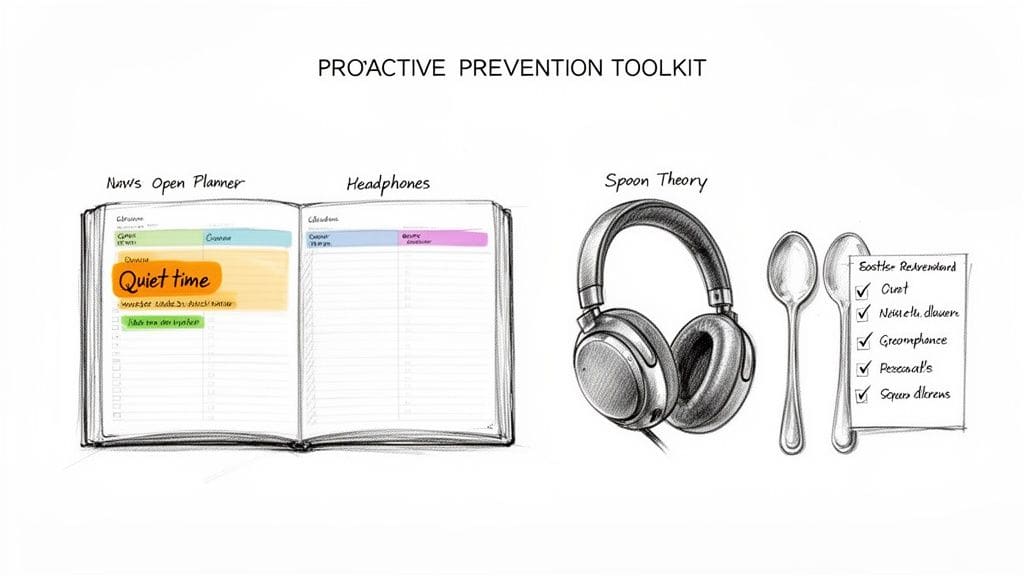
Your own toolkit might include things like:
- Scheduled Quiet Time: Block out 15-30 minutes of non-negotiable quiet time in your daily calendar. Treat it like a meeting you can't miss, especially after an activity you know is draining.
- Sensory Shields: Keep noise-canceling headphones or sunglasses in your bag. Having them ready for environments you know are overstimulating is a game-changer.
- Energy Budgeting: Use concepts like "Spoon Theory" to map out your week. If you know a big social event is on Friday, schedule a low-energy day on Thursday to prepare and Saturday to recover.
- Practice Difficult Conversations: For those of us who find tough conversations draining, you can learn more about effective ways to regulate emotions before and after these talks. Using an app like tonen to rehearse what you want to say in a private, low-stakes space can build real confidence for when it actually counts.
Taking this kind of proactive approach to managing your energy is the true foundation of a more balanced, sustainable life.
When to Pause and When to Seek Professional Support
The in-the-moment grounding and boundary-setting strategies we've covered are your first line of defense. They are powerful tools for getting through a tough moment. But it's just as important to recognize the difference between a tough moment and a chronic struggle.
Knowing what to do when feeling overwhelmed also means knowing when self-help isn't cutting it anymore. If that swamped, overloaded feeling is becoming your default state rather than an occasional visitor, it might be time to bring in professional support. This isn't a sign of failure; it's a sign of powerful self-awareness.
Telltale Signs Overwhelm Is Becoming Chronic
So, how do you know if you've crossed the line from manageable stress into something more serious? The signs often creep up on you, which makes them easy to brush off at first. But if you see persistent patterns, it's a clear signal that your current coping skills are being pushed past their limits.
Keep an eye out for these indicators:
- Frequent Shutdowns or Meltdowns: You find yourself shutting down more often, feeling like you can't speak or move. Or maybe you're having emotional meltdowns over things that seem small on the surface.
- Constant Anxiety: There's a low-level hum of dread that follows you through your day, even when nothing is obviously wrong.
- Difficulty with Daily Tasks: The basics—showering, making a meal, answering a simple email—feel like climbing a mountain.
- Social Withdrawal: You're consistently dodging friends, family, or social events you used to like because the effort just feels like too much.
If this list feels a little too familiar, it's a strong sign you could benefit from some outside help. You're not just having a bad week; your nervous system is consistently overloaded. When you're constantly trying to figure out what to do when feeling overwhelmed, it's your brain's way of telling you it needs deeper support.
The Value of Professional Guidance
Reaching out for professional help can feel huge and intimidating, but it's one of the most powerful things you can do to reclaim your well-being. Therapy, coaching, and support groups offer structured, compassionate spaces where you can build new skills and gain perspective.
For neurodivergent folks, finding a professional who gets it is absolutely essential. Look for therapists or coaches who specialize in autism, ADHD, or social anxiety. They won't just give you generic advice; they'll offer strategies that are actually tailored to how your brain works.
> Seeking help isn't admitting defeat. It's equipping yourself with a better map and a more experienced guide for the journey.
Finding the right support demystifies the whole process and gives you a clearer path forward. You don't have to figure all of this out alone. For those just starting to explore their options, a great first step can be checking out the best free mental health apps available in 2026. They can offer accessible support while you search for the right professional. Recognizing it's time to ask for help is a critical part of knowing what to do when feeling overwhelmed.
Still Have Questions About Managing Overwhelm?
We've walked through a lot of different strategies, both for heading off overwhelm before it starts and for dealing with it in the moment. But it's completely normal to have a few lingering "what if" questions, especially about those really tricky situations.
Let's tackle some of the most common ones. This is the troubleshooting part—what to do when your go-to plan isn't cutting it, how to talk about what you're feeling without oversharing, and how to cope when you literally can't walk away.
What if My Grounding Techniques Aren't Working?
It happens. You try the 5-4-3-2-1 method, but instead of calming down, you just feel more agitated or anxious. If a technique isn't helping, the first rule is simple: stop. Don't ever try to force something that your nervous system is rejecting in that moment. The whole point is to find an off-ramp from the overwhelm, not to add another layer of stress because a specific "trick" isn't working.
If a sensory exercise is too much, stop or simplify it. Try noticing one comfortable object or moving to a quieter place. You do not need stronger sensations, loud sound or pain to interrupt the feeling.
It's also possible you need a different type of tool altogether. If your senses are overloaded, trying to engage them further might backfire. That's a good time to pivot to a verbal strategy, like silently repeating a simple, comforting phrase to yourself or using a pre-saved script to ask for the space you need.
> Remember, this is about building a versatile toolkit, not finding one magic bullet. What works today might not work tomorrow, and that's perfectly okay. The goal is to have options.
How Do I Explain This Without Oversharing?
You don't owe anyone a detailed medical history or a play-by-play of your internal state. Simple, clear, and firm language is your best friend when you need to communicate your needs while you're under pressure.
The key is to use "I" statements. This keeps the focus on what you need, not on what they're doing, which helps prevent the other person from getting defensive.
- "I need a few quiet minutes to reset."
- "I'm reaching my capacity for today and need to step back from this."
- "My brain is a bit overloaded right now, can we pause this conversation for a bit?"
For many neurodivergent people, the mental energy it takes to come up with these phrases on the spot can be huge. This is exactly why having a personal library of scripts from tonen, the Scripts Library, is so helpful. It saves you from having to invent the words when your brain is already maxed out.
How Can I Handle Overwhelm in Public or at Work?
What about when you can't just leave? You're in an important meeting, a crowded classroom, or a noisy store, and you feel that familiar spike of panic. The trick here is to use discreet "micro-resets" that can give your nervous system a break without drawing any attention.
- Take a break: If possible, step away from the immediate demand.
- Choose comfortable grounding: Notice the chair supporting you or the texture of a familiar object. Avoid causing pain.
- Ask for time: “I need a moment to think. Can I come back to you later?”
These small actions can create just enough internal space to prevent a full shutdown, letting you get through the situation without completely draining your battery.
Learning to manage overwhelm is a skill you build over time, not a problem you solve overnight. With tools like tonen, you have a Calm Kit for overwhelm, a Scripts Library, and a Perspective Helper right in your pocket, ready to support you when you need it most.
tonen is available on iOS with 21 free scripts, Box Breathing and 5-4-3-2-1 Grounding, plus one free request each in Reply Helper, Perspective Helper and Debrief. Optional Premium adds the full script library, Phone Call Mode, Body Scan and Safe Place, and 50 requests per week shared across the three helpers. Check the App Store purchase screen for your local price and any eligible trial.