Feeling overwhelmed at work is a common signal that your nervous system is in overdrive. Your immediate goal isn't to power through the chaos—it's to break the stress cycle so you can think clearly again. This can feel counterintuitive when deadlines are looming, but taking just a few minutes to get grounded is the fastest way back to being productive. We'll walk through simple, discreet actions you can take right at your desk to calm your nervous system and regain a sense of control.
Your Immediate Plan to Regain Control
That rising tide of panic—the tight chest, the racing thoughts, the feeling that every single task is both urgent and impossible—is your brain flooding with stress hormones like cortisol. In that state, clear, logical thinking is incredibly difficult. The instinct might be to work harder and faster, but that usually just makes the feeling of being overwhelmed even worse.
The most effective response is to intentionally step back for a moment. This isn't about avoiding your responsibilities. It's about giving your nervous system a chance to reset so you can approach your to-do list with clarity instead of chaos.
The key is to have a simple, private 'first-aid kit' of mental tools you can use right where you are, without drawing any unwanted attention. Here are three powerful techniques to get you started.
Find Your Centre with Grounding Techniques
First things first, you need to pull your mind out of the future (worrying about what's next) and bring it squarely into the present moment. This is what grounding is all about. It anchors you to your physical surroundings, which is an incredibly fast way to quieten all that mental noise.
You don't need to do anything obvious. A classic and highly effective method is the 5-4-3-2-1 technique:
See 5 things: Look around you and silently name five objects. Your monitor, a pen, a water bottle, a book, a plant. Don't just glance; really see* them.
* Touch 4 things: Focus on the sensation of four things you can feel. The smooth, cool surface of your desk; the texture of your jumper; the weight of your phone in your hand; the warmth of your mug.
* Hear 3 things: Tune into the sounds around you. The low hum of your computer, the distant sound of someone talking, the click of your own mouse.
* Smell 2 things: What can you smell? Maybe it's the coffee on your desk or the faint scent of hand sanitiser.
* Taste 1 thing: Focus on a single taste. Take a deliberate sip of water, or just notice the neutral taste in your mouth.
> These tiny actions force your brain to switch from abstract worry to concrete, sensory information. It's an immediate circuit breaker for overwhelming thoughts. If you'd like to explore more of these, there are lots of different grounding techniques for anxiety that are easy to adapt for a work setting.
When you're feeling overwhelmed, having a few go-to calming strategies can make all the difference. The table below is a quick-reference guide to a few discreet but powerful actions you can take the moment you feel that stress response kicking in.
Your 5-Minute Overwhelm First-Aid Kit
| Technique | What It Does | How to Do It (Quick Steps) |
|---|---|---|
| Box Breathing | Calms your nervous system by regulating your breath. | Inhale for 4 counts, hold for 4, exhale for 4, hold for 4. Repeat 3-5 times. |
| The 5-4-3-2-1 Method | Pulls your focus from anxious thoughts to your senses. | Silently name 5 things you see, 4 you can touch, 3 you can hear, 2 you smell, and 1 you taste. |
| Rapid Brain Dump | Moves thoughts from your head to paper to reduce mental clutter. | Grab a pen and paper. For 5 minutes, write down every single task or worry on your mind. |
| Tactile Grounding | Uses physical sensation as an anchor to the present. | Press your feet firmly into the floor. Tightly grip and release your hands. Focus on the sensation. |
Think of these as your emergency toolkit. Having them ready means you can respond to overwhelm proactively instead of just reacting to it.
Calm Your Nervous System with Box Breathing
When you get stressed, your breathing often becomes shallow and quick, which just tells your brain to panic even more. You can interrupt this feedback loop by deliberately slowing your breath down. This sends a powerful signal to your body that the danger has passed, helping to calm your entire system.
'Box breathing' is a brilliant, simple four-step pattern that you can do anywhere, anytime.
1. Breathe in slowly through your nose for a count of four.
2. Gently hold your breath for a count of four.
3. Breathe out slowly through your mouth for a count of four.
4. Hold your breath again for a count of four.
Just repeating this cycle three to five times can make a huge difference. The predictable, rhythmic pattern is incredibly calming, and focusing on the count gives your anxious thoughts something else to do.
Clear Your Mind with a Rapid Brain Dump
A lot of the time, the feeling of being overwhelmed at work comes from trying to juggle too many tasks, worries, and reminders in your head all at once. This mental clutter creates a constant, low-level buzz of anxiety that's exhausting.
The solution? Get it all out.
Grab a piece of paper, a sticky note, or open a blank document. For the next five minutes, just write down every single thing that's taking up space in your brain. Don't edit, don't organise, and don't worry about making it neat. Just dump it all out.
This list might include:
* Project tasks you haven't finished
* Emails that need a reply
* Things to prepare for an upcoming meeting
* A nagging worry about some feedback you received
* A reminder to chase someone for information
The simple act of writing everything down transfers the burden from your mind to the page, freeing up precious mental energy. It turns that overwhelming, shapeless cloud of 'stuff' into a tangible, physical list. And once it's written down, you can start to figure out what actually needs your attention right now—a crucial next step we'll explore later on.
Recognizing the Subtle Signs of Burnout

That constant feeling of being overwhelmed at work is more than just a bad week. It's a slow burn that can lead straight to burnout if you ignore it. The tricky part is that the earliest signs are often subtle, easy to brush off as just 'part of the job'. Learning to spot these quiet red flags is your first and most powerful defence against long-term exhaustion.
We tend to imagine burnout as some kind of dramatic collapse, but it rarely starts that way. It's a gradual erosion of your engagement, your energy, and your belief in your own effectiveness.
From Tired to Disconnected
One of the first signs is a growing sense of emotional distance from your work. Tasks that once felt meaningful might now seem pointless or like a never-ending series of demands. You might catch yourself feeling cynical about your role or getting irritable with colleagues over small things.
This isn't just you being moody; it's a protective mechanism. When the cognitive and emotional load gets too heavy, your brain starts to detach as a way to conserve its remaining energy.
Think about these scenarios:
* For the office worker: You used to enjoy the casual chat by the coffee machine, but now you find yourself putting on headphones to avoid conversation, just trying to get through the day.
* For the remote worker: You start your day staring at your screen, feeling a complete lack of motivation to even open your email, a feeling that persists no matter how much coffee you drink.
* For the hybrid worker: The days you commute feel especially draining. It's not the travel, but the monumental effort of switching contexts and interacting with people that wipes you out.
This emotional exhaustion is a core component of burnout. Understanding the importance of protecting your energy is a critical part of maintaining good mental health at work.
The Sneaky Physical Symptoms
Constant stress isn't just in your head; it shows up in your body. While we all get the odd headache, burnout-related physical symptoms are the ones that stick around and don't seem to have another clear cause.
These can include:
* Tension headaches that become a regular afternoon feature.
Feeling overwhelmed by work? tonen can help.
tonen gives you 188+ conversation scripts, tone guidance and calming tools — designed for autistic adults, ADHD and social anxiety. Try it free for 7 days.
Download on the App StoreiOS only. Android coming soon.
* Stomach issues or general digestive unease.
* Persistent fatigue that sleep just doesn't seem to fix.
* A clenched jaw or tight shoulders you only notice at the end of the day.
Your body keeps the score. When you're constantly feeling overwhelmed at work, your nervous system is stuck in a state of high alert, which takes a significant physical toll over time.
The Rise of Decision Fatigue
A less obvious but incredibly draining symptom is decision fatigue. This is what happens when the sheer volume of choices you have to make—both big and small—completely exhausts your mental resources. Suddenly, even deciding what to have for lunch feels like a monumental effort.
> When your brain is overloaded, its capacity for executive functions—like decision-making and prioritisation—shrinks. This is why you might find yourself procrastinating on important tasks while simultaneously feeling anxious about not getting them done.
The experience of feeling overwhelmed at work varies a lot depending on your environment. A UK study highlighted this, showing that field-based workers reported the highest stress levels at 34%, followed by those in fixed locations at 29%. Interestingly, home-based (19%) and hybrid workers (16%) reported lower levels. This suggests that while remote work has its challenges, the environment itself can be a huge factor.
The study also found that heavy workloads were the top stress driver for nearly 47% of workers. You can find more insights from the 2024 Burnout Report to understand these workplace dynamics better.
Recognising these subtle signs isn't about finding flaws in yourself. It's about listening to what your mind and body are telling you. Spotting them early gives you the chance to make small, strategic adjustments before that slow burn turns into a full-blown fire.
How to Discuss Your Workload with Your Manager
Talking to your manager about an unsustainable workload can feel incredibly daunting. It's easy to worry about being seen as incapable or not a team player.
But staying silent when you're feeling overwhelmed at work only guarantees one thing: nothing will change. Learning how to approach this conversation constructively is one of the most powerful steps you can take to get back on track.
This isn't about complaining. It's about collaborative problem-solving. Your manager probably doesn't have a full, minute-by-minute picture of your to-do list. When you present the situation clearly, you invite them to be part of the solution, which is a win for everyone.
Preparing for a Productive Conversation
Walking into this discussion unprepared can make it feel more emotional and a lot less effective. The key is to shift the focus from "I feel stressed" to "Here is the current situation, and I'd like your help in prioritising to meet our goals."
A little bit of prep work turns that anxiety into a clear, actionable plan.
Before you even book the meeting, take some time to gather a few concrete details.
* Document Your Workload: For a few days, keep a simple log of your main tasks and roughly how long they take. This isn't about tracking every single minute, but about getting a clear overview of where your energy is actually going.
* Identify Specific Bottlenecks: Pinpoint exactly what's causing the pressure. Is it two major projects with conflicting deadlines? A sudden increase in "urgent" last-minute requests? A process that just isn't working efficiently?
* Propose Potential Solutions: Start thinking about what could realistically help. Could a deadline be shifted? Could a specific task be delegated? Is it possible to get clear confirmation on which project is the #1 priority right now?
Having this information ready completely changes the conversation. You're no longer just stating a problem; you're presenting a business case and showing you're already thinking about solutions.
Framing the Conversation for Success
The language you use matters. A lot. Your goal is to position yourself as a partner in finding a solution, not an employee lodging a complaint. This collaborative framing makes it much easier for your manager to engage positively instead of getting defensive.
Think about starting the conversation with a shared goal in mind.
> Instead of: "I have way too much work to do and I can't keep up."
> Try this: "I'm really committed to doing high-quality work on Project A and Project B. Looking at the current deadlines, I'm concerned I won't be able to give both the attention they deserve. Could we look at the priorities together?"
This approach immediately establishes your commitment and frames the issue around quality and team success. It shows you're thinking strategically about the work, which is exactly what good managers want to see. Difficult conversations are a skill, and it's always helpful to discover how to handle difficult conversations with confidence.
What to Say and Why It Works
Having a few phrases prepared can reduce anxiety and keep the conversation on track. The right wording can make all the difference between a conversation that feels like a complaint and one that feels like a productive strategy session.
Here's a quick look at how small shifts in language can completely change the tone and outcome.
#### Communicating Your Needs Effectively
| Instead of Saying This... | Try Saying This... | Why It Works Better |
|---|---|---|
| "I'm completely swamped." | "My current capacity is fully allocated. Could you help me prioritise what to focus on this week?" | It uses professional, objective language and asks for specific, actionable help (prioritisation). |
| "I can't possibly do all of this." | "To meet the deadline for Project X, I'll need to push back the start of Project Y. Does that work for you?" | It presents a realistic trade-off and gives your manager a clear choice, showing you've thought through the consequences. |
| "This is impossible." | "I've identified a few challenges with the current timeline. Can we brainstorm a more achievable plan?" | It frames the problem as a shared challenge and invites collaboration, turning it into a team effort. |
These small adjustments in wording can have a huge impact. You're not just highlighting a problem; you are actively participating in solving it.
And it's important to remember you're not alone in this. Recent UK data shows that 79% of adults have felt overwhelmed by stress in the past year. Speaking up is a brave and necessary step toward creating a healthier work environment for yourself.
Taming Your Time and Workload with a Clear Strategy
When your to-do list feels more like an avalanche than a plan, it's a sure sign your current system is broken. Trying to just "work harder" is a recipe for burnout. The real solution is to stop reacting to tasks as they appear and start managing your workload with a proper strategy.
This is especially critical when you're feeling overwhelmed at work. Your brain's ability to prioritise things on the fly is shot. Leaning on a clear framework is what brings order back to the chaos and gives you a manageable path forward.
These techniques aren't just about getting organised. They're about reducing the constant mental drain of figuring out what to do next, freeing up that precious energy for the actual work.
Untangle Priorities with the Eisenhower Matrix
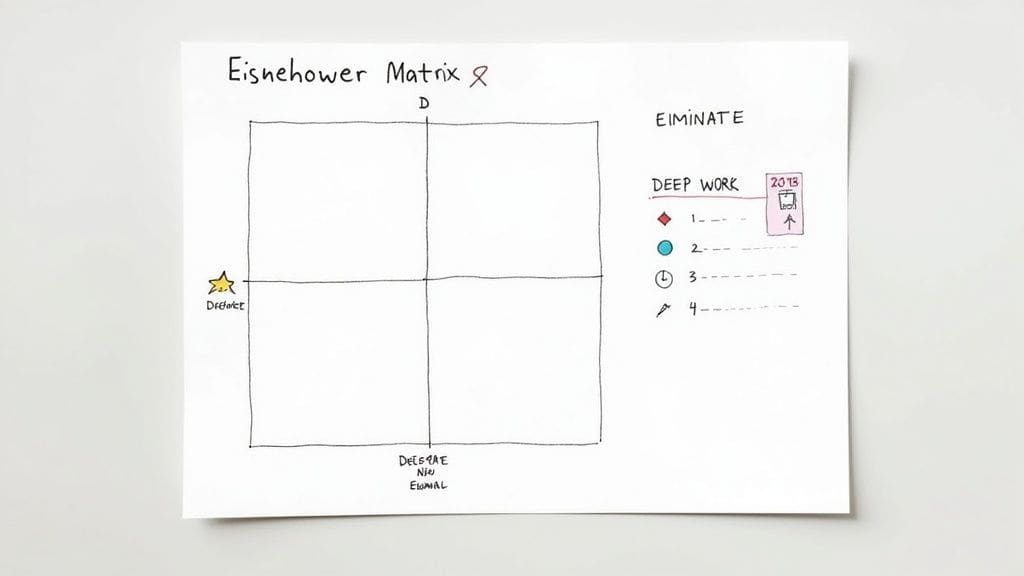
One of the most effective tools for cutting through the noise is the Eisenhower Matrix. It's a beautifully simple but powerful way to sort your tasks based on two things: how urgent they are and how important they are.
Instead of one massive, intimidating list, you divide everything into four clear boxes:
* Urgent & Important (Do First): These are the fires you have to put out. Think of a client crisis or a project deadline that's happening today. They demand your immediate focus.
* Not Urgent & Important (Schedule): This is where the magic happens—the high-impact, strategic work. It's long-term planning, learning new skills, or building relationships. This is the stuff that gets ignored when we're constantly firefighting.
* Urgent & Not Important (Delegate): These are the interruptions that feel important but don't actually move your own goals forward. This might be certain meetings you don't need to be in or emails someone else could easily handle.
* Not Urgent & Not Important (Delete): These are the time-wasters. Mindless social media scrolling, over-organising your inbox for the tenth time—anything that can be ruthlessly eliminated.
> The real power of this matrix is how it visually separates the tasks that feel urgent from those that are truly important. That distinction is the key to breaking the cycle of reactivity that fuels overwhelm.
Conduct a Ruthless Task Audit
With a clearer picture of your priorities, it's time for a task audit. Go through your list, especially the items you put in the 'Delegate' and 'Delete' boxes, and get brutally honest with yourself.
The whole point of an audit is to challenge the default assumption that you have to do everything that lands on your plate. By reviewing your responsibilities one by one, you can spot opportunities to trim down your workload and focus your energy where it actually counts.
Streamline Your Workload
* Eliminate: What can you just stop doing? We often continue tasks out of pure habit, not necessity. Be brave and just drop them.
* Automate: Are there repetitive jobs that software could do for you? Setting up email rules, using scheduling tools, or exploring other strategies for managing multiple projects without burnout can be an absolute game-changer.
* Delegate: Is there anyone else who could handle this? And delegation isn't just for managers. It might mean asking a colleague for a hand or simply clarifying who is genuinely responsible for something.
This process is vital for anyone struggling with that feeling of being overwhelmed at work. For neurodivergent minds, reducing the sheer number of things to juggle can be a massive relief for maintaining focus. Exploring the best apps for ADHD adults can also introduce you to tools that are specifically designed to support these executive functions.
Protect Your Focus with Time Blocking
Once you know your priorities and have trimmed the fat from your to-do list, the final piece of the puzzle is protecting your time. Time blocking is a simple but powerful technique where you schedule specific tasks directly into your calendar.
Instead of working from a list, you work from your calendar.
This simple shift does a few amazing things. It forces you to be realistic about what you can actually get done in a day and it puts up a protective wall around your deep work sessions. When your calendar has a two-hour block that says "Focus on Report," you're far less likely to let a random email throw you off course.
Building Long-Term Resilience by Setting Boundaries
Real, lasting relief from feeling overwhelmed at work doesn't come from a single breathing exercise or a one-off awkward conversation. It's built over time by creating sustainable habits that act as a buffer against burnout. This is about shifting from a reactive, firefighting mode to a proactive one by setting clear boundaries that protect your time, energy, and well-being.
Think of boundaries not as being difficult or uncooperative, but as the essential structure that allows you to do your best work without sacrificing your mental health. It's about making your work-life dynamic sustainable for the long haul, so you're not constantly teetering on the edge of overload.
Define Your 'End of Day' with a Shutdown Ritual
One of the most powerful boundaries you can set is a clear, consistent end to your workday. In our always-on culture, the lines between work and personal life get blurry fast, leaving you in a state where you never truly switch off. A shutdown ritual is a simple sequence of actions that signals to your brain that the workday is officially done.
This doesn't need to be complicated. Your ritual could look something like this:
* Do a final task review. Spend five minutes looking at your to-do list. Acknowledge what you've finished and flag the top one or two priorities for tomorrow. This stops unresolved tasks from swirling around in your head all evening.
* Physically tidy your space. Clear your desk. Put away papers, close your laptop, and wipe down the surface. This physical act of tidying brings a surprising amount of mental closure.
* Create a clear sign-off. If you're in an office, say a verbal goodbye. If you work from home, change out of your work clothes or shut the door to your office. This creates a distinct separation between your work self and your home self.
This small routine is a game-changer for preventing work from bleeding into your personal time, which is a massive contributor to chronic stress and that persistent feeling overwhelmed at work.
Politely Defend Your Off-Hours
Boundaries are only as good as your ability to enforce them. This often means learning to politely but firmly say "no" to requests that pop up outside your working hours. Having a few pre-prepared responses makes this a lot less stressful in the moment.
For instance, if an email lands in your inbox at 8 p.m. with a non-urgent request, you can use a script like this:
> "Thanks for sending this over. I'm offline for the day but will review this first thing in the morning and get back to you then."
This response is professional, it sets a clear boundary, and it manages expectations without being confrontational. You've acknowledged their message while reinforcing that your time outside of work is your own.
Beyond setting these external boundaries, it's also crucial to manage your body's physiological response to stress. Learning how to naturally reduce your cortisol levels can be a powerful tool for building that deep, long-term resilience.
In the United Kingdom, workplace stress is a massive mental health challenge. Work-related stress, depression, or anxiety accounts for an estimated 17.1 million lost working days each year. That's nearly half of all work-related ill health cases. The financial toll is just as stark, costing UK businesses between £21.6 billion and £28 billion annually.
Schedule Proactive Rest with Micro-Breaks
Just like you schedule meetings and project deadlines, you have to schedule rest. Waiting until you're completely exhausted to take a break is a losing strategy. Micro-breaks are short, intentional pauses you take throughout the day to fight off mental fatigue and stop cognitive overload before it starts.
Think of your focus like a muscle—it needs rest to recover. Pushing it non-stop just leads to diminished returns and a much greater chance of feeling overwhelmed at work.
* Try the 50/10 Rule: Work with intense focus for 50 minutes, then take a full 10-minute break completely away from your screen.
* Step away physically. Don't just switch browser tabs. Get up, stretch, walk to the window, or grab a glass of water. The physical separation matters.
* Change your scenery. Even a five-minute walk outside can dramatically reset your mental state, improving your mood and productivity when you return.
Building these small, proactive rest periods into your daily routine is a non-negotiable part of creating a healthier, more sustainable relationship with your work.
Answering Your Questions About Workplace Overwhelm
Even with the best strategies, navigating that feeling of being completely overwhelmed at work can bring up some very specific, tricky questions. Let's tackle some of the most common sticking points with clear, practical answers to help you find your footing.
Sometimes, the real issue isn't even the volume of work itself. It's the constant stream of interruptions that shatters your focus and leaves you feeling mentally overloaded.
How Do I Handle Constant 'Urgent' Requests?
Here's the thing: when everything is labelled as urgent, nothing actually is. The real skill here is learning to manage expectations and gently guide your colleagues to respect your workflow.
Instead of dropping everything the second a new request lands on your desk, try pausing and using a script like this: "I can definitely look at that for you. Right now, I'm focused on [Current Priority Task] to meet its deadline. Can I get to this after lunch, or does it need to take priority over that task?"
This simple response does two powerful things:
* It immediately makes the other person aware of the trade-off.
* It puts the decision to re-prioritise back on them, or it opens up a necessary conversation with your manager.
This isn't about pushing back or saying no. It's about creating a transparent process for how work flows, which benefits everyone.
What If I'm Worried My Manager Thinks I'm Incapable?
This is such a common and understandable fear. The most effective way to handle this is to frame the conversation around resources and priorities, not your personal limitations. Always try to approach it with data, not just feelings.
> Key Takeaway: Approaching your manager with a clear breakdown of your current tasks and asking for help with prioritisation shows you are strategically managing your workload. This is a sign of competence, not weakness.
Focus the conversation on your commitment to quality. For example, you could say, "I want to ensure I deliver high-quality work on both of these key projects. Can we discuss the timeline to make sure both get the attention they deserve?" This positions you as a responsible, proactive member of the team.
Can Technology Actually Help with This?
Yes, absolutely. The right tech can be a brilliant ally, especially tools designed to reduce your cognitive load. Many apps are out there to help you organise your thoughts, manage tasks, and even rehearse for those difficult conversations you've been avoiding.
Many of these tools integrate techniques from Cognitive Behavioural Therapy (CBT) to help you reframe the anxious thoughts that often come with feeling overwhelmed.
For instance, learning to challenge an automatic thought like, "I must do everything perfectly, right now" is a core CBT principle. Exploring different apps for CBT can give you structured, practical ways to practice these helpful mental shifts.
Ultimately, getting a handle on feeling overwhelmed is a mix of immediate coping skills, smart communication, and building sustainable boundaries over time. Every small step you take to regain a sense of control reinforces your ability to manage pressure more effectively in the future.
When preparing for tough conversations or managing social stress at work, tonen can help. Our app provides discreet, on-device scripts and practice tools to help you communicate your needs with clarity and confidence. Find the right words for setting boundaries, asking for support, or navigating difficult discussions, all in a low-stress, private environment. Start your free 7-day trial of tonen today.
Frequently asked questions
This guide covers feeling overwhelmed at work? quick steps to regain control with practical, neurodivergent-friendly strategies—clear steps, scripts where useful, and ways to reduce anxiety or overload rather than vague "be confident" advice.