When searching for the best apps for autistic adults, the goal is to find tools that genuinely help with communication, executive functioning, and emotional regulation. The top options for 2026 include tonen for conversational scripting and anxiety management, Tiimo for visual scheduling, and Calm for sensory regulation. These apps provide practical, accessible support by reducing cognitive load, helping you navigate daily challenges, and building confidence in a world not always designed for neurodivergent minds. This guide breaks down which apps solve which specific problems, so you can find the right fit for your needs.
Navigating Digital Support Tools in 2026
Technology can offer incredible, personalized support, but let's be honest—finding the right tool can feel like another exhausting task. The goal isn't to add another complicated app to your day. It's to find something that genuinely reduces your cognitive load.
In my experience, the most effective solutions are almost always the ones built with neurodivergent experiences at their core. They get it. They prioritize simple interfaces, features you can actually customize, and they take user privacy seriously.
Instead of just listing features, this guide breaks down the best apps for autistic adults by the specific problems they solve. We'll look at which app is the right fit for different real-world situations, helping you make a choice that actually works for you.
Top-Rated Apps for Autistic Adults at a Glance
To give you a quick lay of the land, this table summarizes our top picks. It's a fast way to see what each app does, who it's really for, and what it costs, helping you zero in on the options that make the most sense for your needs.
For a deeper dive into the "why" behind these tools, our guide on a person-centred care approach to autism support offers some valuable context on building a system that works for you.
| App Name | Primary Function | Ideal For | Starting Price |
|---|---|---|---|
| tonen | Scripted Communication & Regulation | Adults needing help with social conversations and anxiety. | $4.99/month |
| Tiimo | Visual Scheduling & Task Management | Individuals who benefit from structured visual routines. | $8.00/month |
| Todoist | Task & Project Organization | Users who need a clean, checklist-based organizer. | Free (with paid tiers) |
| Calm | Emotional & Sensory Regulation | Anyone needing guided meditations and soundscapes. | $14.99/month |
This table is just the starting point. Now, let's get into the details of what makes these apps tick and why you might choose one over another.
Understanding the Need for Digital Aids
For many, navigating a world where social conversations feel like decoding an alien language is just a daily reality. Think about the 61.8 million people affected by autism worldwide—a number that's climbed as diagnostics have improved. This highlights a huge need for tools that can help bridge social and organizational gaps, especially since so many of us experience heightened anxiety in situations full of unspoken social rules.
> The right digital tool isn't about "fixing" anything; it's about providing an accessible bridge. The best apps for autistic adults act like a reliable interpreter, a patient organizer, or a quiet space, available right when you need it.
It's all about conserving your mental energy for the things that actually matter to you. In a way, it's similar to how people approach other areas of life, like finding the best fitness apps of 2026 to support specific goals. It's about finding the right tool for the job.
In the sections that follow, we'll break down our top picks by category, starting with the tools built specifically for social communication.
Comparing Apps for Social Communication Support
Let's be honest: navigating social interactions can be completely draining. Finding the right communication aid is a huge reason why so many of us search for the best apps for autistic adults. The most helpful tools do more than just convert text to speech; they offer real, in-the-moment support that can lower anxiety and make sure your intentions are clear.
We're going to look at a few different kinds of apps—tools like tonen, various AAC (Augmentative and Alternative Communication) options, and social story builders. Each one serves a very different purpose. This breakdown will help you figure out which style is the right fit for you, whether you need on-the-spot scripting, tools to practice with, or a more comprehensive communication system.

And this isn't a niche problem. Autistic adults in places with high prevalence rates like Singapore (1,382 per 100k) and the US (969 per 100k) are facing social hurdles that apps are finally starting to address. Research shows that around 75% of autistic adults deal with social anxiety, and 60% run into barriers at work because of communication differences. You can learn more about these trends by reviewing global autism rates here.
For these reasons, finding an app that gives you structured support isn't just a nice-to-have. It's a vital part of everyday life.
Scripted Communication Apps
For many of us, the hardest part of any conversation is just figuring out what to say, especially when we're under pressure. Scripting apps are built to solve exactly this problem by giving you ready-to-use phrases for common situations.
tonen is a great example in this category because it digs into the nuances of a conversation. It's not just about the words, but how you say them. Its Scripts Library has over 188 scenarios, covering everything from setting boundaries with your boss to just getting through a family dinner.
> The real game-changer with tonen is its focus on tone and flexibility. Instead of one-size-fits-all text, it gives you options like 'Direct' for clarity or 'Softer' for warmth, plus built-in ways to exit a conversation. This lets you communicate like yourself, just without burning through all your mental energy.
Think about preparing for a job interview. It becomes a lot less intimidating when you can use tonen's scripts to practice answering tough questions, toggling the tone until you sound confident but still approachable. This kind of blend between preparation and real-time support is what makes it one of the best apps for autistic adults.
Augmentative and Alternative Communication (AAC) Apps
AAC apps are often thought of as tools for nonspeaking or minimally speaking people, but they're also an incredible support for adults who experience situational mutism or verbal shutdowns under stress. These apps generally use a grid of symbols to help you build sentences.
Unlike scripting apps that provide whole phrases, AAC tools give you the building blocks to construct your own novel sentences from scratch using visual icons.
A Comparison of Communication App Types
| App Type | Primary Use Case | Key Strength | Ideal User |
|---|---|---|---|
| Scripting (tonen) | Pre-planning and in-the-moment conversational help. | Provides contextual phrases with tone options. | Verbal adults who need support with social anxiety and conversational flow. |
| AAC (e.g., Proloquo2Go) | Core communication for nonspeaking or situationally mute individuals. | Builds unique sentences from a robust symbol library. | Individuals who rely on symbols for primary communication. |
| Social Story Builders | Preparing for specific, predictable events. | Creates a step-by-step narrative to reduce uncertainty. | Users who benefit from visual stories to understand social expectations. |
The table really highlights the different paths you can take. If you're verbal but just can't find the right words in a high-stakes moment, a scripting app is a perfect fit. If you need a primary way to communicate, AAC is the answer. If you want to dig deeper, you can read our guide on choosing an app for autism communication.
Social Story and Video Modeling Apps
Social story apps play a more preparatory role. They help you understand and rehearse for a specific event by breaking it down into a sequence of illustrated or written steps. For example, a social story could walk you through everything involved in a visit to a new doctor, from checking in at the front desk to describing your symptoms.
While they are incredibly valuable for lowering anxiety around new situations, they're not built for the spontaneous back-and-forth of everyday conversation. They're fantastic for creating predictability around scheduled events, but they aren't designed for dynamic, real-time interactions.
Ultimately, the right choice comes down entirely to your specific communication needs. For those of us looking to enhance our verbal communication and cut down on social stress, a tool like tonen offers a practical and empowering solution, cementing its place among the best apps for autistic adults out there today.
Evaluating Executive Functioning and Planning Apps
Executive functioning challenges are a huge part of the autistic experience. Things like managing time, staying organized, or just switching from one task to another can feel like a constant uphill battle. The right app can make a world of difference, but the wrong one just adds another layer of cognitive load.
This section digs into some of the top contenders—apps like Tiimo and Todoist—to see how they actually stack up for day-to-day neurodivergent life. The best tool should feel like an extension of your brain, not another chore to manage. A clean, visually intuitive interface isn't just a nice-to-have; it's essential.
The need for these kinds of tools is only getting more urgent. With a 300% surge in US autism diagnoses over the last two decades, millions of autistic adults are looking for practical support. We know 85% report stress in social situations, and executive function struggles are right there alongside it. You can find more on autism diagnosis trends and the need for adult-focused resources.
Tiimo For Visual Routine Building
Tiimo was built from the ground up for neurodivergent people, and it shows. Its superpower is making the abstract concept of time feel tangible and way less scary. It does this with a highly visual, block-based schedule.
Use Case Scenario: Managing a Weekly Schedule
Let's say you're trying to plan a week that has work meetings, a grocery run, and some much-needed downtime. With Tiimo, you can:
* Color-code everything: Assign one color for work, another for chores, and a third for rest.
* Use custom icons: A tiny shopping cart icon tells you what to do faster than reading the words "Grocery Shopping."
* Nest checklists inside blocks: That "Grocery Shopping" block can have its own mini-list, like "Make List," "Drive to Store," and "Unpack Bags."
The visual timer, which literally shows the minutes ticking away, is a game-changer for time blindness and helps ease the jolt of transitioning between activities. Its focus on routine makes it one of the best apps for autistic adults who run on predictability.
> Tiimo is at its best for anyone who needs to build and stick to consistent daily or weekly routines. Its friendly, almost-gamified feel encourages you to use it without adding pressure, turning an overwhelming schedule into a visual flow you can actually follow.
Todoist For Task-Oriented Organization
Where Tiimo nails routines, Todoist is a beast for task and project management. Its clean, minimalist design is perfect for anyone who gets a deep sense of satisfaction from a perfectly organized to-do list.
It doesn't work on a visual timeline like Tiimo. Instead, Todoist is all about lists and projects. It's less concerned with when you'll do something and more focused on capturing every single task so nothing falls through the cracks. It's really helpful to know that for many people, the best system is a combination of tools. For a closer look at how different apps can work together, check out our guide on the best apps for ADHD adults.
Feature Comparison Tiimo vs Todoist
| Feature | Tiimo | Todoist |
|---|---|---|
| Primary Focus | Visual, time-blocked routines and schedules. | List-based task and project management. |
| Interface | Colorful, icon-driven, and highly visual. | Minimalist, text-based, and clean. |
| Best For | Building daily structure and managing transitions. | Capturing, organizing, and completing discrete tasks. |
| Customization | Icons, colors, and premade routine templates. | Projects, sub-tasks, labels, and priority levels. |
Which Planning App Is Right For You?
Honestly, your choice here comes down to your biggest pain point.
* If you wrestle with time blindness and need daily structure: Tiimo is almost certainly your best bet. Seeing your day laid out visually can seriously reduce the anxiety of not knowing what's next.
* If your main problem is forgetting tasks or getting overwhelmed by big projects: Todoist gives you a much better framework for capturing all those "brain dumps" and organizing them into steps you can actually take.
The goal is to find a system that cuts down on your mental workload, not add to it. Both of these are fantastic choices among the best apps for autistic adults, but they solve different problems. Your perfect setup might even be using both—Tiimo for the flow of your day, and Todoist for all the detailed to-do lists that feed into it.
Managing Sensory and Emotional Regulation
When the world gets too loud, finding a way to turn down the volume is non-negotiable. For many of us, managing emotional states and heading off sensory overload are constant, background tasks. The right app can be a lifeline in these moments—a portable quiet room in your pocket that helps you ground yourself before you hit a wall.
It's about finding tools that offer both in-the-moment relief and strategies for long-term coping. While popular apps like Calm have their place, the best apps for autistic adults are often those built specifically with neurodivergent needs in mind. Let's break down the differences to help you find what works for your unique sensory profile.
Mainstream vs Specialized Regulation Apps
Mainstream mindfulness apps like Calm or Headspace are packed with content. They have massive libraries of meditations, ambient sounds, and sleep stories. But sometimes, that sheer volume is the problem. Their interfaces can feel busy, cluttered with suggestions and notifications that actually add to your cognitive load instead of reducing it.
Specialized apps, on the other hand, usually get that less is more. They tend to have minimal, low-clutter designs because they understand one crucial thing: when you're on the verge of a meltdown or shutdown, you need an immediate tool, not a complex menu.
* Calm: Great if you're looking for a massive library of sleep stories or celebrity-narrated content. The downside? The interface can be overwhelming, and trying to find a simple grounding exercise during a moment of panic is a real challenge.
* Specialized Tools: Often feature a "panic button" or a quick-access kit. This takes you straight to a handful of proven techniques, like a box breathing visualizer or a simple grounding exercise, with no fuss.
> For many autistic people, the real dealbreaker is low-sensory design. A clean interface, optional dark modes, and zero distracting pop-ups aren't just "nice to have"—they're critical accessibility features that decide whether an app is genuinely helpful or just another source of stress.
The Role of Integrated Support Systems
Some of the smartest and best apps for autistic adults are now building regulation tools right into their core functions. This approach recognizes that the need for emotional support often comes directly from social or executive functioning challenges. It's a more holistic, connected way to provide support.
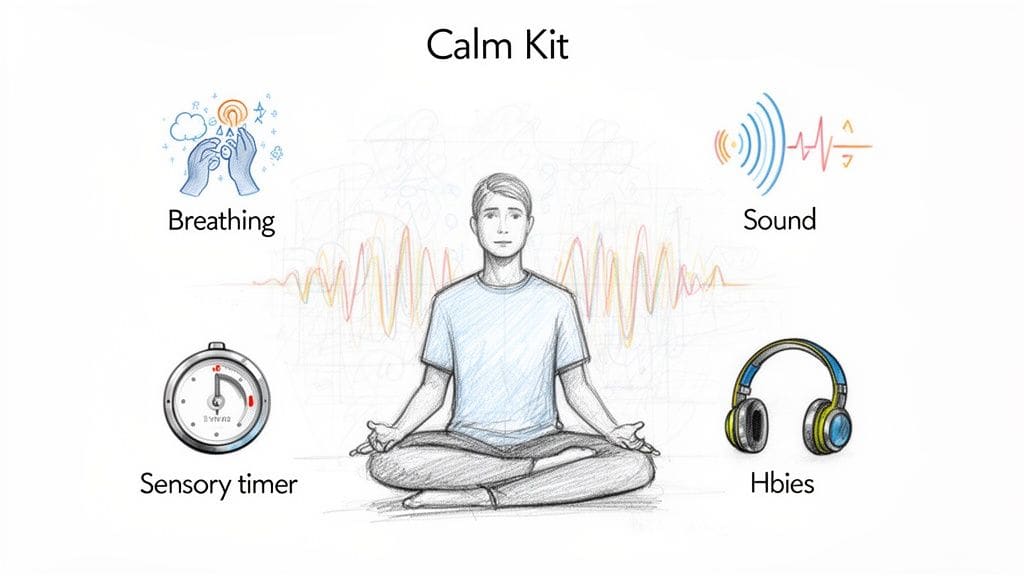
tonen is a perfect example of this integrated model. While its main purpose is to help with communication, it includes a feature called the Calm Kit. This isn't a separate app you have to switch to; it's a built-in sanctuary you can get to instantly from anywhere within the app.
The Calm Kit gives you four simple, effective tools:
* Breathing Exercise: A visual guide for slow, rhythmic breathing to calm your nervous system.
* Grounding Exercise: A straightforward prompt to name things you can see, hear, and feel.
* Body Scan: A short, guided meditation to help you reconnect with your body.
* Safe Place Visualization: An audio guide to help you mentally retreat to a calm space.
Practical Use Case: Choosing Your Tool
Imagine you're in a noisy grocery store. The lights feel too bright, your heart rate is climbing, and you feel the first signs of sensory overload. The app you choose here makes all the difference.
Scenario A: Using a Mainstream App
You pull out your phone and open Calm. You're immediately greeted by the "Daily Calm," new meditation series, and featured sleep stories. You have to navigate through several menus to find a basic breathing exercise. By the time you find it, your stress has probably gotten worse.
Scenario B: Using an Integrated Tool like tonen
You open tonen. The Calm Kit icon is always visible. You tap it and immediately access the breathing tool. Right there in the aisle, you can follow the simple visual guide to regulate your nervous system and get back on track.
This scenario shows why context is everything. If you're looking for more ideas on managing these feelings, check out our article on several free anxiety apps and the different techniques they offer. Ultimately, the best tool is the one that's fastest and easiest to get to when you need it most.
How Tonen Delivers Holistic Neurodivergent Support
While many apps tackle one specific problem, the best apps for autistic adults get that communication, regulation, and executive function are all deeply tangled together. Tonen stands out in 2026 because it delivers an integrated support system built from the ground up for neurodivergent minds. It's a unique mix of a Scripts Library, a Perspective Helper, and a built-in Calm Kit, creating one comprehensive tool that actually addresses the real-world cycle of social stress and sensory overwhelm.
This all-in-one approach means you don't have to juggle three different apps just to manage a single situation. Tonen is designed with the understanding that preparing for a tough conversation (communication), trying to figure out the other person's viewpoint (social processing), and managing the anxiety that comes with it (emotional regulation) are all just different parts of the same challenge.
A Neurodivergent-Led Design Philosophy
Tonen's real strength comes from its neurodivergent-led creation. This isn't a tool designed by outsiders guessing what might be helpful; it's built by people with lived experience who get the critical need for an interface with a low cognitive load.
Every element is intentional:
* No ads or distracting pop-ups: The focus is entirely on your task, with no visual noise to derail you.
* Clean, simple navigation: Features are easy to find, which means you spend less mental energy just trying to use the app itself.
* Privacy-first approach: All your data, scripts, and practice sessions stay on your device. This creates a truly safe space for you to explore.
This thoughtful design completely sidesteps the common pitfall of a tool becoming another source of stress, which happens all too often with feature-heavy apps.
Bridging Communication and Regulation
Tonen's power is in how its features work together. It's not just a random collection of tools, but a unified system designed to help you prepare for, navigate, and recover from socially demanding situations.
Let's look at how this plays out in a practical scenario.
User Scenario: Setting a Boundary with a Family Member
An anonymized user, "Alex," told us he frequently felt completely drained after family gatherings. He struggled to express his need for quiet time without feeling guilty or accidentally causing a conflict.
1. Preparation with the Scripts Library: Before his next visit, Alex opened tonen's Scripts Library. He found a script for "Setting Boundaries" and customized it, choosing a Softer tone to better match his natural communication style.
2. Anticipation with the Perspective Helper: Next, he used the Perspective Helper to think through how his family might react. This helped him feel much less anxious about their potential response.
3. In-the-Moment Regulation with the Calm Kit: During the visit, when he felt his anxiety start to rise, he discreetly used the Calm Kit's breathing exercise to ground himself right before he needed to speak.
Because of this prep work, Alex was able to clearly and kindly communicate his need for a break. He didn't have to switch between a notes app for his script, a journaling app to process his anxiety, and a separate mindfulness app to regulate. It was all in one place. You can see more on how these features work together by reading about the specialized autism communication app features Tonen offers.
Feature Deep Dive: tonen vs. Traditional Approaches
To really see the difference, it helps to compare tonen's integrated design with the more fragmented approach you see in other apps. The table below breaks down how tonen handles common challenges differently.
| Challenge | Traditional App Approach | How Tonen Solves It |
|---|---|---|
| Conversational Anxiety | Offers generic mindfulness exercises, totally separate from the communication task. | Integrates a quick-access Calm Kit with scripting tools, providing regulation support directly in context. |
| Finding the Right Words | Provides static social stories or basic symbol grids with little flexibility. | Offers a Scripts Library with customizable, tone-adjustable phrases for dynamic, real-world conversations. |
| Misunderstanding Others | Lacks tools for social perspective-taking, leaving you to guess and worry. | Includes a Perspective Helper to gently suggest alternative viewpoints and reduce cognitive looping. |
| Cognitive Overload | Often features busy, cluttered interfaces with ads and distracting notifications. | Employs a neurodivergent-led, low-clutter design to ensure the app reduces stress, not adds to it. |
By weaving communication aids and regulation tools together, tonen solves the whole problem, not just a piece of it.
> By weaving communication aids and regulation tools together, tonen functions less like a simple utility and more like a partner in self-advocacy. It conserves mental energy, builds confidence, and fosters autonomy.
Ultimately, this all-in-one design is what makes tonen one of the best apps for autistic adults—it doesn't just give you words; it gives you the support structure needed to use them effectively and confidently.
How to Choose the Right Support App for You
With so many options out there, just picking an app can feel like a project in itself. But finding the best apps for autistic adults really boils down to knowing yourself. The most effective tool will be the one that directly helps with your biggest challenge, whether that's social communication, staying on top of tasks, or managing sensory input.
Think about what you truly need. Is it in-the-moment help for unpredictable situations, or a tool to help you prepare for things you know are coming? Your budget and how much you value a private, ad-free space are also huge factors in finding something you'll actually stick with.
The key is to follow what experts call a person-centred care approach. All that really means is the tool has to fit your life and your brain. The right app should lower your cognitive load, not add to it. A tool built for someone else's mind will just end up being one more frustrating thing to manage.
Define Your Primary Need
First, get really specific about what you're trying to solve. Is your biggest hurdle finding the right words in a conversation? Or is it managing a daily schedule without getting completely overwhelmed?
* For Communication: If you need help articulating your thoughts in a clear, confident way, especially in high-stakes moments, an app like tonen is built for exactly that. It gives you scripts and tone options for real-time support.
* For Planning: If what you really need is strong visual support to get through your daily routines and handle transitions, an app like Tiimo with its icon-based, color-coded schedules might be a better fit.
* For Regulation: If you just need a quick, easy-to-access tool for when sensory overload or anxiety hits, something like tonen's built-in Calm Kit or a separate mindfulness app could be the perfect solution.
Nailing down this core need is the fastest way to cut through the noise and zero in on the tools that will actually be useful to you.
> The goal isn't to fix yourself; it's to find a tool that acts as a bridge. The right app conserves your finite mental energy for the things that truly matter to you, making it an essential part of your support system.
Consider Your Usage Style and Context
Next, think about how and when you'll actually use the app. Do you need something to help you prep in advance, or do you need help on demand when stress is high?
A social story builder is fantastic for getting ready for a planned event, like a doctor's appointment. But it's not going to do you much good when a neighbor starts an unexpected chat. An app with instant scripting or on-demand regulation exercises, on the other hand, is designed for those spontaneous, un-plannable moments.
You also have to evaluate the app's interface. Does it feel clean and simple, or is it a cluttered mess of features you know you'll never touch? Many of the best apps for autistic adults offer free trials. Use them. See if an app's design feels intuitive and calming to you, or if it just adds to your mental clutter. That hands-on experience is the only way to know if a tool is a good long-term fit for your brain.
Still Have Questions About Autism Support Apps?
It's completely normal to have questions when you're looking for the right digital tool. Finding the best apps for autistic adults means weighing things like cost, how effective they really are, and whether they'll actually be usable day-to-day. Let's tackle some of the most common concerns.
The price of support apps can be all over the place, from free tools that run on ads to subscription models like tonen. While a free app is tempting, premium subscriptions often provide a much more focused, ad-free experience. More importantly, they offer specialized features and enhanced privacy that can justify the cost.
Paid tools are usually designed with a core goal: to reduce your cognitive load, not add to it with distracting pop-ups and banners.
Do These Apps Replace Therapy?
Let's be very clear about this: these apps are powerful aids designed to complement professional therapy, not replace it. No app is a substitute for medical advice, a formal diagnosis, or the guidance of a trained therapist.
Think of them as a tool in your toolbox. They're perfect for in-the-moment support when you need to prep for a meeting or manage overwhelm, but they work best when they're part of a bigger support system that might include therapists, coaches, or trusted friends.
How Can I Tell If an App Will Be Overwhelming?
The last thing you need is for a "support" app to become another source of stress. To avoid this, look for practical design choices. Prioritize tools with simple, clean interfaces, navigation that makes sense, and options to customize things to your liking.
An app should feel intuitive and calming, especially when you're already stressed.
> A key sign of a well-designed app is a low-cognitive-load interface. If an app feels cluttered or confusing during a calm moment, it will likely be unhelpful during a stressful one.
The best way to figure this out is to get your hands on it. We highly recommend using free trial periods to test the user experience before you commit. This is your chance to see if an app's flow and features genuinely reduce your daily friction or just add to it.
Ready to find a communication tool that truly understands your needs? tonen was built by neurodivergent makers to provide clear, calm support for social conversations. Start your 7-day free trial today and experience a new way to communicate with confidence.