Learning how to decline a request politely is a critical skill for protecting your mental energy and maintaining your sanity, especially when you're neurodivergent. The most effective way to say no is to be clear, brief, and appreciative. A simple formula works wonders: start by thanking the person for the offer, clearly state your "no," and if appropriate, wish them well. For example: "Thank you for thinking of me for this, but I don't have the capacity to take it on right now. I hope it goes well." This approach respects the other person while firmly protecting your own boundaries.
This guide will walk you through why saying no is so important for mental health, how to assess requests, and provide practical scripts you can use in real-life situations at work and with friends. By mastering how to decline a request politely, you can prevent burnout and reduce the anxiety that often comes with these interactions.
The Power of a Polite 'No' for Better Mental Health
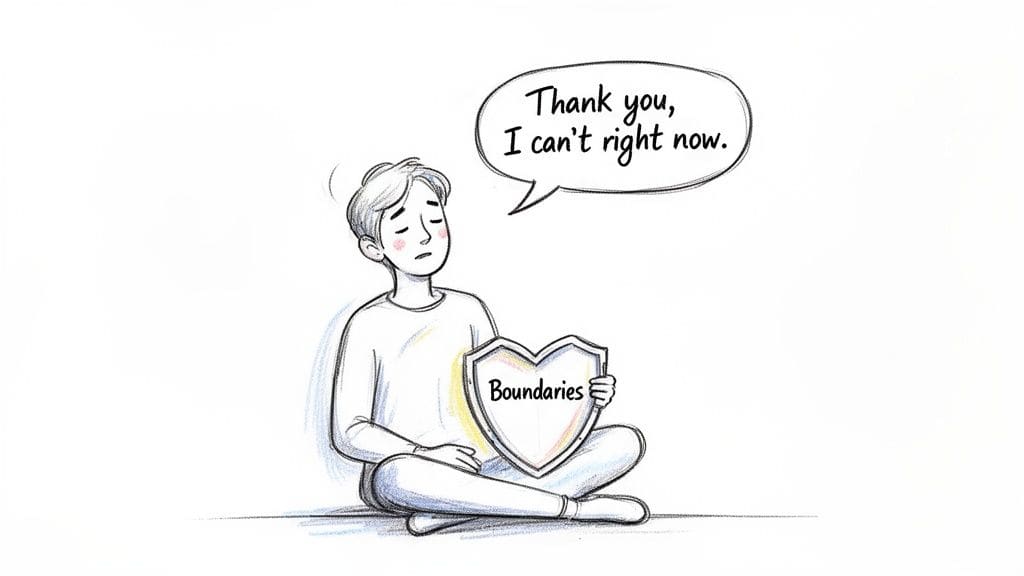
Saying "yes" when every fiber of your being is screaming "no" is a one-way ticket to burnout. For many neurodivergent people—whether you're autistic, have ADHD, or live with social anxiety—the internal pressure to agree can feel absolutely crushing.
This often comes from a deep-seated desire to please others or to sidestep the conflict you worry a "no" might cause.
But constantly pushing your own needs to the back of the line creates a huge amount of stress and leaves you feeling completely overwhelmed. Learning how to say no politely isn't about being unhelpful or difficult; it's about setting healthy boundaries.
These boundaries are the single most important tool you have for managing your energy, focus, and overall well-being. When you protect your time and resources, you can show up more fully for the commitments you do make.
Why Saying No Feels So Hard
The knot in your stomach when you know you need to say no often comes from a few key places, particularly for neurodivergent minds:
- Rejection Sensitivity Dysphoria (RSD): A common experience for people with ADHD, RSD involves feeling intense emotional pain from perceived rejection or criticism. This makes the thought of disappointing someone feel unbearable.
- Masking and Social Camouflaging: Many autistic individuals have spent a lifetime learning to "mask" or hide their true feelings to fit in. Saying "yes" becomes an automatic, default part of that social script, even when it's harmful.
- Fear of Misinterpretation: There's often a nagging worry that your "no" will be taken personally or that your tone will sound rude, damaging a relationship you care about.
This is exactly why having a plan is so powerful. It's absolutely crucial to understand that setting personal limits is non-negotiable for your well-being. Saying no effectively is what stops situations where when emotions run wild and boundaries vanish, it can lead to a relationship disaster.
Having the right words ready can bridge the gap between knowing you need to say no and actually doing it. It helps you steer clear of the common symptoms of emotional exhaustion that come from overcommitment.
How to Assess the Request and Choose Your Tone
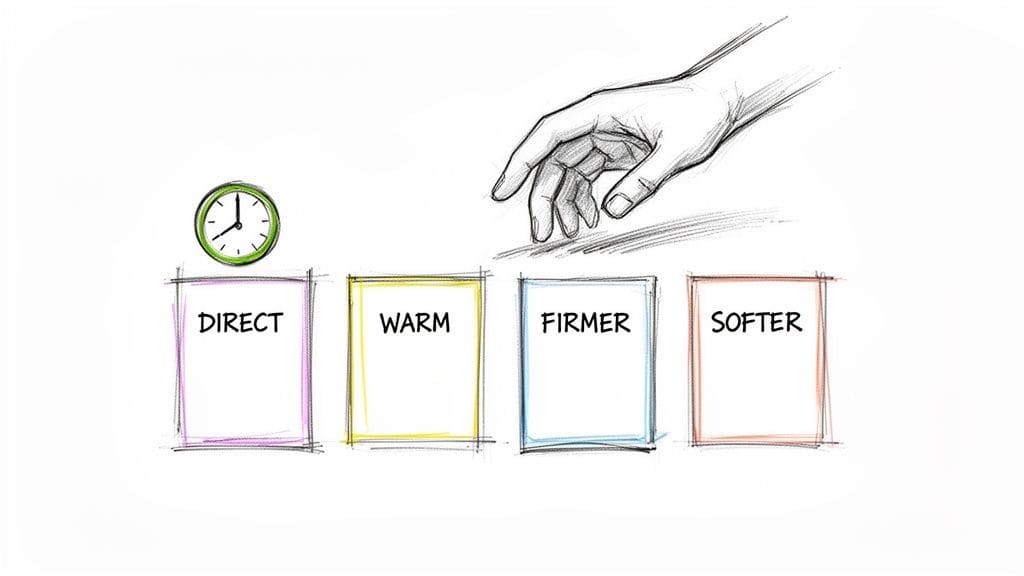
Before you can craft the perfect "no," you need to quickly figure out what you're dealing with. A polite decline isn't a one-size-fits-all script; it's a response tailored to the situation. It all starts with a quick mental check: Who's asking? What do they really want? And what's at stake here?
A last-minute demand from your boss lands very differently than a casual invite from a friend you see every week. Taking just a few seconds to assess the context is the single most important thing you can do. It's what helps you pick the right words and tone, drastically lowering the risk of a miscommunication that leaves everyone feeling anxious.
The Mental Checklist for Evaluating Requests
This doesn't have to be a long, drawn-out process. Think of it as a rapid-fire mental checklist you run through before you even start thinking about your reply.
Just quickly ask yourself:
- Who is the requester? A manager needs a different level of formality than a close family member or a casual acquaintance. Your relationship is the biggest clue for how warm or formal you need to be.
- What is the urgency? Is this a "the-building-is-on-fire" emergency or a "sometime-next-month" task? A genuinely urgent request might need a more direct and immediate response.
- What are the stakes? Saying no to a major project at work carries a lot more weight than declining an invitation for coffee. High-stakes situations need careful, professional phrasing to protect your relationships and reputation.
- What is the unspoken context? Does the person asking seem stressed or overwhelmed? Are they known for being pushy and not taking no for an answer? Reading the subtext can help you respond with exactly the right amount of empathy or firmness. Our guide on how to read someone's tone can offer deeper insights here.
Answering these questions moves you out of a place of panicked reaction and into a position of thoughtful, deliberate action.
Matching Your Tone to the Context
Once you've sized up the request, you can consciously choose a tone that fits. It's like picking the right tool for the job. Your tone is often more important than the specific words you use because it communicates respect and confidence.
> Key Takeaway: Your tone is just as important as your words. Choosing the right one shows respect for the other person and confidence in your own decision to decline the request politely.
Let's say a colleague asks you to help with a last-minute report that's due tomorrow, but your own plate is full. Here's how you could adapt your response using different tones.
- Direct: This is your go-to for clear, low-emotion professional settings. It's efficient and leaves no room for misinterpretation.
- Example: "Thanks for asking, but I can't take that on. I have to focus on my existing deadlines for Project X."
- Warm: Perfect for friends, supportive colleagues, and family. It softens the "no" with a layer of kindness and preserves the relationship.
- Example: "Oh, I wish I could help! My plate is totally full trying to finish Project X. I hope you can get it done in time!"
- Firmer: This tone is necessary when you've been asked repeatedly, the request is unreasonable, or someone is pushing your boundaries. It's about being clear and unshakeable.
- Example: "I've already stated that my priority is Project X. I will not be able to help with your report."
- Softer: A great choice when the person asking is clearly stressed or sensitive, and you want to be extra gentle with your refusal.
- Example: "I see you're in a tough spot. I really can't step in right now as I'm swamped with my own deadline, but I'm sending you good vibes to get it sorted."
By consciously choosing your tone, you take control of the interaction. This simple act makes it so much easier to say no while protecting your energy and your relationships.
Practical Scripts for Saying No in Real-Life Scenarios
Knowing you should say no is one thing. Actually finding the words in the moment, when your brain is racing and the pressure is on? That's a whole different ball game.
This is where having a few pre-planned scripts becomes an absolute lifesaver. They act as a mental shortcut, taking away the anxiety of trying to invent the perfect, polite response from scratch every single time. The goal isn't to sound robotic; it's to have a reliable starting point you can lean on.
Think of it as building a personal library of polite declines. You can check one out whenever you need to protect your time and energy. For many neurodivergent people, this kind of preparation is a core strategy for making social interactions feel less draining and more manageable. You can explore more of these ready-to-use conversation scripts for neurodivergent people.
Struggling to say no without feeling guilty? tonen can help.
tonen offers conversation scripts, Reply Helper, Perspective Helper, Debrief, Phone Call Mode and Calm Kit. Start with 21 free scripts on iPhone. Optional Premium unlocks more features.
Download on the App StoreAvailable on iOS.
Scripts for Saying No at Work
Professional settings often feel like they have the highest stakes. But setting firm, clear boundaries at work is essential for preventing burnout and actually doing your job well. Knowing how to decline a request politely from a colleague or manager shows you're being thoughtful and strategic about your workload, not that you're unhelpful.
Here's a look at a few common workplace scenarios and how you might handle them:
- When asked to take on a non-urgent task:
- Direct: "Thank you for thinking of me for this, but I don't have the capacity to take it on right now."
- Warm: "That sounds like an interesting project! Unfortunately, my plate is full at the moment, but I appreciate you asking."
- When invited to a last-minute, optional meeting:
- Softer: "Thanks for the invite. I need to stay focused on my current deadline, so I'll have to sit this one out. Could you send me the key takeaways afterward?"
- Firmer: "I won't be able to make that meeting on such short notice. My schedule is committed."
Scripts for Saying No to Family and Friends
Turning down requests from the people we love can feel even more complicated. The emotional stakes are higher, and it's easy to feel like you're not just managing a task, but the entire relationship.
> Key Insight: When you say no to a request, you are not rejecting the person. You are simply declining a specific action at a specific time. Reminding yourself of this distinction can help ease feelings of guilt.
Let's look at some social scripts you can adapt:
- Declining a social event when you feel overwhelmed:
- Warm: "Thank you so much for inviting me, that sounds like so much fun! I'm not up for it this time, but I hope you have an amazing night."
- Softer: "I really appreciate the invite, but I need a quiet evening to recharge. Let's catch up soon, though!"
- Turning down a request for a favor (e.g., babysitting, borrowing your car):
- Direct: "I'm sorry, but I'm not able to help with that."
- Warm: "Oh, I wish I could, but that won't work for me. I hope you can find someone else to help out!"
Go Beyond "No" With These Graceful Alternatives
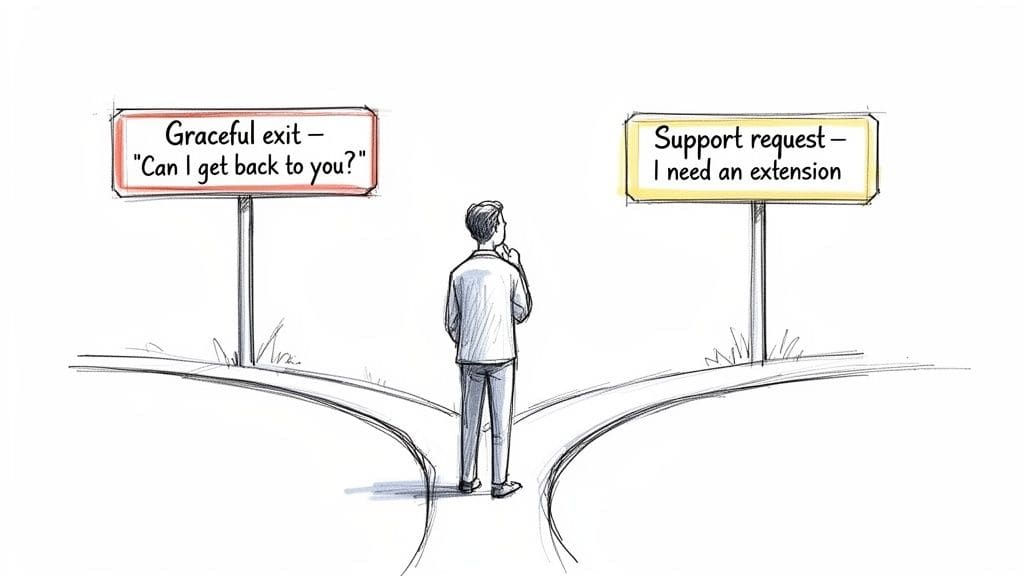
Sometimes, a simple "no" just doesn't feel right for the situation. It can feel too blunt or final. Knowing how to decline a request politely also means having a few other strategies in your back pocket for moments that need more nuance than a direct refusal.
Two of the most powerful moves are the "graceful exit" and the "support request." These aren't just ways to say no; they shift the dynamic from a hard stop into a more collaborative conversation, preserving your energy and the relationship. They're especially helpful when you feel overwhelmed or put on the spot.
Create Space With a Graceful Exit
A graceful exit is your go-to move for buying time. It's a pre-planned "opt-out" line that gets you out of an immediate commitment when you feel cornered or unsure. This isn't avoidance—it's a strategic pause.
Let's say a coworker ambushes you in the kitchen and asks you to join a new committee. Your mind goes blank. Instead of defaulting to a "yes" you'll regret, you can say:
- "Thanks for thinking of me. I need a moment to check my workload before I commit. Can I get back to you?"
- "That sounds interesting. Let me look at my calendar and capacity. I'll let you know by tomorrow."
Using an exit line shows you're taking the request seriously while honoring your own need for processing time. It's a game-changer for preventing people-pleasing. We explore this further in our article on how to set boundaries with friends.
Turn a "No" Into a Negotiation
The second strategy, asking for support, turns a hard "no" into a conditional "yes." This is an incredibly powerful negotiation tool, especially at work. Instead of just shutting down a request, you explain what you would need to make it happen.
> Key Takeaway: By asking for support, you're not just declining; you're actively problem-solving. It shows you're a team player who is also realistic about your capacity.
For instance, if your boss asks you to take on yet another project, rather than flat-out refusing, you could respond:
"I can definitely take that on. To do it well, I'd need to get an extension on the X deadline, or we'd need to shift some of my other tasks. Which would you prefer?"
You can state a limit and make a practical request without turning it into a judgement about yourself: “I need written priorities before I can agree to another task.” This does not guarantee agreement, but it makes the request clear.
Deciding which strategy to use can be tricky. This table breaks down when to use a simple 'no,' an opt-out line, or a support request based on what's happening.
Choosing Your Response Strategy
| Situation | Best Strategy | Why It Works |
|---|---|---|
| A request you absolutely cannot or do not want to do. | A Simple 'No' | It's clear, firm, and leaves no room for misinterpretation. |
| You're ambushed or feel pressured to answer immediately. | Graceful Exit | It buys you precious time to process the request and respond thoughtfully later. |
| You're willing to do it, but not under the current conditions. | Ask for Support | It opens a negotiation, turning a potential conflict into a collaborative solution. |
| The request is vague, and you need more information before you can decide. | Graceful Exit | It lets you pause the conversation so you can ask clarifying questions later. |
| It's a low-stakes social request you're just not up for. | A Simple 'No' | A polite but direct "I can't make it, but thanks for the invite!" is perfectly fine. |
| A manager asks you to take on work that will lead to burnout. | Ask for Support | It reframes your boundary as a resource issue, protecting your well-being. |
Ultimately, having these alternatives ready means you're not just reacting. You're responding with intention, equipped to handle almost any request that comes your way while keeping your own needs front and center.
How to Practice and Prepare to Reduce Social Anxiety
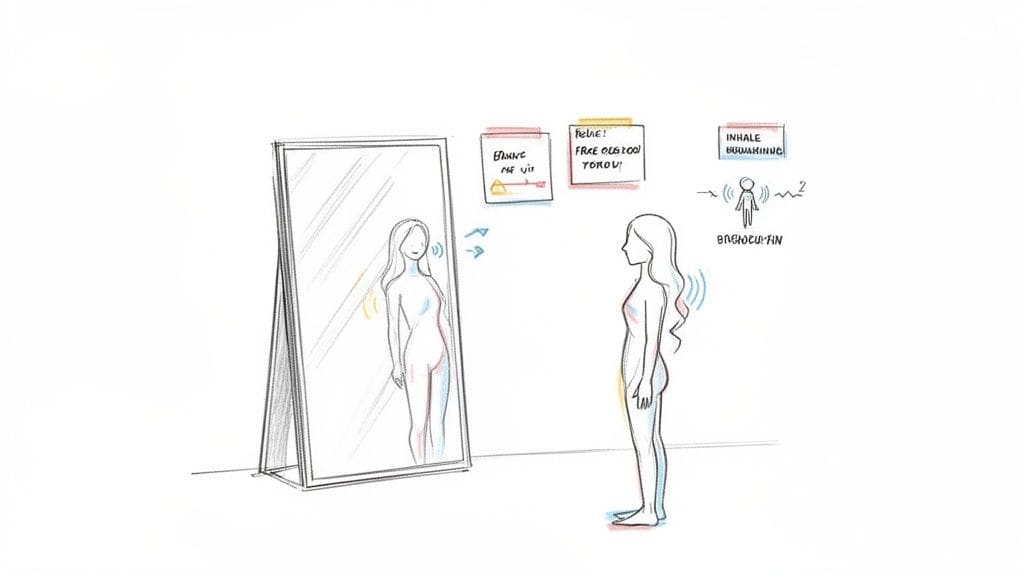
Knowing the right words is only half the battle. The real challenge comes when social anxiety floods your system, making it feel impossible to say what you've planned. This is where preparation becomes your superpower. To truly master how to decline a request politely, you need to practice until the words feel like your own, not something you're reciting from a manual.
This rehearsal is what turns a script into confident, real-world communication. Feeling anxious before a tough conversation is completely normal, but with the right preparation, you can build the muscle memory you need to state your boundaries calmly and clearly.
Rehearse Your Scripts Out Loud
Reading a script in your head feels worlds away from actually saying it. The only way to find the right rhythm and tone—so the words feel authentic when you need them—is to practice them out loud.
- Practice in a private space: Say your chosen phrases to yourself in the mirror. This little bit of rehearsal helps you get comfortable with the words and see how your body language comes across.
- Use a voice recorder: Record yourself saying a script and then play it back. This gives you invaluable feedback on your tone. Do you sound hesitant, or confident and clear?
- Role-play with a trusted person: If you have a supportive friend or family member, ask them to role-play the scenario with you. It's the closest you can get to a real-life practice run without the high stakes.
This kind of prep work seriously reduces the cognitive load in the actual moment, making it much easier to stick with your decision.
Reframe the Situation to Lower Anxiety
Social anxiety often tricks us into assuming the worst-case scenario. We imagine the other person getting angry or feeling disappointed, and our minds spiral into catastrophizing the outcome. Cognitive reframing is a technique that helps you challenge those negative automatic thoughts.
Instead of jumping to, "They are trying to overwhelm me," try reframing it as, "They probably don't realize how much is on my plate right now." This small shift in perspective changes the narrative from feeling attacked to simply seeing a lack of information. This mental switch can dramatically lower your stress before you even respond.
> Key Takeaway: You are not rejecting the person; you are declining a specific request. This mental reframe can ease feelings of guilt and make it easier to protect your own well-being.
Use Self-Regulation Techniques to Stay Grounded
Before you head into the conversation, take a few moments to calm your nervous system. These simple techniques can ground you and reduce the physical symptoms of anxiety, like a racing heart or a shaky voice. For those who struggle with this, exploring methods for reducing anxiety naturally can provide some powerful coping strategies.
Here are two quick exercises you can do anywhere:
- Box Breathing: Inhale for a count of four, hold your breath for four, exhale for four, and hold again for four. Repeat this cycle three to five times. It's a remarkably effective way to regulate your breathing and heart rate.
- Grounding: Pull your attention away from anxious thoughts and into the present moment by focusing on your senses. Silently name five things you can see, four things you can feel (like your feet on the floor), three things you can hear, two things you can smell, and one thing you can taste.
When you combine rehearsal, reframing, and self-regulation, you create a powerful toolkit. You can find more practical tips for social anxiety in our other articles.
Your Questions About Saying No, Answered
Learning to say no brings up a lot of "what if" scenarios. It's one thing to know the words, but it's another thing to use them in the moment. Setting boundaries is a skill that takes practice, and it's completely normal to have questions as you start navigating these new social dynamics.
Let's get into some of the most common concerns that come up.
What If Someone Gets Angry After I Politely Decline?
If someone reacts poorly to your respectful "no," remember this: their reaction is their responsibility, not yours. Your only goal was to be respectful while protecting your own needs, and you did that.
The best way forward is to hold your boundary calmly. You can do this by repeating your refusal in a simple, firm way. You don't need to get drawn into an argument or feel pressured to justify a perfectly valid boundary.
A good response might be, "I understand you're frustrated, but my answer is still no." You can also use a clear exit phrase like, "I've made my decision and I'm not going to discuss it further."
How Can I Say No Without Feeling Guilty?
Guilt is incredibly common, especially for those of us with rejection sensitivity. The key is to actively and consciously remind yourself why you said no in the first place—was it to protect your energy, manage your workload, or preserve your mental well-being?
> A crucial reminder: You are not rejecting the person; you are declining a specific request. This mental shift helps detach the action from your feelings about the relationship.
Over time, as you practice setting boundaries and see the positive effects on your life, that feeling of guilt will start to fade. It really does get easier.
Is It Okay to Just Say 'No' Without a Reason?
Yes. It is absolutely okay. You are not obligated to provide a long, detailed explanation for your decision. In fact, keeping it brief often prevents the other person from trying to "solve" your reasons for you, which can be an exhausting experience.
A simple phrase like one of these works perfectly:
- "I'm not able to do that right now."
- "Thanks for the offer, but I'll pass."
For neurodivergent people who may feel an intense pressure to over-explain, practicing these short, direct phrases is incredibly freeing. It conserves precious mental energy and reinforces that "no" is a complete sentence.
How Do I Decline a Request From My Boss Without Risking My Job?
This scenario definitely requires a more strategic approach. Instead of a flat "no," you want to frame your response around professional priorities and your existing capacity. This shows you're engaged and responsible, turning the conversation into a negotiation about workload rather than a refusal.
Try one of these professional scripts:
- "I can definitely take that on. To make sure it gets the attention it deserves, which of my current projects should I de-prioritize?"
- "I'd be happy to help. To do this well, I'd need an extension on Project X. Does that work for you?"
This method helps you learn how to handle a tough request in a high-stakes environment by shifting the focus from simple refusal to realistic resource management.
Navigating these conversations is tough. The tonen app gives you conversation scripts, perspective helpers, and tone options to say "no" with confidence. With tools designed by and for neurodivergent people, you can reduce anxiety and communicate your boundaries clearly. Find the words you need on the App Store.