This guide offers practical, evidence-based tips for social anxiety designed to reduce cognitive load and build genuine confidence. Instead of vague suggestions like "just be yourself," you will find specific, actionable strategies that provide a clear path forward in challenging social settings. We will cover concrete tools you can implement immediately to manage the physical and mental symptoms of social anxiety, such as using brief scripts for common interactions, employing grounding techniques to stay present, and utilizing strategic planning to make events more predictable.
1. Cognitive Behavioral Therapy (CBT) for Social Anxiety
Cognitive Behavioral Therapy (CBT) is an evidence-based psychological approach that empowers you to reframe negative thoughts and beliefs about social situations. This method is a powerful tool for managing social anxiety because it directly targets the cycle of catastrophic thinking that fuels fear. It works by helping you identify anxious thought patterns, challenge their validity, and consciously replace them with more balanced and realistic perspectives. For a deeper understanding of this powerful approach, explore this guide on What is Cognitive Behavioral Therapy (CBT).
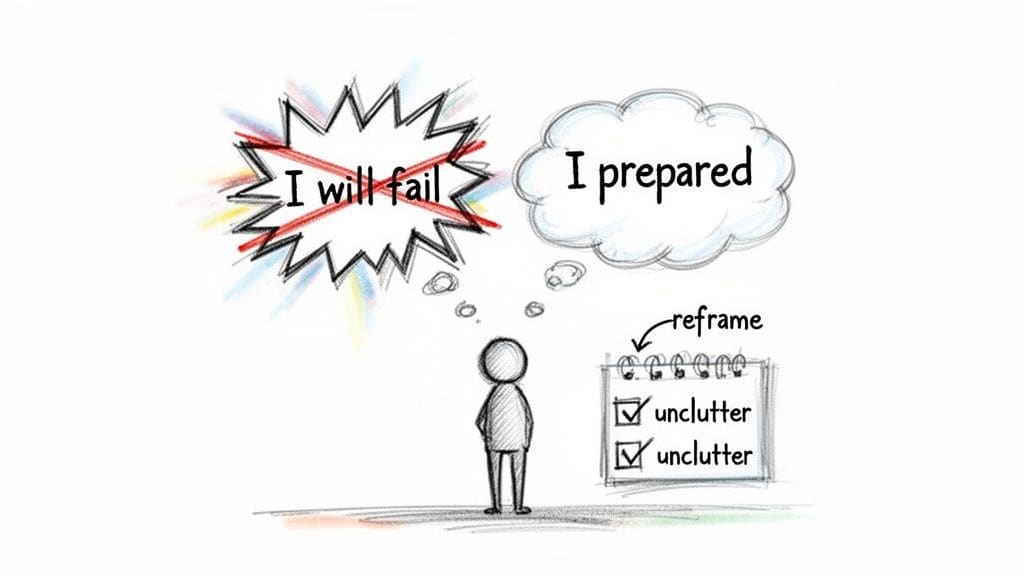
For instance, someone anxious about a presentation might automatically think, "I'm going to freeze up and everyone will think I'm incompetent." Using CBT, they can reframe this to, "I've prepared thoroughly and I am knowledgeable. It's okay if I'm nervous, and I can handle any questions that come up." This shift doesn't ignore the anxiety; it just stops the unhelpful thought from taking over.
How to Apply CBT to Social Situations
To start using this technique, you don't need to be a professional. Here are some simple, actionable tips you can implement today:
- Isolate and Identify: Focus on one specific anxious thought each day. Writing it down makes it more concrete and easier to analyze.
- Challenge with Evidence: Ask yourself: Is this thought a fact or just my opinion? What proof do I have for or against it?
- Test Your Predictions: If you predict a social event will be a disaster, gently test that belief by attending for a short, defined period. Gather real-world evidence.
Many digital tools can support this process. You can learn more about how apps can assist with CBT exercises and help you practice these skills consistently.
2. Exposure Therapy and Gradual Desensitization
Exposure therapy is a structured technique that helps you gradually and repeatedly face feared social situations in a safe, controlled way. This powerful approach reduces anxiety over time through a process called habituation, where your nervous system learns that the situations you dread are not actually dangerous. By pairing these exposures with relaxation techniques, you can systematically desensitize your anxiety response, making it one of the most effective strategies.
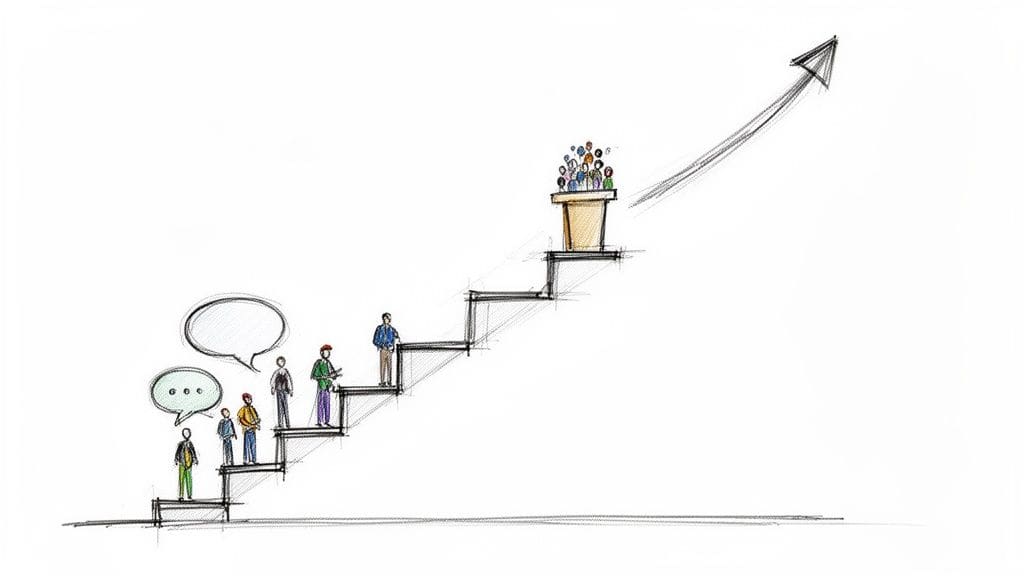
For example, if you have phone call anxiety, you might start by calling a business to ask for their hours. You would then progress to calling a friend for a brief chat. Similarly, a person anxious about meetings could begin by attending a low-stakes team huddle before eventually working their way up to leading their own meeting. The key is to take small, manageable steps.
How to Apply Exposure Therapy to Social Situations
Starting this practice involves planning rather than just jumping into your biggest fear. Here are some actionable steps using this method:
- Create a Fear Hierarchy: List your feared social situations and rank them on a scale of 0-100 based on how much anxiety they cause. This creates your roadmap.
- Start Small: Begin with situations rated around 30-40 on your hierarchy. Don't start with your most terrifying scenario; success at lower levels builds confidence.
- Stay and Habituate: Remain in the situation until your anxiety naturally decreases, which often takes at least 15-20 minutes. Leaving too early can reinforce the fear.
- Repeat and Advance: Practice the same level of exposure multiple times until it feels significantly less daunting. Once you feel comfortable, move to the next step on your hierarchy.
3. Deep Breathing and Physiological Soothing Techniques
Controlled breathing activates the parasympathetic nervous system, which is your body's natural calming response. This is one of the most immediate and effective tips for social anxiety because it directly counteracts the physiological fight-or-flight symptoms like a racing heart or shallow breath. Techniques like box breathing or the 4-7-8 method physically regulate your body's anxiety response in just a few minutes, giving you a powerful tool to regain control when you feel overwhelmed.
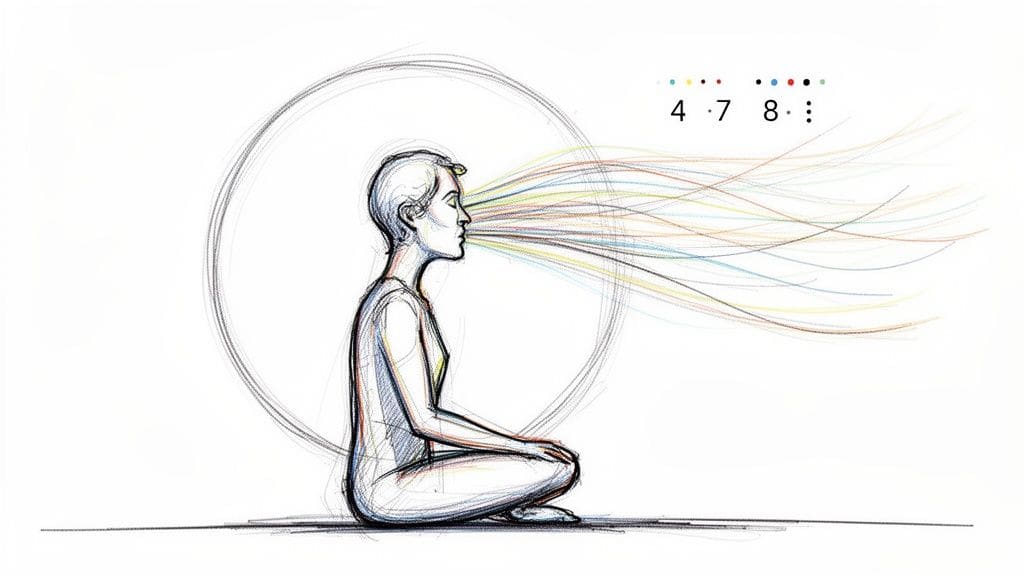
For instance, before entering a crowded room, you could discreetly practice box breathing: inhale for four counts, hold for four, exhale for four, and hold again for four. Before making a difficult phone call, try the 4-7-8 method: inhale for four seconds, hold your breath for seven, and exhale slowly for eight seconds. This simple act sends a signal to your brain that you are safe, helping to reduce the intensity of your anxiety.
How to Apply Soothing Techniques to Social Situations
Integrating breathing exercises into your routine can make them an automatic and reliable coping mechanism. Here are some actionable tips that you can start using today:
- Practice When Calm: Dedicate a few minutes each day to practicing your chosen breathing technique when you are not anxious. This builds muscle memory, making it easier to access the skill during a stressful moment.
- Focus on the Exhale: Intentionally make your exhale longer than your inhale. This has a direct effect on slowing your heart rate and deepening your sense of calm.
- Pair with Grounding: Combine your breathing with the 5-4-3-2-1 grounding technique. As you breathe, consciously notice five things you can see, four you can feel, three you can hear, two you can smell, and one you can taste. This pulls your focus away from anxious thoughts and into the present moment.
4. Social Scripts and Pre-planned Communication for Social Anxiety
Social scripts are pre-planned phrases or full sentences designed for common social situations, which can dramatically reduce the cognitive load that fuels anxiety. This strategy acts as a safety net, removing the intense pressure of generating spontaneous conversation in real time. For neurodivergent individuals who may find real-time social processing challenging, having tested language ready is one of the most effective strategies, as it provides a clear, manageable framework.
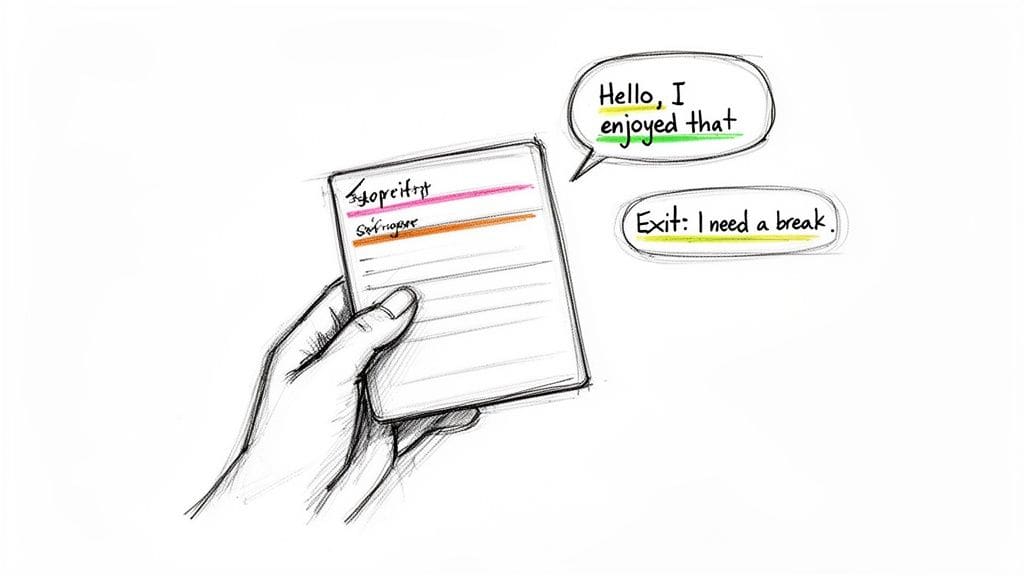
For example, at a networking event, instead of worrying about what to say, you can use a script like, "Hi, I enjoyed the presentation. What was your main takeaway?" If you feel overwhelmed, an exit script like, "I need to step away for a moment, but I'd love to continue this later," gives you a graceful way out. This pre-planning shifts your focus from panic to participation.
Looking for practical social anxiety tips? tonen can help.
tonen offers conversation scripts, Reply Helper, Perspective Helper, Debrief, Phone Call Mode and Calm Kit. Start with 21 free scripts on iPhone. Optional Premium unlocks more features.
Download on the App StoreAvailable on iOS.
How to Apply Social Scripts
You can start creating and using scripts to make social interactions less daunting. Here are some actionable tips you can implement today:
- Memorize Key Phrases: Start by memorizing 2-3 conversation starters for situations you frequently encounter. For a deeper dive, you can explore more techniques on how to start a conversation.
- Practice Out Loud: Rehearse your scripts multiple times. Hearing yourself say the words makes them feel more natural and easier to recall under pressure.
- Prepare Openings and Closings: Ensure you have scripts for both initiating a conversation and ending one. Having a prepared exit line is just as important as an opener.
- Adapt and Personalize: Tweak the language of your scripts to match your own voice. The goal is for them to sound authentic, not robotic.
5. Grounding and Sensory Regulation Techniques
Grounding techniques are powerful tools that anchor your attention to the present moment through sensory engagement. This approach is one of the most effective strategies because it interrupts the spiraling thoughts of social judgment and redirects your nervous system away from threat-detection mode. By focusing on tangible sensations, you can shift your awareness to the safety of your immediate environment, which helps regulate overwhelming feelings. For a comprehensive overview, you can explore these grounding techniques for anxiety.
For example, when you feel a wave of panic in a conversation, you might internally use the 5-4-3-2-1 method: silently name five things you can see, four things you can hear, three you can feel, two you can smell, and one you can taste. This sensory scan pulls your focus from internal fears to external reality. Another method is to subtly press your feet into the ground and notice the firm sensation, reminding your body that you are stable and supported.
How to Apply Grounding in Social Situations
Integrating these techniques into your daily life can make them more accessible when you need them most. Here are some actionable tips to get you started:
- Practice Proactively: Use the 5-4-3-2-1 technique daily, even when you're calm, so it becomes second nature during moments of high stress.
- Carry a Grounding Object: Keep a small, tactile item like a smooth stone, a fidget toy, or even a tube of scented lotion in your pocket to discreetly engage your senses.
- Choose comfortable sensations: Hold a familiar object or notice the support beneath you. Avoid pain or intense sensations, and stop if it feels worse.
6. Perspective-Taking and Thought Reframing
Perspective-taking and thought reframing are powerful tips that involve shifting your focus away from self-critical internal monologues. This technique directly challenges the assumption that others are judging you by encouraging you to consider alternative, more realistic interpretations of a situation. It interrupts the cycle of anxiety by questioning the automatic negative thoughts that tell you people are hyper-focused on your perceived flaws. For additional insights on interpreting social cues, explore this guide on how to understand what someone truly meant.
For example, an anxious thought like, "Everyone noticed I stuttered and thinks I'm incompetent," can be reframed. A more balanced perspective would be, "Most people were likely focused on the content of what I was saying, not my delivery. Even if they noticed, it doesn't define my entire contribution." This shift helps you see that your internal experience of anxiety is often much more intense than what others perceive. For a deeper dive into adjusting thought patterns, explore various cognitive reframing techniques.
How to Apply Perspective-Taking in Social Situations
You can begin using this method immediately to manage anxious thoughts. Here are a few practical ways to start:
- Write It Down: When an anxious thought arises, write it down. Then, list three to five alternative, more neutral, or positive interpretations of the situation.
- Be a Friend to Yourself: Ask, "What would I tell a friend who was having this exact same thought?" We often offer more compassion to others than to ourselves.
- Seek Counter-Evidence: Actively look for evidence that contradicts your anxious thought. Did someone smile at you? Did the conversation continue normally?
7. Progressive Muscle Relaxation (PMR)
Progressive Muscle Relaxation (PMR) is a deep relaxation technique that involves systematically tensing and then releasing different muscle groups throughout the body. This practice is one of the most effective physical tips because it directly combats the body's stress response. By creating a stark contrast between tension and relaxation, you teach your nervous system what true calm feels like, reducing the physical symptoms that fuel anxious thoughts.
For example, before a presentation, you might tense your shoulders up to your ears for five seconds and then let them drop completely. The goal is to consciously notice the difference. Similarly, you could perform a full-body PMR session the evening before a major social event to promote restful sleep or do a quick version focusing on your hands and face during a break before a meeting. This method increases body awareness and gives you a tangible way to release stored tension.
How to Apply PMR to Social Situations
You can practice PMR almost anywhere to manage physical anxiety symptoms. Here are some actionable tips you can implement:
- Start Small: Begin with a 5-minute version focusing only on your shoulders, hands, and face, as these areas often hold the most tension.
- Time it Right: Tense each muscle group for 5-7 seconds, then fully release the tension for 15-20 seconds, focusing on the feeling of relief.
- Practice Consistently: Use PMR regularly, not just when you feel anxious. Consistent practice makes the relaxation response more automatic and effective when you need it most.
- Use Audio Guides: When you're first learning, use guided PMR audio tracks to help you master the proper form and sequence.
8. Preparation and Research (Situational Planning)
Anxiety often stems from the unknown, and reducing uncertainty is a powerful strategy for managing social fears. Situational planning involves researching the details of an upcoming social event to feel more prepared and in control. This proactive approach helps demystify the situation, allowing you to anticipate what to expect and mentally rehearse your interactions. For neurodivergent individuals who thrive on predictability, this is one of the most effective strategies.
For example, before starting a new job, you might look up the company's team page to familiarize yourself with colleagues' names and roles. For a networking event, you could review the LinkedIn profiles of key attendees or research common topics in their industry. This preparation gives you a foundation for conversation and transforms an unpredictable event into a more manageable one. This method is a key part of coping with social anxiety because it directly lowers the stakes.
How to Apply Situational Planning
You can integrate this strategy into your routine to reduce pre-event stress and build confidence. Here are some actionable tips you can use:
- Create a Research Checklist: For different situations (e.g., parties, meetings), make a list of what to find out: dress code, attendees, location layout, and potential conversation topics.
- Set a Time Limit: Prevent overthinking by setting a timer for your research, such as 20-30 minutes. The goal is to feel prepared, not overwhelmed.
- Plan Your Arrival and Exit: Decide on your arrival time, giving yourself a buffer to avoid rushing. Also, plan a simple exit line and strategy so you feel empowered to leave when you need to.
9. Mindfulness and Acceptance-Based Approaches
Mindfulness and acceptance-based approaches, like Acceptance and Commitment Therapy (ACT), offer a powerful alternative to fighting anxiety. Instead of trying to eliminate anxious feelings, these methods teach you to observe them without judgment. This is a crucial tip for social anxiety because it helps break the cycle of "anxiety about anxiety," where fear of the physical and mental sensations of anxiety makes the experience much worse. You learn to acknowledge that anxiety is present while still choosing actions that align with your personal values.
For example, instead of getting caught up in the belief, "I'm going to embarrass myself," you can mindfully notice it as a mental event: "I'm having the thought that I'll embarrass myself." This creates distance. Similarly, you might attend a social gathering despite feeling anxious because you value friendship. The goal isn't to erase anxiety, but to stop it from controlling your life. This shift in perspective allows you to coexist with discomfort while pursuing what truly matters to you.
How to Apply Mindfulness and Acceptance to Social Situations
Integrating these strategies into your daily life can fundamentally change your relationship with social fear. Here are some actionable tips you can use to get started:
- Observe Your Thoughts: Practice labeling anxious thoughts as just "mental events" rather than undeniable facts. This small change in language can reduce their power.
- Identify Your Values: Before a social event, ask yourself what is important to you in that situation. Is it connection, learning, or supporting a friend?
- Act on Your Values: When anxiety arises, ask, "What would a valued action look like right now?" This helps you make choices based on your goals, not your fears.
- Practice Grounding: If physical sensations like a racing heart become overwhelming, use a grounding technique. Focus on the feeling of your feet on the floor to bring yourself back to the present moment.
10. Social Support and Communication of Needs
Connecting with trusted people and clearly communicating your needs is one of the most powerful strategies. Rather than facing social situations alone, this approach transforms isolation into connection. Disclosing your anxiety to someone you trust can reduce its power, provide practical in-the-moment support, and make challenging social environments feel far more manageable. It's about building a team, even if it's just a team of two.
For example, before a large party, you might text a friend: "I'm feeling anxious about tonight. Could you check in with me around 9 PM?" Or you could tell a coworker, "I sometimes struggle to speak up in big meetings. It would really help if you could ask for my thoughts on the project if you see an opening." This transparency turns an internal struggle into a shared, solvable problem.
How to Build Your Support System
Effectively communicating your needs is a skill you can develop. Here are some actionable tips you can use to build your network:
- Start Small: Begin by disclosing your feelings to just one trusted person, like a close friend, partner, or family member.
- Be Specific: Instead of saying "I'm anxious," specify what kind of support helps. For example, "Could we stand near the exit so I know I can step out if I need to?"
- Frame it as Information: Present your anxiety as a piece of information, not an apology. Phrases like, "Just so you know, I get overwhelmed in loud places," are direct and effective.
- Find Your Community: Connecting with others who share similar experiences can be incredibly validating. You can explore online support communities for social anxiety to find people who truly understand.
Social Anxiety: 10-Strategy Comparison
| Technique | ⚡ Resources & time | 💡 Ideal use cases |
|---|---|---|
| Cognitive Behavioral Therapy (CBT) for Social Anxiety | Therapist-guided or self-study; weeks–months | Persistent social anxiety; desire for long-term change |
| Exposure Therapy and Gradual Desensitization | Repeated practice/sessions; weeks with consistent effort | Specific fears and avoidance behaviors |
| Deep Breathing and Physiological Soothing Techniques | Minimal resources; effective in minutes | Acute anxiety episodes; discreet use |
| Social Scripts and Pre-planned Communication | Time to draft and practice; low material needs | Networking, predictable interactions, neurodivergent users |
| Grounding and Sensory Regulation Techniques | Minimal resources; 2–5 minutes per use | Acute overwhelm, situations needing discreet regulation |
| Perspective-Taking and Thought Reframing | Low materials; consistent practice over weeks | Catastrophic interpretations, pre-event anxiety |
| Progressive Muscle Relaxation (PMR) | 15–20 minutes for full session; quiet space | Pre-event preparation, somatic anxiety, sleep issues |
| Preparation and Research (Situational Planning) | Time upfront (minutes–hours); checklists help | First-time events, interviews, predictable settings |
| Mindfulness and Acceptance-Based Approaches | Daily practice recommended; weeks–months | Chronic anxiety, avoidance cycles, value-driven goals |
| Social Support and Communication of Needs | Requires trusted people; ongoing relational time | Those with supportive networks; need for accountability |
Building Your Personal Social Anxiety Toolkit
Navigating a world designed for extroverts can feel overwhelming, but managing social anxiety is not about becoming someone you're not. It's about building a personalized and effective toolkit filled with strategies that support your unique neurotype and communication style. Throughout this guide, we've explored a collection of powerful tips for social anxiety, moving beyond generic advice to provide actionable, neurodivergent-friendly techniques. The journey toward social ease is not a linear path but a process of discovery, practice, and self-compassion.
Key Takeaways: From Theory to Practice
The most crucial takeaway is that you are in control of building your support system. You are the architect of your own social comfort. Remember these core principles:
- Preparation is Power: Proactive strategies like crafting social scripts, researching event details, and rehearsing conversations are not signs of weakness. They are intelligent and effective methods for reducing uncertainty and calming an anxious mind.
- Physiological Regulation First: You cannot think your way out of a physiological anxiety response. Techniques like deep breathing, Progressive Muscle Relaxation (PMR), and sensory grounding are essential for calming your nervous system and creating the mental space needed to engage socially.
- Mindset Matters: Cognitive tools are invaluable. Challenging negative thought patterns through CBT-inspired reframing, practicing mindfulness to stay present, and shifting your perspective can fundamentally change your experience of social situations.
Your Action Plan for Moving Forward
True progress comes from consistent application, not just passive reading. The value of these strategies lies in their implementation. Start small and build momentum.
1. Select Your Starting Trio: Choose just three techniques from this list that feel most accessible to you right now. Perhaps it's one breathing exercise, one grounding technique, and the idea of preparing a single exit line.
2. Practice in Low-Stakes Environments: Don't wait for a high-pressure event. Rehearse your social scripts while driving, practice your breathing techniques before a phone call, or use a grounding technique while waiting in line at the grocery store.
3. Reflect and Refine: After a social interaction, take a moment to consider what worked. Did your pre-planned question help? Did tapping your fingers help you stay present? This reflection helps you refine your toolkit over time.
Ultimately, managing social anxiety is an act of profound self-advocacy. It's about giving yourself the tools, permission, and grace to navigate social landscapes in a way that feels sustainable and authentic. Every small step you take, every script you write, and every deep breath you intentionally take is a victory. These strategies empower you to reclaim your agency, build genuine connections, and show up in the world with greater confidence and ease. Remember that seeking professional support is also a powerful and courageous step in this journey. You have the capacity to build a more comfortable and fulfilling social life, one intentional action at a time.
*
Ready to put these strategies into practice with a tool designed for you? tonen helps you build and rehearse personalized scripts, access perspective helpers, and use calming exercises, turning these tips for social anxiety into an actionable, pocket-sized toolkit. Explore how tonen can support your journey today.