Trying to interpret what someone meant can feel like solving a puzzle with missing pieces, especially for neurodivergent people. This guide gets straight to actionable, low-energy strategies to help you decode conversations with more confidence. For many, navigating social nuances is exhausting. Sarcasm, indirect requests, and emotional subtext require constant mental analysis, often leading to social burnout. This isn't a flaw; it's a different way of processing the world, but it can be incredibly draining. The goal is to add practical tools to your toolkit, making social navigation a manageable skill.
Navigating Social Nuances Without Exhaustion
For many neurodivergent folks, just trying to keep up with unspoken social rules is a monumental effort. The sheer amount of mental energy it takes to decipher sarcasm, indirect requests, or emotional subtext often leads to a state of total exhaustion called social burnout. This isn't a flaw; it's just a different way of processing the world.
This constant effort is like running a background app on your computer that never, ever shuts down. You're analyzing every word choice, every pause, and every gesture for hidden data. Over time, this can lead to social masking, a mentally draining process where you consciously or unconsciously hide your natural self to fit in. You can learn more about the significant impact of autism masking and its daily challenges and how it ties into this daily struggle.
Why Is This So Draining?
At its core, the problem is often a mismatch in communication styles. Neurotypical communication relies heavily on a ton of unspoken assumptions and shared context that might not be obvious to a neurodivergent mind at all. This creates a gap where misunderstandings happen way too easily.
* Literal Interpretation: Taking words at their exact face value can be a default setting. This makes it tough to catch things like sarcasm or implied meanings that others seem to get instantly.
* Anxiety and Rejection Sensitivity: The fear of getting it wrong and saying the wrong thing can be completely overwhelming. This can create a nasty cycle of overthinking everything and then avoiding social situations altogether.
* Sensory Overload: In a busy, noisy place, trying to process social cues on top of all the other sensory input is just another layer of difficulty piled on.
To get a handle on social dynamics without feeling so drained, it's helpful to understand the building blocks. Learning about what emotional intelligence is is a great starting point, as it gives you a framework for recognizing emotions in yourself and others.
> The goal isn't to rewire your brain. It's about adding practical tools to your toolkit—tools that can make social navigation feel less like a high-stakes performance and more like a manageable skill.
This guide is all about low-energy, practical methods to help you interpret what someone meant with way more confidence. We'll walk through strategies and resources, like the tonen app's perspective helper, which is designed to give you real-time support. By offloading some of that heavy analytical work, you can save your mental energy for the connections that actually matter, making social interactions more rewarding and a whole lot less depleting.
A Practical Framework For Gathering Social Data
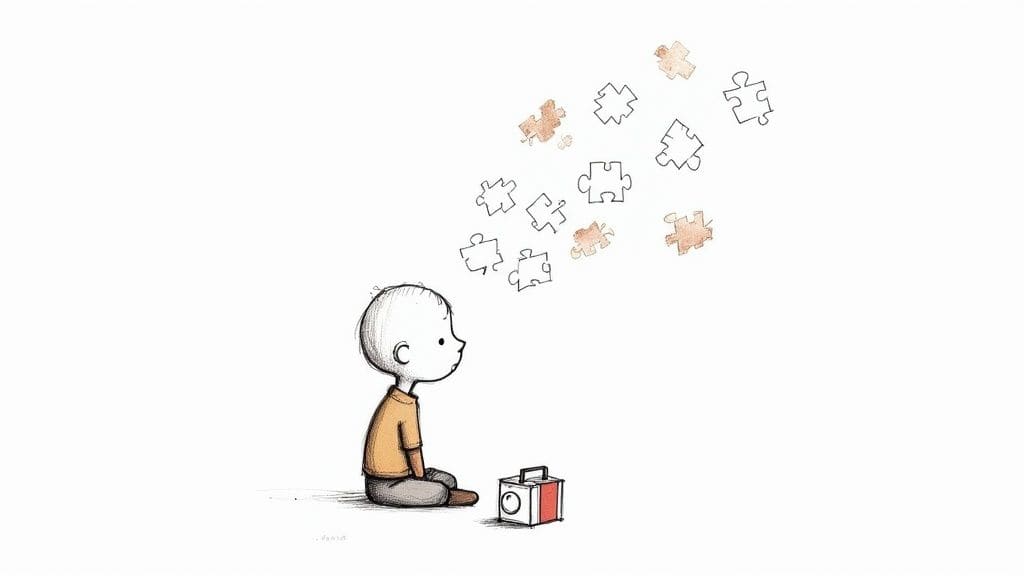
To really understand what someone means, you have to look beyond just their words. For many neurodivergent people, this can feel like trying to solve a puzzle in the middle of a storm, but breaking it down makes it much more manageable.
Think of yourself as a detective. Your job is to calmly observe the clues without jumping to conclusions. This mindset helps lower the pressure and gives you a much clearer picture of what's actually happening in a conversation.
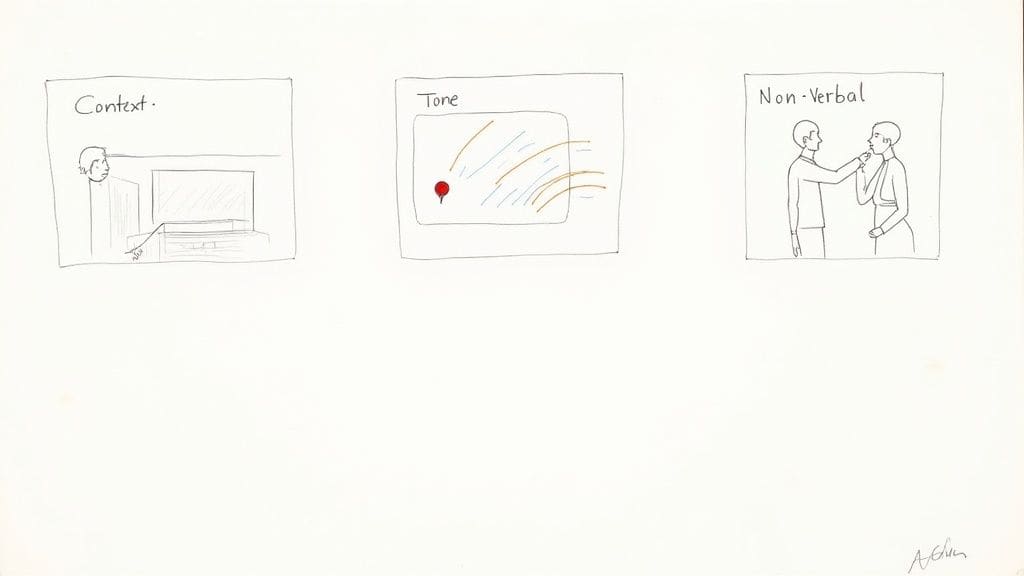
The key is to focus on three core areas: the context of the conversation, the speaker's tone, and their non-verbal cues.
Analyzing The Context
Context is the "where" and "why" of a conversation, and it shapes everything. The exact same sentence can land in completely different ways depending on the situation.
For instance, your manager saying, "This needs to be redone," feels very different in a private one-on-one meeting than it does in a tense, public team review. The first might be constructive feedback; the second can feel like a public critique.
Always take a moment to consider these factors:
* The Setting: Is this a formal work meeting, a casual coffee chat, or a noisy party?
* The Relationship: Are you talking to a close friend, a new acquaintance, or your boss?
* The Goal: Why is this conversation happening? Is it to solve a problem, share information, or just connect socially?
Listening For Tone
Tone of voice carries a massive amount of emotional information that words alone just don't have. It's the music behind the lyrics.
For neurodivergent people who often process language more literally, learning to tune into tone is a powerful skill. It's a core component of many practical social skills training programs for adults precisely because it bridges that gap between words and intent.
A simple phrase like "That's just great" can be genuinely enthusiastic or dripping with sarcasm. The difference is entirely in the delivery—the pitch, volume, and speed of the words.
> You don't have to analyze everything at once. Just start by noticing one thing. Does their voice sound relaxed, or does it sound tight? Small observations build a bigger picture over time.
Observing Non-Verbal Cues
Body language and facial expressions often tell a story that's completely at odds with what's being said. Someone might say "I'm fine" while avoiding eye contact, fidgeting constantly, or crossing their arms tightly across their chest. These are all signals that something else is going on under the surface.
The importance of these visual signals is becoming clearer even in professional fields. In remote interpreting, for example, video-based services are growing 12% faster than phone-only methods. Why? Because seeing someone allows for a much more precise interpretation of non-verbal cues, which are essential for understanding true intent.
By consciously gathering information from these three areas—context, tone, and non-verbals—you create a much richer, more reliable foundation before you even begin to understand the conversation.
Trying to figure out what someone meant? tonen can help.
tonen gives you 188+ conversation scripts, tone guidance and calming tools — designed for autistic adults, ADHD and social anxiety. Try it free for 7 days.
Download on the App StoreiOS only. Android coming soon.
Using Technology To See Other Perspectives
Even with the best observation skills, our brains can get stuck. They latch onto a single, usually negative, interpretation of a message and refuse to let go. For many neurodivergent folks, this is the trigger for a full-blown anxiety spiral. The challenge is breaking that mental loop when your brain is already screaming "worst-case scenario." This is where technology designed to be a co-pilot for your social brain can make a difference.
The goal is to disrupt the default path. When you're trying to interpret what someone meant, having a tool that offers neutral alternatives can instantly lower the emotional temperature. It creates a needed buffer between a confusing message and your gut reaction.
Introducing The tonen Perspective Helper
This is exactly why digital tools designed with neurodivergent needs in mind, like the tonen app, can be a game-changer. Its "Perspective Helper" feature is built to combat black-and-white thinking by generating multiple, kinder interpretations for a confusing social moment.
Let's use a classic example. You get a short, blunt email from your boss that just says, "Let's talk about the project report tomorrow."
For many of us, the internal alarm bells start ringing immediately: I'm in trouble. I messed something up. This is it. That single, catastrophic thought can completely take over, making it impossible to think clearly or respond calmly.
The Perspective Helper interrupts that process. You plug in the situation, and it offers alternative viewpoints your anxious brain can't access on its own. It's like having an on-demand, private second opinion to help you see things from a different angle.
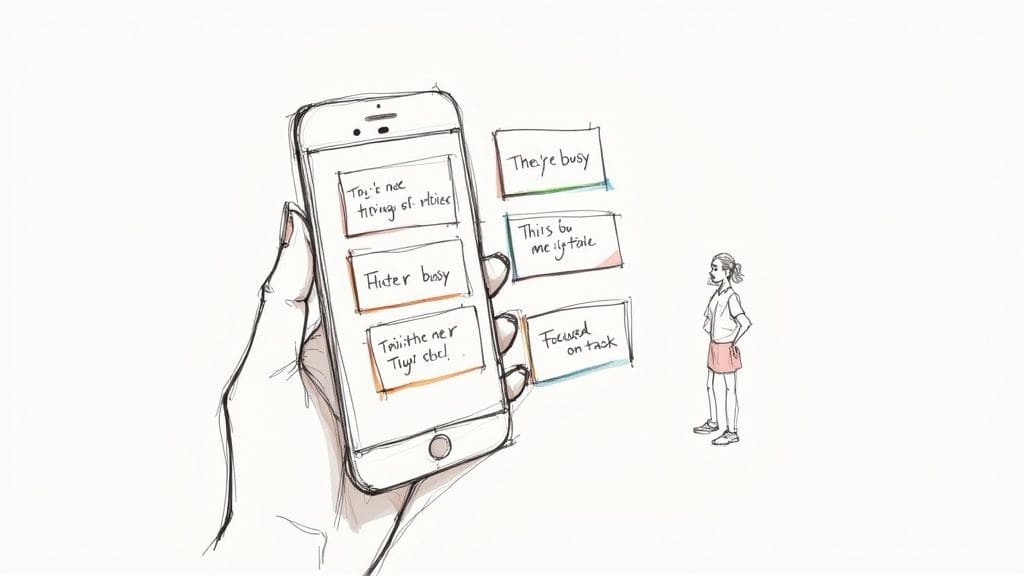
This is what it looks like in action, reframing a message that could easily send you into a spin.
As you can see, it provides several plausible, non-threatening explanations, shifting the focus away from the idea that you've done something wrong.
Real-World Application
So, for that scary email from your boss, the Perspective Helper might generate alternatives like these:
* They might just be in a hurry. Their shortness could be about their own busy schedule, not about being mad at you.
* This could just be their normal communication style. Maybe they write emails like this to everyone, and it's not personal at all.
* They're focused on the task, not the tone. The report is the priority, and the message is purely functional.
> The point isn't to tell you your initial feelings are wrong. Instead, it gently introduces the idea that your first interpretation isn't the only one—and maybe not even the most likely one. This simple act of generating options can massively reduce the emotional stakes.
This process helps you shift from a place of fear to a place of curiosity. Once the anxiety starts to fade, it becomes so much easier to think with a clearer head.
This approach is especially helpful for anyone who finds social decoding exhausting. It offloads some of that heavy cognitive work, giving you a chance to breathe. For a deeper look into how specialized tools can support communication, you might want to explore our guide on finding the right app for autism communication. Ultimately, it's about using resources to make navigating the social world less draining and a lot more manageable.
How To Ask For Clarity Without Feeling Awkward
Knowing you need more information is one thing. Actually asking for it can feel like a high-stakes social maneuver. It's so easy to worry about seeming rude, incompetent, or just plain awkward.
The key is to have a few low-stakes, customizable scripts ready to go. Think of them as social scaffolding—a reliable structure you can lean on. This seriously reduces the mental load of trying to invent the perfect response from scratch, especially when you're already feeling anxious or confused.
Simple Scripts You Can Adapt
Moving beyond a blunt, "What do you mean?" can make the conversation feel much smoother. The goal here is to frame your question around your need for understanding, not their failure to explain. Using "I" statements is a fantastic way to do this.
Consider trying one of these approaches:
* To check your interpretation: "I want to make sure I'm understanding correctly. When you said [the specific phrase], did you mean [your interpretation]?"
* To ask for a different explanation: "My brain sometimes takes things very literally. Could you explain that in a different way for me?"
* To confirm a feeling: "I'm sensing some urgency here. Is this a top priority right now?"
These phrases are gentle and collaborative. They invite the other person to help you get on the same page, which is a core part of learning how to communicate without upsetting people.
> Remember, asking for clarity is a sign of engagement and conscientiousness. It shows you care enough to get it right, which is a strength, not a weakness.
Why Direct Clarification Is Crucial
Relying on assumptions is just plain risky. Even the most advanced systems struggle to interpret what someone meant without explicit context. Just look at the translation industry—only 19% of enterprises trust AI for external communications because it frequently misses crucial cultural nuances and intent.
This highlights that direct clarification isn't just a helpful strategy; it's essential for avoiding misunderstandings that technology can't solve. You can discover more insights on translation trends and AI.
By equipping yourself with a few simple scripts, you make it a collaborative effort. You're not guessing in isolation; you're working with them to bridge the communication gap. This simple shift in approach can dramatically reduce the anxiety of social uncertainty and build stronger, clearer connections with the people around you.
Managing The Anxiety Of Social Uncertainty

That moment right after a confusing comment hangs in the air can feel incredibly intense. Your mind starts racing, replaying their words, trying to crack the code of what someone meant. The pressure to respond right now, combined with the fear of getting it wrong, can unleash a tidal wave of anxiety.
The single most powerful thing you can do here is give yourself permission to pause.
This isn't about ignoring what happened. It's about creating a small, crucial gap between the emotional trigger and your practical response. That little bit of space is where you take back control, shifting from a panicked reaction to a thoughtful one.
Create A Response Buffer
A "response buffer" is just a simple, pre-planned phrase that buys you a few seconds to process without feeling trapped. Think of it as a social safety net. Having a few of these ready can stop an anxiety spiral before it even starts.
* "That's an interesting point. Let me think on that for a second."
* "I need a moment to process that properly. Can we circle back to it?"
* "I want to give that the attention it deserves, and my brain is a little full right now."
Using a buffer acknowledges the other person but still honors your own need for time. It's a calm, assertive way to handle that immediate pressure to perform.
> The goal is to choose how and when you engage, rather than feeling forced into an immediate, anxiety-fueled reaction. This small act of self-advocacy can dramatically lower the stress of social uncertainty.
Validate Your Own Experience
It's so important to remember that feeling confused is a completely normal, valid human experience. Finding communication hard isn't a personal failure.
In fact, the global translation services market is projected to shoot past £38 billion by 2033. Why? Because accurately interpreting context and intent across cultures is immensely challenging. If massive corporations struggle with this, it's proof that misinterpretation is a universal problem.
When anxiety spikes, it's easy to feel like you're the only one. Grounding yourself can pull your focus away from those swirling thoughts and back to the present. Simple exercises can make a huge difference. For some practical methods to calm your nervous system, check out our guide on grounding techniques for anxiety.
Know When To Opt Out
Sometimes, the best response is no response at all—at least not right away. If you feel overwhelmed, it is perfectly okay to "opt out" or delay your reply.
You can say you need to check your schedule, gather some info, or simply that you'll get back to them. In high-stakes situations like job interviews, preparation is key. You can find some great tips for navigating remote job interviews that show how preparation helps you stay in control.
By intentionally pausing, you give yourself the power to respond when you are calm and centered, not when you're in the grip of anxiety.
Still Have Questions? Let's Clear Things Up
It's completely normal to have a few lingering questions. The journey to feeling more confident in conversations is a personal one, filled with its own unique challenges and victories. Let's tackle some of the most common things people ask when they're working to interpret what someone meant.
What If I Ask For Clarification And The Person Gets Annoyed?
This is a big one, and it's a completely valid fear. If someone reacts poorly to a genuine request for clarity, it's almost always a reflection of their own stress or communication style, not a failure on your part.
You can soften your approach by using "I" statements, which feels less accusatory. Try something like, "To make sure I'm on the right track..."
Most people who actually value clear communication will appreciate your effort to understand them correctly. If you find someone consistently reacts with annoyance, it may be a sign to limit complex conversations with that person when you can.
How Is The tonen App's Perspective Helper Different From Asking A Friend?
While talking to a friend is wonderful, the Perspective Helper in the tonen app offers a different kind of support. It provides immediate, private, and unbiased alternatives 24/7, right when you need them most.
A friend, with the best intentions, might bring their own emotional history or personal bias into the situation. The app, on the other hand, is designed to generate multiple neutral or gentle possibilities without that extra emotional layer.
This makes it an incredible tool for reducing in-the-moment anxiety and getting a quick reality check before you even have a chance to talk it over with someone you trust.
How Can I Stop Overthinking And Replaying Conversations?
Ah, the dreaded replay loop. This cycle, often called rumination, is incredibly common. One surprisingly practical strategy is to schedule a dedicated "worry time" for later in the day—maybe just for 10 minutes.
When you catch yourself replaying a conversation, gently tell your brain, "I'll think about this at 6 PM."
By the time your scheduled slot arrives, the emotional intensity has often faded. This technique, combined with grounding exercises, can help break the cycle and bring your focus back to the present moment, making it easier to finally let go.
Ready to reduce the stress of social communication? The tonen app provides practical tools like the Perspective Helper and a library of customizable scripts to help you navigate conversations with more confidence. Download tonen from the App Store and start your 7-day free trial today.
Frequently asked questions
This guide covers how to interpret what someone meant: a neurodivergent guide with practical, neurodivergent-friendly strategies—clear steps, scripts where useful, and ways to reduce anxiety or overload rather than vague "be confident" advice.