Learning how to say things without upsetting people isn't about tiptoeing around tough topics; it's about changing the frame entirely. The secret is to stop seeing these conversations as confrontations and start treating them as collaborative projects. Think of a disagreement not as a battle to be won, but as a puzzle you need to solve together. This one shift in mindset is the foundation for preserving relationships while still tackling the hard stuff.
Build a Foundation of Collaborative Communication
The most powerful thing you can do is to assume positive intent. Walk into the discussion with the genuine belief that the other person also wants a good outcome. This simple act de-escalates tension before it even has a chance to build.
When you do this, you create a safe space for honesty. Potential arguments transform into problem-solving sessions. Instead of bracing for a fight, you're preparing for a partnership.
Adopt a Team Mentality
Viewing the other person as a teammate instead of an opponent changes absolutely everything. Your language will naturally become less accusatory and more inclusive. It's a subtle but powerful shift.
* Instead of: "You're not pulling your weight on this project."
* Try: "How can we work together to get this project back on track?"
This isn't just a workplace trick. It works for family disagreements, tense negotiations, and social snafus. It's a universal strategy for getting your point across without burning bridges. Of course, building that collaborative spirit often requires a deeper connection. A great guide on how to build emotional intimacy offers some really practical insights on this front.
Small changes in your mindset can completely redirect the flow of a conversation. Moving from a "me vs. you" stance to a "us vs. the problem" stance makes all the difference.
Mindset Shift From Confrontation to Collaboration
| Confrontational Mindset (Avoid) | Collaborative Mindset (Adopt) | Resulting Outcome |
|---|---|---|
| "I need to prove I'm right." | "We need to understand each other's view." | Mutual understanding and respect. |
| "This is their fault." | "Let's figure out what's causing this." | Focus on solutions, not blame. |
| "I'm going to win this argument." | "How can we both walk away feeling good?" | A stronger, more resilient relationship. |
Adopting the mindset on the right turns a potential conflict into a chance to strengthen your connection by solving something together.
Prioritize Harmony and Compromise
In a world that often feels like a constant battle, choosing to prioritize harmony is a practical superpower. Research shows that professionals overwhelmingly want to find peaceful resolutions.
In one comprehensive survey, 55.7% of professionals said restoring peace with colleagues was their number one goal in a conflict. Even more telling, a staggering 87.8% said they are willing to compromise to break a deadlock, mostly because people are more driven by avoiding a loss than by securing a win.
> The goal isn't to win the argument; it's to solve the problem together. When you reframe the interaction this way, you remove the ego and focus on a shared, positive outcome. This is the core of knowing how to say things without upsetting people.
It's also crucial to remember that not everyone communicates the same way. What feels blunt to one person is simply direct communication for another—a common experience for many neurodivergent people. For some valuable perspective, our guide on how to communicate better with neurodivergent people is a great resource.
By building this collaborative foundation first, you set the stage for productive, respectful dialogue every single time.
Choose Your Words for Clarity and Kindness

The words you choose in a tough conversation can either build a bridge or put up a wall. Knowing how to say things without upsetting people isn't about tiptoeing around the issue; it's about having a toolkit of phrases that invite discussion instead of sparking a fight.
This is all about being precise and kind with your language. It's a skill, and like any skill, it gets stronger with practice.
Adopt "I" Statements to Own Your Perspective
One of the simplest yet most powerful shifts you can make is to start using "I" statements. This technique isn't a trick; it's just a way to frame your perspective from your point of view, which is undeniably true. It's your reality.
When you start a sentence with "I," you immediately lower the other person's defenses because you're not pointing a finger. You're sharing information about yourself, not making an accusation about them.
For example, instead of saying, "You confused me with that deadline change," try, "I felt confused by the deadline change." The problem is the same, but the delivery is collaborative instead of confrontational.
> The goal is to express your reality without invalidating theirs. "I" statements allow you to share your feelings, needs, or confusion as personal data, not as an accusation. This simple change is fundamental to productive dialogue.
This approach is especially helpful in neurodivergent communication, where directness can sometimes be misinterpreted as aggression. Framing observations as personal experiences keeps your message clear while softening the delivery. It creates space for understanding, not conflict.
Use Softening Language to Introduce Ideas
Sometimes, a difficult message just needs a gentle runway. Softening language acts as a cushion, allowing you to bring up a disagreement, a tough request, or a different idea without sounding demanding.
These little phrases signal respect and show you're open to discussion, which makes the other person far more likely to listen.
Here are a few you can start weaving into your vocabulary:
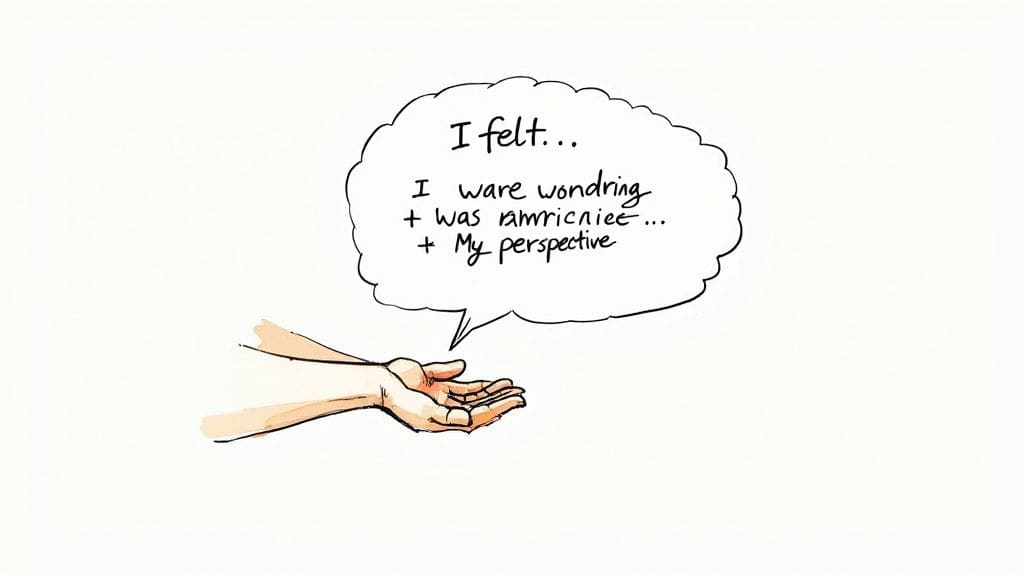
* "I was wondering if..."
* "My perspective is a bit different..."
* "Could we explore another option?"
* "I might be misunderstanding, but it seems like..."
This isn't about watering down your point. It's about delivering it with strategic grace. It shows you value the relationship and see them as a partner in the conversation, not an opponent. If you want to dive deeper into these fundamentals, exploring ways to improve your overall conversation skills can add even more tools to your communication toolbox.
Worried about accidentally upsetting someone? tonen can help.
tonen gives you 188+ conversation scripts, tone guidance and calming tools — designed for autistic adults, ADHD and social anxiety. Try it free for 7 days.
Download on the App StoreiOS only. Android coming soon.
Actionable Scripts for Tough Situations
When you're feeling emotional or just caught off guard, having a few pre-planned phrases can be a total lifesaver. Think of these as templates you can grab and adapt to your own situations.
| Situation | Accusatory Phrasing (Avoid) | Collaborative Phrasing (Use) |
|---|---|---|
| Giving a friend difficult feedback | "You're always late, and it's rude." | "I feel a bit disrespected when I have to wait. Can we talk about our plans for next time?" |
| Disagreeing with your boss | "That plan won't work." | "I have some concerns about potential challenges with this plan. Could I share my perspective?" |
| Asking for a change at home | "You never help with the dishes." | "I'm feeling overwhelmed by the chores. Could we figure out a system that works better for both of us?" |
Practicing scripts like these builds the muscle memory you need for kinder, clearer communication. Ultimately, mastering this skill is about choosing words that open doors to connection and problem-solving, not slamming them shut.
Master Your Tone and Nonverbal Signals
The actual words you use are only half the story. The tone of your voice and the signals your body sends can either back up your message or completely undermine it, often making the difference between the other person feeling respected or attacked.
Getting your delivery right is a huge part of learning how to say things without upsetting people. Even the most carefully crafted sentence can fall flat if it's delivered with a frustrated sigh, a sharp edge in your voice, or crossed arms.
Calm Your Body to Steady Your Voice
When your emotions spike, your body is the first to know. Your heart might start racing, your breath gets shallow, and your voice can become tight, shaky, or way too loud. That physical reaction has a direct line to your vocal tone.
To keep your voice calm and steady, you first have to get your nervous system in check. Before you walk into that tough conversation—or even during a quick pause to collect yourself—try this simple grounding technique:
1. Plant Your Feet: Press both feet firmly into the floor. Just focus on the feeling of the ground underneath you. It's a simple physical anchor that can make you feel more stable and centered.
2. Take a Deep Belly Breath: Breathe in slowly through your nose for a count of four, letting your belly expand. Hold it for just a second, then exhale slowly through your mouth for a count of six.
3. Repeat Three Times: This tiny reset can interrupt your body's stress response, slow your heart rate, and give you back the control you need to speak calmly and clearly.
Getting a handle on your physical state is the first step to controlling your tone. For some of us, nervous reactions can be pretty weird. If you've ever found yourself https://usetonen.com/blog/laughing-when-nervous, you know exactly how easily nonverbal signals can be misread.
Use Open and Engaging Body Language
Your posture and gestures are broadcasting a message long before you open your mouth. If you want to signal that you're open, engaged, and sincere, you need to focus on non-verbal cues that build trust instead of putting up walls.
* Uncross Your Arms and Legs: This is classic advice for a reason. An open posture physically tells the other person that you're receptive and not shutting them down.
* Maintain Gentle Eye Contact: Looking at someone—without staring them down—shows you're listening and you're present in the conversation. If direct eye contact feels intense, try looking at the bridge of their nose or their chin.
* Lean In Slightly: A subtle lean forward communicates that you're interested and involved. It sends the message that you value what they have to say.
> Your nonverbal signals need to be on the same team as your words. When your body language says, "I'm open to this," it makes it so much easier for the other person to actually hear your message without getting defensive.
This idea isn't just for spoken conversations, either. It's just as crucial to understand what is tone in writing and how the attitude you convey through your words impacts the person reading them. Whether you're speaking or typing, your delivery is absolutely key.
Pick the Right Time and Place for Sensitive Talks

When and where you have a tough conversation can be just as important as the words you choose.
Bringing up something serious when your partner is rushing out the door, exhausted after a long day, or right in the middle of a crowded cafe is basically setting the whole thing up to fail. A huge part of how to say things without upsetting people is being smart about the context.
The right environment creates a feeling of safety and respect. It sends a clear signal that you value both the person and the topic. An impulsive, badly timed discussion can feel like an ambush, and that immediately puts the other person on the defensive.
Read the Room Before You Speak
Before you dive into a difficult topic, just take a second to assess the situation. Is the other person relaxed and open, or are they visibly stressed, distracted, or irritable?
Trying to have a meaningful conversation with someone who isn't mentally or emotionally available is like trying to plant a garden in frozen soil—nothing is going to grow.
Look for a few green lights:
* They're making eye contact and seem present with you.
* Their body language is relaxed, not tense or closed off.
* The environment is calm and free of immediate distractions.
If the timing feels off, it is almost always better to wait. A simple, "Hey, I'd like to chat about something when you have a moment. Is now a good time, or would later be better?" gives them a sense of control and shows you respect their headspace.
Schedule the Conversation on Purpose
For bigger, more significant discussions, actually scheduling a time to talk can be incredibly effective. I know it might feel a little formal, but it completely prevents catching someone off guard and gives both of you a chance to mentally prepare.
This simple act can turn a potential confrontation into a planned meeting, which strips out a lot of the emotional volatility.
Suggesting a specific time shows you're serious and have been thoughtful about it. You could say, "I have something important I'd like to discuss with you. Would you be free to talk privately for about 20 minutes after dinner tonight?" This frames the conversation as a structured, manageable event instead of a scary, open-ended conflict.
> Choosing a neutral, private setting is essential. A quiet corner in your home, a walk in a park, or a coffee shop during a slow period can all work. The key is to minimize interruptions and avoid an audience, which just adds pressure and embarrassment.
If the very thought of starting a tough talk brings up a lot of stress for you, it helps to have some tools ready to go. Using some simple grounding techniques to manage anxiety can calm your nervous system right down and help you walk into the conversation with a much clearer mind.
Navigate Real-World Scenarios with Confidence
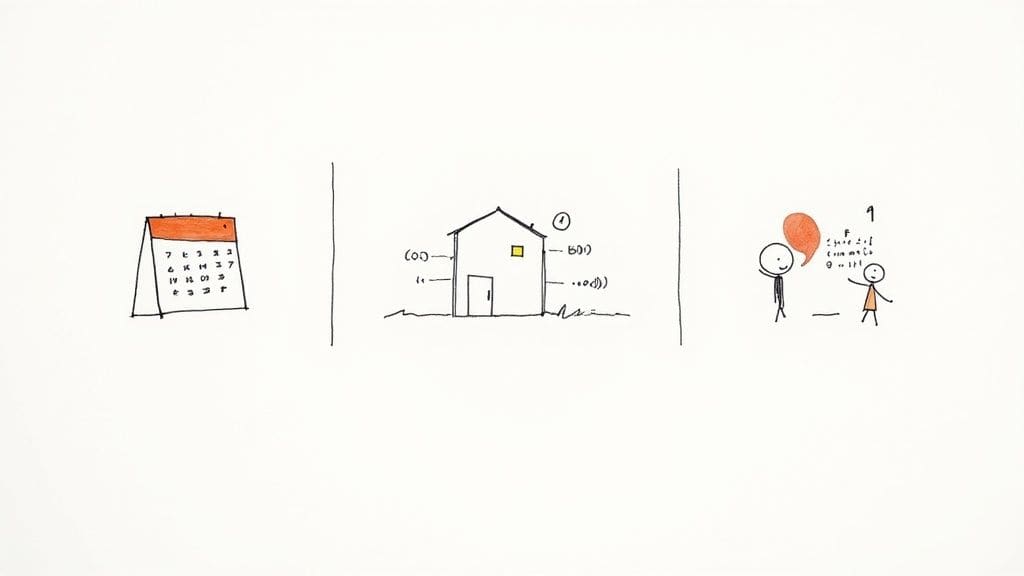
Theory is one thing, but the real test comes when you're standing in front of someone, heart pounding, trying to find the right words. This is where knowing how to say things without upsetting people truly matters.
Let's walk through a few common, tricky situations with some practical scripts you can adapt. Think of these less as word-for-word lines and more as reliable frameworks to build your confidence and handle these moments with a bit more grace.
Addressing a Teammate's Missed Deadlines
This one is a classic workplace minefield. You need to address the problem without sounding accusatory, which is the fastest way to shut down collaboration. The trick is to frame the conversation around teamwork and shared goals, not individual failure.
* What Not to Say: "You missed the deadline again. You're holding up the whole project."
* What to Say Instead: "Hey, I noticed the deadline for the report passed. I wanted to check in and see if everything is okay. Let's figure out what we can do to get this submitted and make sure the next steps stay on track."
See the difference? The first version is pure blame. The second shifts the focus from "You missed..." to a supportive "I wanted to check in..." and a collaborative "Let's figure out..." This approach keeps you on the same team, working on the problem together.
It's a small change with a huge impact. Poor communication is a massive drain on morale. In fact, research shows that 86% of employees and executives point to miscommunication as the root of workplace failures, while clear communication can boost productivity by 25%. You can explore more about how communication impacts the workplace.
Asking a Neighbor to Be Quieter
This conversation can go from zero to hostile in seconds if you get the approach wrong. When you need to ask a neighbor to change their behavior, your timing and tone are absolutely everything.
* What Not to Say: "Your music is way too loud. You need to turn it down." (Usually followed by a slammed door).
* What to Say Instead: "Hi there. I know you probably don't realize it, but the sound travels quite a bit, and it's been a bit loud for us lately. Would you be open to lowering the volume after 10 PM? I'd really appreciate it."
This phrasing starts by assuming good intentions ("probably don't realize"), uses "I" statements to explain the impact on you, and then makes a specific, reasonable request. You're treating them like a reasonable person, which makes it far more likely they'll act like one.
> The core principle is to make a request, not a demand. A request gives the other person a sense of agency and respect, making them a partner in the solution rather than the source of the problem.
Discussing Household Chores with a Partner
Ah, the chore talk. It can quickly devolve into scorekeeping and resentment if you're not careful. To keep the peace, the most effective strategy is to focus on shared responsibility and how you feel, not on a laundry list of what they've failed to do.
Knowing how to say things without upsetting people you share a home with is critical for a harmonious life.
* What Not to Say: "I'm the only one who ever does the dishes. You never help out."
* What to Say Instead: "I've been feeling a bit overwhelmed with the household chores lately. Could we sit down this week and come up with a new system for the dishes and laundry that feels more balanced for both of us?"
This script leads with an "I" statement ("I've been feeling overwhelmed") to express your emotions without pointing fingers. Then, it immediately proposes a collaborative action ("Could we sit down..."), making your partner part of the solution instead of the problem.
If you're looking for more strategies to navigate these personal conversations, you might find our guide on how to handle difficult conversations with confidence really helpful.
Still Have Questions About Tactful Communication?
Even with the best game plan, these conversations can feel tricky. It's totally normal to have a few lingering questions when you're trying to figure out how to say things without upsetting people. Let's tackle some of the most common ones.
What if the Person Still Gets Upset No Matter How Careful I Am?
This is a big one. Here's the thing: you can only ever be responsible for your own delivery, not for their reaction.
If you've been calm, clear, and respectful, you've done your part. The goal isn't to guarantee a happy outcome—it's to be able to walk away proud of how you handled yourself. Sometimes, their emotional response is about them, not you.
You can acknowledge their feelings without taking the blame. A simple, "I can see this is upsetting for you," shows you're listening. If things get too heated and the conversation stops being productive, it's perfectly okay to hit pause and suggest coming back to it later.
How Can I Give Negative Feedback to My Boss Without Getting in Trouble?
Bringing up a concern with your boss feels like walking a tightrope. The key is to frame it as a shared goal, not a criticism. This shifts the dynamic from confrontation to collaboration, which is far less likely to put them on the defensive.
Instead of saying, "Your instructions are really confusing," try positioning yourself as a committed team player.
Something like, "I'm really committed to getting this right for you. Could we walk through the process one more time so I can make sure I understand your vision perfectly?" makes it about your desire to succeed, not their failure to explain.
Is It Ever Okay to Just Avoid a Difficult Conversation?
Honestly? Yes, sometimes it is. If the issue is minor and temporary, or if the other person is going through a tough time and isn't in a good place to talk, waiting might be the wisest move.
But avoidance has a dark side. When a problem is ongoing and chipping away at your well-being, silence often makes things much, much worse.
The fear of upsetting someone is a powerful motivator. A massive 98% of employees think conflict resolution training is important, yet only 17% will actually address a dispute directly. A staggering 47% just let it go. This speaks volumes about how much we dread these moments. A great guide on workplace conflict statistics dives deeper into why we often choose silence.
> The crucial question to ask yourself is: does the potential long-term damage of silence outweigh the short-term discomfort of speaking up? Your answer will guide your decision.
Mastering this communication skill isn't about finding a magic formula; it's a skill you build over time. By focusing on kindness, clarity, and a spirit of collaboration, you'll develop the confidence to handle even the toughest conversations with grace.
Are you looking for more practical tools to handle difficult conversations with less stress? The tonen app offers a library of ready-to-use scripts, tone choices, and calming exercises designed for neurodivergent people and anyone who wants clearer, kinder communication. Download tonen on the App Store to start your 7-day free trial.
Frequently asked questions
This guide covers how to say things without upsetting people: a practical guide with practical, neurodivergent-friendly strategies—clear steps, scripts where useful, and ways to reduce anxiety or overload rather than vague "be confident" advice.