The most effective way to help with communication skills is to provide practical, actionable support, not just advice. To do this, focus on three core areas: practicing active listening to build trust, decoding nonverbal cues to prevent misunderstandings, and creating a toolkit of conversation scripts and calming techniques to manage anxiety. By coaching someone on how to ask better questions, align their body language with their words, and prepare for stressful interactions, you empower them with the confidence and strategies needed for clearer, less stressful communication.
This guide provides a complete framework on how to help with communication skills by creating a personalized support system. For many people, especially neurodivergent individuals, the gap between what they mean to say and how it's perceived can be a source of genuine distress. By focusing on these coachable skills, you can offer meaningful help that builds real confidence and makes the goal of improving communication feel achievable.
Your Guide on How to Help With Communication Skills
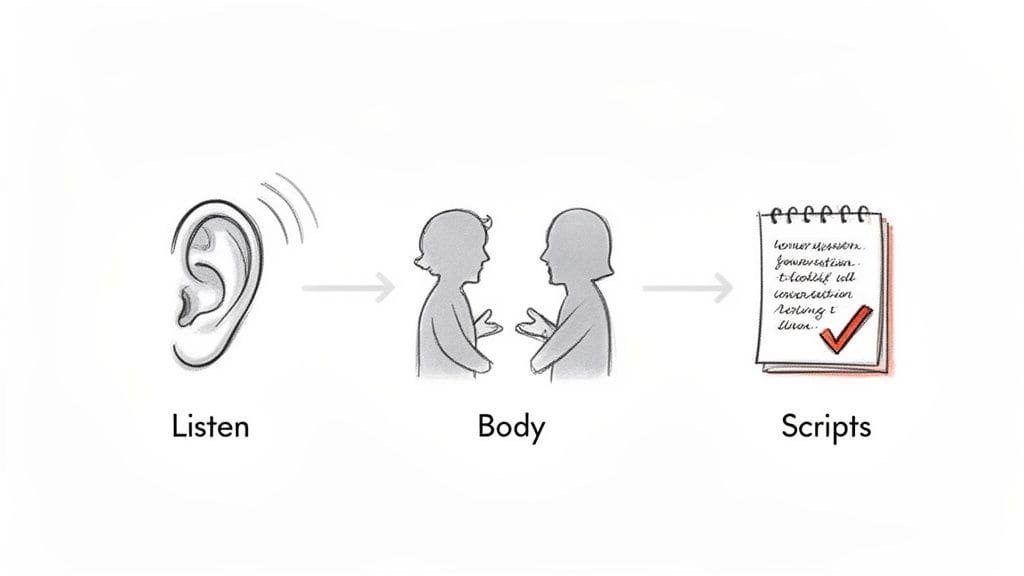
Learning how to support someone's communication journey is about more than just telling them what to do. It's about giving them actionable strategies that build real confidence and reduce anxiety.
For so many people, especially neurodivergent folks, the gap between what they mean to say and how it comes across is a source of genuine distress.
The best way to help is to create a personalized support system. This guide gives you a framework for doing just that, focusing on three core areas that make a huge difference.
Three Pillars of Effective Communication Support
To offer meaningful help, we need to get past vague suggestions like "just be more confident." Instead, the focus should be on specific, coachable skills that someone can actually practice and see improvement in over time.
This table breaks down the three pillars that form the foundation of supportive coaching.
| Strategy | Why It Matters | Your First Step |
|---|---|---|
| Practice Active Listening | It's about understanding the full message, which builds trust and makes the speaker feel valued. This is a game-changer for anyone who finds focus tricky. | When someone is talking, try to summarize what they said back to them with a phrase like, "So it sounds like you're feeling…" |
| Decode Nonverbal Signals | Body language and tone often carry more weight than words. Aligning nonverbal cues with the verbal message prevents major misunderstandings. | Practice saying a simple phrase like "I'm fine" in different tones (happy, frustrated, tired) to hear the difference. |
| Build a Conversation Toolkit | Having pre-planned phrases or a graceful way to exit an overwhelming conversation provides a crucial safety net. This reduces in-the-moment stress. | Write down one simple, polite line to end a conversation, like, "It was great chatting, but I need to get going now." |
Focusing on these concrete areas makes the goal of improving communication feel achievable rather than overwhelming.
For a deeper look at common communication pitfalls in relationships, you can learn how to fix poor communication skills with these tips.
Why Listening Is a Superpower
Active listening is a fundamental skill, but it's often the first one we forget. It's not just polite—it's the bedrock of connection. When someone feels truly heard, it builds trust and psychological safety almost instantly.
> Active listening isn't passive; it's a dynamic process of receiving, interpreting, and responding that makes the other person feel valued and understood. This single skill can transform tense interactions into productive conversations.
Poor listening has massive real-world consequences. Workplace surveys have shown that 67% of employees feel disengaged, partly due to poor listening from colleagues and managers. In the US, this disengagement is linked to an estimated $550 billion in annual productivity losses.
Knowing how to help with communication skills often starts by teaching someone how to truly listen.
Mastering Nonverbal Cues and Body Language
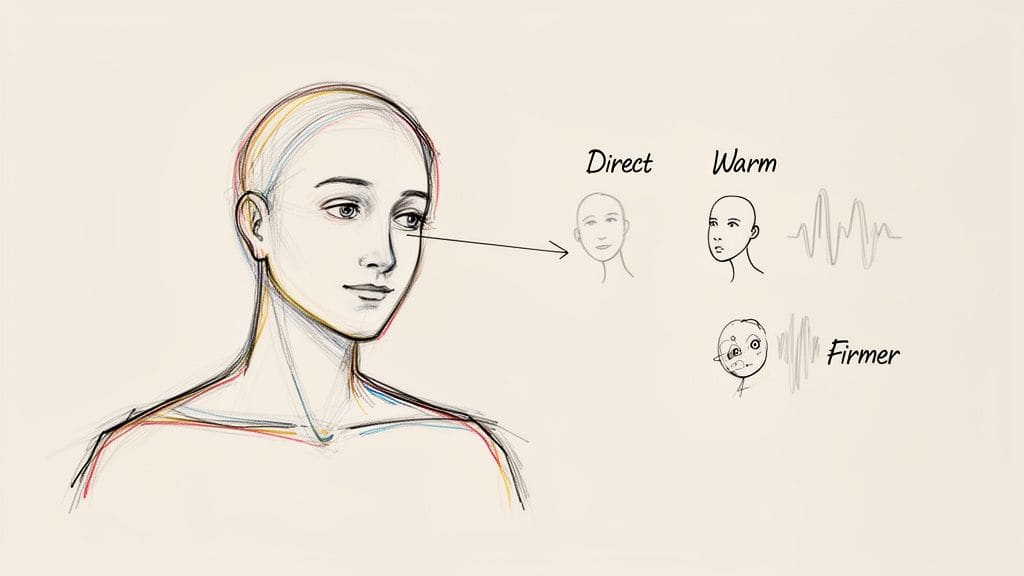
Words tell part of the story, but it's often the things we don't say that speak the loudest. A huge piece of building communication skills is recognizing how much our body language, tone of voice, and eye contact shape the way our message is received.
For many of us, especially if you're autistic or have social anxiety, nonverbal signals can be a major source of stress. Your own body language might be sending messages you don't intend—like avoiding eye contact or crossing your arms for comfort—which others might misread as boredom or disinterest.
This gap between your intent and how you're perceived is incredibly frustrating. Research shows that nonverbal cues can carry anywhere from 65% to 93% more weight than the words you actually say. When your body and your words are out of sync, people almost always trust the nonverbal signal, a point backed up by this detailed guide on improving communication skills from Harvard.
Practicing Intentional Body Language
Helping someone with nonverbals isn't about forcing them into a series of uncomfortable, unnatural poses. It's about finding small, manageable adjustments that feel authentic and reduce the odds of being misunderstood.
A great way to start is by practicing in front of a mirror or recording a short video of yourself talking. Just notice your default posture. Are your shoulders hunched forward? Are your arms crossed without you even realizing it?
Here are a few small shifts to experiment with:
* Open Posture: Simply uncrossing your arms can make you look and feel more approachable and engaged in the conversation.
* Gentle Eye Contact: This doesn't have to be a staring contest. Try looking at the bridge of the person's nose or their chin for just a few seconds at a time. The goal is connection, not intimidation.
* Mindful Gestures: Using your hands to emphasize a point can add energy and clarity, helping your words land with more impact.
Aligning Tone with Your Message
Your tone of voice is another incredibly powerful tool. It carries all the emotional subtext, signaling things like warmth, seriousness, or confidence. For people who naturally speak in a flat or monotone way, their words can sometimes come across as harsh or uncaring, even when that's the furthest thing from the truth.
> The right tone can completely change the meaning of a sentence. Practicing different tones allows you to align your emotional delivery with your verbal message, preventing misunderstandings before they start.
This is an area where a practice tool can make a huge difference by making an abstract concept feel more concrete. It allows you to experiment with specific tones to see what feels right. If you're interested in the nuances of interpreting someone else's signals, you might find our guide on how to make sense of someone's behaviour patterns helpful.
Here's a look at how you can choose a specific tone to practice with.
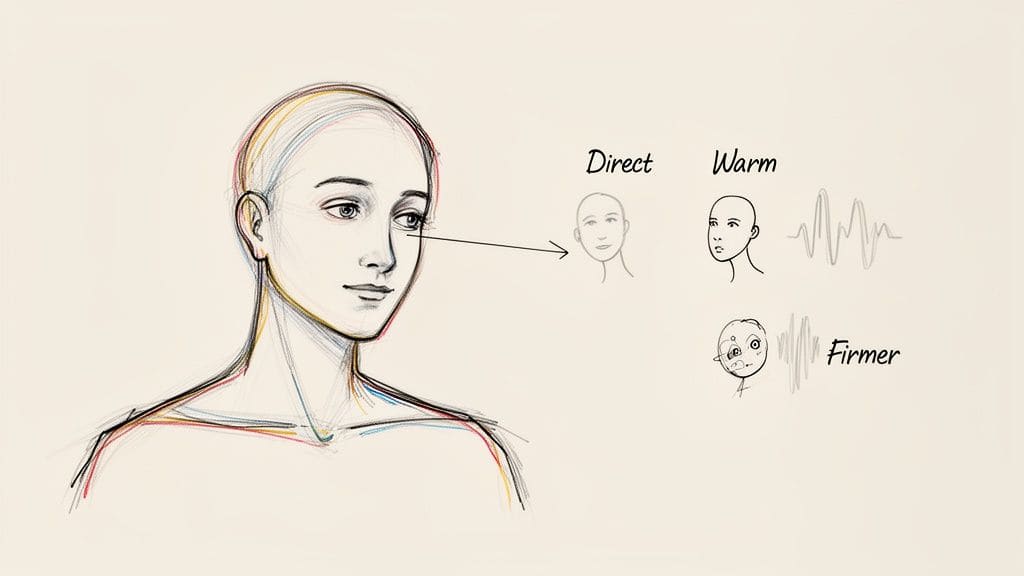
This screenshot from the tonen app shows how users can select 'Tone Choices' like Direct, Warm, or Firmer. This feature provides a concrete way to rehearse how a single phrase can sound completely different, helping you gain control over your delivery.
Want to support someone with their communication? tonen can help.
tonen gives you 188+ conversation scripts, tone guidance and calming tools — designed for autistic adults, ADHD and social anxiety. Try it free for 7 days.
Download on the App StoreiOS only. Android coming soon.
Building a Practical Conversation Toolkit
There's nothing worse than that feeling of being caught flat-footed in a conversation, your mind totally blank. That spike of anxiety is often what makes communication feel so exhausting. The best way to combat it is to build a personal toolkit before you ever need it.
This isn't about becoming a robot or memorizing a clunky monologue. It's about having a safety net. With a few key phrases and strategies in your back pocket, you can free up your mental energy to actually listen and connect, instead of just trying to survive the moment. We'll look at how to build that toolkit, from simple scripts to the all-important "opt-out" lines for when you just need to leave.
Drafting Your Core Scripts
A script is nothing more than a pre-planned starting point for a conversation you know will be tough. Think of it as your anchor. The goal isn't to read it word-for-word, but to internalize the core message so it's there when you need it.
Start small. Pick just one or two situations that consistently cause you stress. Some common ones I see are:
* Asking for an accommodation at work or school.
* Setting a boundary with a persistent family member.
* Trying to make a clear request during a doctor's appointment.
Once you have your scenario, just draft a few simple, direct lines. Focus on what you need to say to achieve your goal. For building out these skills, many people find interactive communication apps with practice tools helpful for getting real-time feedback and practice.
Rehearsing Until It Feels Natural
This is the step most people skip, but it's where the magic happens. Practicing your lines—even just saying them out loud to yourself—is what makes them feel less "scripted" and more like your own words. It builds a kind of muscle memory that you can rely on under pressure.
> The point of a script isn't to deliver a monologue. It's to have a reliable starting point that frees up your mental energy to listen and respond authentically. It's your anchor in a potentially stressful moment.
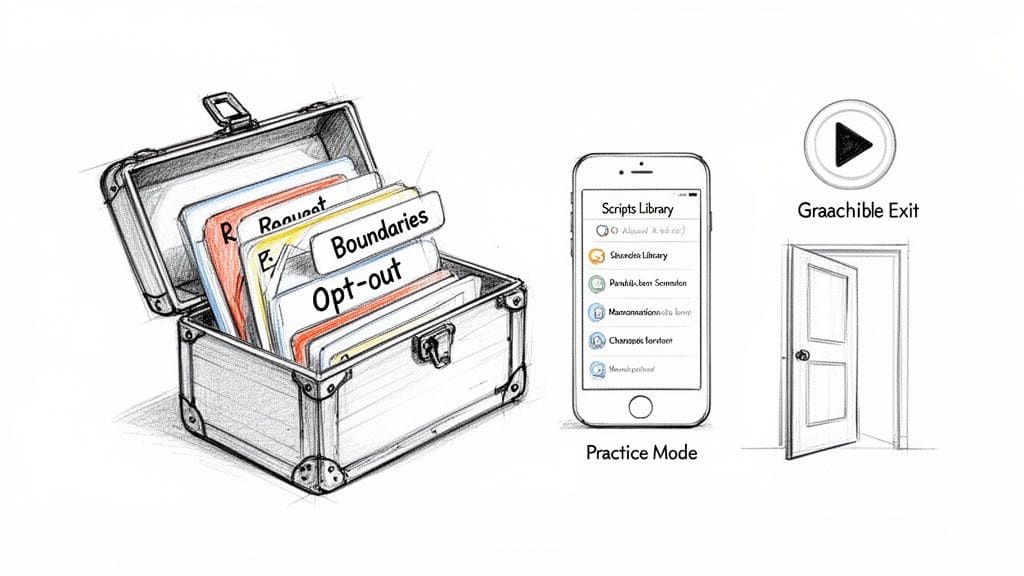
The sketch above captures this perfectly: a briefcase of core scripts, a library of prompts on your phone, and a clear "Gracious Exit" door. It's about having your tools organized and ready.
This is exactly what we aimed for with the tonen app. Its Practice Mode lets you rehearse and tailor over 188 prompts until they sound like you. Having a structured library gives you a concrete place to start when you're staring at a blank page, trying to figure out what to say.
For more ideas on what to put in your own toolkit, you can check out our deep dive into creating effective conversation scripts for difficult situations.
Ultimately, knowing how to help with communication skills comes down to preparation. When you arm yourself with a plan for the hard moments, you take back control from the anxiety of the unknown.
Managing Overwhelm and Anxiety in the Moment
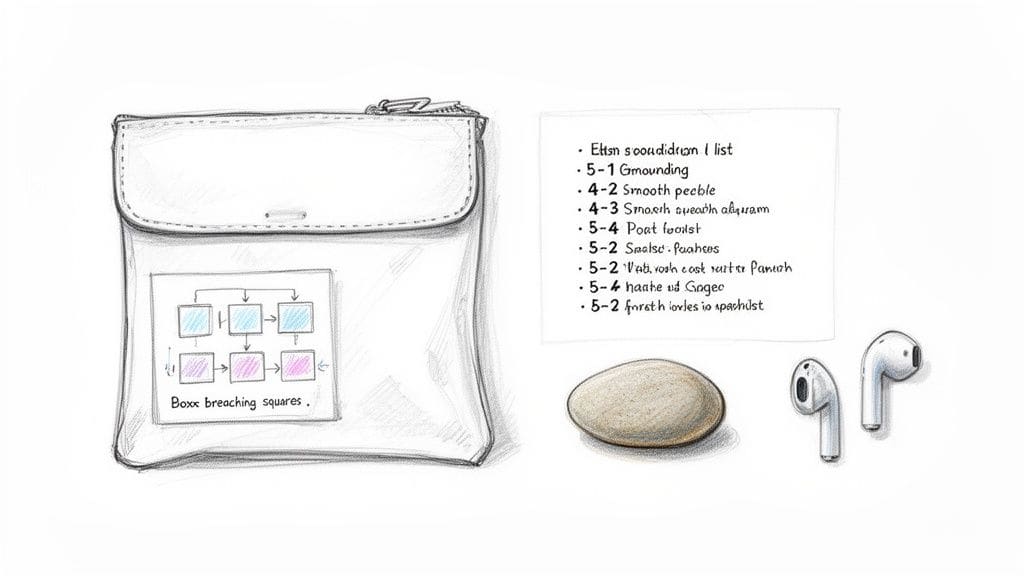
You can have the most perfectly planned script, but if anxiety hijacks the conversation, none of it matters. We've all been there—your heart starts pounding, your mind goes completely blank, and you just want to escape.
This is where having a few practical, in-the-moment strategies becomes a lifesaver. Building a personal "Calm Kit" isn't just a nice idea; it's a set of concrete tools you can use to regulate your nervous system and pull yourself back from the edge.
It's not about just trying to "calm down." It's about using simple, proven methods that interrupt your body's fight-or-flight response, giving you the mental space to think clearly again.
Your Go-To Calming Techniques
The best tools are the ones you can use anywhere, discreetly, without anyone even noticing. Think of these as your first line of defense against rising anxiety. You can use them right before a tough meeting or even in the middle of a conversation when you feel yourself starting to spin out.
Here are a few quick-reference techniques that are incredibly effective for managing that in-the-moment communication anxiety.
| Technique | How It Helps | When to Use It |
|---|---|---|
| Box Breathing | This is a classic for a reason. It slows your heart rate and signals to your brain that you're safe. Inhale for 4 seconds, hold for 4, exhale for 4, and hold for 4. | Before a tough conversation, during a break in a meeting, or any time you feel your anxiety spiking. |
| 5-4-3-2-1 Grounding | This pulls you out of an anxious thought loop by forcing your brain to focus on your senses. Silently name 5 things you see, 4 you can touch, 3 you hear, 2 you smell, and 1 you can taste. | When you feel disconnected or overwhelmed in a busy place, like a crowded room or noisy office. |
| Safe-Place Visualization | Briefly picturing a calm, safe place in your mind—like a quiet beach or a cozy room—creates an immediate sense of peace and a mental buffer from the stress. | When you feel trapped in a conversation and need a quick mental reset without physically leaving. |
Experiment with these to see which ones feel most effective for you. They're different paths to the same goal: interrupting the anxiety cycle. For a deeper dive, you might find our guide on grounding techniques for anxiety really helpful.
Your Digital Calm Kit
The whole point of a Calm Kit is to have clear, simple instructions you can turn to when your brain feels too overloaded to figure things out on its own.
> A 'Calm Kit' isn't just a collection of nice ideas; it's a practical, accessible set of instructions you can turn to when you're overwhelmed. It provides a clear path back to a calmer state, giving you control when you need it most.
This idea is so crucial that we built it directly into the tonen app. It puts a discreet and powerful resource right in your pocket, ready for when you need it most.
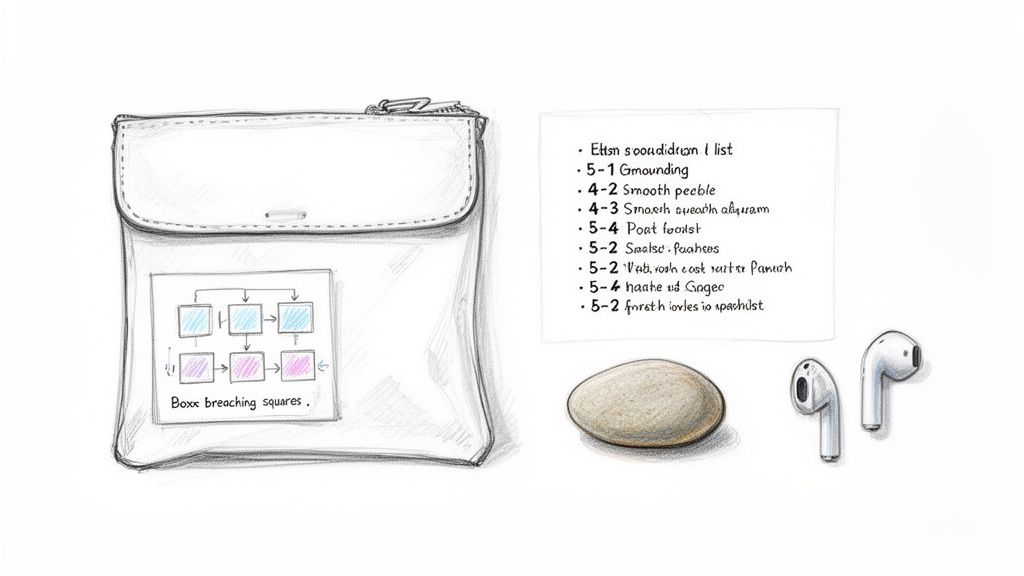
The app's built-in Calm Kit gives you instant access to guided exercises for breathing, grounding, and visualization. Integrating these tools directly into a communication app acknowledges a fundamental truth: knowing how to help with communication skills is just as much about managing your internal state as it is about finding the right words.
How to Coach and Support Others Effectively
Knowing how to help with communication skills is one of the most rewarding ways you can empower someone you care about, whether you're a parent, a manager, or just a good friend. The best support isn't about being a harsh critic; it's about being a trusted ally.
It all starts with creating a safe, non-judgmental space where someone feels comfortable practicing without the fear of getting it wrong. Your role is to help them see their own progress, build self-awareness, and celebrate the small wins—like a little less anxiety, or a new willingness to join in on a chat.
Creating a Safe Practice Environment
The single biggest barrier to practicing new communication skills is the fear of messing up. As a supporter, your most important job is to take that fear out of the equation. This means establishing a judgment-free zone where mistakes are treated as learning opportunities, not failures.
Start by being explicit about your role. You could say something like, "I'm here to be a safe person for you to practice with. There's zero pressure to be perfect; we're just exploring what feels right." This simple act of setting expectations can dramatically lower the stakes.
Here are a few ways to build that psychological safety:
* Emphasize Collaboration: Frame the entire process as a team effort. Use "we" language, like "What should we practice today?" or "How can we make this feel a little less stressful?"
* Validate Their Feelings: Acknowledge that this stuff is hard. Phrases like, "I know this feels awkward, and I really appreciate you trusting me," go a very long way.
* Start with Low-Stakes Scenarios: Don't jump right into practicing a major conflict. Begin with something simple, like rehearsing how to order coffee or ask a question in a store.
Giving Feedback That Builds Confidence
How you give feedback is just as important—if not more so—than the feedback itself. The goal is always to build them up, not tear them down. A great framework is the "praise sandwich": start with something they did well, offer one specific suggestion for improvement, and then end with another piece of positive reinforcement.
> Constructive feedback focuses on specific, observable behaviors, not on personality. Instead of saying, "You seemed nervous," try, "I noticed you were looking at the floor a lot. What if we practice making eye contact with that spot on the wall for a few seconds?"
This approach makes the feedback feel less personal and more like a technical adjustment. It shifts the focus from "what's wrong with me?" to "what's a new strategy I can try?" This is a fundamental aspect of knowing how to help with communication skills effectively. For those in a more formal coaching role, understanding these nuances is critical. Our article on what it takes to be a great mental health coach explores these supportive techniques in greater detail.
Developing Empathy and Perspective
A major challenge in communication is getting stuck in our own heads and making assumptions about what the other person is thinking. Coaching someone to consider other perspectives is a huge step toward more empathetic communication.
You can easily build this into your role-playing. After a practice run, ask gentle, curious questions like:
* "What do you think the other person might have been feeling in that moment?"
* "Is there maybe another way to interpret what they said?"
* "What could be going on for them that we don't know about?"
By gently prompting this kind of thinking, you help them build a more flexible and understanding communication style. It's a key component of how to help with communication skills in a way that truly lasts.
Got Questions About Building Your Skills?
It's completely normal to have questions as you start this journey. Finding your voice and building confidence is a process, and it's smart to anticipate the common hurdles.
Let's tackle some of the most frequent concerns people have when they start working on their communication skills.
How Quickly Can I Actually See Improvement?
You can start feeling a difference within weeks, not months. The secret isn't a massive, overnight change. It's about starting small and being incredibly consistent.
Don't try to overhaul everything at once. That's a recipe for burnout. Instead, pick one tiny, specific goal. Maybe you commit to asking one open-ended question in a conversation each day. Or you spend just five minutes practicing a single script using an app like tonen.
Progress comes from building small, sustainable habits that chip away at the anxiety. Celebrating these little wins is what keeps you going.
What if I Sound Robotic When Using Scripts?
This is a huge, and very valid, fear. It's probably the number one reason people are hesitant to try scripting.
The goal of a script is to be a safety net, not a word-for-word monologue. Think of it as having your key points ready so your brain doesn't have to scramble for them under pressure. The script is the "what," but you still bring the "how."
To make it sound like you, you have to rehearse. Practice your lines out loud, alone, until the words feel comfortable in your own mouth. Experiment with different tone choices—like Direct, Warm, or Softer—to see what fits the situation and your personality.
Eventually, the script stops being a script. It just becomes a flexible foundation you can lean on. And if you're completely stuck, our article on what to say when you don't know what to say is a great resource.
How Can I Help a Neurodivergent Teen Who Resists Practice?
Resistance almost always comes from a place of anxiety or feeling pressured. If practice feels like just another chore, or worse, a criticism of their current skills, they're going to push back. Hard.
The best approach is to reframe it entirely. This isn't about "fixing" them. This is about giving them a tool for self-advocacy and stress reduction.
> Connect the practice directly to their goals. Show them how having a script makes it easier to order their favorite takeout, ask a teacher for an extension, or tell a friend they need some space.
Start with very low-stakes scenarios that are actually relevant to their life. Emphasize features that give them control, like having pre-planned "opt-out lines" to leave a conversation without feeling rude.
When they see it as a tool that serves them and makes their life easier, the resistance usually melts away.
Frequently asked questions
This guide covers how to help with communication skills: a practical guide for 2026 with practical, neurodivergent-friendly strategies—clear steps, scripts where useful, and ways to reduce anxiety or overload rather than vague "be confident" advice.