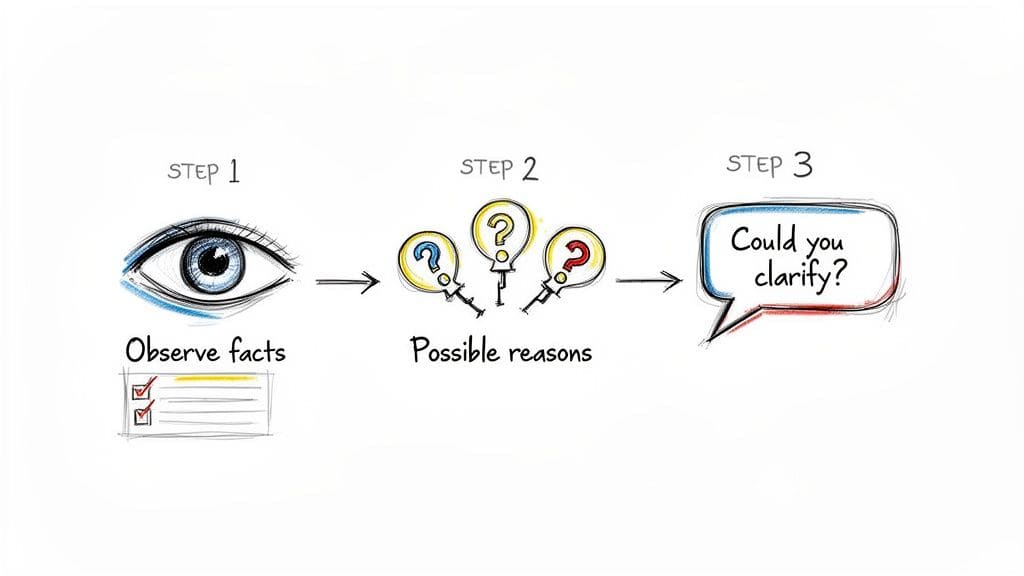
To make sense of someone's behaviour, the most effective method is to shift from making snap judgments to mindfully gathering information before assigning meaning. This involves three steps: first, observe the objective facts (the specific words and actions) without interpretation; second, consider multiple alternative explanations for the behaviour that have nothing to do with you; and finally, ask for clarification if needed. This structured approach helps you separate reality from assumption, short-circuits anxiety, and prevents misunderstandings before they start.
A Practical Framework for Understanding Behaviour
Trying to figure out why people do what they do can feel like solving a puzzle with half the pieces missing. This is especially true for many of us neurodivergent folks, who might process social cues differently and get caught in loops of second-guessing and anxiety.
The core challenge is often our brain's tendency to leap to conclusions. It fills in the gaps with our own fears and past experiences, leading us to personalize behaviour that might have nothing to do with us at all.
Fortunately, there's a structured approach you can use to make sense of someone's behaviour without getting overwhelmed. This isn't about becoming a mind-reader. It's about becoming a better detective. The framework is built on three simple, actionable steps:
- Observe the objective facts. Instead of thinking, "My boss is annoyed with me," you just note the facts: "My boss sent a one-sentence email." This separates reality from your interpretation.
- Consider alternative explanations. Could they be busy? Are they known for being a direct communicator? Maybe they're just having an off day. Generating other possibilities actively challenges your initial negative assumption.
- Ask for clarity when it matters. If you still feel uncertain and the situation warrants it, you can use a prepared script to ask for more information in a non-confrontational way.
This methodical process slows down your reactive mind and gives your logical brain a chance to catch up. It's a powerful way to stop yourself from spiraling into negative thought patterns based on incomplete information.
Why This Shift Is So Important
Jumping to conclusions is a mental shortcut, but it's an unreliable one. When we assume a coworker's silence means they're upset with us, we might act distant in return, creating the very tension we were afraid of. Learning to pause and observe creates a buffer, giving you the space to choose a more thoughtful response.
> The goal isn't to perfectly predict what others are thinking. It's to stop assuming the worst and start gathering better data so you can respond with confidence and less stress.
This framework helps you take responsibility for what you can actually control: your own reactions and interpretations. By doing so, you build resilience and improve the quality of your day-to-day interactions. For those looking for more structured support, exploring professional resources like helpful behavior intervention services can also provide a deeper toolkit.
Ultimately, this approach empowers you to navigate social situations with greater ease. As you practice this kind of mindful observation, you'll find it easier to get a clearer perspective on any given situation and communicate more effectively. It transforms confusion into curiosity and anxiety into agency.
From Reactive Assumption to Mindful Observation
This table offers a quick reference for shifting your approach in real-time. Think of it as a cheat sheet for moving from a knee-jerk reaction to a more considered observation.
| Common Reactive Thought | Actionable Mindful Alternative |
|---|---|
| "They're ignoring my message." | "They haven't replied to my message yet." |
| "She sounded really annoyed on the phone." | "Her tone was brief and she didn't ask follow-up questions." |
| "My friend is mad at me." | "My friend cancelled our plans for this evening." |
| "That was a passive-aggressive comment." | "They said, 'It must be nice to have so much free time.'" |
| "He's judging my idea." | "He was quiet after I shared my idea and asked one question." |
By consciously reframing your thoughts this way, you ground yourself in reality. This small step creates the mental space needed to consider other possibilities and choose how—or if—you want to respond, rather than letting an assumption choose for you.
Observe Without Judgment to See What Is Really Happening
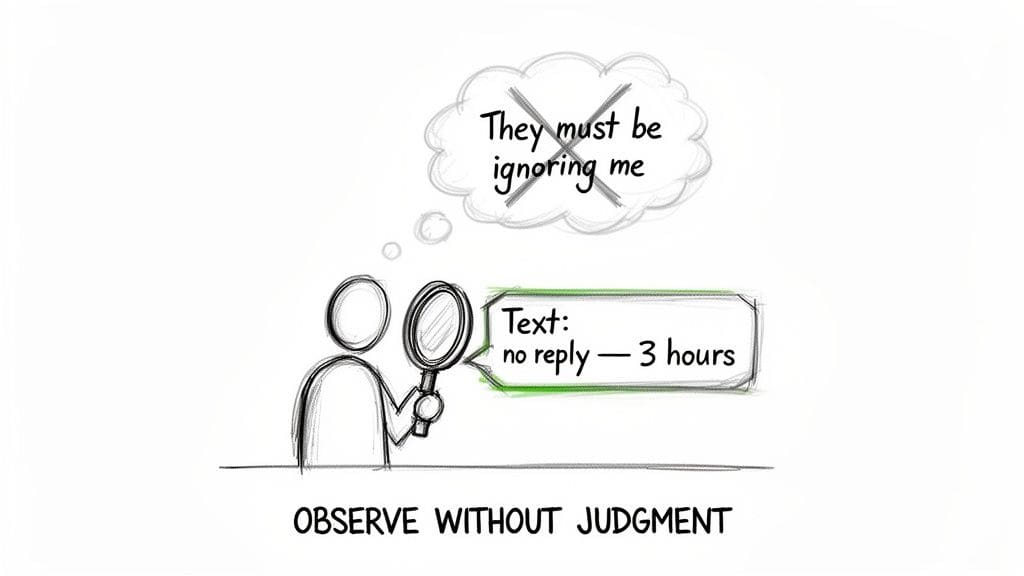
The first step to truly make sense of someone's behaviour is to become a neutral observer. This means consciously separating what you see and hear from the story your brain instantly creates about it.
It's the difference between an assumption—"My friend is ignoring me"—and an objective fact: "My friend hasn't replied to my text from three hours ago." That small shift is a powerful tool for managing anxiety and heading off misunderstandings before they even start.
When you focus only on the observable data, you create mental space. This space stops an immediate, and often negative, emotional reaction, giving your more logical brain a chance to catch up and consider other possibilities.
Spotting Objective Cues
To practice non-judgmental observation, you have to train your brain to zero in on specific, concrete details. Think of yourself as a detective gathering clues, not a judge delivering a verdict. The goal is to collect raw data without adding your interpretation.
Here are the key areas to focus on:
- Body Language: Notice posture, gestures, and facial expressions. Are their arms crossed? Is their body turned away? Are they making eye contact? Just note *what* you see, not *why* you think they're doing it.
- Tone of Voice: Listen to the pitch, volume, and pace of their speech. Was their voice flat, loud, or quiet? Did they speak quickly or slowly? Again, just stick to the observable acoustics.
- Word Choice: Pay attention to the literal words they use. Was their response brief or detailed? Did they use definitive language like "always" or "never"?
This practice helps you sidestep cognitive traps like the Fundamental Attribution Error—our tendency to think others' actions reflect their personality ("they're rude") rather than their circumstances ("they're having a stressful day"). If you're struggling with a sudden shift in someone's behaviour, our guide on how to make sense of an unexpected reaction has more targeted strategies.
Generating Alternative Explanations
Once you have your objective observations, the next move is to challenge your initial assumption. Brainstorm other potential reasons for the behaviour you witnessed. This exercise trains your brain to become more flexible and empathetic.
> The goal isn't to find the one "right" answer, but to simply recognize that multiple possibilities exist. This act alone can significantly reduce the emotional weight of an interaction.
Let's apply this to a common scenario.
Scenario: Your coworker, who is normally chatty, was unusually quiet during a team meeting and didn't contribute any ideas.
- Initial Negative Assumption: "They think my ideas are bad," or "They're mad at me about something."
- Objective Observation: "My coworker did not speak during the meeting and looked at their laptop the whole time."
Now, let's generate at least three alternative explanations that have nothing to do with you:
1. They're dealing with a personal issue. Maybe they got some bad news right before the meeting and are too distracted to participate.
2. They're feeling unwell. A headache or other physical discomfort makes it hard to focus and engage.
3. They have a heavy workload. They might be preoccupied with an urgent deadline and are trying to use the meeting time to catch up on work.
Running through this process helps you account for context, unseen stressors, and individual differences. It's a vital skill to make sense of someone's behaviour without automatically personalizing it, leading to more accurate interpretations and a lot less anxiety.
Confused by how someone is acting? tonen can help.
tonen offers conversation scripts, Reply Helper, Perspective Helper, Debrief, Phone Call Mode and Calm Kit. Start with 21 free scripts on iPhone. Optional Premium unlocks more features.
Download on the App StoreAvailable on iOS.
Consider How Neurodiversity and Mental Health Shape Behaviour
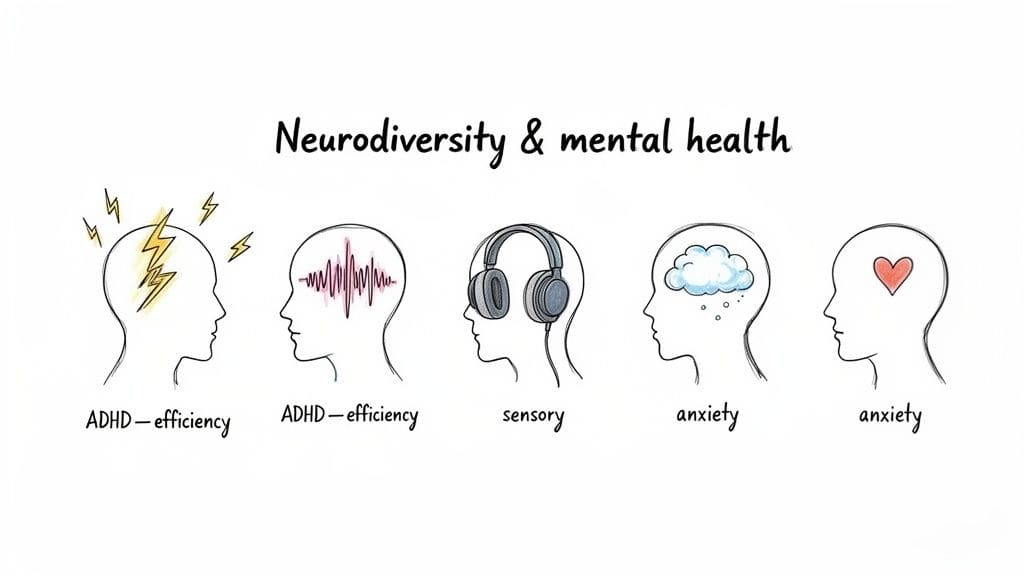
When you're trying to understand what's going on, you have to look deeper into someone's internal world. The way a person's brain is wired—their neurotype—and their mental health status can fundamentally change how they show up in the world.
Keeping this in mind helps you depersonalize things that might otherwise feel confusing or even hurtful.
What you read as bluntness could just be the efficient, direct communication style of someone with ADHD trying to get to the point. That person avoiding eye contact? It might not be a sign of disinterest at all. For an autistic person, it could be a necessary strategy to manage sensory input and prevent overwhelm.
This isn't just about being nice; it's a critical communication skill. With diagnoses for conditions like ADHD and autism expected to become even more common and understood by 2026, recognizing these patterns is essential for building better relationships.
Common Behavioural Manifestations
Certain behaviours often link back to specific neurotypes or mental health states. These aren't hard-and-fast rules, but they can be a really helpful lens for looking at a situation differently.
- Social Anxiety: Someone with social anxiety might cancel plans at the last minute or seem totally withdrawn in a group. This isn't about you; it's a reaction to intense internal distress.
- Autism: An autistic person might prefer texting, take sarcasm literally, or need quiet time alone to recharge after socialising. These are needs, not insults.
- ADHD: A person with ADHD might interrupt you or seem to jump between topics. This often comes from a brain that's processing things incredibly fast, not from a lack of interest in what you're saying.
> Recognizing these patterns allows you to stop assuming negative intent and start seeing the underlying need. It's a key step to make sense of someone's behaviour in a more accurate and compassionate way.
The Growing Importance of Neuro-Inclusion
Understanding neurodiversity is becoming more and more important, especially at work. This isn't just a feeling; hard data shows a massive uptick in both diagnoses and workplace awareness.
What this means is that learning how neurodiversity shapes interactions isn't optional anymore—it's a basic part of modern communication. Just acknowledging that someone's brain might work differently than yours is the first step toward better collaboration and connection.
If you're trying to decode a specific interaction, you can also check out our guide on why someone might have reacted a certain way. Ultimately, this kind of awareness helps you build stronger, more resilient relationships in every area of your life.
Use Conversation Scripts for Clearer Communication
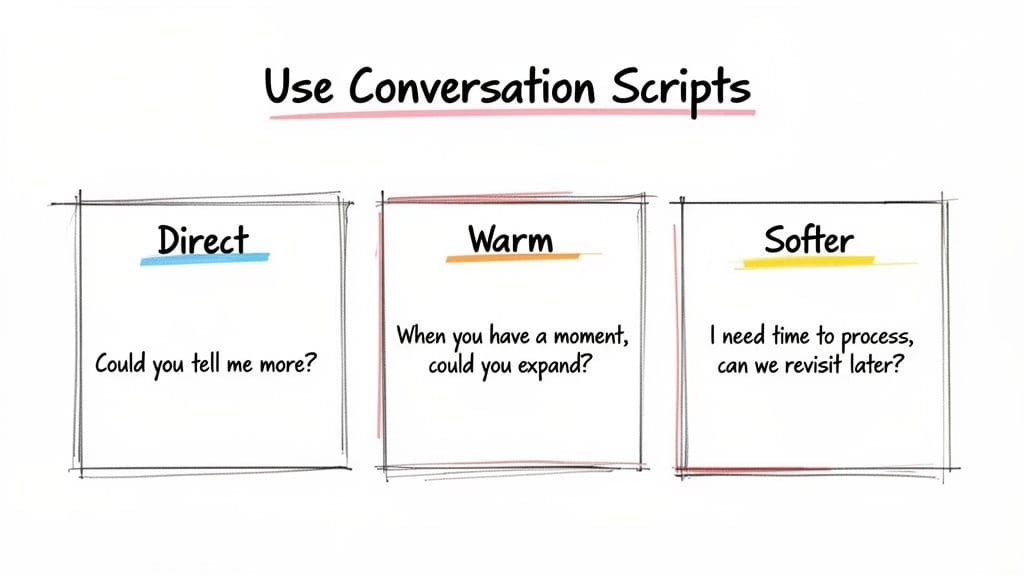
So you've observed the situation and thought through the context. Now comes the part that often feels the most intimidating: asking for clarity. This is where having a few pre-planned conversation scripts can be a total game-changer.
Using scripts helps you find the words you need, right when you need them. This seriously lowers the cognitive load of social interactions and reduces the chance you'll freeze up.
These aren't meant to make you sound robotic. Think of them as a reliable starting point you can tweak to fit your own voice and the specific moment. Having these phrases ready empowers you to get the information you need without escalating things or feeling overwhelmed.
Scripts for Asking for More Information
When someone's communication is vague, brief, or just plain confusing, you need a gentle way to ask them to elaborate. The goal is to invite them into a clearer conversation, not to put them on the defensive.
Try one of these, adjusting the tone to fit the context:
- Direct: "Could you elaborate a bit more when you have a moment?"
- Warm: "I'd love to understand your perspective better. Can you walk me through your thoughts on this?"
- Softer: "I think I might be missing some context. Would you be open to explaining that a different way?"
These phrases frame your request as a need for your own understanding. It's a collaborative way to make sense of someone's behaviour together.
Setting Boundaries and Managing Overwhelm
Sometimes, the behaviour you're observing isn't just confusing—it's overwhelming. In those moments, your priority has to be protecting your own well-being. A good script helps you create that space respectfully.
> Knowing you have an exit line ready can give you the confidence to engage in a difficult conversation in the first place. It's your safety net.
Here are a few options for politely stepping back:
- "I appreciate you sharing this with me. I need some time to process it."
- "Thank you for your perspective. I'm going to take a moment to think about this."
- "This feels like a bigger conversation. Can we schedule a time to talk about it when we're both prepared?"
Mastering phrases like these is crucial. If you're looking for more guidance on this, our article on how to politely decline a request is a great resource.
How to Practice and Adapt Your Scripts
The secret to making scripts feel natural is practice. Say them out loud when you're alone. This helps embed the phrases in your memory so you can access them when you're under pressure.
As you practice, think about which tone—Direct, Warm, or Softer—feels most appropriate for different people in your life. When you're trying to make sense of someone's behaviour, your tone can be just as important as your words.
This is especially true when a person's actions might be linked to something else going on internally. For instance, reviewing a guide on what concussion symptoms in children look like shows just how much an internal condition can alter external behaviour. Having scripts ready helps you approach these delicate situations with both care and clarity.
Know When to Disengage or Seek Support
Part of making sense of someone's behaviour is knowing when to stop trying. It's a tough lesson to learn. Sometimes, no matter how much you observe or analyze, a situation will stay confusing, feel emotionally draining, or even become unsafe.
Protecting your own well-being means knowing your limits. It's not your job to fix or fully understand every person you meet. The real skill is learning to gracefully step away when you're overwhelmed and recognizing when it's time to get some backup.
Graceful Ways to Exit a Conversation
Think of these as your personal exit strategy. They're polite but firm ways to signal you're at capacity without making a big scene. Having these lines ready can seriously reduce the anxiety of entering a tricky conversation because you know you have a way out.
- "Thank you for sharing your perspective. I'm going to take some time to think about this."
- "I'm finding it hard to process this right now. Can we pause and come back to it later?"
- "I can see this is important, but I don't have the emotional energy to discuss it at the moment."
If you find yourself repeatedly needing to use these, it could also be a sign of a bigger issue. It might be worth checking in with yourself for the common symptoms of emotional exhaustion.
Identifying When You Need Backup
Sometimes, a person's behaviour isn't just confusing—it's a pattern. It might be manipulative, passive-aggressive, or create an environment that just doesn't feel safe. In those cases, trying to figure it out on your own isn't just difficult; it's a bad idea. It's time to bring in support.
> Your responsibility is to keep yourself safe and seek appropriate help, not to diagnose or "fix" another person's problematic actions.
Knowing when to escalate is a critical skill. Trust your gut. If an interaction consistently leaves you feeling drained, anxious, or devalued, that's a clear signal the dynamic is unhealthy.
Consider seeking guidance from:
- A trusted friend or family member for a reality check.
- A therapist or counselor for professional strategies.
- An HR representative if the behaviour is happening at work.
Ultimately, learning to make sense of someone's behaviour also means acknowledging when it's hurting you. Prioritizing your own mental and emotional safety is always the right call.
Still Have Questions About Interpreting Behaviour?
It's completely normal to have questions. Learning to decode social interactions is a journey, not a destination, and it's one filled with unique challenges and victories for each of us. Let's tackle some of the most common things that come up when you start putting these strategies into practice.
The point isn't to become a perfect social detective overnight. It's about building a toolkit that lowers your anxiety, helps you feel more in control, and paves the way for more genuine connections. Every attempt is a step forward.
What If I Get It Wrong and Misinterpret Someone?
First, take a breath. Misinterpretations are going to happen. They're a normal and expected part of communication for everyone, neurotypical people included. If you realize you've misread a situation, the best thing you can do is make a gentle course correction.
A simple, non-defensive clarifying statement can work wonders. You could try something like, "I'm sorry, I think I might have misunderstood what you meant just now. Could you help me understand?"
This approach does two powerful things at once: it repairs the immediate interaction and gives you incredibly valuable information for next time. The real win isn't getting it right every time. It's having the confidence to try, and the grace to repair things when you get it wrong.
> This is how genuine connection is built—not on a foundation of perfect interactions, but on the willingness to be a little vulnerable and fix the small missteps along the way.
How Can I Tell If Behaviour Is About Me or Their Neurotype?
It's often a mix of things, but there's a helpful question you can ask yourself to start untangling it: "Is this behaviour consistent for this person across different situations and with different people?"
- Consistent Behaviour: If your coworker is always very direct and to the point with everyone on the team, that's likely a core part of their communication style. It could be influenced by their personality or neurotype (like ADHD or autism). In this case, it's almost certainly not about you personally.
- Situational Behaviour: If their tone is suddenly sharp and seems directed only at you, it's more likely to be related to the specific context of your interaction or something personal.
When you're not sure, it's always better to gently ask for clarity later on rather than jumping to a conclusion. This thoughtful approach is crucial, especially in work environments where misunderstandings can have real consequences.
What's the Best Way to Start Practicing These Observation Skills?
Start small, and start in low-stakes environments. The goal is to build your "observation muscle" without the added pressure of a personal or emotionally charged conversation. This makes it so much easier to use the skill when it really counts.
Try practicing non-judgmental observation in totally neutral situations. Watch people ordering coffee at a café. Listen to how characters interact on a TV show (with the sound off, for an extra challenge!). Observe strangers in a park.
Your only task is to notice what they do and say. Consciously stop yourself from assigning any meaning or intent to their actions. This simple exercise grounds you in objective reality first, which is the foundation for making better sense of someone's behaviour later.
tonen is available on iOS with 21 free scripts, Box Breathing and 5-4-3-2-1 Grounding, plus one free request each in Reply Helper, Perspective Helper and Debrief. Optional Premium adds the full script library, Phone Call Mode, Body Scan and Safe Place, and 50 requests per week shared across the three helpers. Check the App Store purchase screen for your local price and any eligible trial.