Getting a clear perspective on situation can feel out of reach when you're overwhelmed, but gentle, practical first steps can help you see things more clearly without telling yourself your own feelings are wrong. This process is designed to work with a neurodivergent brain, not against it.
Your Practical First Steps to a Clearer Perspective on Situation
When emotional intensity is running high, it's incredibly difficult to untangle what actually happened from the story our feelings are telling us about it. For many neurodivergent people, this is amplified.
In fact, seven out of 10 autistic people also experience a mental health condition like anxiety or depression. Comorbid anxiety is also common for those with ADHD and dyspraxia. This overlap can make finding a balanced perspective on situation feel particularly draining.
The key is to start with a process that reduces your cognitive load. We need to create some mental breathing room before even thinking about how to respond.
Start with Gentle Re-Interpretation
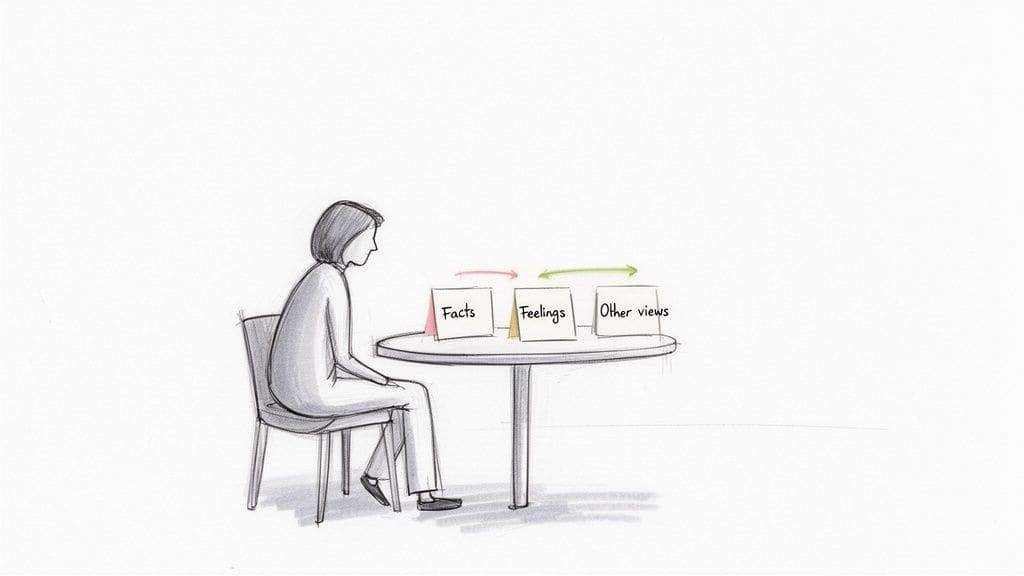
The first step isn't about deciding if you're "right" or "wrong." It's about practicing what I call gentle re-interpretation—a quiet method for separating the concrete facts from your immediate emotional narrative. This creates a little space for other possibilities without dismissing your experience.
Think of it as a simple, three-part checklist:
- Describe what happened. Stick only to the observable facts. Imagine you're a security camera just reporting the data.
- Identify your immediate feeling. Name the core emotion (like hurt, angry, anxious) without any judgment.
- Consider one other possibility. Ask yourself a gentle question, something like, "What is *one* other reason this might have happened?"
For instance, a friend cancels plans. The fact is, "They sent a text to cancel." Your feeling might be "rejection." A gentle re-interpretation could be, "They might be exhausted or dealing with something unexpected."
> This isn't about forcing yourself to feel better. It's about building a small habit of pausing before an emotional spiral takes hold. This is the exact process that tools like the tonen app's Perspective Helper guide you through.
Why This Method Works for Neurodivergent Brains
This approach is intentionally low-demand and structured, which is critical when you feel overwhelmed. It helps bypass the mental exhaustion that often comes with trying to analyze social situations on the fly.
Navigating these moments more effectively can significantly reduce the strain of social interactions. If you find yourself feeling depleted often, our guide on how to stop feeling overwhelmed offers more strategies that might help.
By using this simple framework over and over, you start to build a buffer between an event and your reaction. That pause is incredibly powerful. It gives your nervous system a moment to settle, giving you the clarity you need to decide on your next step, rather than just reacting from a place of stress or anxiety.
Decoding Social Cues with Gentle Re-Interpretations
Misreading a social cue can send your brain into a spiral of worst-case scenarios, and that experience is a massive source of stress. One of the most solid methods for getting your perspective on situation back is to practice what I call gentle re-interpretation.
This technique is a lifeline for anyone who deals with social anxiety or Rejection Sensitive Dysphoria (RSD). It's designed to directly challenge the brain's habit of jumping to the most painful conclusion.
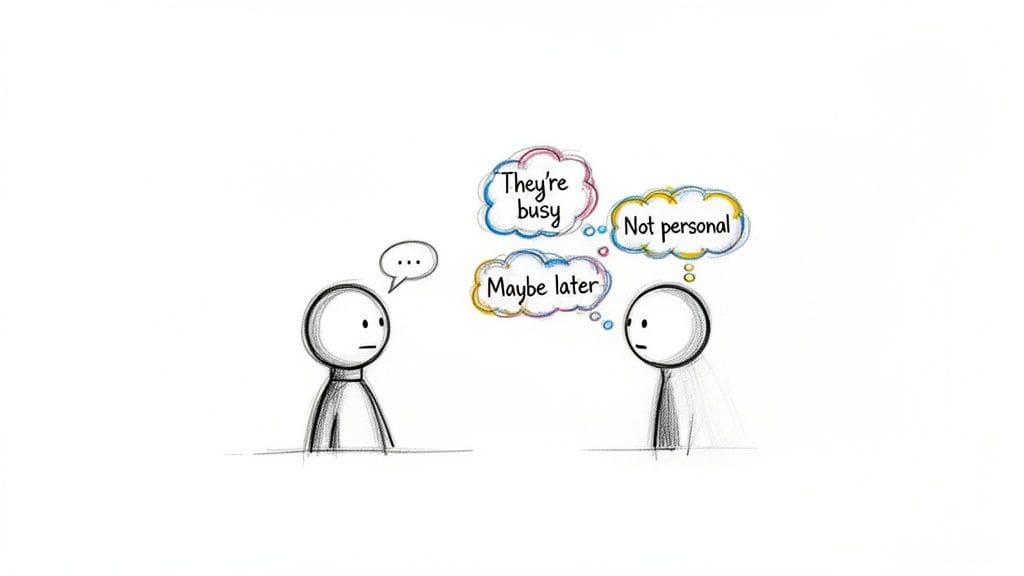
Instead of just accepting that first, gut-punch interpretation that pops into your head, the goal is to consciously come up with two or three alternative, much kinder explanations for what just happened. This isn't about pretending your feelings aren't real; it's about giving your brain more possibilities to work with.
When you make a habit of pausing to consider other potential realities, you can dial down your anxiety in a big way and stop misunderstandings before they spiral out of control.
How Gentle Re-Interpretation Works in Real Life
Let's walk through a classic high-anxiety moment: you get a one-word text. Your immediate reaction might be a jolt of fear—"They're mad at me," or "I must have said something wrong." Gentle re-interpretation is how you actively push back against that first thought.
Try generating a few alternatives on the spot:
- They are busy. That blunt reply could just mean they're in the middle of something else, like a meeting or driving.
- They are low on energy. Texting can feel like a chore, and a short response might be all they can manage right then.
- They don't see texting the same way. For some people, a text is just for quick information. To them, "ok" is a complete, totally neutral answer.
This quick mental exercise shifts the focus from a perceived personal attack to neutral, external factors. It's a powerful reminder that other people's actions are very often about them, not you. Building this skill is crucial, and you can learn more about how to interpret what someone meant in our detailed guide.
> Remember, the purpose of finding a new perspective on situation is not to invalidate your feelings of hurt or anxiety. It is to give your brain more data to work with, preventing a single, negative assumption from becoming your only reality.
From Neutral Feedback to Kinder Explanations
Here's another tough one: getting neutral or ambiguous feedback at work. Imagine your manager says, "This report is fine, but I need you to add the quarterly data." For a brain wired with RSD, that can sound like, "You failed. This isn't good enough."
Here's how to apply gentle re-interpretation in that moment:
| Initial Interpretation (The Fear) | Gentle Re-Interpretations (The Possibilities) |
|---|---|
| "I did a bad job and they are disappointed." | "They are just being direct and giving clear instructions for the next step." |
| "They think I'm incompetent." | "This is standard procedure; they give this feedback to everyone." |
| "I'm in trouble." | "They trust me to make the revision and see it as a minor edit." |
This approach provides a much more balanced view. It helps you recognize that your manager's feedback is probably functional, not personal.
When you're feeling too overwhelmed to do this manually, tools like tonen's Perspective Helper can automate the process. It prompts you to describe what happened and then offers several gentle re-interpretations, giving you a ready-made script to calm that initial wave of anxiety. Practicing this, either on your own or with a tool, builds a powerful mental muscle for navigating social interactions with a whole lot more ease.
Stuck replaying a situation and need a clearer read on it? tonen can help.
tonen offers conversation scripts, Reply Helper, Perspective Helper, Debrief, Phone Call Mode and Calm Kit. Start with 21 free scripts on iPhone. Optional Premium unlocks more features.
Download on the App StoreAvailable on iOS.
Choosing Your Tone Scripts for Clearer Communication
Once you've got a better handle on the situation, the next hurdle is often the biggest: actually saying something. Voicing your needs can feel incredibly difficult, especially when you're worried about how your words will land. This is where having a few pre-planned scripts in your back pocket becomes a total game-changer, seriously cutting down on the mental energy it takes to speak up.
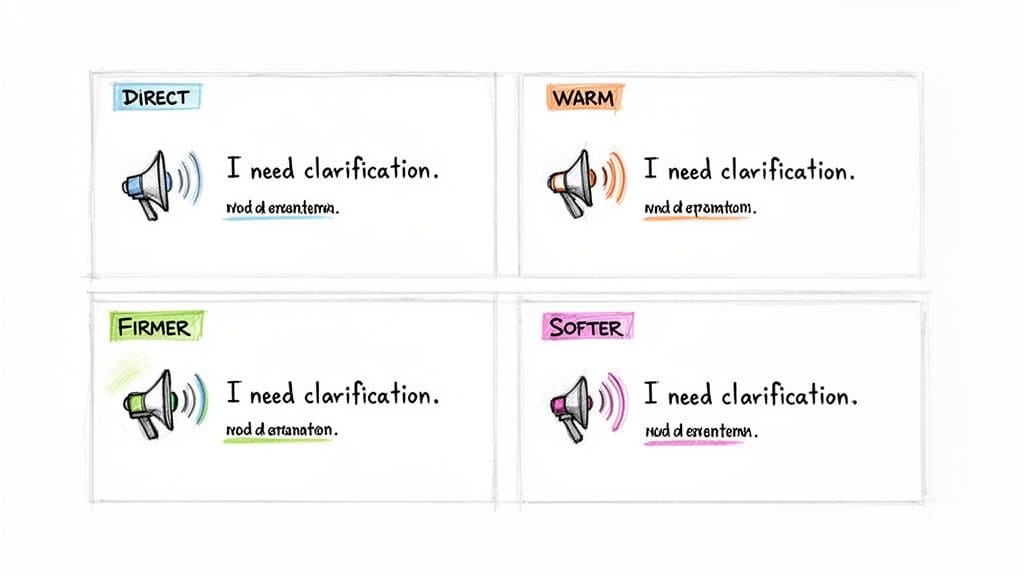
The real key is matching your tone to the specific context. A direct request that's perfectly fine with a close colleague might come across as harsh in a sensitive family conversation. The following examples mirror the tone options you'd find in the tonen app, showing you just how much a single message can change based on the delivery.
Scripts for Setting a Boundary
Setting boundaries is a crucial act of self-care, but it often comes with a huge dose of anxiety. We worry about sounding rude or demanding. Having a couple of phrases ready can make all the difference.
Imagine a family member keeps offering unsolicited advice about your life choices. You need to ask them to stop, but you don't want to start a fight.
- Softer Tone: "I really appreciate that you care about me, but I'd prefer to figure this out on my own for now."
- Firmer Tone: "I've mentioned this before, and I need you to respect my request to stop giving me advice on this topic."
The softer tone works well for a first-time boundary. The firmer one is for when you've already asked nicely and the line has been crossed again. If you're concerned about finding that balance, you can explore more on how to not sound rude in our complete guide.
Scripts for Asking for Clarification at Work
Workplace communication is often filled with vague language, which can be particularly stressful for neurodivergent people who thrive on clear, direct information. Remember, asking for clarification is a strength, not a weakness.
Let's say your manager gives you a vague instruction. To move forward confidently, you need more details.
- Warm Tone: "Thanks for this! To make sure I'm on the right track, could you clarify what you mean by 'as soon as possible'?"
- Direct Tone: "I need a specific deadline for this task to prioritize it correctly. Can you provide one?"
Which one you choose depends on your relationship with your manager and the overall office culture. A warmer tone is usually a safe bet, but a direct tone can be more effective in fast-paced environments where efficiency is king. To make sure your message is always received as intended, it helps to continuously work on your strategies to improve verbal communication skills.
> Having a toolkit of scripts removes the guesswork from these interactions. It empowers you to advocate for your needs clearly and confidently, preserving your energy for the actual task at hand.
The table below shows how a single request—asking for more time on a task—can be framed using different tones to fit various relationships and situations. This flexible approach is central to gaining a better perspective on situation and responding in a way that feels both authentic and effective.
Adapting Your Communication Style with Different Tones
| Tone | Example Script | Best Used When... |
|---|---|---|
| Direct | "I need an extension on this task. The new deadline will be Friday." | You have a clear, established process and just need to state the facts. |
| Warm | "I'm making good progress, but I think I'll need a bit more time. Would it be okay to get this to you by Friday?" | You have a good relationship with the person and a collaborative environment. |
| Firmer | "Due to unexpected delays with Project X, I am moving this deadline to Friday." | You need to assert a boundary or decision professionally and without ambiguity. |
| Softer | "I'm so sorry to ask, but I'm running a little behind. Would it be possible to have until Friday to finish this up?" | The situation is sensitive, you feel you've made a mistake, or you're asking a big favor. |
Having this kind of tangible toolkit for confident communication empowers you to navigate tricky conversations without all the second-guessing.
Mastering the Graceful Opt-Out
Sometimes, the best way to get a new perspective on situation is to just… leave. Mastering the art of the 'opt-out' isn't about being avoidant. It's a critical skill for managing your energy, protecting your peace, and stopping burnout in its tracks.
For many of us, having a few pre-planned exit phrases is a total lifeline. When you're in an unpredictable or overstimulating social setting, trying to script a graceful exit on the spot can feel impossible. Knowing exactly what you'll say ahead of time removes that huge cognitive load.
This isn't about escaping a bad situation. It's a powerful act of self-advocacy—a conscious choice to put your own well-being first.
Building Your Library of Exit Phrases
Think of it like building a mental or digital toolkit. Having a handful of versatile opt-out lines ready to go allows you to respond with confidence instead of guilt. These are your go-to phrases for preserving your social battery. For rehearsal, choose a script, adapt the words and read them aloud yourself if that is useful. You can also practise with someone you trust.
Here are a few examples that work in common scenarios:
- Leaving a Noisy Party: "I've had such a great time catching up, but my social battery is running low. I'm going to head out now, but let's connect again soon."
- Ending a Difficult Conversation: "I can see this is important to both of us, but I don't think we're going to agree right now. I'd like to pause this conversation for now."
- Declining an Unwanted Invitation: "Thank you so much for thinking of me! I'm not able to make it, but I hope you have a wonderful time."
Notice how these phrases are polite but firm. They don't require you to over-explain or make excuses. You're giving a reason, not asking for permission.
Reframing the Opt-Out as Self-Advocacy
Let's be honest, the biggest hurdle for a lot of people is the guilt. We worry about letting people down or coming across as rude. It's so important to reframe this action. It's not a failure to cope; it's a success in self-regulation and a key part of keeping a healthy view.
> Opting out is a powerful boundary-setting practice. It communicates that you understand your own limits and are willing to honor them, which is a foundational aspect of healthy relationships.
Learning to exit gracefully is tied directly to other boundary-setting skills. If you want to explore this more, check out our guide on how to set boundaries with friends.
Each time you successfully use an opt-out phrase, you're reinforcing the idea that your well-being is a valid priority. This confident action helps you maintain control over your environment, which is absolutely essential for managing a healthy and sustainable perspective on situation.
Calming Your Nervous System to Find Perspective
It's almost impossible to get a healthy perspective on situation when your nervous system is screaming "DANGER!" When you're overwhelmed, your brain defaults to survival mode, not nuanced thinking or gentle self-reflection.
So, before you can even think about reframing a situation, you have to create a sense of internal safety. This is where quick, sensory-friendly strategies come in. The goal is to down-regulate your system just enough to give your thinking brain a chance to come back online.
Use Box Breathing to Regulate Your Heart Rate
When stress hits, our breathing often gets shallow and fast, sending panic signals straight to the brain. Box breathing is a simple, structured way to interrupt that cycle and tell your body it's safe.
Here's how it works:
1. Breathe in slowly through your nose for a count of 4. Feel your belly expand.
2. Gently hold that breath for a count of 4. Don't clench.
3. Breathe out slowly through your mouth for a count of 4.
4. Pause for a count of 4 before the next breath.
Just a minute or two of this can make a huge difference. Its predictable rhythm gives your racing mind one simple thing to focus on, which is incredibly grounding when you feel scattered.
> Creating a calm internal state is the non-negotiable first step to gaining a clearer perspective. These tools aren't just for relaxation; they are for creating the mental space required for effective problem-solving and communication.
Try a Grounding Exercise to Reconnect with the Present
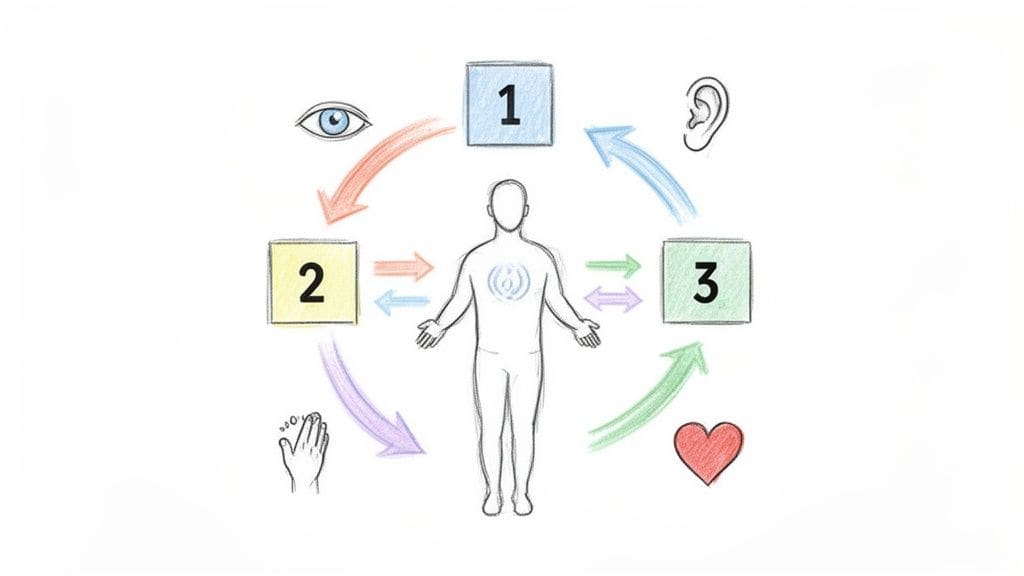
When anxiety drags you into a vortex of "what-ifs," grounding exercises use your senses to pull you back to the here and now. The 5-4-3-2-1 method is a classic for a reason—it's straightforward and it works.
Quietly, to yourself, identify:
- 5 things you can see: "My blue pen," "the pattern on the rug," "a light switch."
- 4 things you can feel: "The texture of my shirt," "the chair under me," "the cool table."
- 3 things you can hear: "The computer humming," "a bird outside," "my own breath."
- 2 things you can smell: "The faint scent of coffee," "the soap on my hands."
- 1 thing you can taste: Maybe the mint from your toothpaste or just the neutral taste in your mouth.
When you're struggling to find clarity, incorporating calming art therapy exercises for anxiety can also be a huge help. These sensory tools are vital for keeping a manageable perspective on situation. For a deeper dive, our guide on how to regulate emotions offers more strategies to help you stay grounded.
Still Have Questions?
It's completely normal to have a few lingering questions. The journey to getting a clearer perspective is a personal one, filled with its own unique challenges and victories. Let's tackle some of the most common things people ask when they're working on these skills.
What if I Still Feel My Initial Reaction Was Right?
That's a great outcome, actually. The point of looking for a new perspective isn't to prove yourself wrong. It's about exploring all the possibilities before you land on a conclusion.
Sometimes, after you've considered other angles, you'll just confirm that your first take was the most accurate one. When that happens, the process actually helps you build more confidence in your judgment over time. The key is making that consideration a conscious step. It stops you from defaulting to a single, often negative, interpretation without more evidence.
How Can I Practice Scripts Without Sounding Robotic?
Practice is everything. It's like learning lines for a play; at first, they feel foreign and clunky, but after a while, they start to sound like your own words.
Saved scripts and downloaded Calm exercises can be used offline. Reply Helper, Perspective Helper and Debrief use online processing, so do not treat them as an offline private notebook. Review tonen’s privacy policy before sharing sensitive information.
A good tip is to start using them in low-stakes situations first, maybe with a trusted friend, before you try them out when things feel more stressful.
> The point of a script is to provide a starting structure, not a rigid mandate. Your unique voice is what makes the communication authentic.
What if I'm Too Overwhelmed to Try Anything?
If you're in a state of overwhelm, shutdown, or meltdown, your only job is to get to a safe place and co-regulate. Problem-solving can wait. This is when you turn to your calming tools first and foremost.
Forget about analyzing the perspective on situation. Instead, focus entirely on grounding exercises, breathing techniques, or just physically stepping away from whatever triggered you. Give yourself full permission to do nothing but care for your nervous system until it settles.
Only once you feel more regulated should you even think about trying to analyze what happened or plan what to do next.
tonen is available on iOS with 21 free scripts, Box Breathing and 5-4-3-2-1 Grounding, plus one free request each in Reply Helper, Perspective Helper and Debrief. Optional Premium adds the full script library, Phone Call Mode, Body Scan and Safe Place, and 50 requests per week shared across the three helpers. Check the App Store purchase screen for your local price and any eligible trial.