Ever found yourself completely stumped, asking why did someone react that way? The quick answer is that a person's reaction is almost never just about you or the immediate situation. It's a complex blend of their internal world—their past experiences, current stress levels, unseen triggers, and even how their brain is wired. Understanding this allows you to take things less personally and respond more effectively. Instead of asking "what did I do wrong?", a more helpful question is, "what might be happening for them right now?". This small shift is the key to decoding confusing interactions and reducing your own anxiety.
The Inner World Behind an Unexpected Reaction
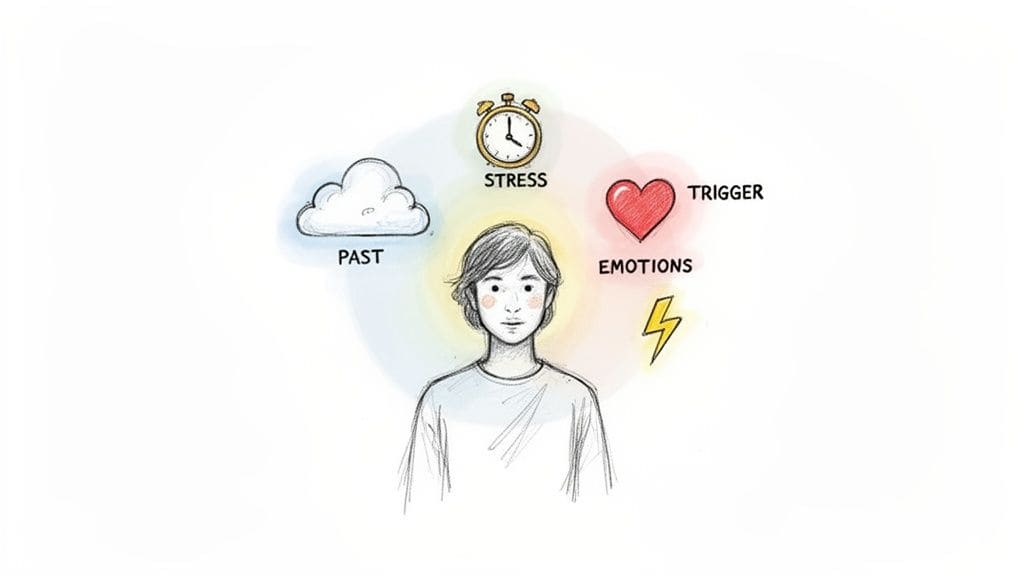
When a reaction feels out of place, our first instinct is often to think, "What did I do wrong?" But what if we shifted that thought to, "What might be going on for them right now?" This small change can open the door to real understanding and dial down our own anxiety.
The truth is, how a person responds often says more about their own internal landscape than it does about you. Let's peel back the layers on what might really be happening.
The Invisible Backpack Everyone Carries
Imagine that everyone you meet is carrying an invisible backpack. It's filled with all of their life experiences, current worries, and personal sore spots. A seemingly small comment from you can feel like the final, heavy item that makes the whole backpack too much to bear, causing them to stumble or react strongly.
So, what's inside this backpack?
- Past Experiences: Old wounds and negative encounters can create emotional hair-triggers. A neutral question from you might accidentally sound just like a criticism they've heard a hundred times before.
- Current Stress Levels: Someone juggling work pressure, family drama, or health issues just has fewer mental and emotional resources to spare. Their fuse is simply shorter.
- Physical Needs: Being hungry, exhausted, or in pain can drastically change someone's mood and patience. Sometimes a sharp reply is just a signal that they really need a break or a sandwich.
> Behavior is communication. An unexpected reaction isn't always a judgment on you; often, it's a flare signal about what's happening inside their own world.
Miscommunication and Different Brains
Of course, another huge piece of the puzzle is simple misinterpretation. The words you chose might have landed in a way you never intended. For instance, a direct and efficient email might come across as cold or demanding to someone who prefers a warmer, more personal communication style. To figure out if your message got lost in translation, check out our guide on how to understand if you misread something.
On top of that, neurodiversity plays a massive role in all of this. People with ADHD, autism, or social anxiety often process information and social cues in a fundamentally different way.
Here's a quick look at some of the common factors that can lead to a reaction that feels out of the blue.
Four Common Reasons for Unexpected Reactions
This table is a quick reference for the primary things that might be influencing how someone responds in any given situation.
| Factor | What It Means | Example |
|---|---|---|
| The Invisible Backpack | Their past experiences and current stress levels are influencing their present mood. | They had a terrible morning, so your neutral question feels like one more demand they can't handle. |
| Miscommunication | The tone or meaning of your words was interpreted differently than you intended. | You sent a short, direct email to be efficient, but they read it as angry or dismissive. |
| Neurodivergent Processing | Their brain processes social information, subtext, or sensory input differently. | They took your sarcastic joke literally and were confused or offended. |
| Unmet Physical Needs | They are hungry, tired, or in pain, which dramatically shortens their emotional fuse. | They haven't eaten all day, so their response to a simple request comes out sharp and irritable. |
Understanding these factors is the first step toward decoding why someone reacted that way. It helps you take things less personally and gives you a real framework for figuring out how to navigate these tricky moments with a lot less stress.
Uncovering the Hidden Layers of Communication
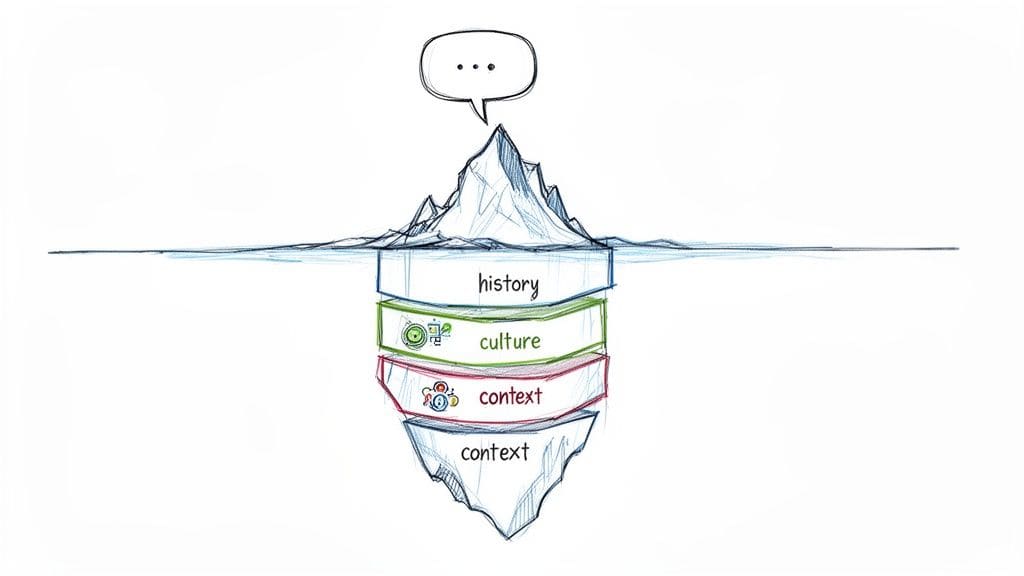
When you're trying to figure out why someone reacted that way, it helps to think of communication as an iceberg. The words you actually hear or read are just the tip—the small, visible part floating above the water. Beneath the surface lies a massive, unseen foundation that gives the reaction its true shape and weight.
This hidden part of the iceberg is made up of a person's emotions, past experiences, current stress levels, and cultural background. What seems like an isolated, confusing reaction is often the logical result of these combined, invisible factors. A critical skill here is learning to improve your emotional intelligence so you can start sensing what's happening below the surface.
The Power of Context and Relationship
Context is everything. The exact same words can carry entirely different meanings depending on where they're said and who says them. Consider the simple phrase, "We need to talk."
- From your boss at work: This phrase likely triggers professional concern. You might start reviewing recent projects, wondering if there's a problem with your performance or an urgent deadline you missed.
- From your partner at home: The same four words can feel much more personal and emotionally loaded. Your mind might jump to the state of your relationship, a recent disagreement, or an important life decision.
Your reaction—anxiety, curiosity, or defensiveness—is shaped not by the words themselves, but by the entire frame around them.
> A reaction isn't just about the 'what' that was said, but the 'where,' 'when,' and 'who' of the entire situation. Ignoring this context is like trying to understand an iceberg by only looking at the tip.
The Unspoken Social Subtext
Beyond the immediate context, every conversation has a subtext—an undercurrent of unspoken rules, expectations, and history between people. This is especially true in ongoing relationships, whether with family, friends, or coworkers.
For instance, a friend who has always been your go-to for support might react with surprising irritation when you vent about a minor problem. Their reaction isn't about your problem today. It might be because they are feeling emotionally drained themselves, or perhaps they feel the give-and-take in your friendship has become unbalanced. Their response is colored by the history of your relationship. If you're looking to get better at spotting these subtle layers, our article on how to understand the hidden meaning in messages can provide deeper insights.
Ultimately, seeing reactions as the culmination of these hidden layers allows you to step back from taking everything so personally. This shift in perspective is the first step toward responding with curiosity instead of confusion or hurt when you find yourself wondering why someone reacted that way.
Puzzled by how someone reacted? tonen can help.
tonen offers conversation scripts, Reply Helper, Perspective Helper, Debrief, Phone Call Mode and Calm Kit. Start with 21 free scripts on iPhone. Optional Premium unlocks more features.
Download on the App StoreAvailable on iOS.
Why Different Brains React Differently
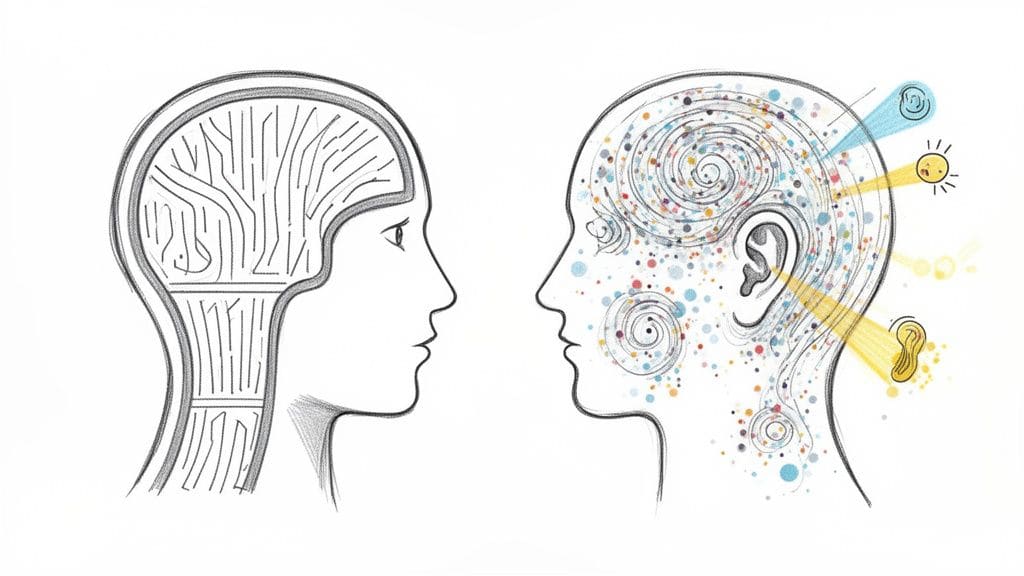
So often, when we're left puzzling over a confusing social signal, the answer isn't about intent—it's about neurology. Many of the most baffling interactions happen simply because not all brains are wired the same way. When you're trying to figure out why someone reacted that way, one of the most important things you can consider is neurodiversity: the natural, normal variation in how human brains learn, pay attention, and process the world.
A reaction that seems totally out of left field to a neurotypical person might be the most logical conclusion for a neurodivergent individual, like someone who is autistic or has ADHD. It's not about one person being 'right' and the other 'wrong.' It's more like trying to run Mac software on a Windows PC. The operating systems are just different.
Different Wiring, Different Responses
For many neurodivergent people, communication is a very direct and literal affair. All those subtle social cues, sarcastic asides, and idioms that neurotypical people use without a second thought might not even register. This can easily lead to confusion or a response you weren't expecting.
What might feel like rudeness from the outside could actually be an expression of something else entirely.
- Literal Interpretation: Someone on the autism spectrum might hear a common phrase like "I'm dying of laughter" and react with genuine alarm. The brain processes the literal meaning first, not the figurative one.
- Sensory Sensitivity: A person with ADHD or sensory processing differences might seem irritable or distracted. But what you can't see is that the hum of the overhead lights or the scratchy tag on their shirt is causing them genuine, overwhelming discomfort.
- Emotional Regulation: The way someone shows their feelings might not match neurotypical expectations. A reaction could seem really muted or, conversely, overly intense because their internal emotional experience and how they express it externally just don't line up in the way you're used to.
Grasping this requires an appreciation for topics like promoting ASD awareness and inclusion, which really drive home how vital it is to recognize and make space for these different styles. For a much deeper dive, you can learn what being neurodivergent means in our detailed guide.
The Weight of Past Experience
These different ways of seeing and processing the world can create major hurdles, especially at work. A long history of being misunderstood or penalized often leads neurodivergent people to develop protective or defensive habits.
> A defensive or cautious reaction from a neurodivergent colleague isn't necessarily about the current conversation. It could be a learned response from years of being misunderstood, criticized, or penalized for thinking differently.
Understanding these factors is one of the biggest keys to decoding why someone reacted that way. It allows you to move past your initial confusion and respond with genuine empathy.
How to Generate Gentler Interpretations of Behavior
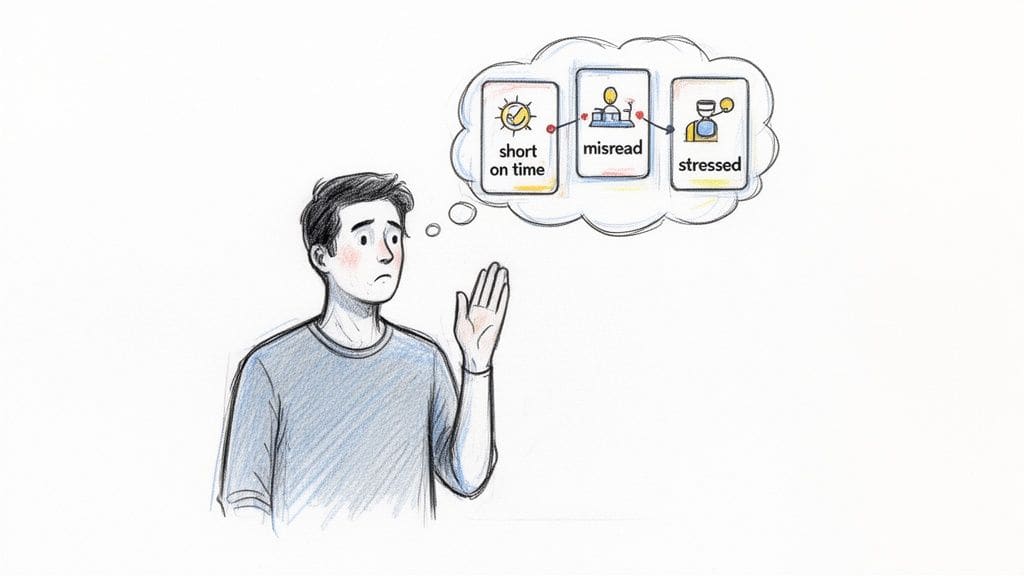
When you're left feeling confused and wondering why someone reacted that way, the brain often snaps to the worst-case scenario. It's a self-protective instinct, but it's rarely helpful. Instead of assuming the worst, you can learn to generate gentler interpretations—a skill that can de-escalate your own anxiety and open the door for a much more constructive response.
This mental shift is all about moving from a place of defense to one of curiosity. Was that blunt email from your coworker really an attack, or were they just short on time and focused on being efficient? A simple reframe like this can completely change how you feel about the entire situation.
The Power of the Pause
The very first step is to simply pause before you react. Jumping to conclusions is a fast, automatic process rooted deep in our brain's wiring. By intentionally stopping yourself, even for a few seconds, you create a small but powerful window to think more slowly and deliberately.
During this pause, you can actively challenge your first, often negative, interpretation. This isn't about ignoring your feelings or pretending something didn't hurt. It's about asking whether your initial assumption is the only possible truth. This is a foundational skill for anyone wanting to better read someone's tone in messages, as it separates the message itself from its immediate emotional sting.
Building a Library of Possibilities
To make this easier over time, start building a mental "library" of alternative reasons for someone's behavior. The more possibilities you can come up with, the less power any single negative interpretation holds over you.
- Environmental Factors: Could they be overwhelmed by a noisy cafe, a looming deadline, or a personal stress you know nothing about?
- Communication Mismatch: Is it possible they're just a very direct communicator and didn't intend for their words to sound so harsh?
- A Simple Mistake: Could they have misread your original message or even be responding to the wrong person entirely?
> Generating kinder possibilities is a form of emotional self-regulation. You are actively choosing to view a situation through a lens of curiosity rather than assuming negative intent, which gives you more control over your own response.
This process can feel really difficult, especially when you're already feeling hurt or anxious. It takes practice to build this mental muscle. This is precisely where a tool like tonen's Perspective Helper can provide immediate support, because it's designed to help you practice this exact skill.
For example, if you input a confusing situation like, "My friend sent a one-word reply to my long message," the app can provide several plausible interpretations. It might suggest they are busy driving, feeling overwhelmed, or simply didn't realize their brief reply would come across as dismissive. This helps you understand why someone reacted that way without defaulting to self-blame. By offering concrete, less threatening scenarios, it empowers you to approach social friction with curiosity instead of fear.
Practical Strategies for Responding with Confidence
Once you've found a gentler perspective, what comes next? Understanding why someone reacted a certain way is only half the battle. Now you have to figure out how to respond effectively—without making things worse or ignoring your own feelings.
The key is having a plan. Knowing what to do ahead of time, whether that means asking for clarification, setting a boundary, or just having the right words to stay calm, makes all the difference.
Having a few frameworks ready to go can be a game-changer. For example, a tool like tonen's Scripts Library gives you access to tested phrases for hundreds of common situations. This takes the pressure off of inventing the perfect response on the spot, so you can handle tricky conversations with more confidence and less anxiety.
Choose Your Words and Tone Carefully
The same sentence can land in completely different ways depending on your tone. A simple request can sound like a demand or a gentle invitation based on subtle changes in your wording. When you consciously choose your tone, you make sure your message is heard the way you mean it.
For instance, imagine a friend cancels plans last minute. Your response will guide what happens next.
- Direct: "That's disappointing. I was looking forward to it. Let me know when you want to reschedule."
- Warm: "No worries at all, I hope everything is okay! We can definitely catch up another time."
- Firmer: "I understand things come up, but I'm feeling let down as this has happened a few times. I'd appreciate more notice in the future if possible."
Each of these is a perfectly valid response. But they each do something different—one prioritizes the relationship, while another sets a clear boundary. There's no single "right" way, only the way that best reflects what you need in that moment.
> Your response is a tool. It can be used to gather more information, express your feelings, reinforce a boundary, or de-escalate tension. Choosing the right tool for the job is a skill you can build with practice.
Have a Plan for Asking, Stating, and Exiting
Navigating a difficult interaction is much easier when you have a simple, three-part strategy: ask for clarification, state your position, and know when to exit. This approach helps you stay in control of the conversation, not just react to it.
1. Ask for Clarification: If a message is confusing or feels loaded, a simple, non-accusatory question can clear things up instantly. Try phrases like, "I'm not sure I'm understanding correctly, could you explain what you mean by that?" or "When you say [X], are you feeling [Y]?"
2. State Your Needs or Boundaries: Clearly and calmly state your perspective or set a boundary. Using "I" statements is a great way to own your feelings without sounding accusatory. Think, "I feel overwhelmed when the conversation gets this intense," or "I need a moment to think about this before I respond." If you want more ideas on this, check out our guide on how to navigate difficult conversations.
3. Gracefully Exit: It is always okay to step away from a conversation. If things become unproductive or just too stressful, you can say, "I don't think we're going to solve this right now. Let's take a break and revisit it later," or more simply, "I'm not able to continue this conversation right now. I'm going to step away."
These strategies shift you from a place of confused reaction to confident action. By having prepared phrases and a clear plan, you can handle tough moments with grace—protecting both your relationships and your own well-being.
Still Have Questions About Understanding Reactions?
It's completely normal to have more questions when you're trying to make sense of human behavior. When you're wrestling with why someone reacted that way, it often feels like peeling back the layers of a very complicated onion. Let's tackle some of the most common questions that come up.
The simplest truth is that reactions are almost never just about the single thing that happened. They're a messy, complicated mix of a person's entire internal world—their stress levels, their past hurts, their neurotype—colliding with the present moment. Grasping this helps you shift from a place of self-blame to one of gentle curiosity, which is the real starting point for better communication.
Is It My Fault If Someone Overreacts?
It's a natural human instinct to wonder if you caused a big reaction. But framing it as "fault" is often a dead end. While your words or actions might have been the trigger, the size of their reaction is almost always fueled by something already going on inside them. Think of it as pre-existing emotional kindling—their stress, past experiences, or even their neurotype.
Your responsibility is to try and communicate with clarity and kindness. Their reaction, however, belongs to them. The most helpful path forward isn't assigning blame, but simply focusing on understanding where they're coming from.
How Can I Tell If It's Neurodiversity or Something Else?
Trying to distinguish between a reaction rooted in neurodivergence and one caused by, say, a terrible, stressful day can be tricky. From the outside, they can look almost identical. The real clue isn't in the single reaction itself, but in the underlying pattern over time.
- Situational Reactions: If a person who is usually pretty chill suddenly snaps on a day they're facing a huge deadline, the cause is likely temporary. It's the situation, not the person.
- Patterned Reactions: If someone consistently takes your sarcasm literally, seems to require incredibly direct instructions, or gets overwhelmed by background noise, that might be a hint about their neurotype.
Ultimately, you don't need to be a detective or have a perfect diagnosis. The best strategy is a universal one: approach every confusing interaction with patience and a genuine willingness to ask clarifying questions.
> Trying to figure out why someone reacted that way is less about being a detective and more about being a gentle scientist. Observe the patterns, consider the context, and lead with curiosity instead of assumptions.
Why Do Some People Get So Defensive at Work?
Defensiveness in the workplace often comes from a history of feeling misunderstood, penalized, or just plain unseen. This is especially true for many neurodivergent professionals who have spent years navigating environments that simply weren't built for them.
The Equal Employment Opportunity Commission (EEOC) has noted a significant increase in cases related to neurodiversity, highlighting that workplaces are still adapting. A defensive reaction might just be a protective habit learned from past negative experiences. You can read more about the rise of neurodiversity in employment to understand the evolving workplace and its legal context.
What If I Just Can't Generate a Gentle Interpretation?
Sometimes, a reaction is just plain hurtful. It's okay to acknowledge that. The whole point of generating gentle interpretations isn't to excuse bad behavior or force you to ignore your own feelings. It's a tool—a practical strategy to manage your own immediate spike of anxiety and stop yourself from firing back impulsively.
If you can't find a kinder possibility, just aim for a neutral one. Instead of jumping to, "They are definitely mad at me," try reframing it as, "I don't have enough information to understand their tone right now." This simple shift creates just enough mental breathing room for you to choose a calm, deliberate response instead of an equally charged one.
Feeling overwhelmed trying to find the right words? tonen is a mobile app designed to help you handle social conversations with less stress. With a library of ready-to-use scripts, a Perspective Helper to reframe confusing situations, and a Calm Kit for when you feel overwhelmed, it provides the tools you need to communicate with confidence. Discover how to make every interaction clearer and kinder at https://usetonen.com.