For neurodivergent people, being told to start talking it through can feel like being pushed onto a stage without a script. The real problem isn't a lack of wanting to connect. It's that open-ended, unstructured conversations often spiral into overwhelm, misinterpretation, and stress. This guide provides a structured approach to turn conversational chaos into manageable steps, starting with understanding the hidden hurdles.
The Hidden Hurdles of Talking It Through for Neurodivergent Minds

The simple idea of a chat relies heavily on unspoken social rules, decoding subtle cues, and managing a high cognitive load. These are all things that can be uniquely challenging for autistic adults, people with ADHD, and those with social anxiety. When a conversation feels unpredictable, the mental battery required to participate drains incredibly fast.
This isn't some kind of personal flaw; it's a difference in how our brains process information. Many of us thrive on structure and clarity. So when we're faced with a vague conversation, our brains can go into overdrive trying to predict every possible outcome, decode hidden meanings, and come up with the "right" thing to say.
Why Unstructured Dialogue Creates Stress
Without a clear framework, conversations can feel like navigating a minefield. The most common pain points usually boil down to a few key fears:
- Fear of Misinterpretation: That constant worry your tone will be read wrong, or that you'll completely misread the other person's intentions.
- Cognitive Overload: Trying to juggle what you want to say, *how* you want to say it, and processing everything they're saying all at once is just too much.
- Improvisation Anxiety: The intense pressure to respond instantly, without a moment to gather your thoughts, is a massive source of stress.
> The solution isn't to change who you are. It's about equipping yourself with structured supports that turn conversational chaos into manageable steps.
Simple, practical tools like conversation scripts or pre-selected tone choices can bring immediate relief. By preparing a few key phrases ahead of time, you dramatically reduce the in-the-moment mental load.
This frees up your brainpower to actually listen and connect authentically. You can learn more about these strategies in our in-depth guide to neurodivergent communication strategies.
How to Prepare for Any Conversation
Real confidence when you're talking it through almost always starts long before you say a single word. Preparation is what turns that churning anxiety into a feeling of control. The very first step, before you even think about what to say, is to pin down a clear, simple goal.
What do you actually need from this conversation? Are you trying to ask for an accommodation at work? Set a boundary with a family member? Maybe just clear up a misunderstanding with a friend. Knowing your destination gives you a compass for the entire interaction.
Find Your Starting Point
I think we can all agree that staring at a blank page is one of the most paralyzing feelings. So don't. Instead of trying to invent the perfect words from scratch, lean on a resource like a scripts library. It gives you a solid foundation to build on, saving you the stress of finding the right phrases on the spot.
Once you have a prompt, the next job is to make it sound like you. Think of it as a template—the basic structure is solid, but you need to fill in the details with your own personality and the specifics of your situation. For more ideas on just getting the ball rolling, you can check out our guide on how to effectively start a conversation.
> A crucial part of preparing is anticipating the other person's perspective. It's not about predicting the future, but about considering their point of view, which can help you feel more grounded and less surprised by their reaction.
This whole process applies to so many high-stakes discussions. For a great example of how this plays out in the professional world, it's worth reading a success guide on preparing for a job interview. By mapping out your goal, your script, and a few potential responses, you turn a scary unknown into a manageable plan. Suddenly, the idea of talking it through feels a whole lot more achievable.
Choosing Your Tone and Scripting Your Lines
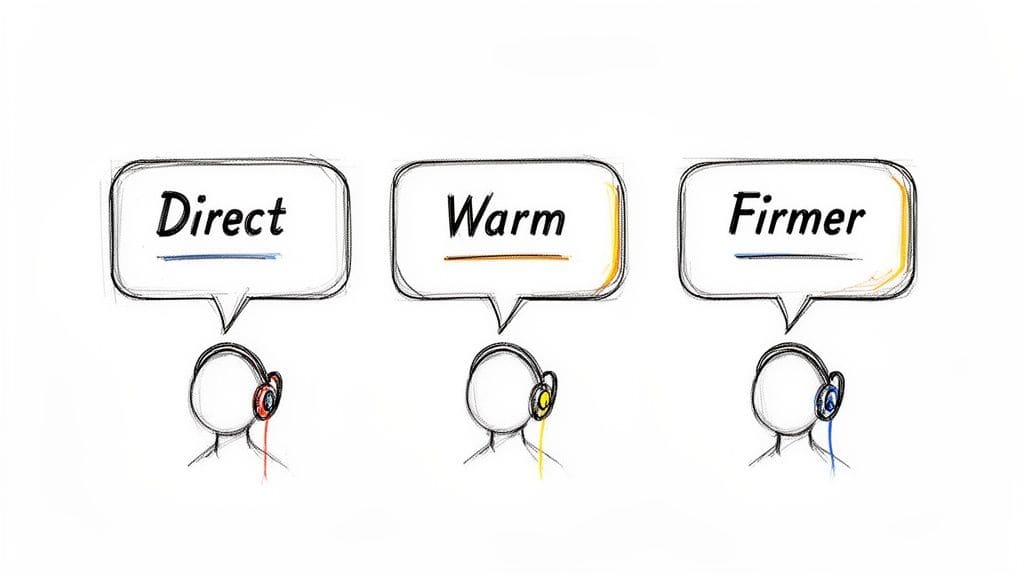
How you say something often matters just as much as what you say. It's a hard truth, but intentionally choosing your tone and scripting a few key phrases before a tough conversation can make all the difference.
This isn't about being fake. It's about removing the intense cognitive load of trying to find the perfect words when your emotions are running high.
Different moments need different approaches. Setting a clear boundary might call for a 'Firmer' tone, while asking a friend for support probably works better with a 'Warm' one. Having these options ready helps you adapt without getting flustered.
Need help processing your thoughts? tonen can help.
tonen offers conversation scripts, Reply Helper, Perspective Helper, Debrief, Phone Call Mode and Calm Kit. Start with 21 free scripts on iPhone. Optional Premium unlocks more features.
Download on the App StoreAvailable on iOS.
Scripting Your Key Phrases
The best scripts are short, clear, and sound like you. I find it easiest to focus on just three parts of the conversation: the opening, the main point, and the exit.
- Opening Lines: Start things off on the right foot. Try something collaborative like, *"I'd like to find a time to talk about [topic] so we can get on the same page."*
- Key Points: State your need or observation directly but kindly. For instance, *"When [action] happens, I feel [emotion]. What I need is [request]."*
- Exit Strategy: This is crucial. Always have a graceful way to leave if you feel overwhelmed. A simple, *"Thank you for listening. I need some time to think about this,"* is a perfectly polite way out.
> Scripting isn't about sounding robotic; it's about providing your brain with a reliable map. This frees you up to listen and connect, rather than scrambling for the right words.
By preparing just a few lines for each stage, you create a structure that holds you up when you feel shaky. This framework helps you stay on track and deliver your message clearly. We cover more on this in our article about how to say things without upsetting others.
Practice and Rehearse for Real-World Confidence
Confidence isn't some magical trait you're born with—it's a skill, and like any other skill, it gets stronger with practice. Just think about how you'd rehearse for a big presentation to feel more prepared. Applying that same logic to a difficult conversation can make a world of difference in managing that in-the-moment anxiety.
The process of talking it through with yourself first transforms a dreaded, unpredictable event into a planned interaction you can lead.
Actually saying the words out loud is a surprisingly critical step. It helps your script feel less like a collection of words on a page and more like your own authentic voice. This kind of rehearsal builds a bit of muscle memory, making the phrases feel more natural and much easier to recall when you're under pressure. For many neurodivergent people, this preparation is a powerful way to manage cognitive load and stay focused on the actual goal of the conversation.
> Rehearsal isn't about chasing perfection. It's about building familiarity so you can lead the conversation with confidence instead of just reacting to whatever comes your way.
Fine-Tuning Your Delivery
As you practice, you can start to experiment with different tones to see what feels most effective and authentic for your specific situation.
- Practice with a 'Firmer' tone for when you need to set clear boundaries.
- Try a 'Warm' tone for those moments when you're asking a loved one for support.
- Use a 'Direct' tone for making clear, professional requests at work.
This kind of vocal rehearsal is a core part of building better, more intentional communication habits. If you're looking for more guidance on this, exploring different approaches to social skills training for adults can give you a much broader toolkit to work with.
And remember, scripting is only one piece of the puzzle. Discovering other practical exercises to improve your speaking skills can also give your confidence a significant boost.
Managing Overwhelm During the Conversation

Even with the best preparation in the world, a conversation can suddenly become too much. You feel your heart start to race, your thoughts get jumbled, and the urge to just shut down kicks in. When this happens, having a few in-the-moment strategies to keep yourself grounded is absolutely essential.
These tools don't need to be obvious or disruptive. A simple, discreet action can make a massive difference in managing that rising wave of anxiety without derailing the whole discussion. The trick is to find what works for you before you're in the middle of a high-stress situation.
Discreet Tools for Staying Grounded
When overwhelm hits, having a go-to technique can be a total lifesaver. This is exactly why we built tools like the Calm Kit right into the app—to give you structured exercises you can use discreetly, anytime you need them.
A few you can try:
- Breathing Exercises: Focus on a simple box breathing technique. Inhale for four counts, hold for four, exhale for four, and hold again for four. It's a surprisingly powerful way to regulate your nervous system without anyone even noticing.
- Grounding Techniques: Silently name five things you can see around you. Or, focus on the texture of your chair against your back. These small sensory inputs pull your focus out of your racing thoughts and back into the present moment. Our guide on effective grounding techniques for anxiety has even more ideas.
- Quick Visualizations: Briefly picture a safe, calm place. It could be a quiet beach, a cozy room, or anywhere that brings you a sense of peace. This offers a momentary mental escape to reset and catch your breath.
> Knowing you have a polite and graceful way to exit a conversation that has become too much provides a powerful sense of security, making you more willing to engage in the first place.
Your Next Step Toward Clearer Communication
Learning how to successfully talk it through isn't about masking or becoming someone you're not. It's a skill, and like any other, you can build it up and sharpen it with the right supports. This guide gives you a clear, structured method to turn that feeling of conversational dread into genuine confidence.
The goal is to empower you to communicate your needs clearly and authentically. Remember the process: thoughtful preparation sets the goal, scripting gives you a reliable map, and rehearsal builds the muscle memory. And just as important, having tools to manage overwhelm ensures you can stay in control, even when things get intense. Each piece works together to lower the cognitive load.
> These techniques are designed to build a foundation of self-advocacy. They empower you to set boundaries, ask for support, and engage in kinder, clearer conversations on your own terms.
Mastering this doesn't happen overnight, but taking the first step is simple. Exploring practical tools can make a huge difference, and you can start right now.
tonen is available on iOS with 21 free scripts, Box Breathing and 5-4-3-2-1 Grounding, plus one free request each in Reply Helper, Perspective Helper and Debrief. Optional Premium adds the full script library, Phone Call Mode, Body Scan and Safe Place, and 50 requests per week shared across the three helpers. Check the App Store purchase screen for your local price and any eligible trial.
Still Have Questions? Let's Clear Things Up
It's completely normal to have a few lingering questions. The journey to feeling more confident in conversations is a personal one, and it's smart to think through the details. Let's tackle some of the most common things people ask.
Will Using Scripts Make Me Sound Robotic or Fake?
Not at all. Think of a script as a solid foundation, not a cage. The goal isn't to make you memorize lines like an actor, but to handle the heavy lifting of organizing your thoughts so you don't have to do it in the moment.
This actually frees you up to focus on how you want to say something—your tone, your warmth, your delivery. It's like having a reliable map for the conversation. The map doesn't tell you how to drive, but it makes sure you don't get lost along the way.
What If the Other Person Doesn't React the Way I Planned?
This is a really common and valid fear, and it's exactly where a little prep work makes a huge difference. By taking a moment to think about their perspective beforehand, you can usually anticipate a few of the most likely reactions, which takes away a lot of the element of surprise.
Most importantly, your script should always include a pre-planned, graceful exit line. If a conversation takes a turn that feels unproductive or overwhelming, you have a polite, ready-to-go way to pause the discussion. This simple tool puts control right back in your hands.
How Can I Use These Techniques to Support My Neurodivergent Teen?
The best way to approach this is as a collaborator, not an instructor. Instead of just giving advice, you could sit down together in a low-pressure moment and explore a communication support app like tonen.
You can help them find situations they find stressful and browse the Scripts Library for ideas. For rehearsal, choose a script, adapt the words and read them aloud yourself if that is useful. You can also practise with someone you trust. By modeling preparation and offering supportive tools, you're empowering them to build their own communication confidence from the ground up.
tonen is available on iOS with 21 free scripts, Box Breathing and 5-4-3-2-1 Grounding, plus one free request each in Reply Helper, Perspective Helper and Debrief. Optional Premium adds the full script library, Phone Call Mode, Body Scan and Safe Place, and 50 requests per week shared across the three helpers. Check the App Store purchase screen for your local price and any eligible trial.