To understand if I misread something, the first step is to pause and separate the concrete facts from the emotional story your brain creates. For example, the fact is your friend sent a one-word text. The story is that they are mad at you. Recognizing this difference stops you from immediately jumping to the worst-case scenario. This guide provides practical tools to check your interpretation, ask for clarity without causing conflict, and know when it's healthier to just let it go.
That split second between something happening and how you react to it is everything. It's the space you need to keep your brain from immediately jumping to conclusions, letting anxiety hijack the whole situation.
How to Check if You Misread a Social Situation
We've all been there. That sinking feeling after a conversation, where you replay every word, convinced you took it the wrong way.
Did their one-word email mean they're mad at you, or were they just in a hurry? Was your friend's comment a lighthearted joke or a jab with a hidden meaning? Before you spiral, you need a way to ground yourself. This is about giving you immediate, practical tools to find clarity without piling on more stress.
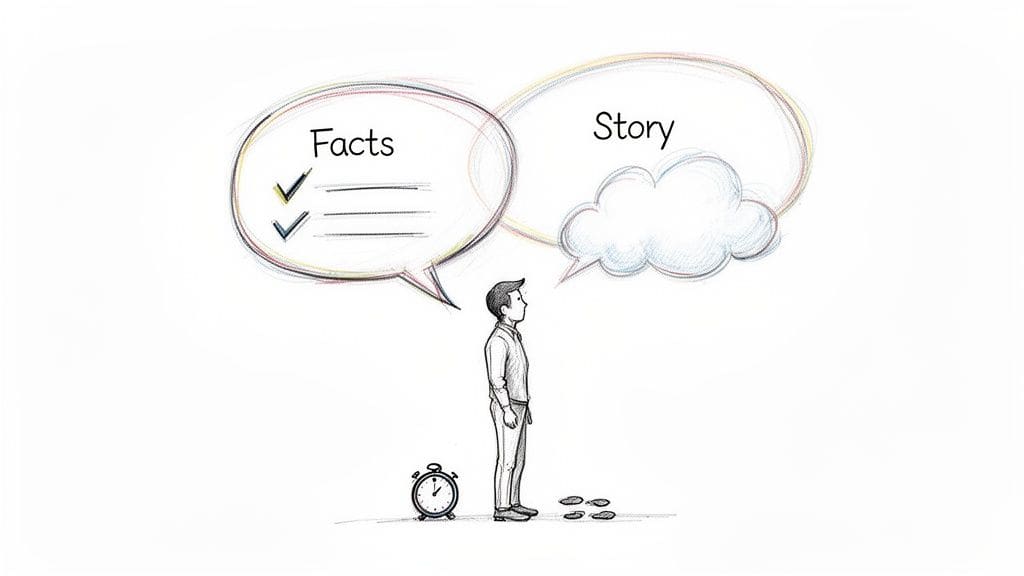
Separate the Facts From the Story
The core technique here is learning to pull apart what actually happened from the interpretation your brain instantly attached to it. It's a simple but powerful way to question the narrative you've built around an interaction.
- The Fact: What can be proven? For example, "My manager sent a one-sentence reply to my email."
- The Story: What is my interpretation of that fact? For example, "She's annoyed with me and thinks my work is terrible."
> This mental checklist is a game-changer. It builds a crucial buffer between a social trigger and your emotional response, giving you the space you need to decide what to do next.
If you'd like to go deeper, it's helpful to explore different ways to interpret a social situation correctly beyond your first gut reaction.
To make this even more practical, here are a few questions you can ask yourself in the moment to get grounded.
Immediate Self-Check Questions
Use this quick reference table to calmly assess a situation and determine if you might have misread it.
| Question to Ask Yourself | What This Helps Clarify |
|---|---|
| What words were actually said or written? | This grounds you in the literal data, separating it from any inferred tone or intent. |
| Could there be another reason for their behavior? | This opens you up to alternative explanations (e.g., they're busy, stressed, or distracted). |
| Am I assuming their intention based on my own fears? | This checks if your past anxieties are coloring your perception of the current event. |
| If a friend described this to me, what would I tell them? | This helps you step outside your own emotions and see the situation more objectively. |
Running through these questions isn't about ignoring your feelings or telling yourself you're wrong. It's about acknowledging your emotional reaction without letting it write the whole story.
By separating the concrete evidence from the emotional narrative, you put yourself back in the driver's seat.
Recognizing the Signs of Misinterpretation
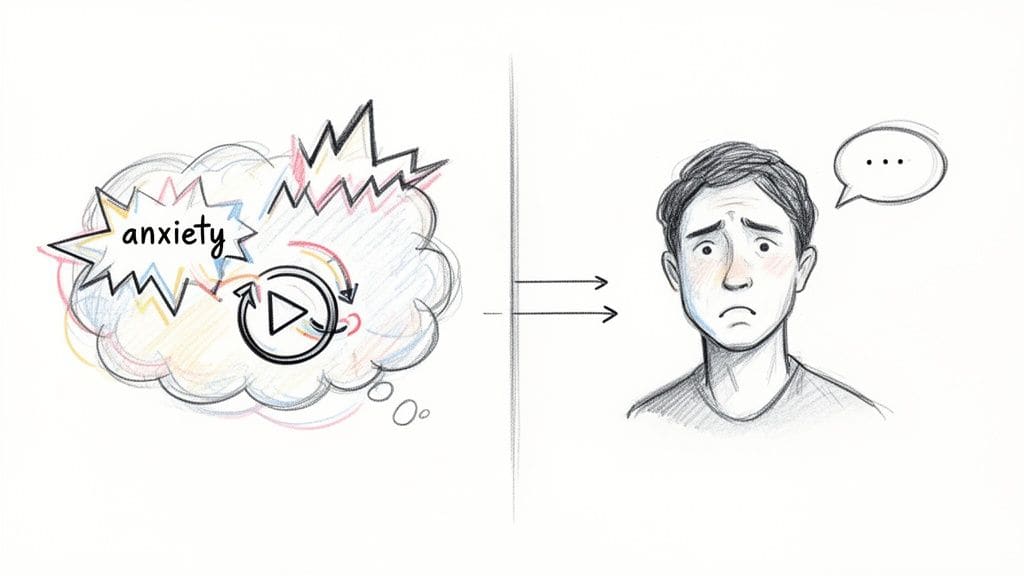
Before you can fix a misunderstanding, you first have to catch that feeling that something is… off. Spotting these little clues is a critical step, and it's what lets you step in before your anxiety takes over.
These signals can be internal—like that sudden, sinking feeling in your gut—or external, like an awkward silence that stretches just a bit too long.
Learning to see these patterns is like having your own early-warning system. It's not about becoming paranoid; it's about being more tuned in to your own gut reactions and the social feedback you're getting from others.
Tuning Into Your Internal Alarms
A lot of the time, the very first sign of a misinterpretation comes from inside you. Your own body and mind will send up a flare, even if you can't immediately put your finger on what's wrong. Think of these as personal data points telling you to pay a little more attention.
Some of the most common internal signals include:
- A Sudden Spike in Anxiety: You get a rush of nervousness or a pit in your stomach right after an interaction.
- The Replay Loop: You find yourself mentally replaying the conversation over and over, picking apart every word for some hidden meaning.
- Jumping to the Worst-Case Scenario: Your mind immediately leaps to a catastrophic outcome, assuming the other person is angry, disappointed, or about to reject you.
That mental replay loop is absolutely exhausting, and it often just makes the initial uncertainty feel ten times worse. The key is simply to notice when you're doing it.
For many neurodivergent people, a tendency toward unfiltered honesty or literal interpretation can create situations that need a second look. If you want to dig deeper into this, our guide to understanding hidden meanings in messages offers a lot more context.
> Acknowledging these feelings isn't the same as agreeing with them. It's just about seeing them for what they are. Think of them as clouds passing by—you don't have to stand in the rain, but you can acknowledge that you might get a little wet.
Spotting External Cues
While your internal alarms are powerful, external signals can give you more objective clues that your interpretation might not line up with the other person's reality. These are observable shifts in the dynamic of the conversation.
Keep an eye out for these external signs:
- An Abrupt Shift in Demeanor: The person's tone of voice, facial expression, or body language suddenly changes. They might go from warm and engaged to quiet and withdrawn.
- An Awkward or Unexpected Ending: The conversation wraps up abruptly, leaving you with a weird sense of unresolved tension or confusion.
- A Confused or Surprised Reaction: The other person looks puzzled by your response, which is a good sign that what you said didn't land the way they expected.
For instance, you might misread a colleague's blunt email as being critical when it was just hurried. When you're trying to read between the lines in written communication, an online email tone analyzer can offer some valuable perspective on potential misinterpretations.
Spotting these cues gives you a chance to pause and decide if you need to ask for more clarity, which is a key part of learning to effectively handle miscommunications.
Using Low-Pressure Scripts to Seek Clarity
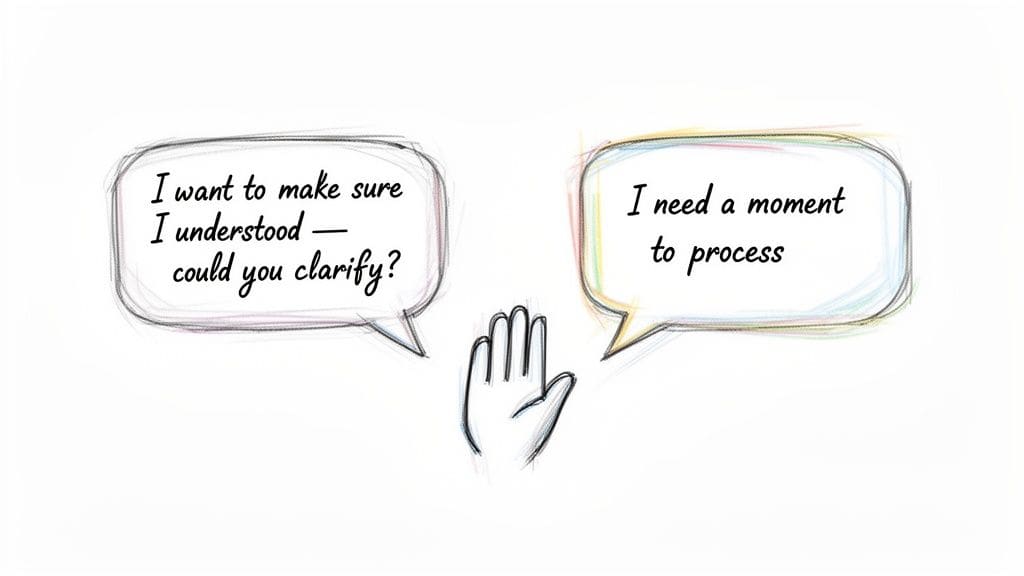
We've all felt it—that sinking feeling in your gut when you suspect you've completely misread what someone just said. In that moment, asking for clarity can feel like a high-stakes move, but it doesn't have to be.
The key to successfully getting clarity is to have a few gentle, low-pressure scripts ready to go. Think of them as communication tools that help you check your perceptions without creating tension or putting the other person on the defensive. It's about owning your experience, not placing blame.
These scripts open a door for more information rather than demanding an explanation. By using "I" statements, you frame the conversation around your own feelings and interpretations, which is far less confrontational. This approach can turn a moment of potential conflict into an opportunity for genuine connection.
Worried you misread a situation? tonen can help.
tonen offers conversation scripts, Reply Helper, Perspective Helper, Debrief, Phone Call Mode and Calm Kit. Start with 21 free scripts on iPhone. Optional Premium unlocks more features.
Download on the App StoreAvailable on iOS.
Framing Your Questions Gently
How you phrase your request for clarity makes all the difference. Asking, "What did you mean by that?" can sound accusatory, even if you don't mean it to. Softer language, on the other hand, invites collaboration and shows you're just trying to get on the same page.
Here are a few adaptable scripts that focus on owning your perspective:
- "I want to make sure I'm understanding you correctly. Could you explain that in a different way?"
- "The story I'm telling myself right now is that you're frustrated. Is that accurate?"
- "My brain sometimes hears things literally. Can you help me understand the nuance of what you just said?"
- "I'm feeling a little lost in the conversation, could we go back for a moment?"
These phrases are non-judgmental. They signal that your goal is to align with the other person, not to challenge them. If you're looking to build this skill, exploring these examples of clarifying questions can offer some great ideas for different professional and personal contexts.
> The most effective scripts don't just ask a question; they share a small, vulnerable piece of your own internal experience. This encourages empathy and shifts the tone from interrogation to teamwork.
Creating Space with Opt-Out Lines
Sometimes, you're just not ready to seek clarity in the moment. You might feel overwhelmed, emotionally flooded, or simply need time to process before you can even figure out what to ask. In these situations, having a graceful "opt-out line" is essential.
An opt-out line isn't about ending the conversation permanently; it's about hitting the pause button. It's a respectful way to signal your need for a break without shutting the other person down completely. This is a crucial skill for managing anxiety, as it stops you from reacting from a place of high stress.
Effective opt-out lines might sound like this:
- "I really appreciate you sharing that with me. I need a moment to process it before I respond."
- "That's a lot to take in. Can we circle back to this a bit later?"
- "My brain is feeling a bit overloaded right now. Could we pause this conversation for a few minutes?"
Using these phrases gives you the space to regulate your emotions and return to the topic when you feel more grounded. If you're looking for more strategies to manage these tough conversations, learning how to start talking things through with a partner can provide additional support and scripts. These tools empower you to manage challenging moments with confidence.
How to Build Confidence and Reduce Communication Anxiety
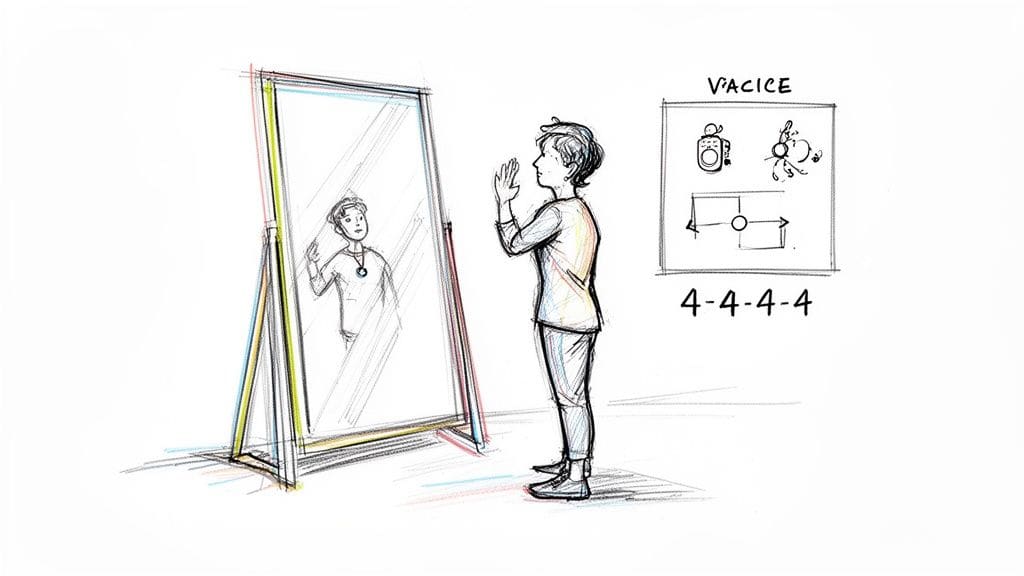
Knowing the right words is only half the battle. The other half—the harder half, for many of us—is finding the confidence to actually say them, especially in those awkward, heart-pounding moments.
Building that confidence starts in private, with low-stakes practice. The goal isn't to become a perfect actor but to build muscle memory. When you rehearse what to say next, the process becomes more automatic and less terrifying when it happens for real.
This is about proactively preparing for future conversations before anxiety even has a chance to take over. By practicing in a safe space, you turn theory into an embodied skill.
Creating a Private Practice Routine
Like any skill, communication gets better with a little deliberate practice. The key is to create a comfortable, judgment-free space to experiment. Think of this as your personal training ground for social resilience.
A great place to start is simply practicing your go-to clarification scripts in front of a mirror. Saying the words out loud helps you get comfortable with how they sound and feel coming out of your mouth.
You can also use a voice recorder on your phone to check your tone. What sounds calm and neutral in your head might come across as defensive or aggressive when spoken. Another fantastic method is to role-play a few common scenarios with a trusted friend—someone who gets it. This gives you a chance to get live feedback in a supportive setting.
- Mirror Practice: Say your scripts aloud. Pay attention to your facial expressions. Do you look curious or confrontational?
- Voice Recording: Listen to the playback. Does your tone sound calm and inquisitive? Make small adjustments until it does.
- Role-Playing: Ask a friend to act out a tricky situation, like getting a confusing text or a vague comment from a boss.
> The whole point of these exercises is repetition. The more you rehearse these phrases, the more naturally they'll come to you in a real, high-stress situation.
Grounding Techniques for In-the-Moment Anxiety
Even with all the practice in the world, anxiety can still bubble up right when you need to have a tough conversation. Your heart starts racing, your mind goes blank, and your carefully rehearsed scripts fly out the window.
When that happens, you need tools to pull yourself back to the present moment. Grounding techniques are simple but powerful exercises designed to manage the physical storm of anxiety. They work by shifting your focus from the chaotic thoughts in your head to the physical sensations in your body.
For a deeper dive into this, our article on strategies to reduce social anxiety offers some excellent, in-depth strategies.
Simple Grounding Exercises
- Box Breathing: This is a classic for a reason. Inhale slowly for a count of four, hold your breath for four, exhale for four, and hold again for four. A few cycles can make a huge difference in calming your nervous system.
- The 5-4-3-2-1 Method: This one is brilliant for pulling your brain out of a spiral. Silently name 5 things you can see, 4 things you can physically touch, 3 things you can hear, 2 things you can smell, and 1 thing you can taste.
Using these techniques helps you regain a sense of control when you feel overwhelmed. That little bit of clarity is often all you need to address a situation effectively.
Deciding When to Let It Go or Ask for Support
Not every single misunderstanding is worth the energy it takes to untangle it. Sometimes, the relentless pursuit of clarity can be more draining than the original uncertainty itself. The real skill is learning to consciously decide when to let something go, saving your emotional energy for the conversations that truly matter.
This isn't about ignoring your feelings; it's a strategic choice. Chasing down every last detail to be 100% sure you didn't misread something can leave you exhausted and even put a strain on your relationships. It's about developing a personal filter to know which situations are worth your time and which are healthier to just release.
A Framework for Letting Go
Before you jump into yet another "can we talk?" conversation, just pause for a minute. Ask yourself a few direct questions. The answers will give you a much clearer picture of the real-world impact of the potential misreading and help you choose the path that's kindest to yourself.
- Will this still matter tomorrow? Or next week? This question is a game-changer for putting things in perspective. So many of the little anxieties that keep us up at night fade on their own if we just give them a little space.
- What's the emotional cost of addressing this? Be honest with yourself. Think about the mental and emotional energy you'll have to spend to have this conversation. Sometimes, the peace of mind you think you'll gain just isn't worth the stress of the confrontation.
- Is this a one-off thing or a recurring pattern? If it's a single awkward comment from someone you rarely have issues with, letting it slide might be the smartest move. But if you're constantly feeling misunderstood by the same person, it might be time to address the bigger communication pattern.
> The ability to let things go isn't a sign of weakness; it's a sign of wisdom. It's recognizing that your emotional well-being is a finite resource, and it's your job to protect it.
This is closely related to the skill of learning to set boundaries with friends and colleagues, which is all about protecting your energy in these exact kinds of situations.
Knowing When to Ask for a Second Opinion
Let's face it: sometimes you're just too close to a situation to see it clearly. Your emotions are cranked up to ten, and your own biases are coloring everything. This is the perfect time to phone a friend.
A trusted friend, mentor, or even a family member can offer an invaluable outside perspective. They aren't caught up in the emotional storm and can often see things from a much more neutral angle. Honestly, just the act of explaining the scenario out loud to someone else can help you organize your own jumbled thoughts.
You might want to reach out for support when:
- You've been replaying the interaction in your head for hours and just can't break the loop.
- The situation involves a high-stakes relationship, like with your boss, a partner, or a close family member.
- You feel totally overwhelmed and aren't sure you can even handle the conversation by yourself.
Getting a second opinion doesn't mean you have to do what they say. It's just another data point. It gives you that fresh perspective you need to either confidently let it go or approach the conversation from a much more grounded place.
Common Questions and Clear Answers
Navigating social interactions can feel like you're constantly trying to solve a puzzle, especially when you're asking yourself, "did I misread that?" You're not alone. Let's walk through some of the most common questions that come up and get you some direct, practical answers to feel more prepared.
What if I'm Overthinking a Small Interaction?
It's so easy to get stuck replaying a conversation, especially if social anxiety is part of your life. The real trick is learning to spot the difference between helpful reflection and getting caught in an anxiety loop.
Overthinking loves to jump to the absolute worst-case scenario with zero evidence. Healthy reflection, on the other hand, is about calmly wondering, "Okay, what are some other possible reasons that happened?"
If you feel your brain spinning, try this quick test: ask yourself, "Will this matter in 24 hours?" It's a simple question, but it's surprisingly good at breaking the cycle and putting things back into perspective. Most minor social blips fade fast.
How Can I Tell if Someone Is Just Busy or Actually Upset?
This is a huge challenge for so many of us. A blunt, one-word text could mean they're furious with you, or it could just mean they were driving and used voice-to-text.
The key is to look for patterns, not just single events.
- Is this how they normally communicate? If your boss is always super brief on Slack, their short reply probably isn't about you.
- What's the bigger picture? Did they mention they were swamped with a deadline earlier in the day? Context is your best friend here.
- Check their in-person vibe. If they're warm and engaged the next time you see them, you can be pretty sure the short message was just a result of them being busy.
Is It Rude to Always Ask for Clarification?
This is a really common fear, especially for autistic folks who often need more explicit information to feel secure in a conversation. The truth is, how you ask matters a whole lot more than how often you ask.
Asking for clarification isn't rude at all. In fact, it usually shows you're engaged and that you genuinely care about getting it right.
> Framing your request with "I" statements makes a world of difference. Saying, "I want to make sure I'm on the same page," feels collaborative and safe. But a phrase like, "What do you mean?" can sometimes sound accusatory, even if you don't mean it that way.
The goal is to show you're trying to connect, not to challenge them.
What if I Ask for Clarity and They Get Defensive?
You can use the gentlest, most perfect script in the world, and someone might still react defensively. When that happens, it's almost always about their own emotional state, not about you.
If you find yourself in this spot, the best thing you can do is stay calm and de-escalate.
You can use a simple phrase that acknowledges their feelings without you taking the blame:
- "It wasn't my intention to upset you. I was just trying to make sure I understood."
- "I can see this is a sensitive topic. Maybe we can talk about it later."
Your only job is to manage your own response, not their reaction. It is perfectly okay to hit the pause button and gracefully exit a conversation that's become unproductive.
How Do I Know if My Anxiety Is Just Making Things Up?
Anxiety is an incredibly creative storyteller. It can take one small, neutral fact—like someone not smiling back at you in the hallway—and spin a whole dramatic narrative about how they secretly hate you.
To figure out whether you've truly misread something or if your anxiety is just inventing a story, go back to the "Fact vs. Story" technique.
Actually write it down. On one side, list the objective fact (what actually happened). On the other, write down the story your anxiety is telling you about it. Seeing them side-by-side makes it so much easier to see how much you're assuming. It's a great practice for challenging those automatic negative thoughts and grounding yourself in what's real.
Navigating these moments can be tough, but you don't have to do it alone. tonen is a mobile app designed to help you handle social conversations with less stress. With a library of ready-to-use scripts, tone choices, and a Perspective Helper, tonen gives you the tools to communicate with confidence. Find clearer, kinder ways to set boundaries and reduce anxiety by checking out the tonen communication app today.