If you're trying to make sense of a sudden reaction, it helps to know what's really going on inside your brain. The most important thing to understand is that an overwhelming response is often a biological reflex, not a character flaw. It happens when your brain's threat-detection system, the amygdala, mistakes social or emotional stress for physical danger, triggering a fight, flight, or freeze response. To manage this, you can use a simple three-step process: Identify the trigger, Acknowledge the physical reflex, and consciously Choose your next action instead of letting the automatic reaction take over.
This 'social alarm system' is the key to understanding why a seemingly minor comment can feel like a major threat, especially for neurodivergent people or anyone with social anxiety. By learning to recognize your triggers and practicing grounding techniques, you can regain control and respond with clarity.
Why Sudden Reactions Happen and How to Manage Them
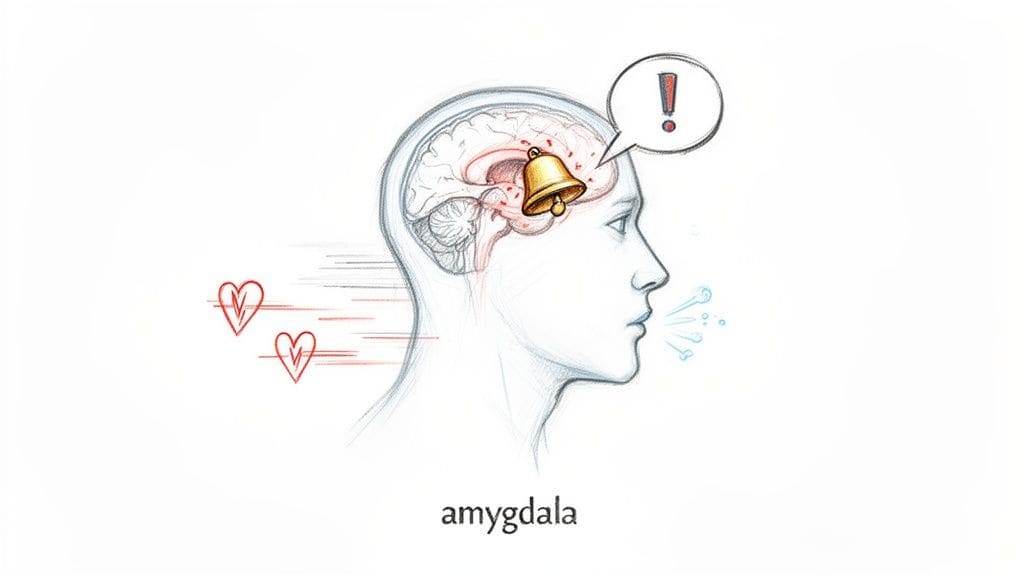
Have you ever felt a conversation go off the rails in a split second? One moment it's a casual chat, and the next, your heart is pounding, your palms are sweating, and you can't think clearly. This isn't a sign of weakness; it's your brain's amygdala—its internal alarm—hijacking your rational thought process.
When this alarm misfires in a social setting, it creates a powerful and confusing experience. Say you're at work and someone snaps at you over a minor comment. That immediate physical and emotional overwhelm you feel is a classic sudden reaction.
Decoding the Social Alarm System
To make sense of a sudden reaction, think of it like an overly sensitive smoke detector. It's designed to protect you, but sometimes it goes off from burnt toast instead of an actual fire. The goal isn't to get rid of the smoke detector, but to learn how to understand its signals and reset it quickly.
To do that, you can use a simple, three-step framework to get your bearings in the heat of the moment. This process helps turn a chaotic emotional surge into something you can actually analyze and manage.
A Quick Guide to Decoding Sudden Reactions
Use this three-step process to understand and manage a sudden emotional surge.
| Step | What It Is | Your Action |
|---|---|---|
| 1. Identify | Pinpoint the trigger. | What was the exact word, tone, or situation that set off your internal alarm? |
| 2. Acknowledge | Recognize the reflex. | Notice the physical signs—racing heart, tense muscles—as a biological response, not a personal failing. |
| 3. Choose | Decide on your response. | Instead of letting the automatic reaction take over, consciously choose how to act next. |
This framework empowers you to respond with clarity instead of just being swept away by the reaction. It puts you back in the driver's seat.
Learning about the emotional roots of our actions can also provide valuable insights. For example, our post on getting emotional eating help shows how deeply feelings can drive our behaviors—a similar mechanism is at play here.
By recognizing the trigger, acknowledging the physiological response, and having a plan, you regain control. To dig deeper into what might be happening for the other person, you might find our guide on understanding why someone reacted that way helpful.
Common Triggers for Neurodivergent People
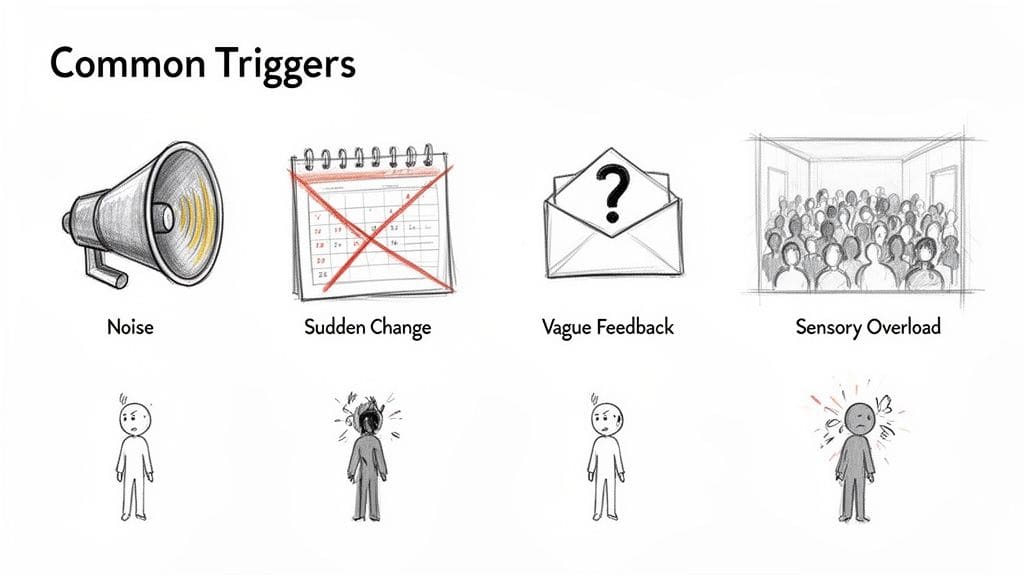
For many neurodivergent people, the world is full of invisible tripwires that can set off a sudden, intense, and often confusing response. Getting a handle on these common triggers is the first real step to make sense of a sudden reaction before it takes over completely. These aren't just simple social slip-ups; they are often subtle situations that can quickly send the nervous system into overdrive.
While these triggers aren't universal, they all tend to have one thing in common: they threaten our internal sense of safety, predictability, or social belonging. Learning to spot your own personal patterns is the key to getting back a feeling of control when these moments hit.
Unpredictability and Ambiguity
For autistic folks, a predictable environment is often a non-negotiable part of feeling secure. Unexpected shifts can feel deeply destabilizing, firing up the body's threat response almost instantly. This isn't about being "rigid"—it's a crucial strategy for conserving the enormous mental energy it takes to navigate a world that so often feels chaotic.
- Sudden Plan Changes: A friend canceling dinner last-minute or a meeting getting moved without warning can feel less like a minor inconvenience and more like a personal rejection or a catastrophic event.
- Ambiguous Feedback: That vague email from a manager saying, "We need to talk about your report," can trigger a massive spike in anxiety. The lack of specific details leaves a huge, terrifying void for negative self-talk to fill.
- Unclear Social Cues: The exhausting mental calculus of trying to figure out what someone *really* means by their tone or a weird look puts you on constant high alert, making a sudden reaction much more likely.
This sensitivity can also tie into demand avoidance, where even the perception of a demand can trigger a response that feels a lot like panic. If this feels familiar, you can get a better sense of how to navigate these feelings by digging into the topic of demand avoidance in autism and what's really going on under the surface.
Social and Sensory Overload
For those of us with ADHD or social anxiety, the twin pressures of social evaluation and sensory input are massive triggers. The brain is already working overtime just to process everything, which leaves it incredibly vulnerable to overload.
> "A sudden, intense regression into the emotional state of a wounded inner child." - Pete Walker, M.A., M.F.T., on emotional flashbacks.
That feeling—of suddenly being small, powerless, and completely overwhelmed—is a very real experience. For people with ADHD, it often shows up as Rejection Sensitive Dysphoria (RSD), where even the slightest perceived criticism or rejection causes extreme emotional pain. This isn't just "being too sensitive"; it's a very real neurological response that makes social feedback feel like a direct and personal threat.
Common sensory and social tripwires include:
- Sensory Overload: A room that's too loud, too bright, or has too many conversations happening at once can completely drain your processing power. This leaves you with zero buffer to handle even a minor social stressor.
- Perceived Criticism: A totally neutral comment from someone else can land like a harsh critique, triggering an immediate defensive reaction or an emotional shutdown.
- Feeling Rushed or Pressured: Being put on the spot to make a fast decision or answer a question can activate a freeze response, making it feel literally impossible to think clearly.
Simply learning to recognize these triggers in your own life is an incredibly powerful tool. It helps you make sense of a sudden reaction by linking it back to a concrete cause. This validates your experience and gives you a clear starting point for figuring out what to do next.
A Framework to Analyze What Happened Afterward
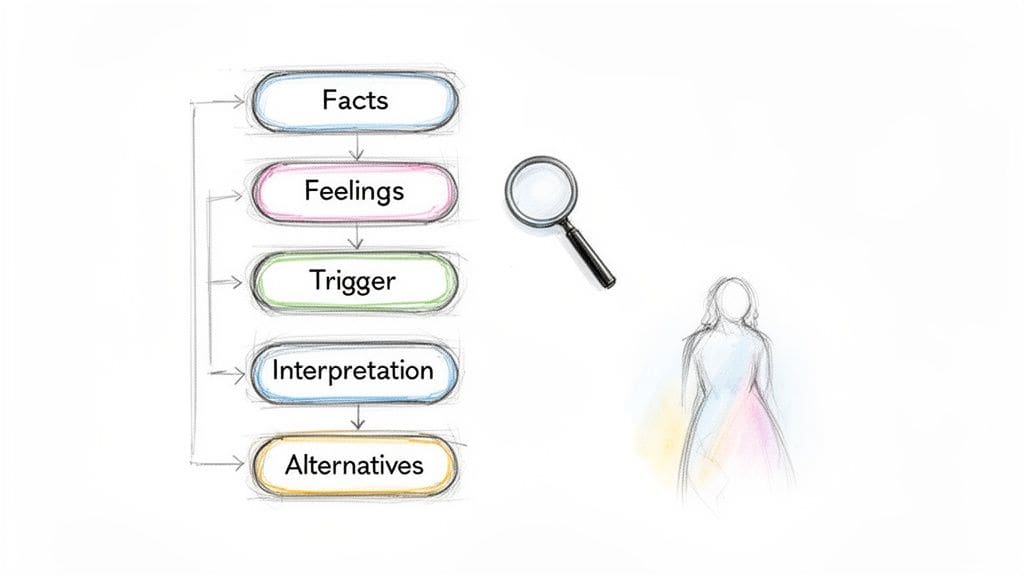
Once the emotional storm has passed, the quiet aftermath can be just as confusing. This is the moment to make sense of a sudden reaction with gentle curiosity, not self-blame. By using a structured debrief, you can turn a baffling moment into a powerful learning opportunity and start to notice the patterns that drive your responses.
This process isn't about judging yourself for what you felt. Think of it more like being a gentle detective investigating an incident. The goal is to carefully separate the objective facts from your emotional interpretation, giving you the clarity you need to move forward.
Step 1 Factually Describe the Situation
First, try to strip away all the emotion and judgment. Just write down what happened as if a security camera recorded it. Who was there? What was said, word for word? What was the physical setting?
This step is so important because our feelings often color our memory of events. Getting a neutral, factual baseline stops you from getting stuck in a spiral of "coulda, shoulda, woulda" thinking.
Confused by a sudden emotional reaction? tonen can help.
tonen offers conversation scripts, Reply Helper, Perspective Helper, Debrief, Phone Call Mode and Calm Kit. Start with 21 free scripts on iPhone. Optional Premium unlocks more features.
Download on the App StoreAvailable on iOS.
Step 2 Identify Your Sensations
Next, turn your focus inward. What did you actually feel in your body? A racing heart, a tight chest, a hot flush, or that sudden urge to run are all crucial data points.
Then, try to name the emotions that surfaced. Was it fear, shame, anger, or something else entirely? Being specific helps you understand the emotional texture of the reaction.
Step 3 Pinpoint the Exact Trigger
Now, it's time to connect Step 1 and Step 2. Look at your factual sequence of events and identify the precise moment your internal state shifted. Was it a specific word? A certain tone of voice? An action someone took?
> Pinpointing the trigger is like finding the one domino that starts the chain reaction. Once you know what it is, you have the power to intervene before the whole line falls.
Understanding your specific triggers is the key to being able to make sense of a sudden reaction over the long run.
Step 4 Brainstorm Alternative Perspectives
This is where you get to challenge your initial interpretation. The story you told yourself in the heat of the moment might not be the only one—or the most accurate one. Could the other person's comment have been a clumsy attempt at a joke instead of a personal attack? Were they stressed about something completely unrelated to you?
Tools like a Perspective Helper can be incredibly useful here. They guide you to consider gentler, alternative interpretations, breaking the cycle of assuming the worst. For more on this, check out our guide on how to gain perspective on a situation.
By consistently practicing this framework, you'll build the mental muscle to reframe your understanding in real time and respond with more confidence in the future.
Practical Strategies for Responding in the Moment
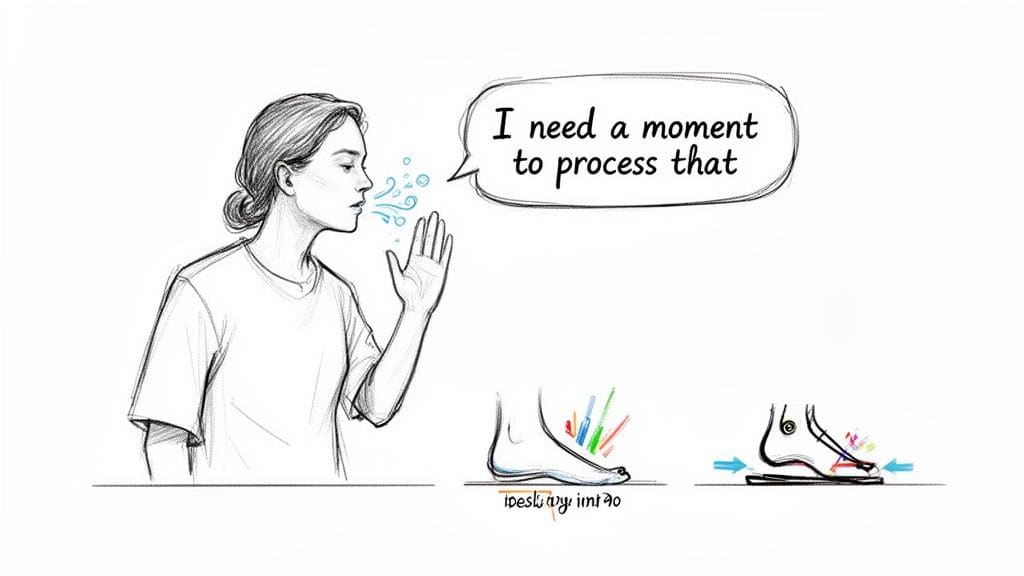
When you feel that familiar rush of internal alarm, the immediate goal is to hit the 'pause button' on your nervous system. This creates just enough space to interrupt an automatic response and lets you choose what happens next. The key is to have simple, practical strategies ready to go, giving you a way to manage a sudden reaction as it's happening, not just after the fact.
These in-the-moment tools aren't about suppressing what you feel. Far from it. They're about helping you regulate your body's stress response so your thinking brain can come back online. This is what keeps you from getting stuck in a fight, flight, or freeze loop.
Grounding Your Nervous System
Your body is your most reliable anchor to the present moment. When your mind starts to spiral, simple physical actions can signal safety to your brain and dial down the internal alarm bells.
- Press Your Feet to the Floor: No matter where you are, focus on the sensation of your feet planted firmly on the ground. Feel the texture of your socks or the solidness of the floor beneath you. This simple act reconnects you to your physical self and the immediate environment.
- Focus on Your Breath: Take a slow, deep breath in through your nose for about four counts. Hold it for just a moment. Then, exhale slowly through your mouth for a count of six. A longer exhale is a direct message to your nervous system to calm down.
These grounding techniques are incredibly discreet and can be done anywhere—in a meeting, during a tense family dinner, or on a crowded bus. Think of them as your first line of defense. For those looking for more ways to cultivate calm, exploring specific exercises for managing ADHD can also offer some effective techniques.
Having Your Script Ready
In the heat of a reaction, trying to form a coherent sentence can feel impossible. This is where having a few pre-planned scripts becomes an absolute lifeline.
> Think of these scripts as a social 'get out of jail free' card. They buy you time, set a boundary, and communicate your needs without requiring any complex, in-the-moment thinking.
Imagine you're in a meeting, you've just pitched an idea, and your boss frowns slightly. The panic floods in. Instead of clamming up, you could pull out a prepared line. The tonen app, for instance, provides conversation scripts for work, family, and social situations, each with different tone options to fit the moment. When you're overwhelmed, its Calm Kit also offers body-scan and visualization tools to ground you fast.
Choosing Your Tone and Opt-Out
The words you choose matter, but how you say them can change everything. A single script can land completely differently depending on the tone you use.
Sample script: “I need a moment to process that.”
You can say it, type it or show it as a note. A particular expression, tone or eye-contact pattern is not required.
Having an "opt-out" line is just as crucial. It's your escape hatch when you feel too overwhelmed to continue the conversation productively.
- Example Opt-Out: "I need to step away for a minute, but can we revisit this in an hour?"
Practicing these strategies helps build the muscle memory you need to respond with intention rather than reacting on autopilot. For a deeper dive into this topic, you can learn more about how to regulate your emotions in our dedicated article.
How to Practice for Future Conversations
Knowing what your triggers are is one thing, but building the muscle memory to handle them differently takes real practice. It's not enough to just understand why you react; you have to rehearse a new way of responding.
Think of it like a social fire drill. You practice an escape route for a fire so you don't have to think when the alarm goes off. It's the same idea here. Rehearsing what you'll say or do when a trigger pops up helps you bypass that initial knee-jerk reaction and choose a more intentional response instead.
This kind of rehearsal carves out a new, calmer pathway in your brain. When you're under pressure, that practiced response is suddenly easier to grab than the old, automatic one.
Creating a Low-Stakes Rehearsal Space
The key is to practice in a completely safe environment—somewhere private where you can experiment without any fear of judgment or real-world consequences.
tonen offers Conversation Scripts, Reply Helper, Perspective Helper, Debrief, Phone Call Mode and Calm Kit. Choose a script for wording, Reply Helper for a draft response, Perspective Helper for possible interpretations, or Debrief to reflect afterwards. AI suggestions are possibilities to check, not evidence of another person’s intentions.
The Power of Repetition and Tone Experimentation
Repetition is what turns a new skill into an instinct. The more you say a boundary-setting script out loud, the more natural and accessible it will feel when you actually need it.
Start by picking one or two common scenarios that tend to knock you off balance. It could be getting ambiguous feedback from a manager or dealing with a sudden, last-minute change of plans.
- Rehearse Your Scripts: Say the words out loud. Does "I need a moment to process that" feel better than "Let me think on that for a bit"? Get a feel for the phrasing that actually fits your voice.
- Experiment with Tone: A script can feel completely different depending on your tone. Practice saying the same words in a Direct tone versus a Warm one. This gives you incredible flexibility and a sense of control for the real moment.
- Save Your Favorites: Keep a running list of the phrases and tones that feel right. Having these "go-to" responses ready to go makes them much easier to recall when you start to feel overwhelmed.
> The point of practice isn't to become some kind of socially perfect robot. It's about building readiness. It's about shrinking the intensity of your automatic reactions just enough to give yourself a precious moment to choose how you want to respond.
This deliberate practice shifts your whole approach from being reactive to being proactive. Over time, you'll realize you have more options available than just fight, flight, or freeze.
For anyone looking to get better at navigating tough conversations, our guide on talking it through offers even more strategies. This kind of preparation is a fundamental step to help you make sense of a sudden reaction and move through it with a lot more ease.
When You Might Need Professional Support
Self-help strategies are incredible, but they aren't meant to solve everything. It's so important to recognize when you might need to bring a professional into your corner.
If you find that these intense reactions are consistently getting in the way of your work, your relationships, or just your general sense of well-being, it might be time to talk to a therapist. Reaching out for help isn't a sign of failure. It's a proactive and genuinely courageous step toward feeling better.
Sometimes, to really make sense of a sudden reaction pattern, you just need an expert's outside perspective. A good therapist can help you untangle the complexities of your experiences in a safe, structured way.
What Professional Support Looks Like
The thought of seeking help can be intimidating, but the entire process is designed to put you back in the driver's seat. A qualified therapist or counselor can offer a few game-changing benefits:
If reactions feel difficult to manage or are affecting daily life, a qualified healthcare professional can help explore possible explanations and support. Describe what happens and its impact rather than relying on an article to identify a diagnosis.
> "Guilt is a feeling. Feelings need to be validated and we need to find ways to accept, integrate, and move forward with these feelings."
This really gets to the heart of what therapy can do: validate your experience. A professional can help you accept that your feelings are real and justified, while also giving you the tools to manage them.
For those whose reactions feel deeply rooted in past trauma, a therapist who specializes in CPTSD can offer specific, life-changing strategies like those in Pete Walker's guide to managing emotional flashbacks.
Ultimately, professional support is a vital piece of a complete self-care plan. It provides the kind of structure and expert guidance that can help you build real, lasting change.
Still Have Questions About Sudden Reactions?
It's completely normal to have lingering questions as you start to unpack these moments. The journey to understanding and managing sudden reactions is a personal one, and a little clarity can go a long way. Let's tackle some of the most common things people ask.
Is a Sudden Reaction the Same as Being Overly Sensitive?
No, and this is a really important distinction. People often mislabel these moments as being "too sensitive," but a sudden reaction is a physiological event, not a personality flaw. It's a deep-seated neurological and hormonal response from your brain's threat-detection system.
It's an involuntary cascade—not a choice. Seeing it this way is the first step toward treating yourself with compassion instead of criticism.
Can I Completely Stop Having Sudden Reactions?
The goal isn't really to eliminate them. After all, they're a natural protective mechanism that everyone has. The real work is in reducing their frequency and intensity, and most importantly, shortening the time it takes you to recover.
By using frameworks to understand your triggers and practicing new ways to respond, you can learn to manage the reaction. It stops being something that controls you and becomes something you can navigate.
How Can I Explain My Reactions to Others Without Oversharing?
You don't owe anyone your entire psychological history just to set a boundary. Simple, pre-planned phrases are incredibly effective for communicating your needs clearly and calmly.
For example, you could say, "I sometimes need a moment to process things, can we pause?" or "My brain is a bit overloaded right now, let's talk about this later." Having a script ready makes it so much easier to advocate for yourself in the moment.
Navigating these moments is a skill, and tonen is designed to help you practice. With a library of scripts, a Perspective Helper, and a Calm Kit, it gives you the tools to respond with confidence. Take the next step and download it from the App Store today.