When you're put on the spot, knowing what to say when you don't know what to say is a crucial skill for reducing anxiety and maintaining connection. The most effective approach is to use a simple, pre-practiced 'bridge' phrase that buys you time, clarifies expectations, or gracefully exits the conversation. This allows you to regulate your nervous system, organize your thoughts, and respond with intention rather than reacting under pressure.
Whether it's a direct pause like 'I need a moment to think,' a clarifying question, or a boundary-setting statement, having these tools ready prevents panicked silence and leads to clearer, kinder communication. In this guide, we'll explore specific, actionable phrases to help you navigate these tricky moments at work, with family, and in social settings, turning uncertainty into an opportunity for thoughtful connection. For more specific advice on navigating professional conversations with poise, consider these tips on how to speak confidently at work.
1. The Honest Pause: 'I need a moment to think about that'
One of the most effective responses is to give yourself permission to think. The Honest Pause, using a simple phrase like "I need a moment to think about that," directly communicates your need for processing time without shutting down the conversation. This technique validates the other person's contribution while creating the space necessary to gather your thoughts, a particularly useful strategy for anyone who needs extra time to process information. Knowing what to say when you don't know what to say often starts with honestly stating where you're at.

Popularized by communication coaches and neurodiversity advocates, this approach reframes silence not as a failure, but as an intentional act of thoughtful engagement. It is a powerful tool for anyone, but especially for neurodivergent individuals who may have different processing speeds. By stating your need for a moment, you control the conversational pace and prevent a rushed, poorly considered response.
How to Use the Honest Pause
The key is pairing the pause with a clear expectation. This turns an indefinite silence into a structured delay, which shows respect for the other person's time. You can adapt the tone and phrasing to fit any situation.
* At Work: "That's a critical point. I need a moment to think about that properly. Can I follow up with you by the end of the day?"
* With Family: "I want to give this the thought it deserves. Let's talk about this again after dinner."
* In Social Settings: "That's an interesting question. Let me think on it for a second."
> This simple script is a great answer because it's universally respectful and puts you in control of your response time.
This technique is especially helpful if you find yourself in a complex or confusing situation where you need to clarify your own thoughts before speaking. For more strategies, you can find help to understand a confusing situation and respond effectively.
2. The Reflective Question: 'Can you tell me more about that?'
When you're stumped, a powerful strategy is to shift the focus back to the other person. Using a Reflective Question like "Can you tell me more about that?" turns your uncertainty into an opportunity for deeper connection. This approach buys you valuable processing time while showing genuine interest, reducing the pressure to formulate an immediate response. It allows you to gather more context, which is essential for giving a thoughtful and relevant reply.

This technique is a cornerstone of person-centered communication, popularized by figures like psychologist Carl Rogers and Marshall Rosenberg, the creator of Nonviolent Communication. By asking for elaboration, you validate the speaker's thoughts and feelings, making them feel heard and understood. This is especially effective in emotionally charged or complex conversations where a quick, uninformed comment could do more harm than good. It frames your silence not as a void, but as an invitation for more detail.
How to Use the Reflective Question
The effectiveness of this technique depends on specificity and a genuine tone. Instead of a vague "What do you mean?", try to ask questions that guide the conversation toward clarity. This shows you're actively listening and invested in understanding their viewpoint.
* At Work: "That's an important perspective on the project's delay. Can you walk me through the specific challenges you're seeing?"
* With Family: "I hear that you're upset. Help me understand your perspective on this so I can see it from your side."
* In Social Settings: "That's a fascinating point. I'd love to hear more about what you meant by that."
> This script is a brilliant answer because it demonstrates curiosity and respect, turning a conversational roadblock into a bridge for better understanding.
This approach is invaluable when someone's comment is ambiguous or their reaction is unexpected. It gives you a direct path to clarify their intent and feelings. For a deeper dive into this, you can learn more about understanding why someone might react a certain way to improve your conversational skills.
3. The Warm Bridge: 'I care about this conversation, so let me be honest...'
When you find yourself stuck, figuring out what to say when you don't know what to say can be solved by leading with your positive intent. The Warm Bridge uses a phrase like, "I care about this conversation, so let me be honest," to create a safe space for directness or vulnerability. It reassures the listener of your goodwill before you share something difficult, setting a collaborative rather than confrontational tone.
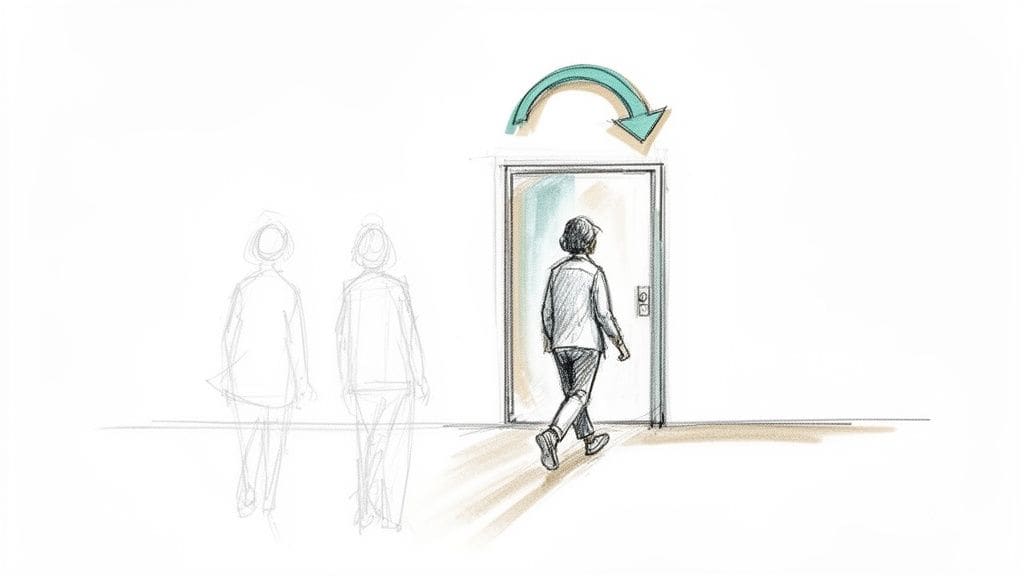
This approach, popularized by vulnerability researcher Brené Brown and neurodivergent advocates, shifts the dynamic from conflict to connection. It's an especially useful script for neurodivergent communicators who may need to deviate from social norms; it signals that the directness is intentional and caring, not rude. By affirming the relationship first, you make it easier for the other person to hear what comes next without becoming defensive.
How to Use the Warm Bridge
The effectiveness of this technique lies in its sincerity and immediate follow-through. State your positive intent clearly, and then deliver your honest message without hesitation. This prevents the opener from feeling like empty politeness.
* Setting Boundaries: "I care about our friendship, so I need to be honest. I can't handle surprise visits, but I'd love to schedule time to see you."
* Advocating for Needs: "I really value learning in this class, so I need to ask for written instructions instead of only verbal ones to do my best work."
* With Family: "I love you, so I'm going to tell you directly that comment hurt me. Can we talk about it?"
> This is a powerful script because it protects the relationship while allowing you to speak your truth, turning a potentially difficult moment into a chance for deeper understanding.
Finding yourself lost for words at the worst times? tonen can help.
tonen gives you 188+ conversation scripts, tone guidance and calming tools — designed for autistic adults, ADHD and social anxiety. Try it free for 7 days.
Download on the App StoreiOS only. Android coming soon.
This method is ideal for situations where you must share a personal need or feeling that might otherwise be misinterpreted. Learning how to express your feelings in words is a critical skill this phrase supports, especially in high-stakes conversations.
4. The Collaborative Deflection: 'What do you think we should do?'
When you're stuck for an answer, a powerful option is to shift the focus from a solo response to a shared solution. The Collaborative Deflection, using phrases like "What do you think we should do?", turns personal uncertainty into a partnership. This approach invites the other person into the problem-solving process, reducing pressure on you while fostering a sense of teamwork and mutual respect.
Championed by advocates of servant leadership and neurodiversity-affirming workplaces, this technique reframes "I don't know" from a moment of weakness to an opportunity for joint exploration. It's especially useful for managers who want to empower their teams, individuals with executive function challenges who benefit from external input, or anyone in a relationship conflict looking for a path forward together. By asking for their thoughts, you validate their perspective and make them part of the solution.
How to Use the Collaborative Deflection
Success with this method depends on showing genuine curiosity and a willingness to act on the input you receive. It's about building consensus, not just offloading responsibility. You can adjust the phrasing to suit the context and your relationship with the other person.
* As a Manager: "I'm not sure which approach is best here. What do you think would work well? You have a closer view of the daily operations."
* With ADHD Executive Function Struggles: "I'm having trouble planning this out. What would help you organize it if you were in my shoes?"
* In Relationship Conflict: "It feels like we both want different things right now. How should we figure this out together?"
> This strategy is a great answer because it builds trust and turns a potential communication dead-end into a productive, shared effort.
This approach is highly effective when you genuinely value the other person's input and see the problem as a shared one. It demonstrates humility and confidence, showing that you prioritize the best outcome over having all the answers yourself.
5. The Graceful Exit: 'I'm going to step back from this conversation for now'
When an interaction becomes overwhelming, knowing what to say can mean preserving your well-being. The Graceful Exit, using a self-aware phrase like "I'm going to step back from this conversation for now," allows you to remove yourself from an intense situation without causing offense. It's a crucial tool for managing sensory overload, emotional dysregulation, or neurodivergent overwhelm, signaling your need for a break while reinforcing your commitment to the relationship.
This approach is championed by mental health advocates and neurodivergent self-care experts as a way to practice distress tolerance. Rather than shutting down or reacting poorly, you acknowledge your personal limits and communicate a clear plan to re-engage. This validates both your needs and the importance of the conversation, turning a potential conflict into a moment of healthy self-regulation.
How to Use the Graceful Exit
The effectiveness of this technique lies in pairing the exit with a clear intention to return, which prevents the other person from feeling abandoned. Your tone should be firm yet gentle, communicating need, not blame. You can adapt the phrasing for different contexts.
* In Overstimulating Situations: "This is feeling like a lot right now. I'm going to take 10 minutes to reset and come back."
* During Family Tension: "I can feel myself getting upset, and I need to step back before I say something I'll regret. Let's talk about this later tonight."
* In Work Overwhelm: "My brain is full at the moment. Can we pick this up tomorrow morning when I'm fresher?"
> This strategy is one of the best answers because it protects your emotional state and the health of your relationships. It's a proactive choice, not a reactive escape.
This method gives you the space to use grounding techniques before rejoining the discussion. Taking a moment to breathe or recenter makes all the difference in learning how to speak to people effectively, especially when emotions are high.
6. The Curious Clarifier: 'What I'm hearing is... Is that right?'
When a conversation becomes complex or emotionally charged, one of the best responses is to clarify what you've heard. The Curious Clarifier, using the phrase "What I'm hearing is... Is that right?", is a structured check-in that shows active listening while giving you a moment to process. This technique prevents misunderstanding by mirroring back your interpretation, creating an opportunity for correction before you respond.
Popularized by Nonviolent Communication practitioners and couples therapists, this method is fundamental in reducing misinterpretations. It's especially valuable for neurodivergent individuals who may find it hard to decode subtext or mixed messages. By repeating their point back to them for confirmation, you ensure you're both on the same page, which lowers social anxiety and improves communication accuracy.
How to Use the Curious Clarifier
The effectiveness of this technique lies in your genuine curiosity. Starting with "What I'm hearing is..." feels less accusatory than "You said..." because it centers your perception, not their words. This invites correction rather than defensiveness.
* In Misunderstandings: "So, what I'm hearing is that you felt dismissed when I didn't respond immediately. Is that accurate?"
* For ADHD Processing: "Let me make sure I understand. You need this by Friday, not today. Is that right?"
* In Conflict Resolution: "It sounds like what you need is more advance notice for these requests. Did I get that right?"
> Knowing what to say when you don't know what to say can be as simple as ensuring you truly understand. This approach builds a bridge of understanding before you even formulate your own point.
This tool is a powerful way to slow down a heated discussion and show the other person that you are genuinely trying to understand their perspective. It shifts the focus from winning an argument to reaching a mutual understanding. To go deeper, you can practice identifying communication styles to better adapt your clarifications.
7. The Humble Admission: 'I'm not sure, but here's what I think...'
When you find yourself stuck, one of the most effective solutions is admitting your uncertainty while still offering your thoughts. The Humble Admission, using a phrase like, "I'm not sure, but here's what I think..." combines intellectual honesty with a genuine willingness to contribute. It signals that you're engaged, even if you don't have a perfect, fully-formed answer.
This approach, popularized by academics and leaders practicing vulnerability, reframes uncertainty as an opportunity for collaborative thinking rather than a sign of weakness. It's especially powerful for neurodivergent individuals who may process information differently or have unconventional ideas they feel hesitant to share. By stating your uncertainty upfront, you lower the stakes and create space for a more exploratory, less-pressured contribution.
How to Use the Humble Admission
The strength of this technique lies in pairing the disclaimer with a substantive thought. The admission of uncertainty acts as a preface to a genuine idea, showing that you've engaged with the topic even if you haven't reached a final conclusion. The key is to avoid over-apologizing and to present your thought with quiet confidence.
* In Work Meetings: "I'm not sure this is the best solution, but what if we tried approaching it from this angle?"
* In Educational Settings: "I'm uncertain about the specifics, but here's my understanding based on what I've read so far."
* With Social Anxiety: "I don't know if this is exactly what you meant, but my thought is..."
> This script is a powerful answer because it balances humility with active participation, inviting others to build on your idea rather than expecting a flawless final answer.
This method works well in any environment that values growth and open discussion. It shows you're willing to be vulnerable and think out loud, which often encourages others to do the same. This can lead to more creative and honest conversations where the pressure to be "right" is replaced by a collective desire to find the best path forward. For those looking to build more confidence in these moments, practicing this script with a communication coach or in a practice mode can be very effective.
8. The Boundary-Setting Statement: 'I appreciate [what you did], and I also need [what you're asking]'
When you don't know what to say in a situation that requires a boundary, this powerful "both/and" statement can be your guide. The phrase, structured as "I appreciate [X], and I also need [Y]," allows you to hold two truths at once: validating the other person's intention while clearly stating your own needs. This is an excellent script for what to say when you don't know what to say without causing conflict, as it sidesteps the false choice between being kind and being firm.
Popularized by concepts from Nonviolent Communication and the work of researchers like Brené Brown, this approach is a cornerstone of modern therapy and neurodivergent advocacy. It replaces a harsh "but" with a collaborative "and," signaling that both your appreciation and your need are equally valid. This makes it particularly effective for anyone, including neurodivergent individuals, who may feel guilty or anxious about setting direct boundaries.
How to Use the Boundary-Setting Statement
The key is to make the appreciation specific and genuine, showing the other person that you see their positive intent. This prevents the statement from sounding like a polite dismissal and instead frames it as a collaborative problem-solving effort.
* Family Dynamics: "I appreciate that you want to help me with this project, and I also need the space to try and figure it out on my own first."
* At Work: "I value our collaborative chats, and I also need uninterrupted focus time from 9 to 11 AM each day to meet my deadlines."
* Social Needs: "I'm so glad you want to hang out tonight, and I also need to be home by 9 PM because I get overwhelmed by too much sensory input."
> This script is a top-tier answer for protecting your well-being, because it validates others while honoring your personal limits.
Using this framework helps you communicate your needs without making the other person feel rejected or criticized. It fosters mutual respect and understanding. For more detailed guidance, you can explore other scripts for setting boundaries to handle various situations with confidence.
8 Responses for When You Dont Know What to Say
| Phrase | 🔄 Implementation complexity | ⚡ Resource requirements | 📊 Expected outcomes | ⭐ Ideal use cases | 💡 Key advantages / Tips |
|---|---|---|---|---|---|
| The Honest Pause: "I need a moment to think about that" | Low — simple to use in most contexts | Minimal — time and brief acknowledgement | Fewer reactive replies; clearer, more considered responses | Meetings, casual conversations, async replies | Validates processing; pair with a timeframe ("in 5 minutes," "by tomorrow") |
| The Reflective Question: "Can you tell me more about that?" | Low–Moderate — requires active listening | Low — attention and follow-up prompts | More context and clarity; reduces misinterpretation | Feedback sessions, ambiguous comments, anxiety-triggering moments | Elicits detail and buys time; follow up with specific clarifiers |
| The Warm Bridge: "I care about this conversation, so let me be honest..." | Moderate — needs sincere tone and emotional awareness | Moderate — emotional labor and authentic examples | Increases trust and reduces perceived rudeness when direct | Sensitive topics, boundary-setting, disclosure of differences | Frames bluntness as caring; deliver sincerely and follow with specifics |
| The Collaborative Deflection: "What do you think we should do?" | Low–Moderate — facilitation skills helpful | Moderate — relies on others' input and time | Shared solutions; reduced individual pressure; diverse ideas | Team decisions, managers, parents, power-imbalanced settings | Builds partnership and ownership; ask guided questions to focus responses |
| The Graceful Exit: "I'm going to step back from this conversation for now" | Low — direct but needs planning for return | Low — short break tools (breathing, grounding) | Prevents escalation; enables emotional regulation and better follow-up | Overwhelm, sensory overload, high-emotion conflicts | Protects mental health; specify return time/triggers and use calming routines |
| The Curious Clarifier: "What I'm hearing is... Is that right?" | Moderate — requires accurate paraphrasing | Low — attentive listening and concise restatement | Fewer misunderstandings; stronger shared understanding | Conflict resolution, literal communicators, ADHD-related misreads | Verifies meaning before responding; start with "What I'm hearing" to reduce defensiveness |
| The Humble Admission: "I'm not sure, but here's what I think..." | Low — straightforward phrasing | Low — honesty and concise reasoning | Encourages contribution while signaling honesty; invites correction | Meetings, learning environments, collaborative problem-solving | Balances humility and input; follow the admission with substantive reasoning |
| The Boundary-Setting Statement: "I appreciate [X], and I also need [Y]" | Moderate — craft both/and language under stress | Moderate — specificity and genuine appreciation | Preserves relationships while enforcing limits; reduces resentment | People-pleasing situations, work focus-time, family requests | Validates + sets limits; use "and" (not "but") and make appreciation specific |
From Uncertainty to Confidence: Your Path Forward
Navigating conversations can feel like walking a tightrope, especially when you're grappling with what to say when you don't know what to say. This article has armed you with a practical toolkit of phrases designed to transform those moments of hesitation into opportunities for connection. From the simple power of an "Honest Pause" to the directness of a "Boundary-Setting Statement," each strategy is a building block for more confident communication. Knowing what to say isn't about memorizing perfect lines for every scenario; it's about having a reliable set of tools to create space, clarify meaning, and respond authentically, even when you feel lost for words.
The core insight is that you don't need to have an immediate, brilliant response. True communicative strength comes from managing the gap between a question and your answer with intention and self-compassion. The most effective communicators are not those who are never speechless, but those who handle being speechless with grace.
Key Takeaways and Your Next Steps
To make these strategies a permanent part of your communication style, focus on gradual adoption rather than trying to master everything at once.
Summarize the Core Tools: The phrases we've explored fall into a few key categories: creating space ("I need a moment"), gathering information ("Can you tell me more?"), setting boundaries ("I need to step back"), and admitting uncertainty with confidence ("I'm not sure, but here's what I think..."). Recognizing the purpose* behind each phrase is as important as the words themselves.
Start Small and Practice: Choose just one or two phrases from this list that feel most natural to you. Rehearse them out loud when you're alone. The goal is to make them feel like your* words, so they are ready when you need them.
* Identify Your Triggers: Pay attention to the specific situations where you most often feel at a loss for words. Is it during performance reviews at work? Tense family dinners? Unexpected social questions? Knowing your triggers helps you prepare a go-to response in advance. If your uncertainty is tied to the pressure of addressing a group, you may find it helpful to explore techniques for overcoming your fear of public speaking to build more general confidence.
The True Value of a Well-Placed Phrase
Ultimately, this is about more than just avoiding awkward silences. Having a plan for what to say empowers you to stay present in difficult conversations, advocate for your needs, and build stronger, more honest relationships. It helps you replace the anxiety of the unknown with the assurance of a plan. Each time you use one of these phrases successfully, you are not just navigating a single conversation; you are building a lasting foundation of self-trust and social confidence. Remember that this is a universal human experience. How you choose to handle it is what makes all the difference.
*
Ready to turn these strategies into real-world skills? The tonen mobile app is designed to help you practice and find the right words in any situation. Build your personal script library and use our AI tools to find your confident voice. Download tonen today and start transforming your conversations.
Frequently asked questions
This guide covers what to say when you don't know what to say: 8 essential phrases for 2026 with practical, neurodivergent-friendly strategies—clear steps, scripts where useful, and ways to reduce anxiety or overload rather than vague "be confident" advice.