To express your feelings in words, first, identify the physical sensation in your body (e.g., a tight chest, a knot in your stomach). Next, attach a specific feeling word to that sensation (e.g., 'anxious' or 'disappointed' instead of just 'bad'). Finally, use an "I feel" statement to communicate your experience without placing blame, such as saying, "I feel lonely when we don't talk," instead of, "You always ignore me." Learning how to express your feelings in words is a skill built on this foundation of self-awareness and clear, non-confrontational language, which opens the door to connection rather than conflict.
This guide provides practical steps, scripts, and strategies to help you translate your internal world into clear communication, especially for those moments when the words just won't come.
Why It's Hard to Put Feelings Into Words and How to Start
If you've ever found it tough to translate what's happening inside into actual words, you're in good company. So many of us struggle, worried we'll sound awkward, start a fight, or just be completely misunderstood. This gets even harder when the emotions are big and the conversation feels important.
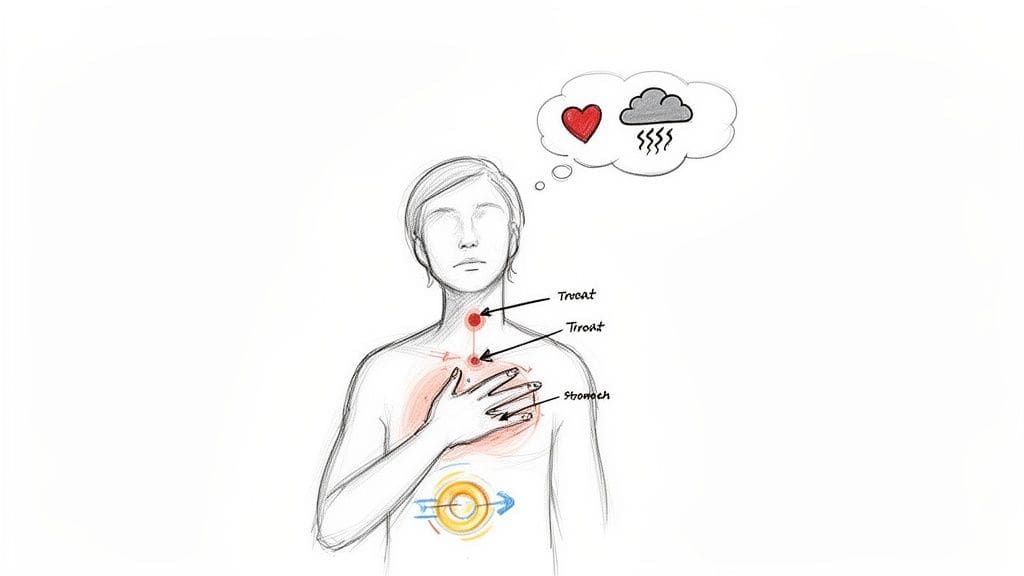
The root of this difficulty is often a simple disconnect: we feel emotions physically long before our brain can slap a label on them. A tight chest, a knot in your stomach, or a sudden surge of energy are all physical clues from your body. Learning how to put your feelings into words starts by tuning into those signals without judging them.
Tune Into Your Physical Sensations
Before you can say what you feel, you have to know what you feel. This is a skill, not an innate talent, and it gets better with practice. When the words just aren't there, your body gives you a tangible place to start.
The best first step is to just pause and do a quick internal check-in. Ask yourself:
* Where do I feel this in my body? Is there tension in your shoulders? A flutter in your chest?
* What's the quality of this sensation? Is it sharp and hot, or dull and cold?
* What does this feeling make me want to do? Do you feel an urge to pull away, to lash out, or to move?
This challenge of articulating our inner world can feel even more pronounced for neurodivergent individuals. Understanding the unspoken link between ADHD, Autism, and emotions can be incredibly validating and shed light on why this process can feel so exhausting.
This isn't just about our personal relationships, either—it has a huge impact on our professional lives. Research shows that being able to express emotions authentically at work, like sharing gratitude or sympathy, builds trust and makes teams work better. When we suppress those feelings, it leads to burnout. In fact, 48% of employees and 53% of managers report feeling exhausted at work.
By grounding yourself in what your body is telling you, you start building a bridge from feeling to speaking. If you want to dive deeper into this, our guide on how to regulate your emotions is a great next step.
Getting the Right Words Out with Practical Scripts
Okay, so you've gotten better at noticing the signals your body is sending you. The next hurdle is translating those physical sensations into actual words. A lot of us walk around with a pretty limited emotional toolkit—happy, sad, mad—and it can feel like trying to paint a masterpiece with only three colors.
Learning how to express your feelings in words is all about expanding your palette. It gives you the precision you need to help others really get what's going on inside.
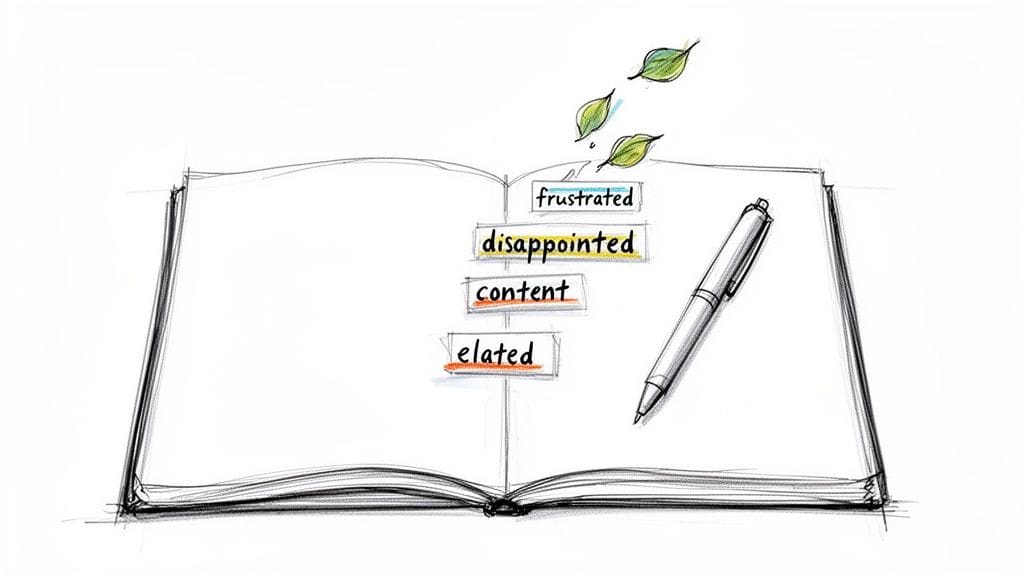
Think about it. Instead of just saying you feel "bad," can you dig a little deeper? Are you feeling disappointed? Frustrated? Overwhelmed? Lonely? Each of those words paints a completely different picture and asks for a different kind of support.
From Vague Emotions to Specific Feelings
Moving beyond the basic emotions is a game-changer. A great way to start is by sorting more specific feelings under those big, general categories. This helps you build a bridge from a fuzzy gut feeling to a word that actually fits.
Here's a quick breakdown to get you started:
* Instead of MAD, try: Frustrated, irritated, resentful, annoyed, defensive.
* Instead of SAD, try: Disappointed, hurt, lonely, vulnerable, disheartened.
* Instead of HAPPY, try: Content, proud, relieved, joyful, optimistic.
* Instead of SCARED, try: Anxious, overwhelmed, insecure, worried, hesitant.
Just naming the feeling with more accuracy can take away some of its power and make it feel more manageable. It's like turning on the light to find that the vague, scary shadow in the corner is just a coat rack.
How Communication Scripts Can Help
Having the right word is a huge step, but let's be real—when you're overwhelmed, forming a complete, coherent sentence can feel impossible. This is where communication scripts are a lifeline. They're basically pre-planned phrases that give you a reliable place to start.
> Think of scripts as conversational guardrails. They don't steer the entire conversation for you, but they get you started safely and take a huge amount of mental load off your plate.
These are especially useful for things like setting boundaries, asking for what you need, or even sharing something positive without feeling super awkward about it.
For many neurodivergent people or those of us with social anxiety, the mental energy a tough conversation requires can be completely draining. Supportive apps for social anxiety can pair regulation tools with conversation prep. If you're interested in how pre-planned phrases can help, you can explore our conversation scripts for neurodivergent people in our detailed article. Just having a few go-to lines ready can make all the difference.
Practical Scripts You Can Use Today
Building up your own library of scripts takes time, but here are a few examples to show you just how simple and versatile they can be. Notice they all start with "I" and clearly state a need or observation.
For Setting a Boundary:
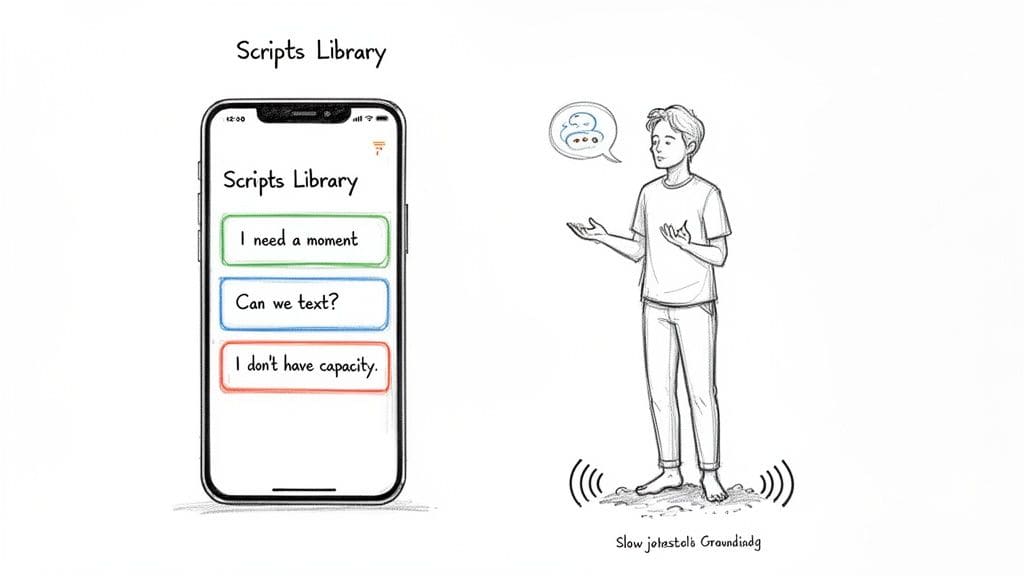
"I really appreciate you thinking of me, but I don't have the capacity for that right now."
"I need some space to think this over. Can we talk about it tomorrow?"
For Expressing a Need:
"I'm feeling pretty overwhelmed and could really use your help with this."
"It would mean a lot to me if we could spend some quality time together this week."
Struggling to find the right words? tonen can help.
tonen gives you 188+ conversation scripts, tone guidance and calming tools — designed for autistic adults, ADHD and social anxiety. Try it free for 7 days.
Download on the App StoreiOS only. Android coming soon.
For Sharing Positive Feelings:
"I wanted to let you know that I really appreciated it when you..."
"I feel so happy and supported when you listen like that. Thank you."
These simple templates give you a solid foundation for knowing how to express your feelings in words, making those hard conversations feel a whole lot more approachable.
Mastering Tone and Finding the Right Moment

You've done the hard work of figuring out what you're feeling and even found the words for it. But the job isn't finished. The exact same sentence can land like a warm hug or a sharp jab depending entirely on how and when you say it.
Think about the classic phrase, "I'm fine." Said with a relaxed smile, it's a sign of genuine contentment. But spoken with a flat voice and zero eye contact, it practically screams that something is wrong. Your tone of voice and the timing of your delivery fill the gap between what you mean and what the other person hears.
This is especially critical for neurodivergent folks, who might find it challenging to either control their own tone or accurately read someone else's. Making a conscious choice about your tone before you speak can completely change the outcome of a conversation. If you want to get better at decoding others, learning how to read another person's tone of voice is a great place to start.
Choosing Your Intended Tone
Before you jump into a conversation, pause for a second. What's the goal here? Are you trying to connect, set a boundary, or just state a fact? Each one calls for a different vocal texture.
* Warm Tone: This is your go-to for building connection, offering support, or sharing something positive. It's softer, often a bit slower, and full of empathy.
* Direct Tone: Use this for clear, no-nonsense communication. The goal is simply to be understood without any ambiguity. It's neutral and steady, without a lot of emotional color.
* Firmer Tone: Save this for setting important boundaries or talking about a serious problem. It's not aggressive, but it is strong and steady. It communicates that your needs are non-negotiable.
Intentionally picking a tone helps you steer the conversation, dramatically cutting down the odds of being misunderstood.
The Critical Importance of Timing
Timing is everything. Trying to voice a major frustration in the middle of a screaming match is like trying to have a picnic in a hurricane. It's just not going to work. Your words, no matter how perfectly chosen, will get swept away in the emotional storm.
> Recognizing a good moment is a skill in itself. A calm, private space where both people have the time and emotional bandwidth to listen is always the best-case scenario.
If the moment feels all wrong, it's completely fine to hit pause. You can use a simple script to postpone the talk without making the other person feel dismissed.
Let's say your partner brings up something stressful just as you're rushing out the door for work. Instead of reacting in the moment, you could say: "What you're saying is really important to me, and I want to give it my full attention. Can we please talk about this tonight when I get home?"
This approach validates their feelings while also protecting your ability to have a sane, productive conversation later. Learning how to express your feelings in words effectively means choosing the right battlefield—and sometimes, that means choosing not to fight at all.
Making It Work for Autistic, ADHD, and Anxious Minds
If you're autistic, have ADHD, or live with social anxiety, the advice to "just say how you feel" can feel like being asked to climb a mountain without any gear. It's not that simple. When your brain is wired differently, the standard playbook on communicating feelings just doesn't cut it.
The key is to work with your brain's wiring, not against it. That means using strategies that reduce the in-the-moment overwhelm and let you build confidence on your own terms. It's about preparation, having a backup plan, and learning to communicate your needs around the conversation itself.
Scripting and Rehearsal for Lower Stakes
One of the most powerful things you can do is plan out what you want to say beforehand. This isn't about becoming a robot; it's about reducing the massive cognitive load of trying to find the perfect words while you're already stressed.
You can create your own short scripts for situations you know are coming, like asking for feedback at work or setting a boundary with a friend. An app to improve communication skills with a built-in Scripts Library can be a huge help here, giving you starting points that you can make your own.
> Rehearsing these scripts in private is the secret sauce. A 'practice mode' in an app lets you try out different phrases and tones without a live audience. This builds muscle memory, so the words come out a lot more smoothly when you actually need them.
This whole process turns a high-stakes, terrifying interaction into a much more manageable task. When you've already done the hard work of finding the words, you free up so much mental energy to actually listen and be present in the conversation.
Managing Overwhelm with Grounding and Exit Lines
Even with the best prep work, conversations can get overwhelming. When you feel that familiar spike of anxiety or your thoughts start to scatter, you need tools to calm your nervous system right then and there.
Simple grounding techniques can be a total lifeline:
* The 5-4-3-2-1 Method: Silently name 5 things you see, 4 things you can physically feel, 3 things you can hear, 2 things you can smell, and 1 thing you can taste. This pulls your brain back to the present moment.
* Physical Grounding: Press your feet firmly into the floor. Squeeze your hands together. This physical sensation acts as an anchor.
Alongside grounding, having planned "exit lines" is a game-changer. These are your pre-approved permission slips to pause a conversation before it leads to a meltdown or shutdown. They aren't rude; they are a critical act of self-preservation.
Examples of Gentle Exit Lines:
* "I'm feeling a bit overwhelmed right now. Can we take a 10-minute break and come back to this?"
* "This is important, and I need some time to process it. Let's pick this up tomorrow morning."
Communicating Your Communication Needs
A huge part of knowing how to express your feelings is being able to talk about the process of communication itself. It is absolutely okay to tell someone what you need to have a productive conversation.
This can look like:
* "I find it way easier to talk about complex stuff over text so I can get my thoughts in order. Would that work for you?"
* "My brain works a bit slower sometimes. Could you give me a moment to think before I respond?"
This kind of directness creates a much safer and more understanding space for everyone. Research from Wharton actually shows that when people feel safe enough to be honest about their feelings and are met with empathy, problem-solving and creativity get a major boost. This is especially true for neurodivergent folks, who often burn enormous energy just trying to mask.
If you're looking for more guidance on this, our article on how to talk through issues effectively has some great strategies.
Putting It All Into Practice: Real-World Scenarios
Alright, theory is great, but let's be honest—it's what happens when you're actually standing in front of your boss, partner, or friend that really matters. This is where all the work we've done on identifying feelings, choosing a tone, and using short scripts comes to life. It's how you start building connections that feel healthier and more honest.
To make this feel less abstract and more like a tool you can actually use, let's walk through a couple of common, tricky situations. Visualizing how these conversations can go makes the whole process feel much more manageable.
Scenario 1: Telling Your Manager You're Overwhelmed
The situation: Your workload is out of control, and you can feel burnout creeping in. In the past, you might have just worked later and later, letting resentment silently build. This time, you're going to communicate what you need.
* Your gut reaction: "This is impossible. They're just trying to crush me with work."
* The actual feeling underneath: You're feeling overwhelmed, anxious, and maybe a little unsupported.
* The script you choose (using a direct, professional tone): "I wanted to check in about my current projects. I'm feeling overwhelmed by the workload and I'm concerned about meeting all the deadlines without the quality dropping. Could we look at the priorities together?"
This approach works because it frames the issue as a shared goal—doing good work—instead of an accusation. It's professional, solution-focused, and clear. Learning how to improve communication in relationships isn't just for romantic partners; it's a critical skill for the workplace, too.
Scenario 2: Setting a Boundary With a Friend
The situation: A friend you care about has a habit of asking for last-minute favors that throw your whole schedule into chaos. You're starting to feel taken for granted and you know you need to protect your time and energy.
* Your gut reaction: "They are so selfish. They only call when they need something from me."
* The actual feeling underneath: You're feeling frustrated, resentful, and frankly, tired.
* The script you choose (using a warm but firm tone): "I really value our friendship, but I'm finding that I don't have the capacity for last-minute plans right now. I need more predictability in my schedule to manage my energy. Could you try to give me a bit more notice in the future?"
This script is effective because it leads with affirmation ("I value our friendship"), which helps the other person hear the boundary without getting defensive. Clear, respectful communication like this is the key to navigating all sorts of tough conversations. For more strategies on this, our guide on how to navigate difficult conversations is a great resource.
The workplace is another place where this skill is absolutely vital. According to a 2026 report from Pumble, poor communication is a huge driver of stress and burnout. They found that 82% of employees report increased stress due to poor communication, and a staggering 40% have experienced burnout as a direct result.
But here's the flip side: teams that encourage emotional honesty are actually three times more productive. This shows that learning how to express your feelings clearly isn't just a "soft skill"—it's a powerful professional asset. You can discover more workplace communication statistics to see the full impact.
> Putting these skills into action is a brave step. Remember that the goal isn't to control the other person's reaction, but to honor your own feelings with clarity and respect. Each attempt, regardless of the outcome, builds your confidence and reinforces your self-worth.
Common Questions About Expressing Feelings
Even with the right tools and a genuine desire to connect, learning how to express your feelings in words can feel… complicated. It's a skill, and like any other, hitting a few snags is just part of getting better at it. Let's walk through some of the most common worries that come up.
What if I Get a Bad Reaction?
This is the big one, isn't it? It's probably the number one fear that holds people back. You finally get the courage to share something vulnerable, and the other person just shuts down, gets defensive, or waves it off. It stings, a lot. But their reaction doesn't mean you failed.
You are responsible for communicating your feelings with clarity and respect. You are not responsible for managing their response. Your job is to honor your own experience. If you're met with a wall of negativity, you can stay grounded with something simple.
> "I'm sorry you see it that way. My intention was just to share how this is affecting me."
It's also incredibly smart to have an exit line planned to protect your own well-being. A simple, "It seems like we can't talk about this calmly right now, so let's take a break," can stop a conversation from spiraling and give you the space you need.
How Can I Share Feelings Without Feeling Weak?
So many of us were handed an outdated rulebook that said showing emotion—especially the tough ones—is a sign of weakness. It's time to toss that idea out for good.
Expressing your feelings honestly is an incredible act of strength and self-respect. It shows that you value yourself enough to be clear about what you need and how you feel.
Start small. Practice in low-stakes situations with people you trust. Use simple "I feel" statements that are just factual reports of your experience. Something like, "I feel disappointed about the change in plans." The more you do it, the more you'll realize that this kind of genuine communication actually builds much stronger, more resilient connections.
What if I Can't Identify My Feelings?
This happens all the time, especially for neurodivergent folks. It's sometimes related to something called alexithymia—a real difficulty in identifying and describing emotions. When you just can't find the right word for a feeling, pivot. Describe the physical sensation instead. Your body is giving you a ton of information.
For example, instead of getting stuck trying to name an emotion, you could say:
* "My chest feels really tight right now."
* "I have a knot in my stomach."
This is a completely valid and powerful way to communicate what's happening inside. You can even follow it up with, "I'm not sure what emotion this is, but my body feels very tense." It's a perfect first step in learning how to express your feelings in words when the labels feel just out of reach.
Navigating these conversations takes real courage, and having the right support can make all the difference. The tonen app was designed by neurodivergent makers to help you find the right words, choose your tone, and practice difficult conversations in a safe, private space. With a library of scripts and grounding tools, it's like having a communications coach in your pocket. Download tonen from the App Store and start your free trial today.
Frequently asked questions
Many autistic and ADHD adults experience alexithymia — difficulty identifying and naming emotions internally. Sensory overload, masking fatigue, or fear of judgment can also make verbal expression feel impossible in the moment. It is not a communication failure; it is a neurological difference.