Ever walk away from a conversation feeling like you missed something huge, or had a simple text message send your anxiety spiraling? To understand a confusing situation, the most effective strategy is not to guess what others mean but to pause, challenge your initial negative assumptions, and ask for clarity. This method empowers you to respond from a place of calm confidence rather than anxious reaction. This guide provides a simple, actionable framework to help you navigate social ambiguity and stop replaying interactions in your head.
Feeling lost in a conversation or misreading social signals is incredibly stressful, leading to anxiety and exhaustion from trying to decipher mixed messages. This experience is far more common than you might think. We will explore why these moments feel so threatening and introduce a practical, 3-step strategy to help you find your footing and build confidence.
Your Guide to Navigating Confusing Situations
It's that familiar spike of anxiety from a vague comment, or the mental exhaustion of trying to decipher mixed messages. This experience is far more common than you might think.
This guide gives you immediate, actionable tools to stop feeling so lost and start navigating social interactions with a bit more ease. We'll look at why social ambiguity often feels so threatening and introduce a practical strategy to help you find your footing.
Who This Guide Is For
> The goal is to shift from self-blame to self-awareness. It's not about "fixing" how you think but about equipping yourself with strategies that work for your brain.
The 3-Step Framework for Instant Clarity
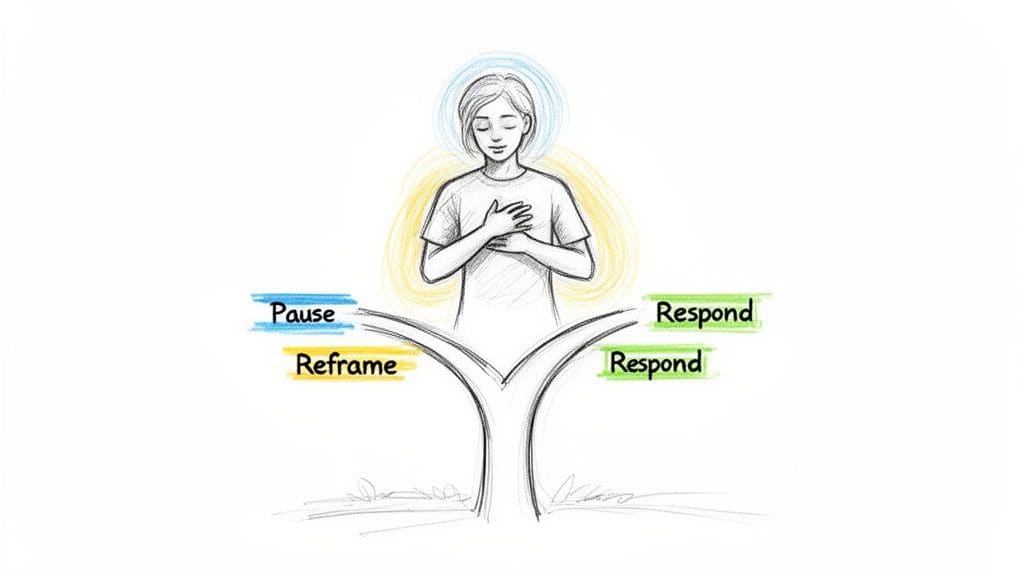
We're going to break down an immediate, three-step method to help you understand a confusing situation as it's happening. Think of it as a quick-start guide for handling those perplexing social moments with a simple, effective process.
This approach gives you a solid foundation for building confidence and cutting through the mental noise.
| Step | Action | Goal |
|---|---|---|
| 1. Pause | Ground yourself before reacting. | Create the mental space to process without the pressure of an instant reply. |
| 2. Reframe | Consider alternative, gentler interpretations. | Break the cycle of jumping to the worst-case scenario. |
| 3. Respond | Choose a response that is calm and clear. | Communicate from a place of confidence and control, not anxiety. |
Let's unpack what each of these steps looks like in the real world. By mastering this simple process, you can start to feel more in control during those moments that used to throw you off balance.
Step 1: Pause to Ground Yourself
This is the most critical step. Instead of reacting instantly when you feel that jolt of confusion or anxiety, you intentionally create a small buffer of time. This isn't about ignoring the person; it's about giving your brain a moment to catch up.
A pause can be as simple as taking a slow, deep breath before you speak or type. This small action interrupts the fight-or-flight response that ambiguity often triggers, allowing your logical brain to come back online.
Step 2: Reframe Potential Interpretations
Our brains are wired to spot threats, which is why it's so easy to assume the worst. A short text might mean they're angry. A vague comment in a meeting could feel like a personal attack. Reframing is the act of consciously challenging that first negative thought.
Ask yourself: "What are two other, more generous reasons for this?" Maybe they were just busy when they texted. Perhaps their comment had nothing to do with you at all. This isn't about being naive; it's about breaking the habit of negative fortune-telling.
Step 3: Respond with Confidence
Once you've paused and considered a few other possibilities, you're in a much better position to respond. Armed with a more balanced perspective, you can choose what to do next instead of just reacting.
Your response might be to ask for clarification, or you might decide the comment doesn't even need a reply. Either way, the choice is yours. You're responding from a place of calm consideration, not from a spike of anxiety. This is how you start to build real confidence, one interaction at a time.
Why Social Interactions Can Feel So Confusing
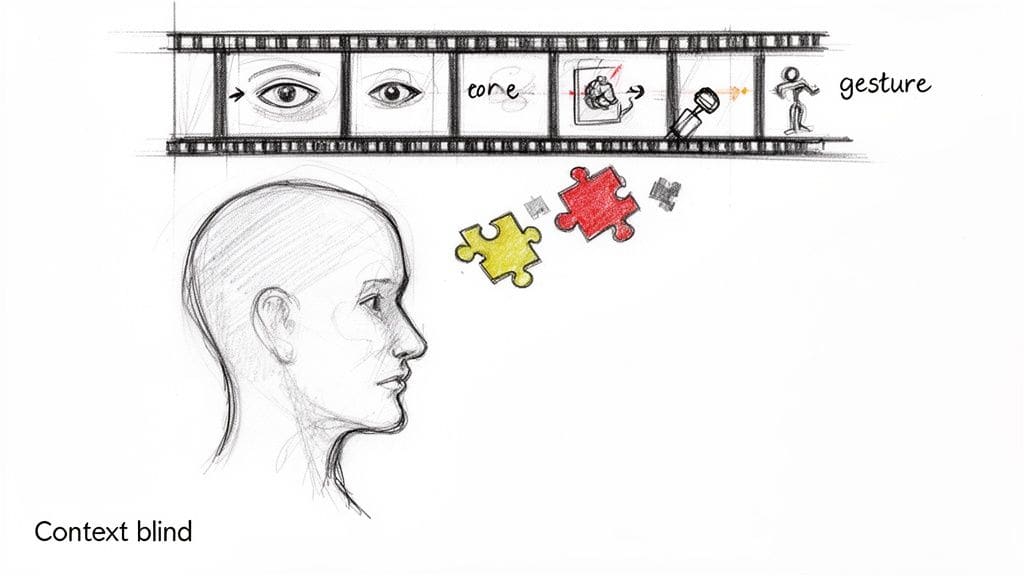
Social interactions can feel overwhelmingly confusing because many people—especially those of us who are neurodivergent—are simply processing the world on a different operating system. It's like trying to follow a movie when you're missing half the scenes; you might grasp the main plot points but miss the subtle glances, shifts in tone, and unspoken rules that give the story its real meaning.
To understand a confusing situation, the first step is knowing that your brain isn't broken. It's just operating on a different wavelength. This gap in perception isn't a personal failing; it's a cognitive difference. Things that seem obvious to some are a complex puzzle for others. This mismatch can lead to chronic anxiety and social burnout as you spend enormous mental energy just trying to keep up.
The Missing Social Subtitles
Think of social cues as a language spoken entirely without words. For many people, this language is absorbed and processed automatically. For others, it's a manual, exhausting translation process.
Three key cognitive factors often play a huge role in this feeling of being lost:
- Context Blindness: This is the struggle to automatically piece together the *context* of a situation. Your brain might zero in on the literal words someone says but miss the surrounding cues—like the time, place, or what just happened—that change the meaning entirely.
- Theory of Mind Challenges: This is the process of understanding that other people have thoughts, feelings, and intentions completely separate from your own. When this isn't intuitive, others' actions can seem random and unpredictable.
- Alexithymia: This is a difficulty in identifying and describing your *own* emotions. If you can't easily put a name to what you're feeling, it becomes exponentially harder to recognize and interpret the emotions of others.
> Acknowledging these differences is the first step toward self-compassion. It shifts the focus from "What's wrong with me?" to "How does my brain work, and what tools can help me?" This self-awareness is how you truly understand a confusing situation without the crushing weight of self-blame.
From Cognitive Load to Emotional Burnout
Constantly trying to decode all these missing pieces creates a massive cognitive load. This intense mental strain is why a social event can feel as tiring as running a marathon. It's not the talking itself that's exhausting; it's the intense background processing required just to participate. This is often why your social battery drains so much faster than others'.
This persistent effort takes a real emotional toll. The fear of getting it wrong can trigger intense anxiety, while repeated misunderstandings lead to frustration and a deep sense of isolation. When you frequently understand a confusing situation differently than everyone else, it can make you feel profoundly disconnected.
Recognizing the 'why' behind your confusion is validating. If you want to dive deeper into this, you can learn more about why things feel off in a social situation in our related article. Building this self-awareness helps you move away from blame and toward finding practical strategies that honor the way your mind actually works.
Trying to make sense of a confusing situation? tonen can help.
tonen offers conversation scripts, Reply Helper, Perspective Helper, Debrief, Phone Call Mode and Calm Kit. Start with 21 free scripts on iPhone. Optional Premium unlocks more features.
Download on the App StoreAvailable on iOS.
Practical Steps to Decode Social Ambiguity
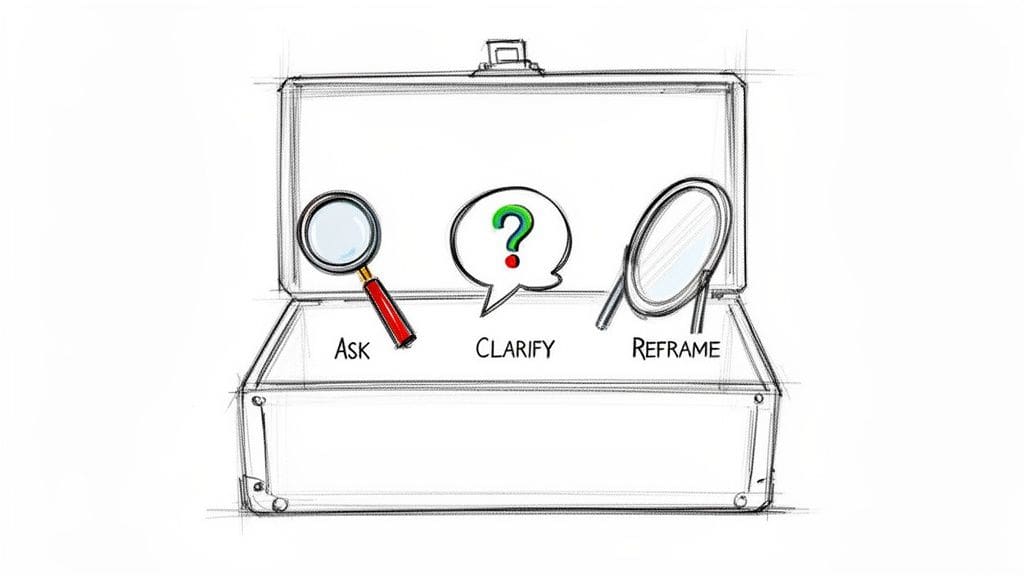
Alright, we've covered why social situations can feel so confusing. Now let's move from theory to practice with a real toolkit for those moments when you're left guessing. The single biggest shift you can make is from filling in the blanks with assumptions to actively gathering more information.
When you learn to understand a confusing situation with a few simple techniques, you stop letting anxiety write the story. This isn't about turning into a detective in your friendships. It's about giving yourself the tools and confidence to handle ambiguity with grace. Remember, asking for clarity isn't weakness—it's a sign of strength and self-respect.
Gather Information Tactfully
The fastest way to clear up confusion is simply to ask. But for many of us, the fear of sounding confrontational or needy is a huge barrier. The secret is to frame your questions so they're about your need for clarity, not their failure to communicate.
Here are a couple of ways to get more information without putting the other person on the defensive:
- Use "I" Statements: Instead of an accusatory, "What did you mean by that?", try something like, "I'm not sure I'm following, could you explain that a different way for me?" This makes it about your understanding, not their vague message.
- Reflect and Ask: A great technique is to repeat what you *think* you heard and then ask for confirmation. For example, "Okay, so it sounds like you're saying [X]. Is that right?" This shows you're engaged and gives them an easy way to correct any misinterpretation.
Shift Your Perspective
Before you even open your mouth, one of the most powerful things you can do is challenge your own first interpretation. Our brains are wired for self-protection, which often means they jump straight to the worst-case scenario. It's a mental shortcut that can cause a lot of unnecessary pain.
A tool like tonen's Perspective Helper is built specifically to counteract this habit by offering gentler, more neutral possibilities.
> For instance, a friend cancels plans last minute. Your gut reaction might be, "They don't want to see me." A perspective-shifting tool would gently suggest alternatives: "Maybe they had a brutal day and are just exhausted," or "Perhaps something unexpected and urgent came up at home."
This mental exercise doesn't mean you have to ignore your feelings of disappointment. It just stops a negative assumption from hardening into a "fact" in your mind. This creates the breathing room you need to respond calmly instead of reacting with hurt or anger.
To get a better handle on this, check out our guide on how to make sense of another person's behaviour. When you arm yourself with a few different viewpoints, you're much better equipped to understand a confusing situation from a place of balance.
Build Your Confidence with Ready-Made Scripts
We've all been there. You're in a confusing conversation, someone says something unexpected, and your mind just… goes blank. That sudden wave of anxiety can be completely overwhelming, making it impossible to figure out what to say next.
This is where scripting comes in. It's the simple but powerful act of preparing what you might say before you're in the thick of it. Having a plan dramatically reduces that in-the-moment panic, giving you a clear path forward and helping you communicate with real confidence. It's like being handed a map in an unfamiliar city—you're far better equipped to handle any unexpected turns.
Your Communication Lifeline
Think of a library of scripts as a communication lifeline. It's a resource you can turn to for all sorts of moments, whether you're navigating small talk at work or trying to set a firm boundary with a family member. For example, tonen's Scripts Library gives you conversation scripts that cover a huge range of life situations.
This kind of support can be a game-changer for many neurodivergent people. For autistic adults, having access to scripts for work, health appointments, and family events—complete with different tone options—can be the difference between a successful interaction and a meltdown. As some of our users have shared, rehearsing these privately builds fluency, reduces anxiety, and makes setting boundaries much easier. You can find more details in this 2026 overview of neurodiversity statistics.
> Having a script doesn't mean you sound like a robot. It means you've given yourself a starting point, which you can adapt to your own voice and the specific context you're in.
Adjusting Your Tone for Any Situation
The words you choose are important, but how you say them often matters even more. Tone is everything. A good script isn't just a rigid set of words; it's a flexible tool you can adjust to fit exactly what you need.
Let's take a common scenario: politely declining an invitation.
- Warm Tone: "Thank you so much for thinking of me! I won't be able to make it this time, but I'd love to catch up soon."
- Direct Tone: "I appreciate the invitation, but I'm going to have to pass."
- Firmer Tone: "Thanks for the invite. I've already made other plans and won't be able to change them."
Each option says "no," but allows you to match the tone to your relationship with the person and the specific situation. Having these options ready helps you understand a confusing situation by preparing you to respond clearly and effectively. You can learn more about how to use these tools by exploring our guide on tonen conversation scripts for neurodivergent people.
Beyond your personal interactions, building this kind of communication confidence can also help with your digital presence. For instance, learning about how to create engaging social media content that connects can help you practice and reinforce these skills across different platforms.
How to Practice and Prepare in a Safe Space
Knowing what to say is a huge first step. But actually saying it, with the right tone and a sense of calm? That's a whole different ballgame. To get truly comfortable handling confusing situations, you need more than just good ideas—you need a place to practice.
Rehearsing what you want to say in a private, low-stakes space is one of the best ways to lower social anxiety. It builds the muscle memory you need so that when a real conversation happens, you're not just trying to survive—you're ready to engage.
From Rehearsal to Reality
Think of it like a musician rehearsing scales before a big show. That repetition moves the notes from a clunky, conscious effort into a smooth, automatic flow. Social communication is exactly the same. When you rehearse a script, you build a kind of social muscle memory that frees up your brainpower for the actual conversation.
For rehearsal, choose a script, adapt the words and read them aloud yourself if that is useful. You can also practise with someone you trust. It's a private space to save your favorite scripts and rehearse them as many times as you need. This isn't about memorizing lines like an actor. It's about internalizing the phrases until they feel like your own.
The goal is to move your planned response from your "thinking brain" to your "talking brain." That proactive prep work builds genuine confidence and puts you in control, ready for whatever the conversation throws your way.
> By practicing, you transform a script from a foreign object into your own words. It helps you find your rhythm and own the message before you ever have to share it with someone else.
Mastering Your Tone
Practice isn't just about the words themselves; it's about the delivery. The tone you use can completely change how your message lands. A simple question can sound genuinely curious or accidentally accusatory. A boundary can come across as gentle and firm, or harsh and rejecting.
Practicing different tones helps you get more skilled at matching your delivery to your intention. Here are a few ways to focus your practice sessions:
- Boundary Setting: Practice saying "no" using both a Warm and a Firmer tone. Notice how each one feels in your body.
- Asking for Help: Rehearse asking for support. Try it with a Direct tone versus a Softer one to see which feels right for different situations.
- Clarifying Questions: Say a phrase like, "I want to make sure I'm understanding," out loud. This helps you get comfortable with the act of seeking clarity.
This kind of rehearsal is crucial. The more you do it, the more equipped you'll be to navigate social dynamics and understand a confusing situation with far less stress. For more on this, our article on the benefits of talking it through offers some great additional guidance.
Managing Overwhelm with a Personal Calm Kit
Let's be realistic. Even with the best scripts and a solid game plan, a confusing interaction can still send your nervous system into a spiral. In those moments when anxiety takes over, you need an emotional safety net.
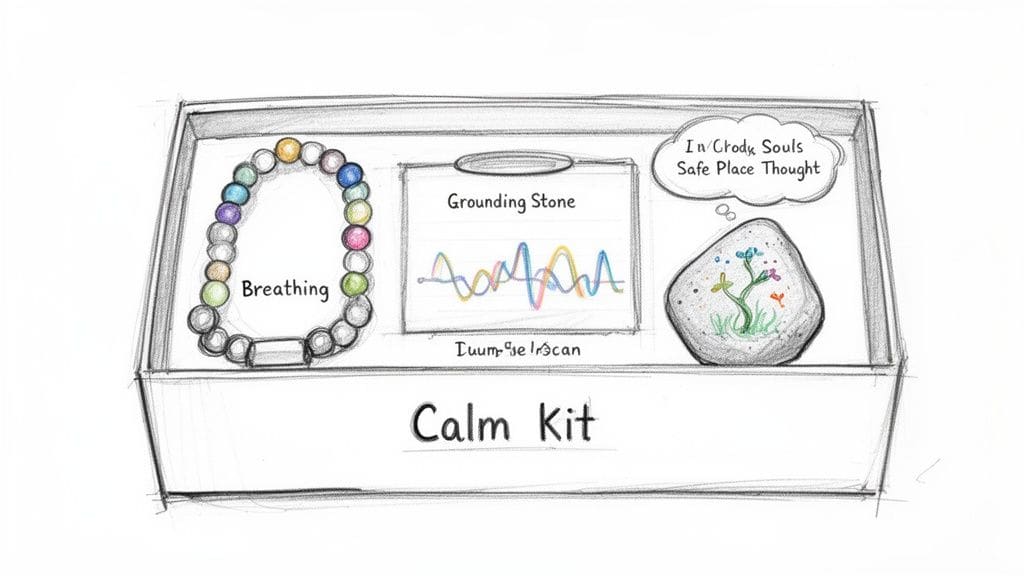
This is where a personal "calm kit" comes in. Think of it like a first-aid kit for your emotions, giving you immediate, discreet tools to regain your footing. The Calm Kit feature inside tonen is built for this exact purpose—to help you understand a confusing situation without getting washed away by the emotional tide.
Just knowing you have a plan B can make social situations feel less like a minefield and much more manageable.
Four Tools for Instant Relief
Your personal calm kit should be filled with simple, real-time exercises you can do anywhere. The whole point is to be quick and discreet. Here are four optional techniques you can use to dial down anxiety the moment it spikes.
1. Guided Breathing: This is the fastest way to send a "you're safe" signal to your brain. Focus on a simple rhythm, like breathing in for four counts, holding for four, and breathing out for six. Making the exhale a little longer is key—it activates your parasympathetic nervous system, which tells your body's stress response to stand down.
2. Sensory Grounding: When your mind starts racing, grounding pulls you back into the present. The 5-4-3-2-1 method is a classic for a reason. Silently name five things you can see, four things you can feel, three things you can hear, two things you can smell, and one thing you can taste. It yanks your focus out of anxious thoughts and back into your physical space.
3. Quick Body Scan: Overwhelm has a physical footprint. It shows up as tension in your body. Discreetly check in with yourself—are your shoulders up by your ears? Is your jaw clenched tight? Starting from your toes and working your way up, consciously release the tension in one area at a time.
4. Safe-Place Visualization: This is a mini-vacation for your brain. For just a moment, close your eyes and picture a place where you feel completely calm and safe. It can be a real memory or somewhere you've imagined. Focus on the sensory details—what do you see, hear, and feel there? This quick mental escape can completely reset your state.
> These techniques aren't about ignoring the problem. They're about managing your body's reaction so you can approach the situation with a clear head. They put you back in charge of your emotions, instead of letting your emotions be in charge of you.
If you find that you're consistently feeling overwhelmed and your calm kit doesn't feel like enough, exploring local professional counselling services can offer deeper, more personalized support. For more self-guided exercises, you might also find our guide on effective grounding techniques for anxiety helpful.
Still Have Questions? Let's Clear Things Up
It's completely normal to have a few lingering questions when you're trying new ways to handle social situations. The journey to feeling more confident is a personal one, and it's smart to think through the details. Let's tackle some of the most common concerns.
What If Asking for Clarification Just Makes Things More Awkward?
This is a huge, and totally valid, fear. We've all been there, worrying that asking a question will just spotlight the awkwardness. But the secret isn't if you ask, it's how you ask.
An accusatory tone like, "What did you mean by that?" can put people on the defensive. Instead, try framing it as your need, using a softer "I" statement. For example: "I want to make sure I'm understanding correctly. Could you say that a different way for me?" This takes the pressure off them and just makes it about your own process. Practicing these lines in a low-stakes moment builds the muscle memory to use them when it really counts.
How Do I Know If I'm the One Misinterpreting Things?
Honestly, trying to guess someone's true intentions is a fast track to exhaustion. It's often impossible, and the mental energy you spend trying to mind-read is better used elsewhere. A much more effective approach is to focus on two things you can control: observable behavior and your own feelings.
> This is where a tool like tonen's Perspective Helper can be a lifeline. Instead of defaulting to a worst-case scenario, it gives you more generous or neutral interpretations to consider, like, "Maybe they are just tired." Starting from a less negative place allows you to respond with more calm and clarity.
If you notice a consistent pattern of confusing behavior from the same person, it's more likely a reflection of their communication style, not a flaw in your ability to interpret things.
Are These Tools and Scripts Only for Neurodivergent People?
Not at all. While tonen was designed with the needs of the neurodivergent community at its heart, the strategies are for anyone who feels social anxiety or simply wants to communicate more effectively.
The need to understand a confusing situation, set healthy boundaries, and manage feelings of overwhelm is a universal part of being human. These tools are for anyone looking to reduce the stress of communication and build stronger, more authentic relationships in every part of their life. Learning to navigate complex interactions is a skill that empowers everyone.
tonen is available on iOS with 21 free scripts, Box Breathing and 5-4-3-2-1 Grounding, plus one free request each in Reply Helper, Perspective Helper and Debrief. Optional Premium adds the full script library, Phone Call Mode, Body Scan and Safe Place, and 50 requests per week shared across the three helpers. Check the App Store purchase screen for your local price and any eligible trial.