That unsettling sense that things just 'feel off' in a conversation isn't just in your head—it's a real signal from your brain, often indicating a mismatch between your internal world and the external social demands you're facing. To understand why things feel off, you must first recognize this feeling as a valid response, not a personal flaw. It's your nervous system reacting to triggers like sensory overload, confusing social cues, or emotional dysregulation, which is an especially common experience for neurodivergent individuals. This guide will help you decode those signals and give you practical tools to navigate social moments with more confidence.
It's not a sign you're "bad at socializing"—it's your nervous system responding to something.
Why That Unsettling Feeling Happens in Social Settings
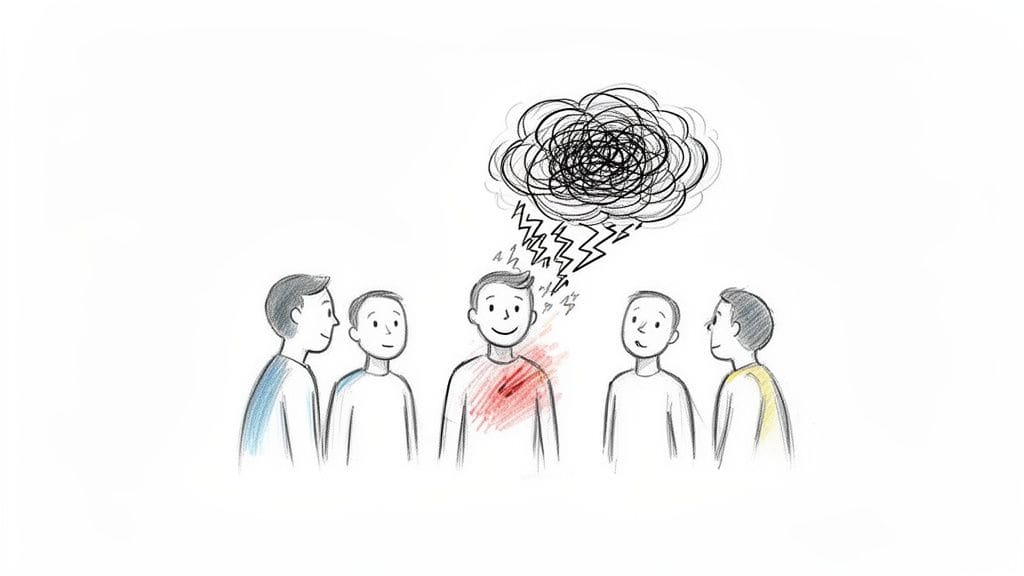
Have you ever been in a conversation and suddenly felt a knot in your stomach? You can't pinpoint exactly what's wrong, but the vibe is just… off. This experience, while common for many, is an intense and frequent reality for neurodivergent people.
This guide will walk you through the reasons behind this experience and give you some practical tools to navigate social moments with more confidence. We'll start by breaking down common triggers and connecting them to the internal sensations they produce, giving you a clearer framework for decoding your own experiences.
The Mismatch Between Your Internal Experience and External Cues
At its core, this "off" feeling often comes down to a disconnect. Neurodivergent brains can process sensory information—like background noise or bright lights—and social data very differently. What a neurotypical person might filter out as background noise, your brain might be experiencing as a firehose of overwhelming data.
This creates a conflict between what someone is saying and what your body is actually feeling. For example, someone might be smiling and using positive words, but their tone of voice or subtle body language feels completely contradictory to you. This dissonance is a key reason you might struggle to figure out the situation; your brain is flagging an inconsistency that others might not even notice.
> This feeling is not a sign that you are broken or "bad" at social interaction. Instead, it's a signal that your nervous system is working hard to make sense of a complex and often confusing environment. It's a cue to pause and check in with yourself.
Common Triggers That Create the 'Off' Feeling
Several factors can trigger this unsettling sensation, and recognizing them is the first step toward managing the experience. It helps to think of these as building blocks that can stack on top of each other, leading to emotional and mental exhaustion.
To help make this clearer, I've put together a table that connects some common external triggers to what they can feel like on the inside.
Decoding the 'Off' Feeling: Common Triggers and Internal Sensations
| Common External Trigger | What It Can Feel Like Internally |
|---|---|
| A loud, crowded room (e.g., a party or restaurant) | A buzzing or static in your head; feeling irritable, foggy, or like you need to escape. |
| Unclear social expectations or subtext | A sense of confusion or panic; feeling like you've "missed" something important. |
| Someone's words not matching their tone of voice | A feeling of unease or distrust; a knot in your stomach, questioning the person's sincerity. |
| Being interrupted or talked over repeatedly | Feeling invisible or dismissed; a sense of frustration or wanting to shut down. |
| A conversation that moves too quickly | Feeling mentally exhausted or overwhelmed; like you're several steps behind everyone else. |
Looking at it this way helps turn a vague, anxious feeling into something more concrete you can identify and work with.
Here are a few of the most frequent culprits that can combine to create that feeling:
- Sensory Overload: Loud restaurants, crowded rooms, or even strong perfumes can overwhelm the senses, making it nearly impossible to focus on a conversation. This overload often leads to irritability and a desperate need to escape.
- Misreading Social Cues: A joke that doesn't land, a sarcastic comment taken literally, or missing a subtle facial expression can create a sudden feeling of disconnect and confusion.
- Emotional Dysregulation: When you're already stressed or tired, your capacity to manage social demands is lower. A minor misunderstanding can feel like a major conflict, intensifying the feeling that things are wrong. If this happens often, you can learn more by exploring the symptoms of emotional exhaustion in our detailed guide.
Ultimately, when you understand why things feel off, you can move from a place of self-criticism to one of self-awareness. The rest of this guide will give you the tools to do just that.
The Science Behind Sensory Overload and Social Cues
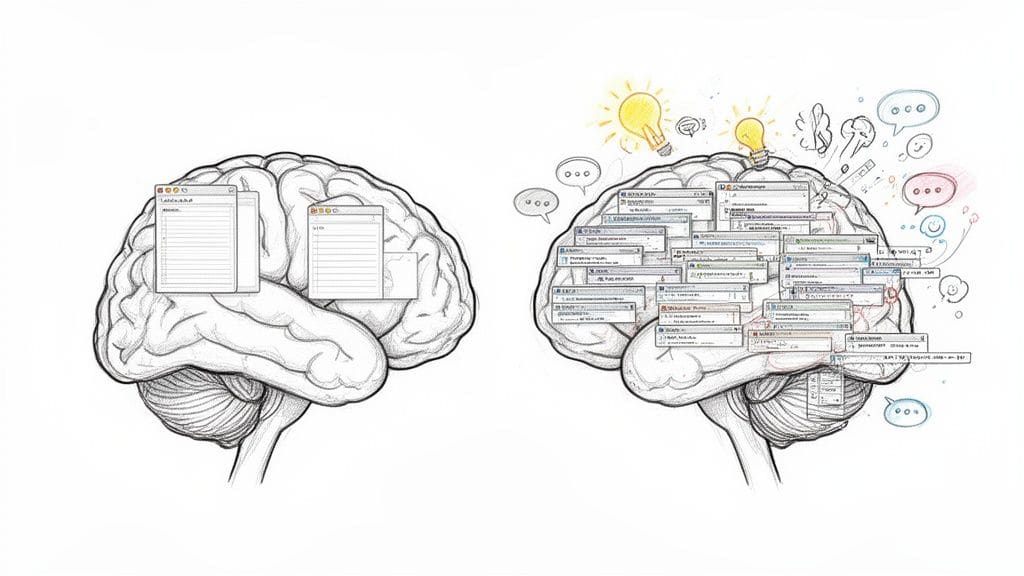
To get to the bottom of that 'off' feeling, we need to talk about the brain's processing power. For many neurodivergent people, the brain is like a high-performance computer running an incredibly sensitive operating system. This is great for deep focus and spotting patterns others miss, but it also means the whole system can crash when it gets too much input.
That crash is what we call sensory overload. It's not just about loud noises or bright lights, although those are definitely part of it. It's the cumulative weight of everything—the background chatter, the flickering fluorescent bulb, the scratchy tag on your shirt—all creating a massive traffic jam in your brain's filtering system.
When your brain is working that hard just to process the room you're in, it has very little bandwidth left for decoding the complex, unwritten rules of social interaction. You might be physically present, but mentally, you're trying to manage an internal storm. It's a disconnect that makes it incredibly hard to feel present or engaged.
The Brain's Filtering System
Think of your brain's sensory filter like a bouncer at a club. In a neurotypical brain, that bouncer is a pro. They know exactly who to let in (the person you're talking to) and who to keep out (the background music, the clinking glasses, the conversation happening three tables over).
For a neurodivergent brain, especially one with autism or ADHD, the bouncer might be less selective. Or maybe they just got overwhelmed and opened the doors to everyone. Now, every sound, sight, and sensation has a VIP pass, and the club is pure chaos. It's impossible to focus on anything. This is a huge reason why you might struggle in even moderately busy places.
> "Sensory overload isn't a choice or a weakness; it's a neurological response. The brain isn't failing to filter—it's trying to process everything at once. Recognizing this shifts the narrative from 'I can't handle this' to 'My brain is getting too much data right now.'"
The Challenge of Interpreting Social Cues
On top of the sensory piece, there's the monumental task of interpreting social information. So much of neurotypical communication relies on a shared, unspoken language of non-verbal cues—the subtle shift in tone, the fleeting facial expression, the almost imperceptible change in body language. For many, this is processed automatically.
For an autistic person, however, reading these cues can feel like trying to understand a language without a dictionary. Your brain might process the words perfectly but completely miss the slight dip in tone that signals sarcasm or the furrowed brow that means "I'm concerned, not angry." This gap between what is said and what is meant creates a constant, low-level hum of uncertainty.
Common Mismatches in Social Cue Processing:
- Tone vs. Words: Someone says, "I'm fine," but their tone is flat or tense. A neurodivergent brain might lock onto the literal words, missing the emotional data and leaving you with a nagging sense that something is off, but you don't know what.
- Body Language: A person might angle their body away, a non-verbal cue that they're ready to end the chat. If you miss that signal, the interaction can start to feel stilted or awkward.
- Figurative Language: Sarcasm, idioms, and metaphors can be a minefield. When processed literally, they can leave you feeling confused and completely out of the loop.
This constant, conscious effort to translate social data is mentally exhausting. It's like running resource-heavy translation software in the background of every single conversation you have. That heavy cognitive load is a key reason why socialising can feel so draining and why you might need a lot of downtime to recover.
For those with ADHD, there are similar challenges. Understanding how assistive technology for ADHD can help manage environmental distractions is a great way to free up some of that precious cognitive bandwidth for social processing. Recognizing these core differences in how your brain works is a massive step forward. If you'd like to dive deeper, check out our article about the autistic experience and communication.
How to Recognize Your Personal Triggers and Patterns
Moving from just knowing something to actually doing something about it is where the real power is. To figure out why you feel "off," you have to become a bit of a detective for your own life, gathering clues about what sets off your internal alarm bells. This isn't about blaming yourself. It's about building the self-awareness you need to predict, prepare for, and handle tricky situations with a lot more control.
The goal is to connect the dots between what's happening on the outside and how you're feeling on the inside. Does that "off" feeling spike in crowded rooms? During unstructured meetings? When plans suddenly get derailed? When you can name these triggers, you stop just reacting to overwhelm and start proactively managing your own well-being.
Start a Trigger-Tracking Journal
One of the best ways to spot these patterns is by keeping a journal. This doesn't need to be a fancy, long-winded diary. A quick note on your phone or a small notebook works just fine. The only real rule is to be consistent.
After a social interaction that left you feeling drained or weird, take a minute to jot down a few details. The act of writing it down pulls the tangled mess out of your head and turns it into concrete data you can actually look at.
Simple Journaling Prompts:
- What was the situation? (e.g., team lunch, video call with a new client, family dinner)
- Who was involved? (e.g., a specific person, a big group, total strangers)
- What was the environment like? (e.g., noisy cafe, quiet office, bright lights, strong smells)
- How did my body feel? (e.g., tight chest, racing heart, stomach in knots, suddenly hot)
- What thoughts were running through my mind? (e.g., "I said the wrong thing," "They think I'm weird," "I don't know what to say next.")
After a week or two, you'll start to see connections pop out. Maybe you'll notice that unstructured social time is way more draining than a meeting with a clear agenda. Or that conversations with one particular person consistently leave you feeling completely exhausted. This is priceless intelligence for your self-care strategy.
Can't figure out why something feels wrong? tonen can help.
tonen offers conversation scripts, Reply Helper, Perspective Helper, Debrief, Phone Call Mode and Calm Kit. Start with 21 free scripts on iPhone. Optional Premium unlocks more features.
Download on the App StoreAvailable on iOS.
Identify Common Trigger Categories
While your triggers are unique to you, they usually fall into a few common buckets. Learning to recognize these categories helps you label your experiences more accurately, which is a huge step toward getting to the root of the problem. This awareness is also a lifeline when a trigger pops up unexpectedly and you're trying to make sense of a sudden reaction.
> Triggers are not just things you dislike; they are specific stimuli that activate a strong, often disproportionate, emotional or physiological response. Identifying them is an act of self-compassion, giving you the knowledge needed to protect your peace.
Here are a few major categories to think about as you reflect on your experiences:
- Sensory Triggers: This is all about your physical environment. Think about loud, overlapping noises, humming fluorescent lights, strong perfumes, or the texture of certain fabrics. For many neurodivergent people, the brain processes these inputs at a really high intensity, which can lead to overload fast.
- Social Triggers: This category involves all the unwritten rules of human interaction. Things like ambiguous social cues, endless small talk, unexpected questions, or the pressure to perform socially (like being the center of attention) can be incredibly draining.
- Cognitive Triggers: These are tied to how your brain processes information. Sudden changes in plans can be a massive trigger because they shatter a carefully built mental map of how things are supposed to go. Feeling rushed, having to multitask during a conversation, or trying to grasp abstract ideas without clear examples can also drain your mental battery in a hurry.
By figuring out which of these categories hits you the hardest, you can start developing strategies that actually work. For example, if you know sensory triggers are a major issue, you might start bringing noise-canceling earbuds to events. If you want to dig deeper into this, our guide on how to make sense of a sudden reaction can give you more tools to work with.
Practical Strategies to Ground Yourself in the Moment
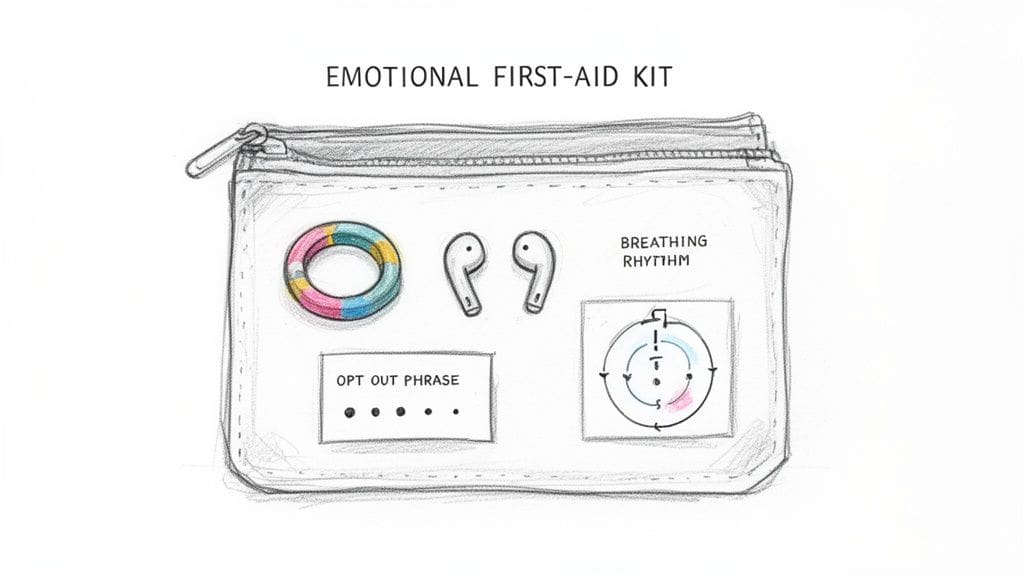
When that wave of sensory overload hits and the world starts to feel fuzzy and disconnected, having a plan is your best defense. Think of these in-the-moment strategies as your emotional first-aid kit, designed to help you get your feet back on the ground when you start to feel overwhelmed.
These aren't just generic wellness tips. They are practical, often discreet, actions you can take to anchor yourself, especially when you're feeling overwhelmed in a public space.
The goal is to gently guide your nervous system from a state of high alert back to a place of relative calm. This process, often called grounding, is all about reconnecting with your body and the present moment, which can feel incredibly far away when your brain is overloaded.
Discreet Sensory Tools for Immediate Relief
When your brain is trying to process way too much information at once, giving it a single, predictable sensory input to focus on can be incredibly calming. It's like telling a frantic air traffic controller to ignore all the incoming planes and just focus on landing one.
- Fidget Ring or Spinner: A simple, silent fidget lets you channel all that anxious energy into a quiet, repetitive motion. The physical sensation can pull your focus back from a chaotic environment.
- Worry Stone: A smooth, pocket-sized stone gives you a specific texture to focus on. Rubbing it between your thumb and fingers creates a simple, tactile anchor to the real world.
- Scented Balm: A tiny tin of lavender or peppermint balm on your wrists offers a discreet olfactory anchor. A quick, subtle sniff can cut through the sensory noise of a crowded room.
These tools work because they interrupt the overload cycle with a controlled, predictable sensation. You're giving your brain a simple, safe task to do, which helps it down-regulate.
Breathing and Body-Scan Techniques
Your breath is one of the most powerful and immediate tools you have for managing your nervous system. When you feel overwhelmed, your breathing often gets shallow and fast, which just signals more panic to your brain. Intentionally slowing it down can reverse that signal.
A simple and powerful method is box breathing.
1. Inhale: Breathe in slowly through your nose for a count of four.
2. Hold: Gently hold your breath for a count of four.
3. Exhale: Breathe out slowly through your mouth for a count of four.
4. Hold: Hold your breath again for a count of four.
Repeat this cycle three to five times. The rhythm helps regulate your heart rate and brings a sense of order to the internal chaos. For a deeper dive, you can explore other grounding techniques for anxiety in our complete guide.
> Grounding isn't about ignoring the feeling that something is off. It's about acknowledging it while giving your body a safe harbor, a moment to reset so you can think clearly again.
Pre-Planned Exit Phrases for Self-Advocacy
Sometimes, the best strategy is a strategic retreat. Having a few "opt-out" phrases ready to go means you don't have to invent an excuse while you're already struggling to hold it together. It's an essential tool for setting boundaries.
Examples of Graceful Exit Phrases:
- "Excuse me, I need to step away for a moment. I'll be right back."
- "It was great chatting, but I need to go get some air."
- "My social battery is running low. I'm going to find a quiet spot for a bit."
These phrases are polite, firm, and don't require you to over-explain anything. Mastering them is a key step to not only acknowledging that "off" feeling but to act on that knowledge to protect your well-being.
Using Technology to Navigate Difficult Conversations
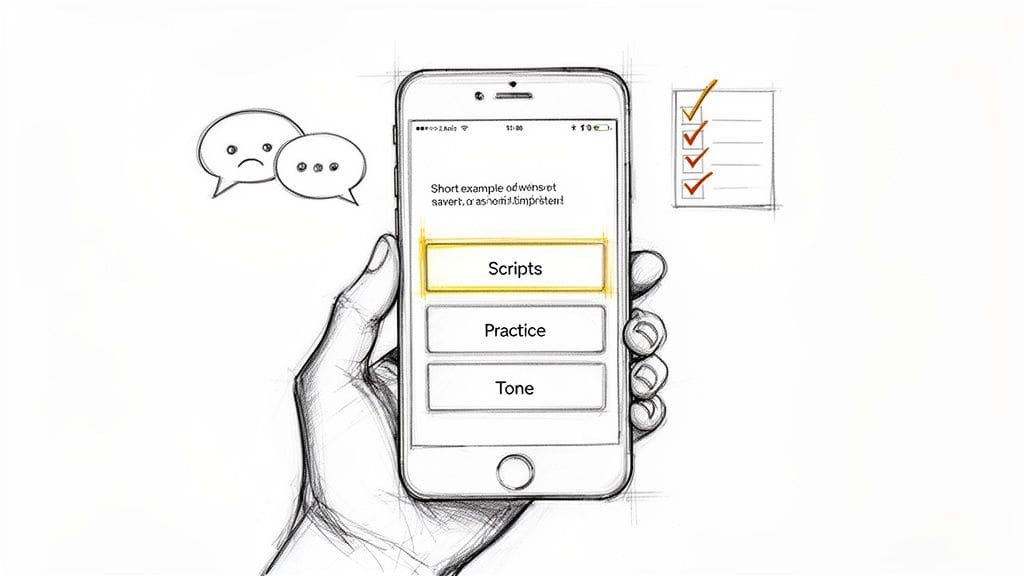
Once you start to get a better handle on your triggers, the next logical step is finding tools that can close the gap between how you feel inside and what the world expects on the outside. When designed with neurodivergent needs in mind, technology can offer a structured, low-pressure way to build communication confidence. Apps like tonen provide a digital toolkit that directly addresses the pain points of social interaction, acting as a supportive guide rather than another source of overwhelm.
These tools turn the abstract stress of a conversation into a concrete, manageable process. Instead of facing a difficult chat armed with nothing but anxious thoughts, you can use technology to prepare, practice, and show up with a safety net. This demystifies unwritten social rules and lowers the stakes, making it easier to engage authentically without the constant fear of saying the wrong thing.
Addressing Core Communication Challenges with Specific Tools
That feeling that things are "off" often comes from a few core anxieties: misreading social cues, fearing you'll be judged harshly, or struggling to match the emotional tone everyone else seems to understand instinctively. Thankfully, modern tools are now being built to tackle these issues head-on.
For instance, the anxiety of not knowing what to say is a huge hurdle. A Scripts Library can be a lifesaver here, offering clear, pre-written prompts for hundreds of scenarios—from asking for a deadline extension to setting a boundary with a family member. This removes the heavy cognitive load of trying to find the right words from scratch when you're already stressed.
Similarly, the fear of accidentally saying something hurtful or inappropriate can be paralyzing. For rehearsal, choose a script, adapt the words and read them aloud yourself if that is useful. You can also practise with someone you trust.
> Technology can act as a bridge, translating unspoken social rules into a clear, accessible format. It doesn't replace human connection; it provides the scaffolding needed to build it with less stress and more confidence.
A Real-World Scenario: Preparing for a Tough Conversation
Let's walk through a common, high-stakes situation: you need to talk to your manager about feeling overwhelmed at work. The very thought of this can be daunting, setting off a cascade of "what ifs." Here is how a tool like tonen can help you get ready.
Step 1: Prepare Your Opening
You open the app and find the "Work" category in the Scripts Library. You select a script for "Discussing Workload" and see a few options. One says, "I'd like to talk about my current workload. I'm feeling stretched and want to make sure I'm prioritizing the most important tasks. Is now a good time?" That feels right—it's direct but not confrontational.
Step 2: Choose Your Tone
The script offers several tone choices: Direct, Warm, or Softer. You know your manager appreciates clarity, so you select the Direct tone. This small choice gives you a sense of control over how you'll come across, which is huge when you're trying to understand why things feel off in professional settings.
Step 3: Anticipate Their Perspective
Next, you use the Perspective Helper. You type in your fear: "I'm worried my manager will think I'm complaining or not capable." The tool might suggest alternative interpretations, like, "Your manager may see this as a sign of proactive communication and a desire to produce high-quality work." This reframing helps calm the anxiety of being misunderstood.
Step 4: Practice and De-Stress
For rehearsal, choose a script, adapt the words and read them aloud yourself if that is useful. You can also practise with someone you trust. By the time the meeting happens, the words feel familiar. You've gone from a state of vague dread to having a concrete plan, which dramatically reduces that "off" feeling.
Matching tonen Features to Common Social Challenges
To make it even clearer, here's a quick breakdown of how specific features in an app like tonen can directly address the common challenges we've been discussing. This table shows the link between the problem and a practical, tech-based solution.
| The Challenge | How tonen's Feature Helps |
|---|---|
| Not knowing what to say in a specific situation. | The Scripts Library offers hundreds of pre-written, context-specific prompts to remove the guesswork. |
| Worrying about sounding rude, aggressive, or awkward. | Selectable Tone Options (Direct, Warm, Softer) let you fine-tune the script to match the situation and your intent. |
| Fearing negative judgment or being misunderstood. | The Perspective Helper reframes your anxieties by suggesting alternative, more positive ways others might see you. |
| Feeling anxious or overwhelmed during the conversation. | The built-in Calm Kit provides grounding exercises and breathing techniques you can use in the moment. |
| The fear of fumbling over words during a live interaction. | Read prepared wording aloud yourself provides a safe, private space to rehearse out loud, building muscle memory and confidence. |
As you can see, each tool is designed to target a specific point of friction, turning an overwhelming social task into a series of manageable steps.
If you're interested in other tools that can help, you might find value in our list of the best social anxiety apps for 2026.
Building a Supportive Environment for Yourself
Dealing with that "something's off" feeling isn't just about having coping skills for when things get intense. It's about intentionally building a life that has fewer of those moments in the first place. Think of it as creating a supportive ecosystem for yourself—a long-term strategy for feeling more regulated and understood.
This all starts with learning how to advocate for your own needs and then surrounding yourself with people who actually respect them.
Self-advocacy is the bedrock here. It means learning to clearly communicate what you need to friends, family, and even colleagues. I know, that can feel incredibly daunting. But when you have a better grasp on your triggers, explaining your needs stops feeling like a confrontation. It becomes more about sharing vital information to help people connect with you better.
How to Communicate Your Needs Clearly
Getting your needs across doesn't require a big, dramatic announcement. It's usually just a series of small, clear statements that give people a window into your experience. The trick is to be direct without being accusatory.
For instance, instead of saying, "You're being too loud," which can put someone on the defensive, you could try framing it from your perspective: "I'm really sensitive to noise right now and I'm having trouble focusing. Could we maybe move to a quieter spot?" This approach explains the why behind your request, which makes all the difference.
- Explain sensory needs: "I find these bright, fluorescent lights super draining. Would you mind if we sat by the window instead?"
- Clarify communication preferences: "Just so you know, sometimes I process things a bit slower. Could you give me a moment to think before I respond?"
- Set social boundaries: "I love spending time with you, but my social battery usually taps out after an hour or so. Can we plan for a shorter visit?"
Having some pre-planned scripts, like the ones in the tonen app, can be a great starting point. They give you the words when your brain just can't find them on its own.
Finding Your People and Why It Matters
Honestly, one of the most powerful ways to feel less "off" is to connect with people who just get it. Finding a community of other neurodivergent folks, whether it's online or in person, is incredibly validating and helps dial down that sense of isolation.
> Community offers a space where you don't have to constantly translate your experiences. It's a place of shared understanding where you can let your guard down, share strategies, and feel seen for who you are.
That shared experience is so important. It confirms that your feelings are valid and that you aren't the only one trying to figure all this out. Learning how to create a community that thrives is a foundational skill for building a personal support network that truly lasts.
Ultimately, building this kind of supportive environment isn't just a nice idea—it's a concrete plan for living a more comfortable and authentic life.
Still Have Questions? Let's Clear Things Up
It's completely normal to have a few lingering questions. The journey to understanding why you feel 'off' is a personal one, filled with its own unique challenges and lightbulb moments. Let's tackle some of the most common things people ask.
How Can I Tell If It's Social Anxiety or This Off Feeling?
This is a big one, because they can feel so similar on the surface. The simplest way I've found to tell them apart is to look for the trigger.
That 'off' feeling is usually an immediate, in-the-moment reaction to something specific—like the sensory assault of a loud, crowded room or the gut-punch of realizing you've misread a social cue. Social anxiety, on the other hand, is often more of a constant hum in the background. It can show up even when there isn't an obvious, immediate reason.
Try tracking when the feeling hits. If you can consistently trace it back to a specific pattern or event, you're likely dealing with the kind of 'off' feeling we've been talking about.
What If My Grounding Techniques Don't Work?
First off, that's not a failure. If your go-to grounding techniques aren't cutting through the noise, it's a sign that the priority needs to shift from managing the situation to changing your environment.
Don't try to power through the discomfort. That's a surefire path to burnout. Instead, use a pre-planned exit phrase like, "Excuse me, I need to step out for a moment." Moving to a quieter space—even a hallway or restroom—gives your nervous system the breathing room it needs to reset and regulate, away from whatever was so overwhelming.
> Recognizing your limits and honoring them by removing yourself from an overwhelming situation is not a failure; it is an act of powerful self-advocacy and a key part of learning how to manage this experience long-term.
Do Only Neurodivergent People Experience This Feeling?
Not exclusively, no. Plenty of people, especially introverts or anyone under high stress, can feel a sense of social disconnect or overwhelm from time to time.
The difference is often in the frequency and intensity. For neurodivergent individuals, this experience is often a more regular and powerful part of life. This is because of fundamental differences in how our brains process sensory input and social information. It's not a flaw, just a different operating system.
And that's precisely why strategies tailored to these specific neurological differences are so incredibly helpful. It's about working with your brain, not against it.
*
tonen is available on iOS with 21 free scripts, Box Breathing and 5-4-3-2-1 Grounding, plus one free request each in Reply Helper, Perspective Helper and Debrief. Optional Premium adds the full script library, Phone Call Mode, Body Scan and Safe Place, and 50 requests per week shared across the three helpers. Check the App Store purchase screen for your local price and any eligible trial.