Autism is a neurodevelopmental difference that shapes how a person communicates, interacts with the world, and processes sensory information. It's not a disease, but a core part of an individual's identity, representing a different way the brain is wired. Forget outdated jargon; understanding autism is about recognizing a natural variation in the human experience. This guide provides practical insights and strategies for adults and families navigating this journey, offering clarity on what it means to be autistic in today's world.
What Is Autism and Why Is It More Visible Today
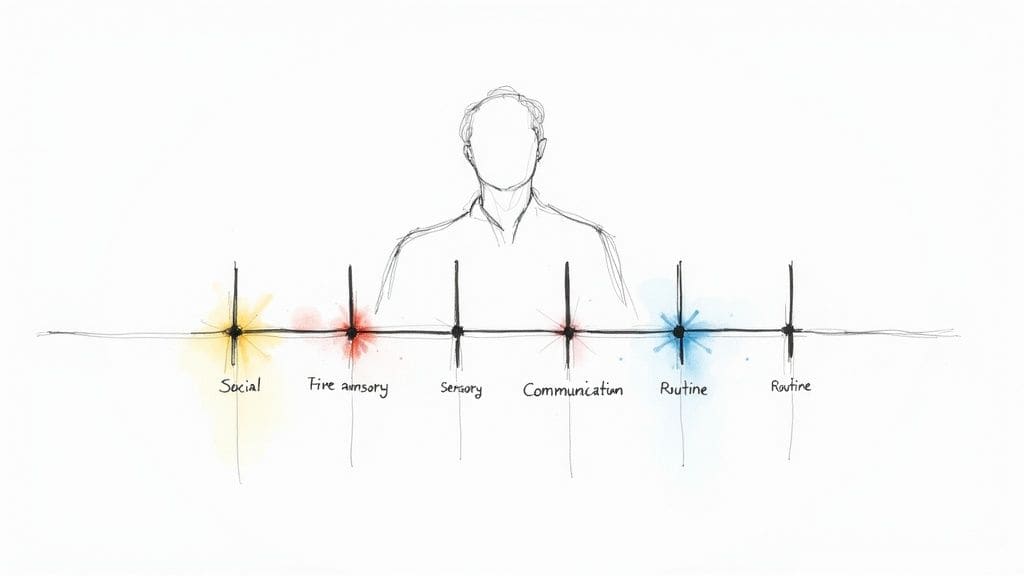
This wiring difference touches everything, from how an autistic person experiences a conversation to the feeling of a shirt tag on their skin. It's an integral part of their identity.
A great way to picture the autism spectrum is to think of a sound mixing board. Every person has a board with different sliders—social skills, sensory sensitivity, pattern recognition, communication. For an autistic person, those sliders are often set at more extreme levels, creating a profile that's completely unique to them.
One person might have the slider for auditory sensitivity turned way up, while their slider for social communication challenges is set lower. Another person might have the exact opposite profile.
The Spectrum Is Not a Line
One of the biggest myths is that the spectrum is a straight line from "mild" to "severe." This is a massive oversimplification that just doesn't capture the reality of the autistic experience. It's far more complex than that.
An autistic person might be a world-class expert in their field of interest but find a trip to the grocery store completely overwhelming due to the noise and lights. The linear model just doesn't make sense of that.
This is where the "mixing board" analogy really helps:
* Everyone is different: No two autistic people have the same settings. This explains the incredible diversity you see within the community.
* It's about strengths and challenges: A high setting isn't always a negative. It can be a huge strength, like an intense focus or a brilliant memory, just as it can be a challenge, like sensory overload.
* Context matters: How these traits show up can change depending on the environment, stress levels, and the support someone has.
Our understanding of autism has changed dramatically over the years. We've moved away from a lot of harmful myths toward a more affirming and accurate view.
Key Shifts in Understanding Autism
| Outdated Misconception | Modern Understanding |
|---|---|
| Autism is a childhood disorder that people "grow out of." | Autism is a lifelong neurotype. Autistic adults exist and have always existed, though many were previously undiagnosed. |
| It's a linear spectrum from "high-functioning" to "low-functioning." | It's a multi-faceted spectrum of strengths and challenges. Functioning labels are harmful and inaccurate. |
| Autism is caused by bad parenting or vaccines. | Autism is primarily genetic, with environmental factors also playing a role. The vaccine link has been thoroughly debunked. |
| Autistic people lack empathy. | Autistic people often experience empathy very intensely, but may express it differently. This is known as the "double empathy problem." |
This shift in understanding is crucial. It's about moving from a deficit-based model to one that recognizes autism as a natural and valid part of human diversity.
> At its core, autism is a difference in the brain's wiring. This affects how information is processed, leading to distinct ways of thinking, learning, and perceiving the world. It is a key aspect of neurodiversity, the natural variation in human brains. You can learn more about how different minds work in our detailed article on what it means to be neurodivergent.
Demystifying the Rise in Diagnoses
You've probably seen headlines about the rising number of autism diagnoses, which can sound alarming if you don't have the full picture.
The numbers are striking. In 2000, autism affected about 1 in 150 eight-year-olds. By 2022, that number had jumped to 1 in 31 children across surveillance sites monitored by the CDC. But this isn't an epidemic. Experts agree this dramatic increase is due to better awareness, broader and more accurate diagnostic criteria, and improved screening.
This is actually good news. It means more people are finally getting the understanding and support they need, often much earlier in life.
For decades, huge numbers of people—especially girls, women, and adults in general—were either missed entirely or misdiagnosed. The increased visibility we see today helps tear down stigma and pushes society to be more inclusive of different ways of being. It also drives the creation of supportive tools like the tonen app, which helps those with autism communicate more easily by scripting conversations and understanding different perspectives on things happening around them.
Recognizing Signs of Autism Across the Lifespan
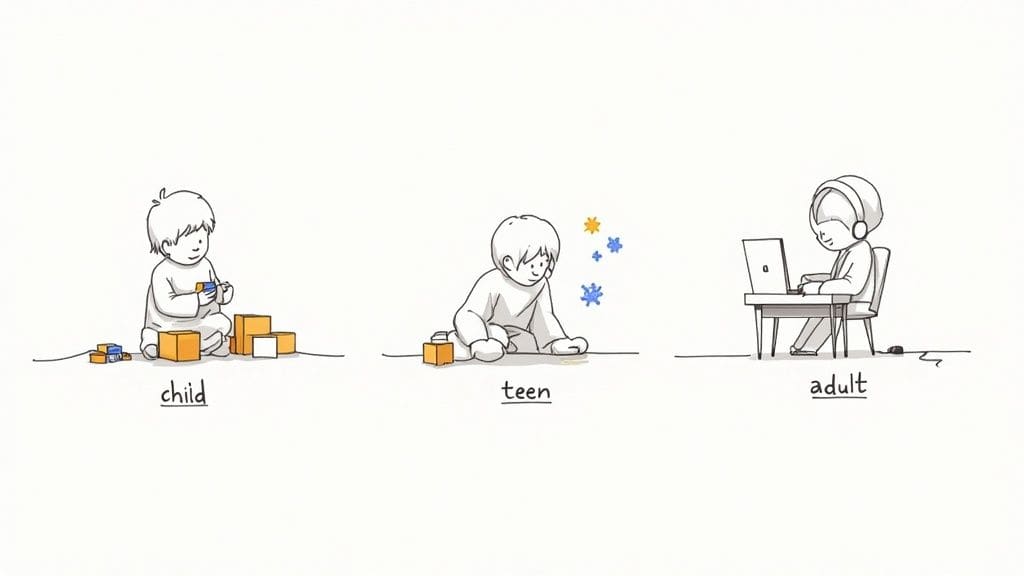
Autism isn't a static checklist of traits; it's a neurotype that evolves with a person. The way it shows up in a young child can look dramatically different in an adult who has spent years learning to navigate a world not built for them.
In early childhood, the signs often revolve around social communication and behavioral patterns. A toddler might develop an incredibly deep knowledge of a specific topic but find the casual back-and-forth of conversation confusing. Routines aren't just comforting; they can feel essential—like arranging toys in a perfect line or needing the day to unfold in the exact same sequence.
Sensory sensitivities are also a huge piece of the puzzle. Things that others might not even notice, like the hum of a refrigerator, the texture of a certain food, or the scratchy seam on a sock, can be intensely distressing. These aren't just preferences; they are deeply felt physical and emotional responses.
The Adolescent and Adult Experience
As autistic people grow up, the social world gets exponentially more complicated. The signs of autism often shift from observable behaviors to internal experiences and sophisticated coping strategies. This is where you'll hear terms like masking and burnout, which are central to the lived experience of so many autistic adults.
Social masking, also known as camouflaging, is the often-unconscious effort to hide autistic traits to blend in. It takes an immense amount of energy to constantly perform "expected" social behaviors.
* Forcing eye contact when it feels invasive or painful.
* Mimicking the facial expressions and gestures of others to appear "natural."
* Mentally scripting conversations before speaking.
* Suppressing self-regulating behaviors (stims) like rocking or hand-flapping.
While masking can feel like a necessary survival tool, it comes at a huge cost. It often leads to exhaustion, anxiety, and a painful feeling of being disconnected from your authentic self. You can take a closer look at this in our guide on what masking in autism is and its heavy impact.
> The constant pressure to perform neurotypical social norms can lead to autistic burnout—an intense state of physical, mental, and emotional exhaustion. It's not just feeling tired; it's a complete depletion of resources that can impair skills and make daily functioning incredibly difficult.
This kind of burnout is often the result of navigating the unspoken social rules at work or trying to manage the sensory chaos of a social gathering. The cognitive load is enormous, and eventually, the battery just runs out.
Gender and Its Impact on Diagnosis
For a long time, our understanding of autism was based almost entirely on research that focused on boys. This created a massive blind spot, leading to countless girls and women being missed or diagnosed incredibly late in life.
The numbers tell a stark story. In the US, boys are diagnosed with autism 3.4 times more often than girls. This isn't because fewer girls are autistic; it's because their traits often don't fit the outdated stereotype. Their deep interests might be in socially "acceptable" topics like literature or animals, and their social differences are frequently mislabeled as shyness or anxiety. You can learn more about the research on gender disparity in autism diagnosis.
Because of this, many women spend decades feeling like there's something wrong with them, never getting the language or understanding for why they feel so different. Recognizing these more subtle presentations is a critical step toward ensuring everyone gets the support they deserve.
Navigating Diagnosis and Self-Identification
When it comes to understanding yourself through the lens of autism, there are really two main avenues people travel: the path of formal diagnosis and the equally valid journey of self-identification. Neither is better than the other; they just serve different needs.
For some adults, getting a formal diagnosis feels like finally getting the answer to a question they've been asking their whole lives. It provides a solid framework for understanding past experiences and a sense of validation that can be incredibly powerful.
This process usually means working with a clinical psychologist or neuropsychologist who really knows adult autism. It's not a quick quiz or a single test. Instead, it's a deep dive into your developmental history, your unique communication style, and your patterns of thinking, often involving in-depth interviews, questionnaires, and observational sessions.
Looking for autism support and resources? tonen can help.
tonen gives you 188+ conversation scripts, tone guidance and calming tools — designed for autistic adults, ADHD and social anxiety. Try it free for 7 days.
Download on the App StoreiOS only. Android coming soon.
A formal diagnosis can also unlock some very practical things, like legal protections against discrimination or getting official accommodations at work. It can open doors to specific therapies and support services, and sometimes, it's the official piece of paper that helps family and friends finally get it. For many, it's the permission slip they needed to stop masking and just be themselves.
The Path of Self-Identification
Alongside the clinical route, self-identification has become a deeply respected and empowering journey within the autistic community. People choose this path for a lot of very good reasons.
The cost of an adult assessment can be a huge barrier, often running into the thousands and rarely covered by insurance. On top of that, the waiting lists can be brutally long, and it can be incredibly difficult to find a professional who specializes in diagnosing adults—especially women and people of color, who have historically been overlooked.
Many adults have also been misdiagnosed for years with things like anxiety, depression, or ADHD, and they've understandably lost faith in a system that failed to see them for who they are.
Self-identification is a journey of careful research, deep self-reflection, and connecting with the lived experiences of other autistic people online and in communities. The goal is exactly the same: self-acceptance and finding your people. This path is just as legitimate as a formal diagnosis. If you're curious about the language people use, you can explore the nuances in our post about the terms autistic versus with autism.
> "Self-diagnosis is often a deeply researched and considered process. For many autistic adults, it's the culmination of a lifetime of questioning and searching for answers that finally click into place when they discover the autistic community."
Resources for Your Journey
No matter which path you're on, connecting with resources led by the autistic community is a game-changer. Organizations run by and for autistic people offer insights that are grounded in real, lived experience—a perspective that clinical definitions alone can never fully capture.
A great example is the Autistic Self Advocacy Network (ASAN). They provide fantastic resources, advocate for policy changes, and foster community support, all from an affirming, rights-based point of view.
This screenshot highlights ASAN's focus on policy, self-advocacy, and creating accessible resources, showing their commitment to empowering autistic individuals.
Ultimately, whether you arrive at this understanding through a formal diagnosis or your own dedicated self-discovery, the real prize is gaining the language and framework to support your own well-being. The journey is about finding your place, not just getting a label.
Practical Strategies For Communication And Social Clarity

For many autistic people, navigating a social conversation can feel like trying to solve a complex puzzle with half the pieces missing. The constant mental effort of decoding unspoken rules, guessing what someone really means, and managing sensory input is flat-out exhausting.
But you don't have to just white-knuckle your way through it. There are practical, concrete strategies that can help bridge those gaps, leading to clearer, less stressful, and more confident interactions.
One of the most effective ways to lower social anxiety is to prepare ahead of time. You wouldn't walk into a final exam without studying, so why walk into a high-stakes social situation without a plan? Scripting and rehearsing conversations can transform a dreaded event into something you can actually manage. This is where technology can be a massive help.
Using Technology To Prepare For Social Situations
Apps designed with neurodivergent minds as the focus can be a complete game-changer. They provide a private, judgment-free space to practice conversations, explore different ways a situation might play out, and build a library of phrases that feel genuinely you.
The tonen app, for example, was built specifically to help those with autism communicate more easily. It allows users to script and rehearse for real-world scenarios. Whether you're prepping for a job interview, a tricky conversation with a family member, or even just a casual party, having a plan makes all the difference.
> For many autistic individuals, the biggest challenge isn't a lack of desire to connect, but the overwhelming cognitive load of "live" social processing. Tools that allow for preparation and practice effectively lower that load, freeing up mental energy for genuine connection.
Exploring different perspectives is another key part of this. The app can suggest alternative ways to interpret a situation or understand what's happening around you, helping to demystify social nuances that might otherwise feel confusing. This kind of guided practice builds a stronger intuitive sense of social dynamics over time. For more ideas on supporting emotional understanding, this gentle guide to emotions for neurodivergent children and SEN learners has some surprisingly useful principles for all ages.
In-The-Moment Support Techniques
While tech is great for prep work, you also need strategies for managing challenges as they happen. A couple of the most effective techniques are grounding exercises and energy budgeting. The autistic experience often involves heightened sensory sensitivity, which can easily lead to overwhelm during social interactions.
Grounding exercises are simple, quick actions that pull your focus back to the present moment and your own body, which helps calm a spiraling nervous system.
* 5-4-3-2-1 Method: Silently name five things you can see, four things you can feel (like your feet on the floor), three things you can hear, two things you can smell, and one thing you can taste.
* Tactile Grounding: Carry a small object with a distinct texture—a smooth stone, a piece of soft fabric, a fidget toy. Focusing on how it feels in your hand can be a quiet anchor in a chaotic room.
* Mindful Breathing: Slowly inhale for four counts, hold for four, and exhale for six. This simple pattern can physically regulate your heart rate and dial down feelings of panic.
Here's a quick look at some of these tools and when they might come in handy.
Communication Support Strategies
This table summarizes some of the effective tools and techniques we've discussed for clearer and less stressful communication.
| Strategy | Description | Best For |
|---|---|---|
| Conversation Scripting | Preparing and rehearsing potential conversations in advance to reduce in-the-moment cognitive load. | High-stakes interactions like job interviews, difficult conversations, or formal meetings. |
| Grounding Techniques | Using sensory-based exercises (like the 5-4-3-2-1 method) to calm the nervous system during overwhelm. | Crowded or overstimulating environments when you feel anxiety or panic setting in. |
| Energy Budgeting | Consciously planning social activities and recovery time to avoid burnout. | Managing a busy week with multiple social demands to prevent exhaustion. |
By combining these strategies, you can build a robust system that supports you before, during, and after social events.
Managing Your Social Energy Budget
Finally, learning to see your social capacity as an "energy budget" is crucial. Social interactions cost energy, and for many autistic people, that battery drains much faster. Pushing past your limit is a one-way ticket to social burnout, making future interactions feel even more daunting.
Think of your daily energy as a finite resource. An energy budget involves consciously deciding which interactions are worth the cost and—just as importantly—planning for recovery time afterward.
* Prioritize: Decide which social events are truly important to you and which ones you can skip without guilt. It's okay to say no.
* Set Time Limits: It's perfectly fine to attend a party for just one hour. Give yourself a clear exit plan before you even arrive.
* Schedule Recovery: After a demanding social event, block out time for low-demand activities that recharge you. This could be reading, spending time in nature, or deep-diving into a special interest.
By combining preparatory tools like tonen with in-the-moment grounding techniques and mindful energy management, you can approach social situations with far greater clarity and much less stress. For a deeper dive, check out our other article on effective autism communication strategies.
Creating Sensory-Friendly and Supportive Environments
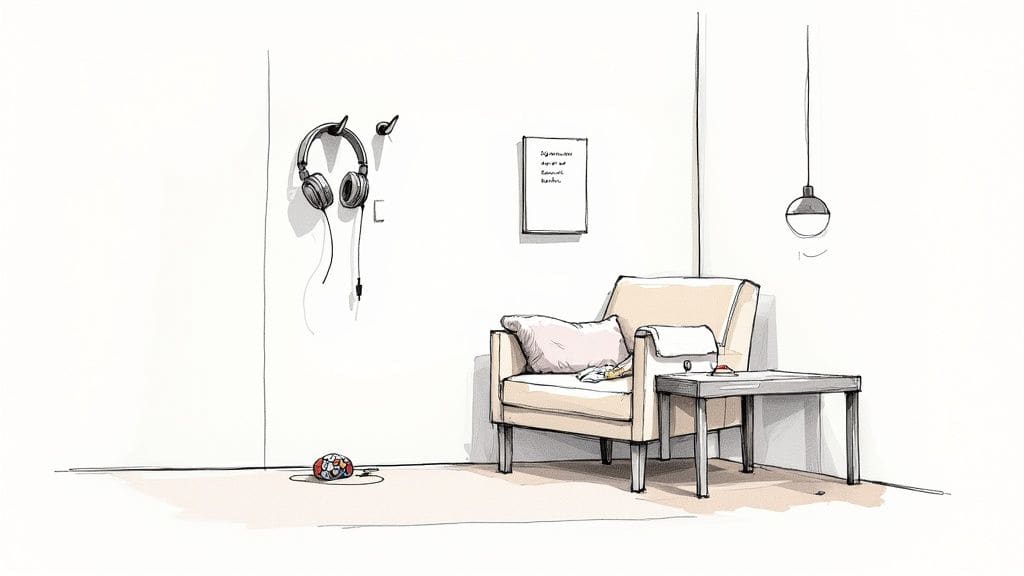
Instead of asking autistic people to change who they are, a much more effective and compassionate approach is to adapt the world around them. Creating environments that support the sensory and processing needs inherent to autism isn't about special treatment; it's about thoughtful design that lowers barriers and allows everyone to actually participate.
The goal is simple: reduce the constant stress of navigating a world that often feels too loud, too bright, and too unpredictable. This shifts the focus from fixing the individual to modifying the environment, recognizing that overwhelm is often a direct result of a mismatch between a person's neurotype and their surroundings.
Managing Sensory Sensitivities
For many on the autism spectrum, sensory input isn't just noticeable—it can be intensely amplified. What feels like simple background noise to a neurotypical person can register as a piercing siren to someone with auditory sensitivities. The key is to provide tools and make adjustments that give individuals more control over their own sensory world.
Think of it as giving someone a personal volume knob and dimmer switch for life. Even small changes can make a massive difference.
* Sound: Noise-canceling headphones or discreet earplugs are absolute game-changers for navigating loud public spaces like grocery stores or open-plan offices. At home, simple fixes like adding rugs to dampen echoes or installing soft-close cabinet doors can eliminate sharp, jarring noises.
* Light: Harsh, buzzing fluorescent lighting is a notoriously common trigger. Swapping these out for warmer LED bulbs or installing dimmer switches can instantly make a room feel calmer and more comfortable. Offering a desk away from a bright, glaring window can also prevent visual overstimulation.
* Touch: For some, the feel of certain fabrics can be genuinely painful or irritating. Choosing soft, seamless clothing and cutting out all the tags can remove a huge source of constant, low-level agitation. Weighted blankets can also provide a deeply calming, grounding sensation through deep pressure.
* Focus: Fidget tools are not toys; they are essential self-regulation instruments. Providing access to things like stress balls, spinners, or tactile putty can help channel restless energy and dramatically improve focus during meetings or classes.
> By proactively addressing sensory needs, we create spaces where autistic individuals can conserve their precious mental and emotional energy for the important stuff—like learning, working, and connecting with others.
Accommodating Processing Differences
Beyond the five senses, many autistic people process information differently. Verbal instructions can feel fleeting and difficult to hold onto, especially when there are other distractions in the environment. Abstract ideas or vague, multi-step directions can also be incredibly hard to follow without a clear, concrete structure.
The solution is to adapt how information is delivered. It's all about making communication as clear, predictable, and unambiguous as possible.
* Provide Written Instructions: Always supplement verbal directions with a written list or a follow-up email. This simple step allows the person to refer back to the information as needed, reducing the cognitive load of trying to remember every single detail.
* Allow Processing Time: This one is crucial. It's vital to build pauses into conversations. An autistic person may need extra time to process what was just said and formulate a thoughtful response. Rushing them or filling the silence can spike anxiety and shut down communication entirely.
* Break Down Large Tasks: A big project with a fuzzy endpoint can feel impossibly overwhelming. Breaking it down into small, sequential, and concrete steps with clear deadlines transforms a mountain of anxiety into a manageable roadmap for success.
These strategies aren't complicated, but they are transformative. They create a predictable and supportive framework that reduces the anxiety born from uncertainty and cognitive overload. When the environment is adapted to support different ways of thinking, success becomes far more accessible for everyone.
Building a Strong and Affirming Support System
Going it alone in a world not always built for autistic minds can be exhausting. While individual coping strategies are helpful, they don't solve everything. The real game-changer is having a strong, affirming community in your corner.
Many autistic people run into significant hurdles with things like employment, healthcare, and just feeling included. These aren't personal failures; they're systemic barriers. A solid support network is what helps you navigate—or push back against—those barriers more effectively.
Let's be real about the scope of the challenge. For many autistic adults and their families, finding stability is a constant struggle. In the US, for example, roughly 75% of adults with an autism diagnosis are underemployed or unemployed. Access to good healthcare can be spotty at best. Discover more insights about these challenges and their impact on the community. These numbers aren't just statistics; they're a clear signal that we need systems that see and build on autistic strengths, not just our challenges.
Assembling Your Support Network
Building a support system isn't about collecting contacts; it's about intentionally finding people, resources, and groups that actually get it. This network acts as a buffer against the constant misunderstandings and offers real, practical help. The goal is to connect with others who can offer emotional validation, share useful resources, and point you toward professionals who are genuinely neurodivergent-affirming.
Your network might have a few key players:
* Peer Support Groups: This is often the most powerful piece of the puzzle. Connecting with other autistic adults means finding a space where you don't have to mask or constantly explain yourself. It can radically reduce feelings of isolation.
* Advocacy Organizations: Groups led by and for autistic people are incredible resources. They provide information on your rights, accommodation strategies, and a community fighting for systemic change.
* Vocational Services: Look for employment services that specialize in working with neurodivergent job seekers. They know how to frame autistic strengths in a way that resonates with inclusive employers.
* Neurodiversity-Affirming Mental Healthcare: Finding a therapist who specializes in autism is critical. They can help you manage co-occurring conditions like anxiety and depression without trying to "fix" your autistic traits.
> A strong support system doesn't just help you survive; it empowers you to thrive. It's a community that sees your strengths, understands your challenges, and advocates for a more inclusive world alongside you.
Addressing Co-Occurring Mental Health Needs
The constant stress of navigating a world that isn't accommodating can really take a toll. It's incredibly common for autistic people to also experience anxiety and depression. A truly supportive network has to include access to mental healthcare that is affirming and understands the autistic experience from the inside out.
For those who are supporting an autistic person through mental health challenges, it's vital to have the right tools. You can find excellent tips and strategies for supporting someone with depression that can make a real difference.
Ultimately, building this reliable network is one of the most important steps you can take for long-term well-being. It's a cornerstone of getting the right kind of help for autism.
A Few Common Questions About Adult Autism
As you start to explore what being autistic means for you or someone you care about, a lot of questions tend to bubble up. Let's tackle a few of the most common ones we hear.
Is Autism a Mental Illness?
Simply put, no. Autism is not a mental illness. It's a neurodevelopmental difference, which is a way of saying the brain is wired differently, right from the start.
Many autistic people do experience mental health challenges like anxiety or depression. This is often a direct result of the immense stress that comes from trying to navigate a world not built for them. But autism itself is a fundamental part of who a person is, not a disorder that needs to be cured.
Can You Develop Autism Later in Life?
You can't develop autism as an adult—it's a neurotype you're born with. What's incredibly common, though, is for people to first realize they're autistic much later in life.
This often happens for a couple of reasons. Maybe public awareness has finally provided the language they were missing, or maybe the coping strategies they've used for years, like masking, have just become too exhausting to maintain.
> For so many adults, getting a late diagnosis or finally self-identifying feels like finding the missing instruction manual for their own brain. It's not about a new condition suddenly appearing; it's about finally understanding a part of yourself that has been there all along.
What Is the Best Way to Support an Autistic Adult?
The best support always starts with listening and believing their experience. Instead of making assumptions, ask what they need. This is the most respectful and effective thing you can do.
Support might look like being flexible with social plans, communicating with direct and honest language, or simply understanding their need for quiet downtime to recover from a socially or sensorily draining day.
For autistic people looking to build more confidence in social situations, the right tools can be a game-changer. An app like tonen, for instance, offers a private space to practice conversations and better understand social dynamics. It's a way to prepare without pressure, helping to lower the anxiety that so often comes with interacting.
Navigating social situations can be less stressful with the right tools. tonen offers a practical way to prepare for conversations, understand different perspectives, and communicate with more confidence. Discover how tonen can support your communication journey.
Frequently asked questions
This guide covers understanding autism with practical, neurodivergent-friendly strategies—clear steps, scripts where useful, and ways to reduce anxiety or overload rather than vague "be confident" advice.