To effectively respond to passive-aggressive behavior, you should calmly and directly address the inconsistency between the person's words and their actions, which places the responsibility back on them to be clear. For instance, if you receive a backhanded compliment, a simple response like, "I'm not sure how to take that. What did you mean?" forces them to clarify their intent. Learning how to respond to passive aggressive behavior is a vital skill for reducing stress and building healthier relationships, particularly for neurodivergent individuals who may find social subtext exhausting. This guide provides practical strategies and ready-to-use scripts to help you handle these situations with confidence.
Navigating Passive Aggressive Behavior in 2026
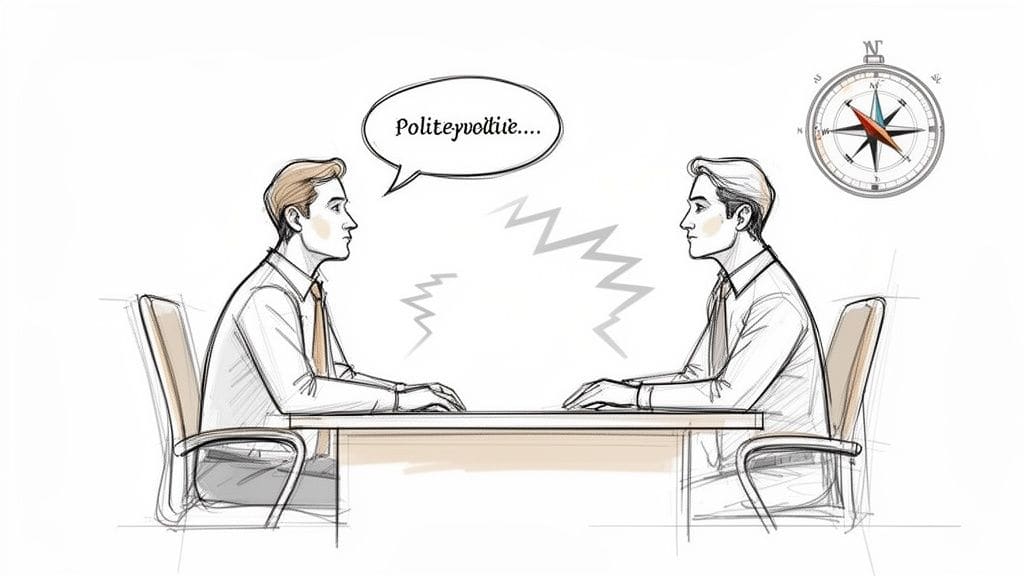
Passive aggression is that confusing space where someone's hostility comes out indirectly. There's a total mismatch between their words and their actions, and it can leave you feeling frustrated and questioning your own perceptions. Learning how to respond to passive aggressive behavior is a critical skill for cutting down stress and building healthier relationships, both on the job and at home.
This isn't just a small annoyance; it has a real, measurable impact. Research shows this kind of behavior creates genuinely toxic environments. A 2022 poll revealed that a staggering 69% of employed adults see passive aggression as a major issue at work, with nearly half saying it's gotten worse since 2020. The fallout is serious—it damages relationships, spikes stress levels, and tanks productivity for everyone. You can dig into the full findings on workplace dynamics and passive aggression for more details.
> This guide is designed to give you clear, actionable tools. Instead of feeling stuck or anxious, you'll learn to spot the signs, use proven scripts, and know when it's better to just walk away. Our goal is to help you handle these tricky situations with confidence.
Understanding the Core Challenge
At its heart, passive aggression is a communication breakdown. The person is often unwilling or just plain unable to express their negative feelings directly. So, instead of saying what's wrong, they use subtle actions to signal their unhappiness.
To help you decode what's happening, here's a quick breakdown of the most common tactics you'll encounter.
Quick Guide to Common Passive Aggressive Actions
| Behavior | Potential Hidden Meaning | Quick Response Idea |
|---|---|---|
| Backhanded Compliments | "I feel competitive with you or resent your success." | "Thanks. I'm proud of how it turned out." |
| The Silent Treatment | "I'm punishing you and want you to work to fix it." | "I can tell you're upset. I'm here to talk when you're ready." |
| Sarcasm / Mocking Tone | "I'm angry, but I'm hiding it behind 'just a joke'." | "I'm not sure I'm catching your meaning. Can you say that directly?" |
| Purposeful Procrastination | "I'm resentful about doing this task for you." | "Just checking on the deadline for [task]. Is there a problem?" |
| Vague, Negative Comments | "I want to express my unhappiness without being accountable." | "Can you be more specific about what you mean?" |
For neurodivergent folks, who often communicate best with direct and literal language, all this subtext is particularly hard to read. It can feel like trying to solve a puzzle with half the pieces missing, which just ramps up the anxiety of the whole situation.
By understanding these patterns, you can shift from reacting with confusion to responding with clarity. Mastering how to respond to passive aggressive behavior starts with decoding it first.
Decoding the Hidden Language of Passive Aggression
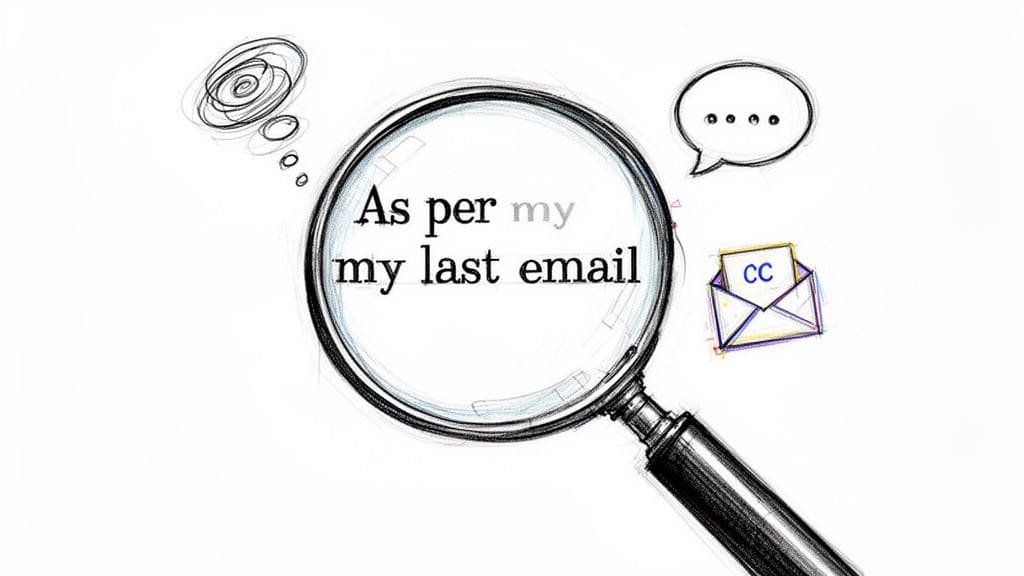
Spotting passive aggression is the first real hurdle, especially when social cues already feel like a second language you're trying to learn on the fly. You know the feeling—that jarring mismatch between what someone says and the tone, body language, or action that comes with it. This ambiguity is a huge source of anxiety for many of us, particularly if you thrive on clear, direct communication.
It's not just you. This stuff is rampant, especially in emails and texts. One recent study found that 83% of American employees have been on the receiving end of a passive-aggressive email. Phrases like "Per my last email" are so common that they've created hostile work environments, leading 23% of employees to actually quit their jobs over it. You can see a full breakdown of passive-aggressive workplace emails if you're curious.
This gap between the words and the real message is exactly what makes figuring out how to respond to passive aggressive behavior so tough. Learning to recognize the patterns is how you start to move from a place of confusion to one of clarity.
Common Tactics and What They Signal
To handle passive aggression, you first need a decoder for the most common moves people make. Think of it as learning the signals so you're not caught off guard by the underlying hostility.
* The Silent Treatment: This isn't just someone needing space. It's a calculated withdrawal of communication designed to punish you. The goal is often to make you feel guilty and scramble to "fix" a problem they haven't even told you about.
* Pointed Sighing or Exasperated Noises: These nonverbal jabs are meant to broadcast displeasure or annoyance without using a single word. They put the burden squarely on you to ask, "What's wrong?"
* Procrastination on Agreed Tasks: When someone repeatedly misses deadlines for things you've asked them to do, it can be a quiet way of showing resentment or silently protesting the task itself.
* Unnecessary CC'ing: Looping in a manager on a minor email chain is rarely about good record-keeping. It's a power move—a way to escalate pressure and say, "I'm watching you, and I'm making sure our boss is, too."
> The core of passive aggression is indirect hostility. Recognizing these behaviors for what they are—attempts to communicate negative feelings without taking responsibility—is the first step toward reclaiming your peace of mind.
Why It's So Confusing
The ambiguity of passive aggression is the whole point. It gives the person plausible deniability, allowing them to fall back on excuses like, "I was just joking!" or "You're being way too sensitive." This can make you seriously second-guess your own perception of reality.
To push back effectively, it helps to get better at spotting subtle communication, and a good guide to reading social cues can be an incredible resource for this.
The real challenge is learning not to get pulled into the drama. Instead of reacting emotionally, your goal is to have a measured response ready to go. You can also work to understand the hidden meaning in messages to better prepare yourself for these interactions. When you can recognize the game, you can choose not to play. That's what puts you back in control.
Your Script Library for Confident Communication
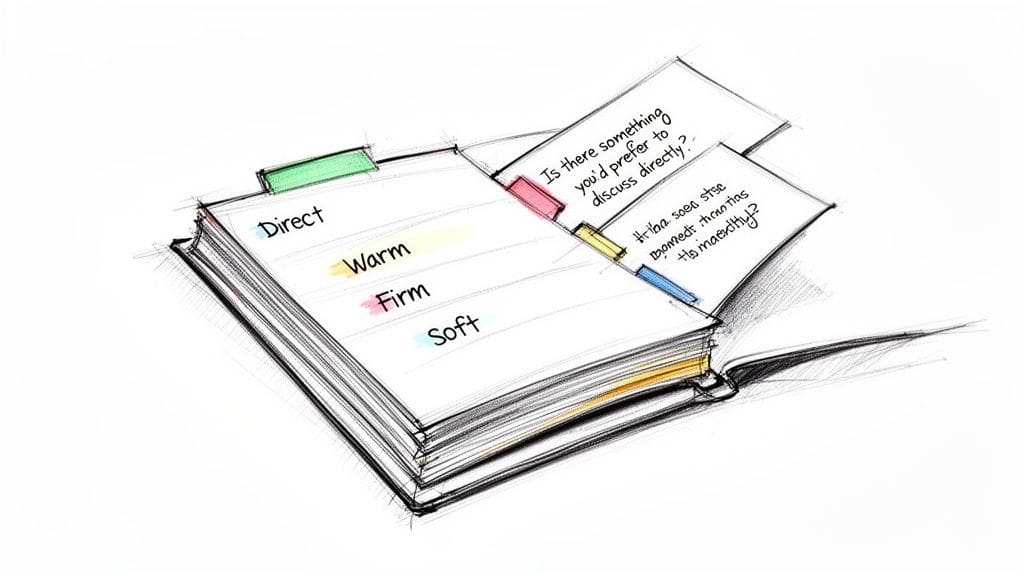
Knowing what to say when you feel put on the spot can be a total game-changer. It's the difference between feeling flustered and feeling prepared. This is your practical playbook—a collection of scripts you can keep in your back pocket to pull out whenever you need them.
Having these phrases ready massively reduces the in-the-moment anxiety of figuring out how to handle a tense interaction. We've organized these by common scenarios and included different tones, because how you say something to a coworker is probably different from how you'd say it to a family member.
Scripts For Backhanded Compliments
You know the kind—a "compliment" that's actually mixed with a subtle insult, leaving you feeling confused and a little bit stung. The best way to handle these is to calmly address the ambiguity.
* Direct: "I'm not sure how to take that. Could you clarify what you mean?"
* Warm: "Thank you. I'm really proud of how it turned out." (This is great because it only acknowledges the positive part and completely ignores the jab).
* Firmer: "That felt like it had a double meaning. I'd appreciate it if you could be more direct with me."
Dealing with confusing mixed messages from people? tonen can help.
tonen gives you 188+ conversation scripts, tone guidance and calming tools — designed for autistic adults, ADHD and social anxiety. Try it free for 7 days.
Download on the App StoreiOS only. Android coming soon.
> Key takeaway: The most powerful response to a backhanded compliment is one that calmly puts the responsibility back on the other person. It signals that you won't play along with veiled insults and forces them to be clear about what they actually mean.
Scripts For Sarcasm And Mocking
Sarcasm is so often just hostility disguised as a joke. When someone says, "I was just kidding," it's usually just a way to dodge accountability for what they really said. Your response should gently push past the "joke" to get at the underlying message.
* Direct: "I'm picking up on some sarcasm here. Is there something you want to discuss more openly?"
* Soft: "I want to make sure I'm understanding you correctly. Could you say that in a different way for me?"
* Firmer: "Jokes aside for a second, what are you actually trying to say?"
If you're looking for even more ways to handle tough comments, our article with scripts for setting boundaries has a ton of other phrases you can use to protect your peace.
Scripts For The Silent Treatment
The silent treatment is a classic manipulation tactic designed to punish you and make you feel responsible for the other person's emotions. It's absolutely crucial not to beg or plead for a response, as that just rewards the behavior. Instead, you state your availability clearly and then step back.
This matrix shows how you can adjust your response based on the situation and your relationship with the person.
Choosing Your Tone: A Script Matrix for Common Scenarios
| Tone | Example Script for 'The Silent Treatment' | When to Use It |
|---|---|---|
| Warm | "I can see you're upset. I'm here to talk whenever you're ready to share what's on your mind." | With a loved one where you want to show you care but refuse to enable the tactic. |
| Direct | "I've noticed you aren't responding to me. I'm happy to discuss what's going on when you're ready to talk." | For colleagues or friends where a clear, boundary-setting statement is what's needed. |
| Firmer | "This silence isn't productive. Let me know when you're prepared to have a constructive conversation." | When this has become a repeated pattern and you need to signal that the tactic won't work anymore. |
Having these different tones ready allows you to choose the right tool for the job, making your response feel both authentic and effective.
Opt-Out And Ask-For-Support Lines
Sometimes, the best move is no move at all. Having a planned exit strategy gives you the power to gracefully step away from a conversation that's going nowhere or to escalate it when necessary.
Here are a couple of lines you can use:
* Opt-Out Phrase: "I can tell this isn't a good time to talk. Let's hit pause on this conversation for now."
* Ask-for-Support Line (to a manager): "I'm having a little trouble getting the information I need from [Name] for our project. Could you help me clarify the next steps?"
Having these tools ready is an essential part of learning how to respond to passive aggressive behavior with confidence instead of anxiety.
How to Practice Your Responses and Reduce Anxiety
Having the right words is one thing. Feeling confident enough to actually use them in the moment is a completely different challenge. This is where preparation comes in—it's the work you do beforehand to lower the anxiety of a potential confrontation.
Practicing your responses is how you make these scripts feel like your own. It builds the muscle memory you need so you don't have to think so hard when you feel flustered or put on the spot. When you rehearse, you're less likely to freeze up, giving you a clear path to responding with intention.
Rehearsal: Building a Foundation of Confidence
Rehearsal is just a fancy word for practicing your scripts privately before you need them. The goal is simple: move the words from the screen into your long-term memory so they feel natural coming from you. Think of it like a musician running through scales. It's not the performance, but it makes the performance possible.
There are a few great ways to do this:
Say Them Aloud: Find a private space and just say your chosen scripts out loud. Really pay attention to your tone. Does a Direct script sound sharper than you want? Try it again with a Warmer tone until it sounds like you*.
* Type Them Out: This is incredibly helpful for passive aggression that happens over text or email. Typing out your responses gives you a feel for the phrasing and lets you tweak the words until they're perfect.
* Role-Play with a Friend: If you have a trusted friend who gets it, ask them to run through a scenario with you. This is the closest you can get to real-world practice and it's brilliant for showing you where you might get stuck.
> Pro-Tip: Don't just practice the words; practice the pause. Before you respond to a backhanded compliment or a sarcastic jab, take a quiet, deliberate breath. This tiny action can stop an emotional reaction in its tracks and give you the space to respond thoughtfully.
Cognitive Reframing: De-escalating Your Own Emotions
Another powerful tool for your toolkit is cognitive reframing. This is a mental technique where you consciously shift your perspective before you react. When you get that curt email or sarcastic comment, your brain might immediately jump to the worst-case scenario: "This is a personal attack. They're trying to undermine me."
Instead, just pause and ask yourself: Is there another possible explanation for this?
Maybe your colleague is completely swamped with their own deadlines and their brevity has nothing to do with you. Perhaps the person is just having a terrible day. This mental shift isn't about making excuses for their behavior. It's about de-escalating your own emotional response so you can act from a place of calm control, not defensiveness.
If you find yourself constantly battling the anxiety that comes with these interactions, it can be really helpful to explore more ways to practice difficult conversations to reduce anxiety. By combining solid rehearsal with cognitive reframing, you build a robust internal system for managing these tough moments.
Managing Overwhelm and Knowing When to Escalate
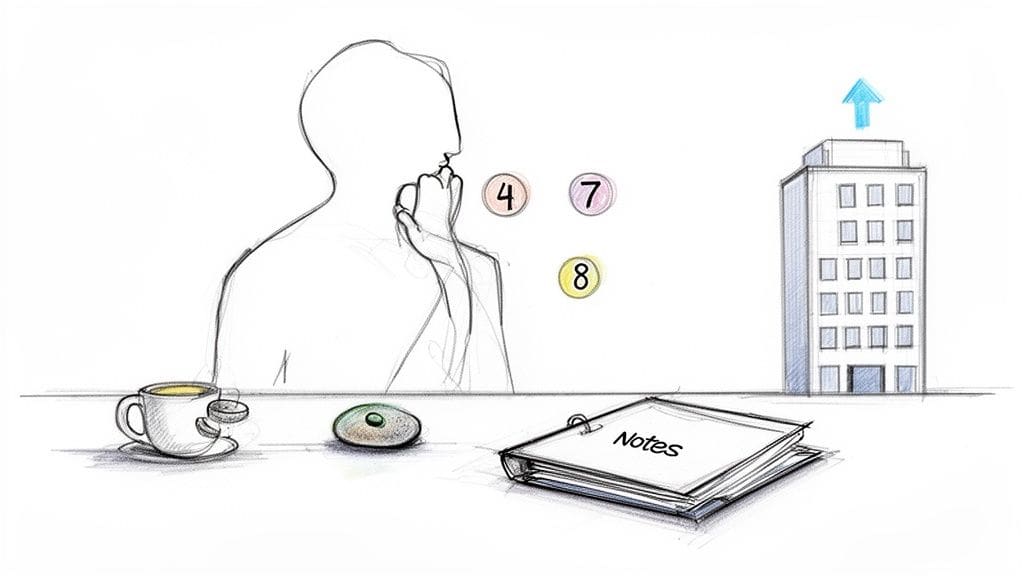
Even with the perfect script, a passive-aggressive comment can still send your anxiety skyrocketing. Suddenly, you're not just dealing with the conversation—you're fighting to stay regulated. That's why your strategy needs two parts: tools to calm yourself in the moment, and a clear game plan for when you need to escalate.
Think of it as having a safety net. The in-the-moment tools protect you from feeling overwhelmed, while the escalation plan ensures you don't get stuck in a toxic dynamic that your direct replies can't fix.
And these dynamics are far from rare. A global survey found that over 30% of professionals feel their workplace culture is unhealthy and passive-aggressive. So let's be clear: knowing when to get help isn't a failure. It's a core skill for protecting your own well-being.
In-the-Moment Calming Techniques
When you feel that spike of anxiety during a tense chat, you need something discreet you can do right there, without having to announce you need a break. The goal is to ground yourself so you can think clearly instead of just reacting.
Here are two quick exercises you can do at your desk or even in a meeting:
* 4-7-8 Breathing: Inhale quietly through your nose for a count of four. Hold your breath for seven. Then, exhale completely through your mouth for a count of eight. This simple breathing pattern is incredibly effective at slowing your heart rate and calming your nervous system down.
* Subtle Grounding: Press your feet firmly into the floor and focus on how solid the ground feels beneath you. Or, try pressing your fingertips together and just notice the sensation of pressure. These small physical acts pull your focus back into your body and out of a thought spiral.
> These techniques are your first line of defense against feeling overwhelmed. They create a small pocket of space between a trigger and your response, which is often all you need to regain your composure.
Recognizing When to Escalate
Sometimes, no matter how perfectly you use a script, the behavior doesn't stop. One-off incidents can often be handled directly, but a consistent pattern of passive aggression is a whole different problem. This is when your strategy has to shift from a single interaction to a long-term solution.
Escalating isn't about picking a fight. It's about protecting your work, your focus, and your mental health from a pattern of behavior that's making your environment unsustainable. This is when bringing in a manager or HR becomes a necessary and logical next step.
How to Prepare for Escalation
When you decide it's time to get support, preparation is everything. You need to show up with a clear, factual account of the problem, focusing on the professional impact, not just your personal feelings.
* Document Everything: Keep a private, dated log of incidents. Write down what was said or done, who was there, and the specific date and time. If you can, quote the exact phrases used.
* Focus on Impact: Frame the issue around its effect on the work. "When I don't receive the files after multiple requests, it pushes the entire project timeline back" is far more effective than, "He's always ignoring me."
* Use Non-Emotional Language: When you talk to your manager or HR, stick to the facts. Present the documented pattern and its tangible consequences. This gives them a clear, professional problem to solve.
Learning how to advocate for yourself is a critical part of this process. Escalating a persistent issue isn't tattling—it's a powerful act of self-advocacy to ensure your boundaries are respected.
Still Have Questions About Passive Aggression?
It's completely normal to have some lingering questions, even with a solid game plan. Learning how to respond to passive aggressive behavior isn't just about memorizing scripts; it's about troubleshooting those specific situations that feel messy, personal, or just plain confusing.
Let's tackle some of the most common concerns that come up.
What if Confronting Them Makes It Worse?
This is a very real and valid fear. It's important to remember that the goal of a direct response isn't to force the other person to have a sudden epiphany and change their ways. The goal is to clearly and calmly establish your boundary.
If their behavior escalates after you address it, that's critical information. It tells you the problem is much deeper than a simple communication mix-up.
Your best move at that point is to disengage and document what happened.
> You can use an opt-out line like, "I can see this conversation isn't productive right now, so I'm going to step away." Then, make a private note of the interaction. A pattern of escalation is serious evidence you would need if you decide to involve a manager or HR.
How Can I Tell if I'm Just Being Too Sensitive?
Passive aggression is designed to make you question your own perception. That's its power. It creates a fog of plausible deniability that can leave you feeling like you're the problem.
The key is to focus on the pattern, not just a single incident. Anyone can make an ambiguous comment by mistake. But repeated sarcasm, the silent treatment, or a steady stream of backhanded compliments is a clear sign that something is wrong.
Trust your gut. If conversations with a specific person consistently leave you feeling confused, drained, or devalued, there is a communication issue at play. Don't let the fear of being labeled "too sensitive" convince you to ignore your own experience—that's often a tactic used to make you drop the issue entirely.
Are These Scripts Only for Work?
Absolutely not. While many of our examples are set in the workplace—because it's such a common battleground for this behavior—the principles are universal. These strategies and scripts are incredibly effective with family members and friends, too.
The main thing you'll adjust is your tone. With a loved one, you'll probably lean toward a "Warmer" or "Softer" script.
For example, instead of a direct, firm boundary line, you might say, "I felt a little hurt by that comment. Is everything okay with you?" The goal remains the same: you are kindly but clearly addressing the impact of the behavior. Setting boundaries is just as vital in our personal relationships as it is in our professional ones. For more guidance on this, you might find it useful to get some help understanding someone's response.
Feeling overwhelmed by tricky conversations? The tonen app gives you the words you need, right when you need them. With hundreds of scripts, tone options, and in-the-moment calming tools, you can handle any interaction with more confidence and less stress. Find your voice and set your boundaries by exploring the app at https://usetonen.com.
Frequently asked questions
This guide covers how to respond to passive aggressive behavior with confidence with practical, neurodivergent-friendly strategies—clear steps, scripts where useful, and ways to reduce anxiety or overload rather than vague "be confident" advice.