If the idea of making small talk makes your heart pound, you're far from alone. For millions, a simple conversation can feel like a high-stakes performance, complete with a racing heart and a blank mind. The best way to overcome this is to practice conversations for anxiety by rehearsing short, low-stakes interactions in a private, controlled space. This builds a foundation of confidence before you ever step into a real-world scenario. You can start by scripting common interactions, rehearsing them alone using a mirror or voice recorder, and then gradually moving to role-playing with a trusted partner.
This approach gives you back a sense of control and builds conversational muscle memory. Instead of being caught off-guard in a real conversation, you'll have a mental library of phrases and responses ready to go. This doesn't mean you'll sound robotic; it means you're giving yourself a safety net so you can focus on connecting, not just surviving.
Why Practicing Conversations Is Your Best First Step
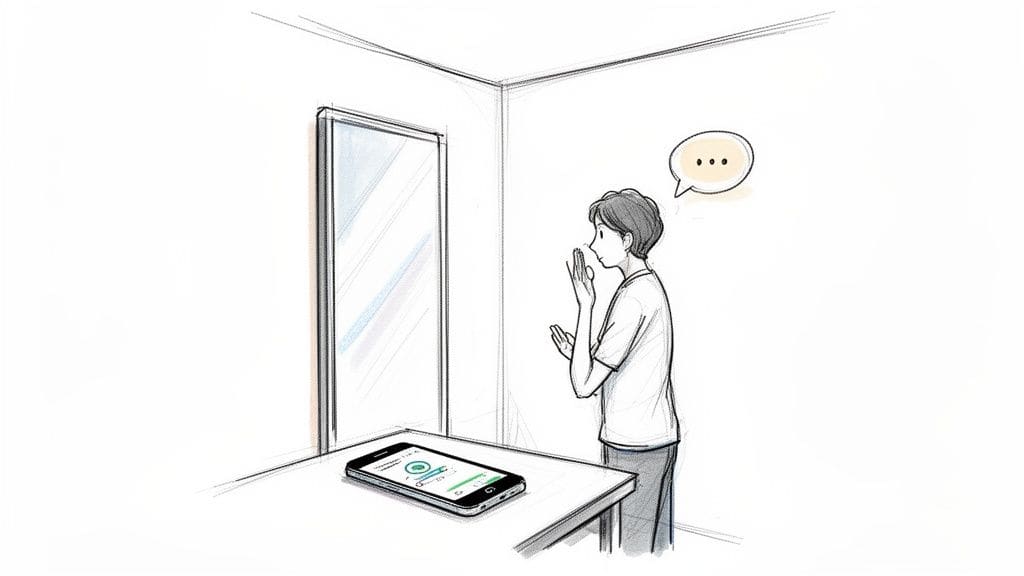
That feeling of dread around social interaction is a hallmark of social anxiety, which is far more common than most people realize.
An estimated 7.1% of U.S. adults experienced social anxiety disorder in the past year, and the lifetime prevalence hits 12.1%. You can read more detailed statistics on social anxiety from NIMH.
This is exactly why intentional practice can be such a game-changer. It's a method rooted in the same principle musicians and athletes use to prepare for a big performance: rehearsal.
By practicing in a safe, low-pressure environment, you begin to desensitize your brain's fear response. You're teaching your nervous system that you are safe.
Build Confidence From the Ground Up
Think of it as building conversational muscle memory. Instead of being caught off-guard in a real conversation, you'll have a mental library of phrases and responses ready to go. This doesn't mean you'll sound robotic; it means you're giving yourself a safety net.
> The goal isn't to deliver a perfect performance. It's to lower the mental and emotional cost of engaging, so you can connect more authentically with others.
This process gives you back control. You can start with simple, everyday scenarios—like ordering coffee or asking for directions—before ever moving on to more challenging ones. This incremental approach ensures you build genuine confidence with each small win.
Key Benefits of Rehearsal
* Reduces Fear of the Unknown: Practice takes the surprise out of conversations by preparing you for common interactions.
Builds Self-Trust: Every successful practice session proves that you can* handle these situations, strengthening your self-belief.
* Lowers In-the-Moment Anxiety: When your brain has a plan, it's less likely to activate its fight-or-flight response.
By making rehearsal a regular habit, you're not just learning what to say—you're retraining your nervous system. For those ready to dive deeper into the mechanics of dialogue, you can also check out our complete guide on how to improve conversation skills.
How To Prepare Your Scripts And Mindset
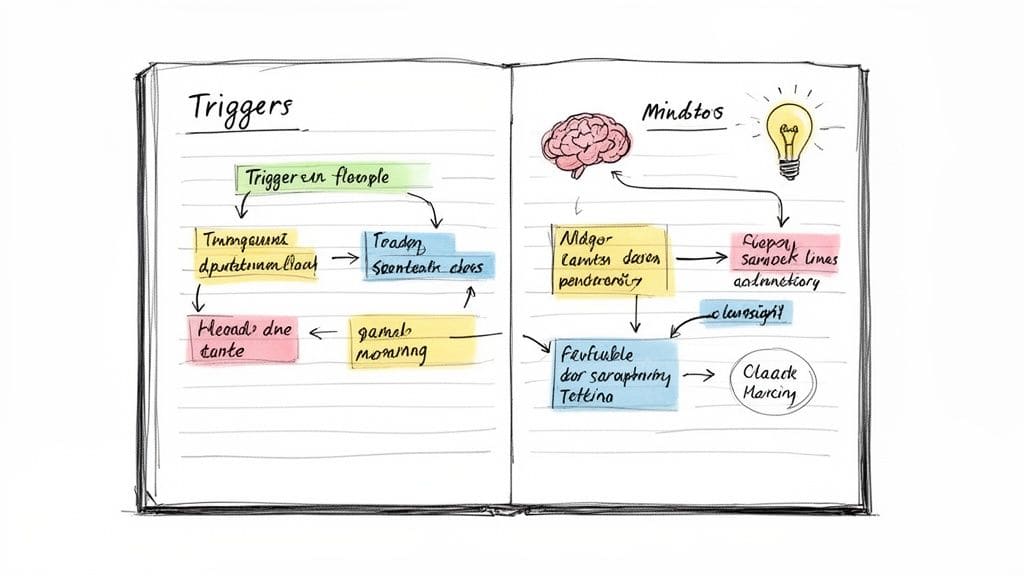
Before you ever say a word out loud, the real work begins inside your head. When you practice conversations for anxiety, success often comes down to this prep work: getting your mindset right and having a few flexible scripts ready to go.
This isn't about becoming a robot. It's about creating a safety net that lowers the cognitive load in the moment, so you can actually focus on connecting with someone instead of just trying not to panic.
A huge part of this is knowing what sets you off in the first place. As you start preparing, learning how to increase self-awareness is a game-changer for understanding your own patterns. Pinpointing your specific triggers helps you practice for the moments that really matter.
Pinpoint Your Conversational Triggers
Take a second to think about recent conversations that made you feel anxious. Where were you? Who were you with? What was the topic?
Maybe it was a work meeting where you felt pressured to give an opinion, or a family dinner where the questions got a little too personal. Getting specific is key. It helps you build practice scenarios that are actually relevant to your life, rather than trying to prepare for every social situation under the sun.
See if any of these common triggers feel familiar:
* Initiating small talk with people you don't know well.
* Asking for help, especially from a boss or someone in authority.
* Setting a boundary with a friend or relative who tends to push them.
* Disagreeing respectfully when everyone else seems to be on the same page.
Once you know what your top triggers are, you can pour your energy into creating scripts for just those moments. This targeted approach is far less overwhelming and makes your practice sessions way more effective.
Build Flexible Scripts, Not Rigid Lines
Let's be clear: a "script" is not about memorizing lines like you're in a play. It's a flexible roadmap. The whole point is to have a few key phrases in your back pocket so you don't have to invent them from scratch while you're stressed.
> Think of a script as a map, not a railroad track. It shows you a possible route, but you can always take a detour if the conversation goes somewhere interesting.
A good script should sound like you. If a phrase feels awkward or unnatural coming out of your mouth, ditch it. The best ones are simple, short, and can be tweaked for different situations.
A solid script usually has three parts:
* The Opener: A low-pressure way to get things started. "This is an interesting event, what brought you here today?"
* The Follow-Up: An open-ended question to keep it moving. "That sounds fascinating, can you tell me more about that?"
* The Exit: A polite way to end the interaction gracefully. "It was great chatting with you, I need to go grab a drink."
For tougher situations, like telling someone "no," our guide on using scripts for setting boundaries has more in-depth examples you can adapt. Having these exit strategies planned is a huge part of using rehearsal to build real-world confidence.
Rehearsal Methods You Can Use Anywhere
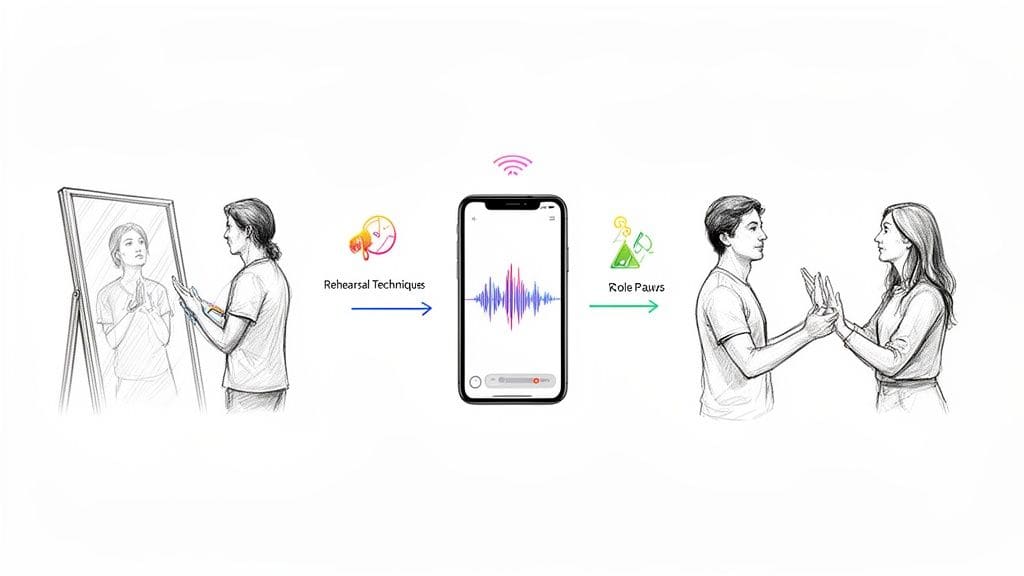
Once you've done the mental prep work and have a few scripts in mind, it's time to actually practice. This is the part that bridges the gap between knowing what to say and feeling confident enough to say it in the real world. You can start right now, wherever you are.
These techniques are designed to be accessible and private—powerful tools for anyone looking to overcome communication anxiety.
The need for this kind of practice is huge. Anxiety disorders are the most common mental disorders worldwide. You can read the full research about these global findings, which highlights how many people are looking for manageable ways to build social confidence.
Want to feel more prepared before conversations? tonen can help.
tonen gives you 188+ conversation scripts, tone guidance and calming tools — designed for autistic adults, ADHD and social anxiety. Try it free for 7 days.
Download on the App StoreiOS only. Android coming soon.
The Mirror Method
One of the simplest ways to start is by practicing in front of a mirror. It might feel a little awkward at first, but this isn't about judging how you look. It's about seeing what other people see.
Say your lines out loud and watch your own face. Are you frowning when you're trying to sound friendly? Are you accidentally avoiding eye contact with your own reflection?
This gives you immediate feedback. You can adjust your posture, soften your expression, or add a small smile to make sure your body language matches the open, approachable tone you're aiming for.
Record and Analyze Your Tone
If the mirror feels like too much, grab your phone. Just open up your voice memos and record yourself saying your opening lines, a few questions, and your go-to exit phrase.
Now, listen back. Try to do it without any self-criticism. Just focus on the sound. Do you come across as warm? Hesitant? Rushed? Hearing your own voice from an outside perspective is an amazing way to fine-tune your delivery without the pressure of a live audience.
> Rehearsal isn't about perfection. It's about building familiarity. Each time you practice, you're making the words—and the feeling of saying them—less foreign and less scary.
Guided Practice With an App
For a more structured solo session, technology can be a huge help. There are some fantastic social anxiety apps that create a private space to rehearse.
Apps like tonen, for instance, let you work with pre-built scripts for hundreds of common situations, from setting boundaries to making small talk. You can practice lines, see how they sound in different tones like "Warm" or "Firmer," and have a planned opt-out line for every scenario. It takes all the guesswork out of what to practice.
Role-Playing With a Trusted Partner
When you're feeling a bit more comfortable, role-playing is the next logical step. This is a powerful way to practice conversations for anxiety because it introduces the one thing you can't control: another person's responses. But it does so in a completely safe environment.
Pick someone you trust—a good friend, a family member, a therapist. Let them know what you're working on and the specific situation you want to run through.
For a good role-play session, try this:
* Have a 'pause' button. Agree on a safe word or a simple hand signal you can use to stop if things get too overwhelming.
* Be specific about the scenario. Don't just say "let's talk." Give them a role. For example, "You're my boss, and I need to ask for a deadline extension."
* Focus on one thing at a time. Don't try to get everything right at once. Maybe one session is just about nailing your opening line. The next can be about holding eye contact for a few seconds longer.
After you're done, talk about it. What felt good? What was tricky? This kind of feedback is gold because it helps you make small adjustments before you take your new skills out into the world.
Navigating Setbacks And Overwhelm
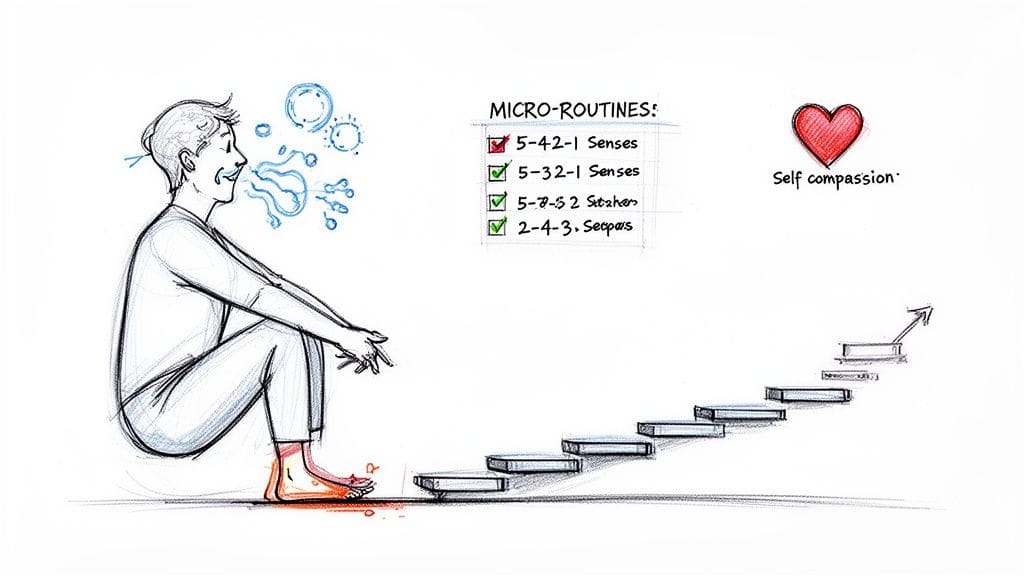
Let's be clear: when you rehearse for social interactions, progress is never a straight line. Some days you'll feel like you've totally nailed it. Other days, you might have an interaction that leaves you feeling drained and defeated.
This is completely normal. A stumble or a moment of panic isn't a sign of failure—it's just part of the process. The real skill is learning how to handle those feelings in the moment and reframe them as valuable data for next time.
Introduce In-the-Moment Micro-Routines
When anxiety suddenly spikes mid-conversation, it can feel like your brain is short-circuiting. In these moments, you need quick, discreet tools that can bring you back to the present. This is where "micro-routines" are a game-changer.
These are simple, fast-acting techniques you can use without anyone even noticing. The goal isn't to erase the anxiety completely, but to take the edge off so you can stay engaged. This is especially helpful when trying to deal with anxiety at work, where stakes can feel high.
Here are a few micro-routines you can try:
* The 5-4-3-2-1 Method: Silently name 5 things you can see, 4 things you can physically feel (like your feet on the floor), 3 things you can hear, 2 things you can smell, and 1 thing you can taste. This pulls your focus out of your anxious thoughts and into your immediate environment.
* Box Breathing: Inhale quietly for a count of four, hold your breath for four, exhale for four, and hold again for four. This simple rhythm is a powerful way to help regulate your nervous system.
* Muscle Clench and Release: Discreetly tense a muscle, like your fist or your toes, for about five seconds, and then let it go. This small physical act can help dissipate that jittery, nervous energy.
If you want to build out your toolkit, our guide on grounding techniques for anxiety has even more exercises. Having a few go-to moves makes it so much easier to ride out a wave of overwhelm when it hits.
> Remember, a setback is just data. It tells you what's still challenging, highlighting where you can focus your next practice session. It's not a judgment on your ability or worth.
Troubleshooting for Neurodivergent Brains
For many neurodivergent people, social anxiety doesn't exist in a vacuum. It's often amplified by other challenges, like sensory overload from a noisy room or the cognitive drain of trying to interpret non-verbal cues.
If that sounds familiar, it's crucial to build accommodations into your practice. Be kind to yourself by acknowledging that you're navigating extra hurdles.
Consider these adjustments:
* Manage Your Sensory Input: If you know loud environments are a trigger, practice in quieter settings first. You might also try wearing noise-reducing earplugs in busy places to take the edge off the auditory chaos.
* Focus on Words, Not Just Cues: It's okay if reading body language isn't your strength. It's exhausting and often unreliable anyway. Instead, focus your practice on listening to the actual words people use and asking clarifying questions like, "Just to be sure I'm understanding, you mean...?"
* Plan for Recovery Time: Socializing can be incredibly tiring. Think of it like a workout for your brain. Make sure you build in some quiet downtime to recharge after a challenging social interaction.
By approaching setbacks with a bit of self-compassion and having a toolkit of micro-routines, you can make the journey feel much more sustainable and empowering.
From Scripts to Authentic Style
Let's be clear about one thing: the whole point of using practice conversations for anxiety isn't to become a perfect, pre-programmed robot. It's about feeling more like yourself, just with the volume on your anxiety turned down.
Scripts are fantastic tools to get you started, but the real magic happens when you begin to riff on them and find a style that's uniquely yours. This is where you take ownership of the process, moving from just rehearsing lines to building a communication toolkit that lets you be genuinely you.
Think of it as learning a new recipe. At first, you follow the instructions to the letter. But once you get the hang of it, you start adding a little more of this, a little less of that, until it tastes like something you made.
Analyze and Adapt Your Scripts
After you've run through a script a few times, take a second to check in with yourself. Which parts felt clunky or forced? Which lines actually made you feel a bit more confident? This isn't about judging your performance; it's about gathering data on what feels right for you.
Take a pre-made script and treat it like a first draft. Ask yourself, "How would I actually say this?"
For example, a script might suggest a polite exit like: "It was a pleasure to meet you. I must be going now."
But maybe your version sounds more like: "Hey, it was really great chatting! I'm gonna go grab a drink, but I'll catch you later."
The second version gets the same job done, but it might feel way more natural coming out of your mouth. Making these small, personal tweaks is the first step toward internalizing the strategy behind the script, not just memorizing the words.
Find Your Authentic Communication Style
Authenticity is the secret weapon against long-term anxiety. When you feel like you're constantly performing, you're burning through mental energy that could be used for actual connection. Finding your style means leaning into your natural way of speaking, quirks and all.
> Your voice is your own. The aim of practice is not to change your personality, but to give it the confidence to come through more clearly, even when you're feeling anxious.
Are you naturally a bit sarcastic? A great listener? More direct and to the point? Use those as your strengths. If you're not a bubbly extrovert, don't waste energy trying to fake it. Your authentic style might be quieter and more observant, and that's a huge asset. The goal is confident communication, not a personality transplant.
If you're looking for more ways to make sure your words match your real feelings, our guide on expressing your feelings is a great place to start.
Scale Your Practice Over Time
Once you're feeling more solid with the low-stakes stuff, it's time to level up. Scaling your practice is how you keep growing without getting overwhelmed. This is all about gently stretching your comfort zone, not yeeting yourself out of it.
Start by setting small, achievable goals that build on each other.
* Introduce a new variable. If you've only practiced alone, try a role-play with a trusted friend. If you've been practicing a simple compliment, try adding a follow-up question next time.
* Increase the complexity. Maybe you move from asking the barista how their day is to practicing a more involved scenario, like returning an item at a store or sharing a brief opinion in a low-stakes meeting.
* Lengthen the duration. Your next goal could be to simply sustain a conversation for one minute longer than you did last time. Just focus on staying present for that slightly extended period.
This slow-and-steady approach is what builds lasting confidence. Every small step you take proves to your brain that you can handle a little more, making the next conversation feel that much less intimidating.
Common Questions About Practicing Conversations
It's completely normal to have questions when you start a new practice like this. The whole point is to feel less anxious, so let's tackle some of the most common worries right from the start.
How Often Should I Practice?
This is a big one. The goal here is consistency, not marathon sessions. You will see far more progress by practicing for just 5-10 minutes a day than you would by cramming in a single, hour-long session once a week.
Think of it like building a muscle. Short, frequent practice builds a sustainable habit and makes the words and strategies feel more natural over time, without leading to burnout. Once it feels easy, you can slowly increase the time.
Will I Sound Robotic If I Use Scripts?
That's a very real fear, and it's one of the biggest myths about this process. It helps to stop thinking of them as "scripts" and start thinking of them as training wheels for your brain. Their only job is to reduce the mental load in the moment, freeing you up to actually listen and connect instead of panicking about what to say next.
> The real goal isn't to memorize the lines, but to internalize the strategy behind them. A script is just a starting point.
As you practice, you'll naturally adapt the words until they sound like you. The script gives you a map, but you're the one driving.
What If I Panic While Practicing With Someone?
First, if this happens, it means you're being brave and pushing your boundaries. It's a sign of courage, not failure. The key is to have a plan before you start. When you practice with a partner, agree on a simple "safe word" or signal that means "let's pause, no questions asked."
It's also smart to have a couple of pre-planned "opt-out" lines ready to go, so you don't have to invent one under pressure. You could try:
* "I'm feeling a bit overwhelmed, so I need to take a quick break."
* "This is great practice, but I think I've hit my limit for today."
Afterward, the most important thing you can do is be kind to yourself. Feeling anxiety during practice is just part of the process.
Can This Actually Help With High-Stakes Work Conversations?
Absolutely. This method is incredibly effective for professional situations where the pressure feels dialled up to ten. You can use this exact same process of scripting and rehearsal to prepare for specific, high-stakes interactions at work.
For example, you can build and practice scripts for things like:
* Performance reviews
* Salary negotiations
* Giving difficult feedback to a colleague
* Presenting your ideas in a meeting
By preparing your key points and practicing how you want to deliver them, you walk into those conversations feeling more in control and far less reactive to stress. It's a powerful way to advocate for yourself professionally.
Ready to stop rehearsing anxious thoughts and start practicing confident conversations? tonen is a mobile app designed to help. With 188 scripts, tone-of-voice options, and in-the-moment calming tools, it's your private space to build real-world communication skills. Download tonen from the App Store and start your free trial today.
Frequently asked questions
This guide covers master social interactions: practice conversations for anxiety with practical, neurodivergent-friendly strategies—clear steps, scripts where useful, and ways to reduce anxiety or overload rather than vague "be confident" advice.