If you are asking what someone meant by a message, start with the possibility that the wording is ambiguous. Separate what they wrote from your interpretation, then ask for the practical clarification you need. A message alone cannot establish another person’s intentions.
You get a text that says, "Can we talk later?" No emoji. No context. No timeline. Your mind starts filling in the blanks. Are they upset? Busy? Formal? Forgetting punctuation? For a lot of neurodivergent people, this kind of uncertainty can feel loud fast.
Most advice online about messages drifts into religious interpretation or vague reassurance. That leaves a big gap for people who need practical, secular help with everyday texts, emails, and verbal cues. If that's you, you're not overreacting. You're dealing with a real communication challenge that many other people face too, as discussed in this piece on why communication can feel so hard for neurodivergent people.
What helps is a process. Separate the words from the story your brain is building. Look at context before tone. Generate more than one possible meaning. Then, if needed, ask for clarity in a way that protects both you and the other person.
Introduction Decoding Ambiguous Messages
Your phone lights up during lunch with a message that says, "Can you call me when you get a chance?" Your chest tightens. You reread it three times, looking for clues that are not there. By the time you put your phone down, your brain may already be building five different stories.
That reaction makes sense, especially if you are neurodivergent. Ambiguous messages ask you to fill in missing social information without enough data. A short text, flat email, or vague comment can feel like being handed a puzzle with key pieces missing. If communication feels unusually hard to decode in everyday life, there is usually a reason. It is not a character flaw.
A lot of online advice about "what did they mean" drifts toward religious or biblical interpretation. That leaves a real gap for people who need practical, secular help with ordinary texts, emails, and spoken comments. This guide focuses on that gap. The goal is not to guess perfectly. The goal is to reduce panic, sort the signal from the noise, and choose a next step you can live with.
What makes this so stressful
Ambiguous communication creates two tasks at once. First, you have to read the actual words. Then you have to estimate the missing parts, like tone, urgency, motive, and whether a reply is expected.
That second task can flood your system fast.
For many neurodivergent people, this is not "overthinking" in the casual sense. It can be a real processing burden. Your brain may scan for patterns, past mistakes, hidden rules, and possible consequences all at once. That is a lot to carry from one tiny message.
A useful rule is simple: if a message supports more than one reasonable meaning, the uncertainty belongs to the message too.
People often send unclear messages for ordinary reasons. They are rushed. They assume shared context. They dislike directness. They are typing while distracted. None of that means you should have been able to decode the message instantly.
What helps right away
Start small. You do not need to solve the whole social situation in one go.
Try this reset:
1. Read the exact words once, slowly.
2. Write down one concrete fact. For example: "They want to talk later."
3. Add two neutral interpretations. For example: "This could be routine," or "This could be time-sensitive."
4. Check your body before you reply. If your heart is racing, pause.
5. Ask for clarity if the stakes are real.
A practical script can help: "Sure. What's the topic, so I can be ready?"
That script works like turning on a flashlight in a dim room. You are not demanding certainty from yourself. You are asking for one more piece of information so the message becomes easier to handle.
Why Messages Feel Like a Puzzle
A text pops up: "Sure."
You pause. Is that warm? Flat? Irritated? Does it mean yes, yes but reluctantly, or yes and they are too busy to say more right now? A single word can leave you doing the social equivalent of finishing a jigsaw puzzle with key pieces missing.
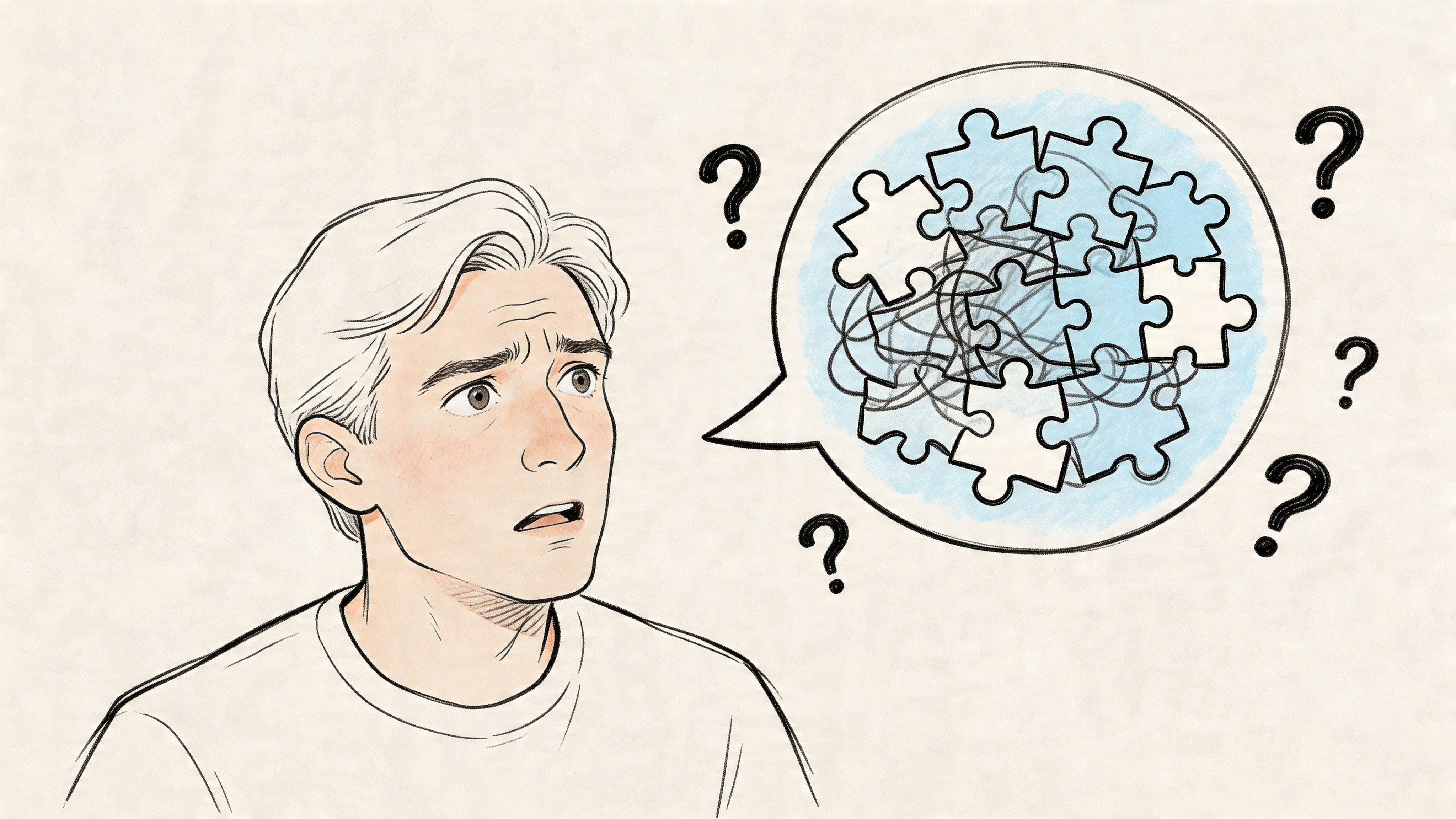
Messages feel hard for a simple reason. Words often carry less information than the sender assumes they do. In plain terms, one short signal can point to several reasonable meanings, and your brain has to sort through those options without enough context to settle the question quickly.
That is extra decoding work. For neurodivergent people, especially those who already spend energy tracking tone, rules, and social risk, that work can pile up fast.
This framing matters because it places the difficulty where it belongs. A vague or low-context message can demand a lot from the person receiving it. If you tend to spiral after short or unclear texts, this article on why you might overthink texts may feel familiar.
The signal and the missing data
Take the message "Sure." The letters stay the same, but the meaning can shift depending on what happened before, how well you know the person, how quickly they replied, and whether they usually text in short bursts.
It could mean:
- agreement
- reluctance
- annoyance
- distraction
- "I saw this and will answer later"
This is why ambiguous messages can feel so exhausting. Your brain is being asked to infer tone and intent from partial data, a bit like trying to identify a song from two notes. Sometimes you can guess correctly. Sometimes several answers fit.
When the message is sparse, your nervous system may treat uncertainty as danger.
For many neurodivergent people, that reaction is not dramatic or irrational. It is a real processing load. You may hold multiple interpretations in mind at once, replay earlier conversations, check punctuation for clues, and try to predict the outcome of each possible reading. That uses working memory quickly.
Why your brain may latch onto the worst reading
Ambiguity often invites threat-scanning. If you have been blindsided by unclear communication before, your brain may learn that vagueness can carry social danger. It starts checking for the sharp edge first.
That protective habit makes sense, even when it hurts. Your mind is trying to prevent another painful surprise with very limited evidence.
A steadier question can help: What information is missing here?
That question shifts the task from self-blame to observation. It also fits a secular, practical approach to message decoding. Instead of searching for a hidden moral lesson or a single "correct" interpretation, you are looking for context, patterns, and the next small clue.
A simpler way to examine the message
Use this formula:
| Part | Question |
|---|---|
| Signal | What exact words did they send? |
| Possible meanings | What are at least two plausible readings? |
| Missing context | What would I need to know to decide? |
That middle step matters. Anxiety often rushes straight from a few words to one painful conclusion. Naming two or three plausible meanings slows the process down and gives your brain a wider lane.
You do not have to decode everything instantly. Sometimes the best first move is to notice that the message is unclear, and that the uncertainty is coming from the message as much as from you.
Confused by what someone really meant? tonen can help.
tonen offers conversation scripts, Reply Helper, Perspective Helper, Debrief, Phone Call Mode and Calm Kit. Start with 21 free scripts on iPhone. Optional Premium unlocks more features.
Download on the App StoreAvailable on iOS.
A Decoder's Toolkit for Spotting Clues
You get a text that says, "Call me when you can." Your chest tightens. Is something wrong? Did you miss a cue? Are they upset?
That reaction is common, especially if unclear messages have gone badly for you before. For many neurodivergent people, the hard part is not a lack of effort. It is that everyday communication often leaves out the very details your brain needs in order to feel settled.
A useful decoder looks at three clue layers: the message, the situation around it, and the sender's usual style. This is a practical, secular approach. You are not searching for one hidden truth inside a vague sentence. You are gathering enough evidence to make a calmer, more grounded guess.
First clue layer is the message itself
Start with what is there.
Read the exact words once. Then read them again as if you were copying them into a note for someone else. That small shift can help you separate the message from the fear attached to it.
Check for these details:
- Word choice. "Can you" often lands differently from "Need you to."
- Punctuation. A period may feel neutral, firm, or distant depending on the relationship.
- Length. A one-word reply can mean rushed, tired, distracted, or annoyed.
- Specificity. "Later" gives you less to work with than "after 3."
The goal is simple. Ask whether the message gives enough information for a confident reading, or whether your brain is being asked to fill in blanks.
Second clue layer is context
Messages arrive inside a moment. The same sentence can mean very different things depending on what was happening before it showed up.
Try these questions:
- What happened right before this message?
- What platform is this on? Email often reads more formal than text.
- What time did it arrive?
- Is there a deadline, conflict, or practical reason for brevity?
For example, a manager who writes "Please call me" at 2 p.m. on a workday may be dealing with routine logistics. A friend who sends the same words right after a tense conversation may be signaling something more emotional.
If tone is hard to read, anchor yourself in timing, relationship, and recent events before you decide what the message "really" means.
Third clue layer is the sender's pattern
One message is a snapshot. Patterns give you a better map.
Some people are brief with everyone. Some avoid direct criticism and sound vague when they are uncomfortable. Some write like they are composing a memo even when they feel perfectly relaxed. Looking for repeated habits can reduce the pressure to decode one sentence in isolation.
Notice whether this person usually:
- sends short texts when busy
- uses "k" or "ok" with everyone
- avoids saying directly when they disagree
- sounds formal across text, email, and voice
This overlaps with skills used in active listening. In text, listening means tracking repeated signals across time, not treating one clipped reply as final proof of what someone feels.
If you want more help reading tone patterns across messages, this guide on how to read someone's tone in text and conversation can help.
A quick worksheet you can use
When a message hooks your anxiety, pause and write four lines:
1. Exact message
2. Known context
3. Sender's usual style
4. Three possible meanings
That last line matters. It gives your nervous system an off-ramp. Instead of forcing one scary conclusion, you create a small menu of possibilities.
If your mind goes blank, use this script with yourself: "I have part of the picture. I do not have all of it yet." That sentence will not solve the message, but it can lower the feeling that you must solve it instantly.
Common Ambiguous Messages and Potential Meanings
Your phone lights up with, "Can we talk later?" Now your brain is trying to solve ten versions of the future at once. For many neurodivergent people, that kind of message does not feel mildly unclear. It can feel like being handed a puzzle with half the pieces missing and being expected to answer fast anyway.
Ambiguity is hard for two different reasons. Sometimes the social meaning is unclear. Sometimes the wording itself allows more than one reading. Both can raise stress, especially in everyday texts, emails, and spoken comments where tone and intent are not fully visible. This guide stays with that practical, secular problem: how to read ordinary messages without assuming there is always one hidden meaning you are supposed to detect.
Decoding common vague messages
Use this table as a menu of possibilities, not a lie detector. The goal is to widen the range of reasonable interpretations so your mind has more than one path to follow.
| Ambiguous Message | Potential Meaning 1 Positive or Neutral | Potential Meaning 2 Negative or Conflict-Avoidant | Clarifying Question |
|---|---|---|---|
| "We need to talk." | They want to discuss logistics or a decision. | They're upset and avoiding details. | "Sure. What's the topic so I can be prepared?" |
| "It's fine." | They genuinely don't mind. | They do mind, but don't want to argue. | "Okay. Do you mean you're good with it, or do you want to revisit it?" |
| "K." | They're busy or typing quickly. | They're irritated or shutting down. | "Got it. Is there anything else you want from me on this?" |
| "Interesting." | They're thinking and not ready to respond. | They dislike the idea but don't want to say so directly. | "Happy to clarify. What stands out to you?" |
| "Let's circle back." | They want to revisit it later. | They want to postpone it without committing. | "Works for me. When would you like to revisit it?" |
| "Can we talk later?" | They're occupied right now. | They want a serious conversation and are building tension. | "Yes. Is this a quick practical thing or a bigger conversation?" |
| "Do whatever you want." | They're flexible. | They feel dismissed or resentful. | "I want to make sure we're aligned. Do you have a preference?" |
A pattern matters here. Short messages often carry very little emotional data. Your nervous system may fill in the blanks with the most painful explanation first. That reaction makes sense. It is also incomplete.
When the wording itself creates confusion
Some phrases are difficult because the grammar branches in two directions.
Examples:
- "Visiting relatives can be tiring."
- "Enraged cow injures farmer with axe."
In the first example, are the relatives visiting, or are you visiting them? In the second, who has the axe? The sentence asks your brain to choose a structure before you can even decide what it means socially. If you already spend a lot of energy decoding tone, that extra language work can make a simple message feel much heavier than other people expect.
This is one reason vague communication can feel so exhausting. You may be solving two puzzles at once: the sentence puzzle and the people puzzle.
If you want more practice with the broader skill around this, this guide on how to read social cues offers useful framing for noticing context and intent.
Questions that usually help more
A steadier approach is to ask yourself:
- What are the most plausible meanings?
- What details support each one?
- What action makes sense before I have full certainty?
That last question can lower pressure fast. In many real situations, you do not need perfect interpretation. You need the next safe step.
> Some messages stay foggy until one more sentence appears. Clarity often comes from follow-up, not mind-reading.
Safe Scripts to Ask for Clarity
You get a text that says, "Sure." That could mean yes, annoyance, exhaustion, or "I saw this and will answer later." Your brain starts filling in the blanks fast. A script helps by giving you one steady next move instead of ten spiraling interpretations.
For many neurodivergent people, this is not about being overly sensitive. It is about having to decode unclear wording, tone, and expectations all at once. Existing advice on "what did they mean" often drifts into spiritual or biblical interpretation. Everyday communication needs something more practical. A short, secular script can turn a foggy moment into a concrete question.
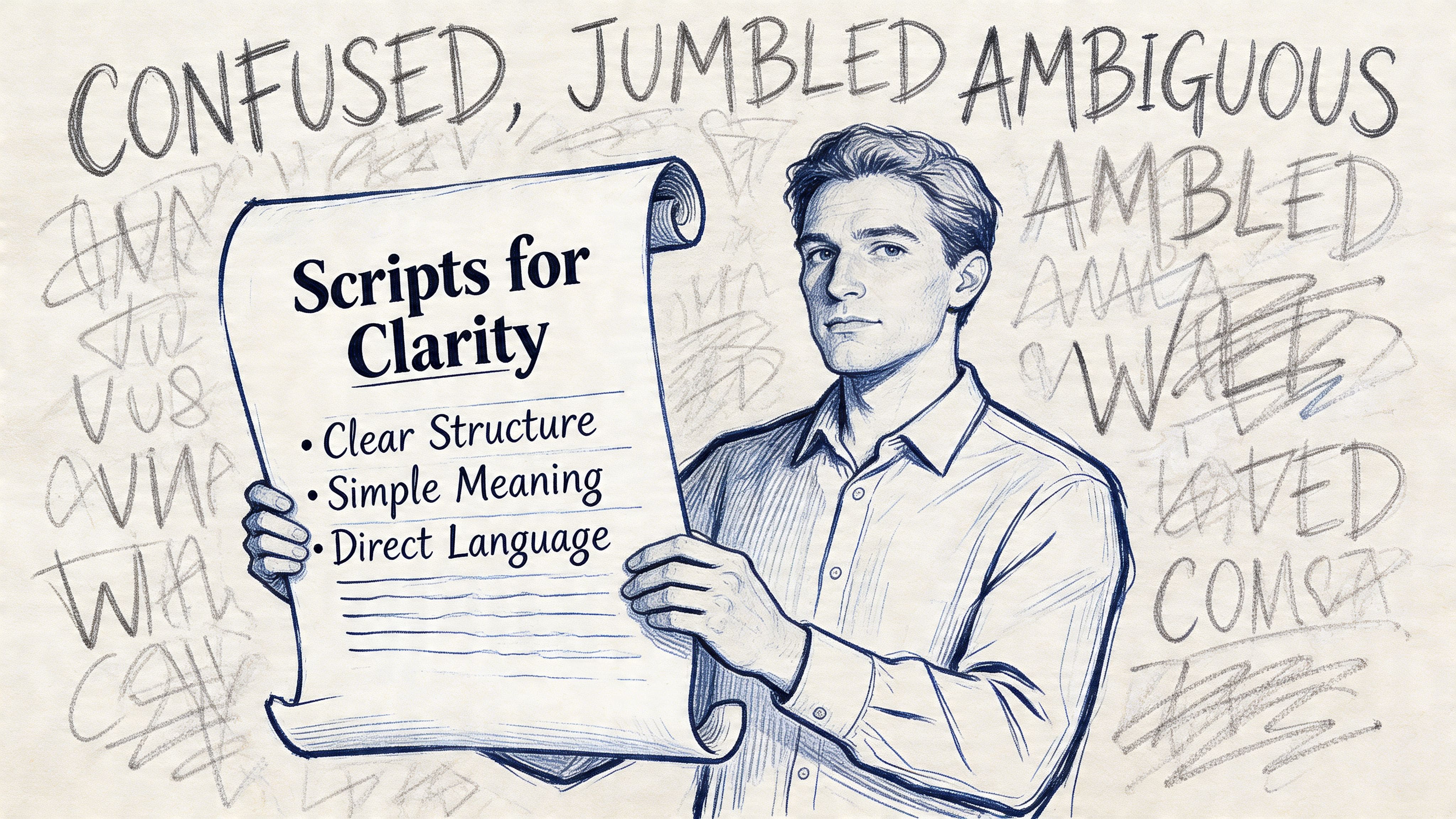
If writing replies is the hardest part, a resource with help wording a message can take some of the pressure off.
A useful script does three jobs. It shows goodwill. It names the confusion. It asks for one clear piece of information. That structure matters because vague replies often create more vague replies.
Warm and collaborative scripts
Use these when you want clarity and you also want to keep the tone soft.
- "I want to make sure I'm reading this right. Are you saying…"
- "Could you say a bit more about what you mean?"
- "I can read this a couple of ways. Which one did you mean?"
These work well with people who are not trying to be unclear, but who communicate loosely or briefly.
Direct and efficient scripts
Use these when your brain needs less ambiguity, not more.
- "Do you mean A or B?"
- "What action do you want from me?"
- "Is this urgent, or can I reply later?"
Closed choices can help a lot. They narrow the problem. Instead of asking the other person to explain everything, you ask them to sort one fork in the road.
> Plain-language option: "I'm not sure how to interpret that message. Can you be more specific?"
Boundary-protecting scripts
Some messages carry pressure without giving enough information to respond safely. You are allowed to slow that down.
- "I'm happy to talk. Please tell me the topic first."
- "I can respond better with specifics."
- "If something's wrong, say it directly so I can understand."
- "I'm not able to decode hints very well. Clear wording helps me."
That last one can be especially helpful if you want to explain a communication need without giving a long personal history.
A formula to reuse
If you freeze when starting from scratch, use this template:
When you say X, I might read it as Y or Z. Which did you mean?
Examples:
- "When you say 'it's fine,' I'm not sure if you mean it's settled or if you're upset. Which did you mean?"
- "When you say 'later,' I'm not sure if you mean today or this week. Which works?"
If sending a clarification question feels scary, start smaller. You can soften the opening without making the question vague. Try, "Quick check," or "I want to make sure I understood." Then ask the concrete part.
Scripts do not make you stiff or impersonal. They reduce guesswork. When your mind is overloaded, that kind of structure can make communication feel more manageable.
Calming Your Mind When a Message Causes Overwhelm
Even if you know a message is ambiguous, your body may react before your logic catches up. Your chest tightens. Your jaw locks. You reread the same line. You draft five responses and send none.
That reaction makes sense. If uncertainty has led to conflict, embarrassment, or rejection before, your nervous system may treat vagueness like a warning sign.
If you need more support with this part, these grounding techniques for anxiety can help you slow the spiral.
What to do before you reply
Try a short pause ritual.
1. Put the phone down for a minute. This interrupts the rereading loop.
2. Exhale longer than you inhale. Keep it easy, not perfect.
3. Name the trigger. "This message is vague."
4. Name the fear. "I'm afraid they're upset."
5. Separate them. The trigger is real. The fear is a possibility, not a fact.
That separation is often enough to lower urgency.
Ground your body first
When your body is activated, interpretation usually gets worse. Grounding isn't avoidance. It's preparation.
Try one of these:
- Five-senses check. Notice something you can see, hear, feel, smell, and taste.
- Feet pressure. Push your feet into the floor or your shoes.
- Object focus. Hold something cool, textured, or weighted.
- Breath count. Count four gentle breaths without trying to "fix" anything.
> You don't need to feel calm before responding. You just need to be calmer than the moment you first opened the message.
Give your brain a holding sentence
A holding sentence is a private reminder that keeps you from escalating the story.
Try:
- "I don't know what they mean yet."
- "Short does not automatically mean angry."
- "I can ask for more information."
- "I'm allowed to wait until I'm steady."
These statements are simple, but they create structure. They keep your brain from rushing into certainty.
If you tend to ruminate
Rumination often looks productive, but it rarely creates new evidence. It usually repeats the same possibilities with more fear attached.
If you catch yourself looping:
- move the message out of sight for a few minutes
- write down the facts on paper
- choose one next action only
- stop trying to solve the entire relationship from one text
That last part matters. A single message is not always a reliable summary of how someone feels about you.
Building Confidence in Your Communication
The question what did they mean by that message may never disappear completely, because human communication will always include some uncertainty. But confusion doesn't have to control you.
You can learn to pause, look at context, notice patterns, and ask for clarity without apologizing for needing it. You can also learn to calm your body before your mind writes a worst-case script. Our dedicated guide to understanding hidden meaning in messages goes deeper on decoding subtext, tone, and context together.
Confidence in communication usually doesn't come from becoming perfect at reading every cue. It comes from trusting that when a message is vague, you have options. You can investigate. You can clarify. You can wait. You can respond in a way that protects your peace and keeps the conversation real.
If you want extra support practicing these skills, tonen is built for neurodivergent communication. For rehearsal, choose a script, adapt the words and read them aloud yourself if that is useful. You can also practise with someone you trust.