You pause before replying, rehearse three versions in your head, notice the other person's face change, then lose your words anyway. If you've been asking why is communication so hard, the short answer is this: communication asks your brain to do many jobs at once in an environment full of hidden rules, emotional risk, and constant interruptions. For neurodivergent people, that load often gets heavier, not because we're broken, but because many conversations are built around assumptions our brains don't naturally share.
That's why communication can feel confusing even when you care, listen closely, and try hard. It isn't just about "saying the right thing." It's about processing language, tone, timing, context, memory, body cues, power dynamics, and stress, all in real time. Once you see those layers clearly, the question of why is communication so hard stops sounding like a personal failure and starts sounding like a systems problem you can work with.
The Real Reason Communication Is So Hard
A conversation can go off track in seconds. Someone interrupts you. You lose your place. You try again, but now you're also tracking their expression, wondering if you sound rude, and deciding whether it's worth finishing your point.
For many neurodivergent people, that exhaustion isn't just annoyance. It's cognitive disruption. If your brain needs a bit more time to organize language, recover a thought, or shift attention, an interruption can feel like someone closing all your tabs at once. Many people dealing with ADHD communication problems recognize this pattern immediately. The issue often isn't lack of effort. It's the mismatch between how fast the conversation moves and how your brain processes information.
Two pressures are happening at once
Communication is hard because internal processing and external pressure collide.
- Inside your brain: You're listening, interpreting, remembering, choosing words, and regulating emotion.
- Outside your brain: You're dealing with noise, social rules, hierarchy, timing, and other people's assumptions.
- Between those two: Misunderstandings happen fast, especially when nobody slows down enough to notice them.
> Communication often feels "natural" only when your brain style matches the setting. When it doesn't, every conversation becomes translation work.
That's one reason broad advice like "just be confident" or "just say what you mean" can feel so useless. It skips the machinery underneath the moment.
If you want a broader neurodivergent framing for this experience, the tonen article on neurodivergent communication is a helpful companion. It treats communication differences as real processing differences, not character flaws.
Why this matters
When people ask why is communication so hard, they're often asking a deeper question: "Why does something other people seem to do automatically feel like labor to me?"
That question deserves a real answer. And the answer starts with this: communication is not one skill. It's a stack of skills happening all at once.
Your Brain's Bandwidth and the Cognitive Load of Talking
Talking can look simple from the outside. Inside your head, it can feel more like running several apps on a device that's already low on memory.
You're not just "having a conversation." You're decoding words, predicting what the other person means, tracking the topic, planning a reply, editing that reply, and trying to keep your body regulated. If one part takes extra effort, the whole system slows down.
Think of communication like mental RAM
A useful analogy is computer bandwidth.
When your brain has enough available "RAM," conversation feels manageable. When that bandwidth is crowded, everything gets choppy. You may know exactly what you think but still struggle to say it in the moment.
Here's what often fills that bandwidth:
| Mental task | What it feels like in real life |
|---|---|
| Listening | Trying to catch every word so you don't miss the point |
| Working memory | Holding their last sentence in mind while planning your reply |
| Self-monitoring | Checking whether your tone, face, or volume seems "off" |
| Context tracking | Remembering the history, subtext, and stakes of the conversation |
That's why some people communicate much better in writing, after a pause, or with a script. The issue isn't intelligence. The issue is processing load.
The Curse of Knowledge makes things worse
Another problem sits on the other side of the conversation. People often assume they've explained themselves clearly when they haven't. This is called the Curse of Knowledge.
In daily life, it sounds like this:
- "I already told you."
- "You know what I mean."
- "It's obvious."
- "I thought that was clear."
For the speaker, it feels clear because they already know the context. For the listener, key pieces may never have been said aloud.
> Practical rule: If a conversation keeps failing, don't assume someone isn't trying. First ask whether too much information stayed inside one person's head.
A small shift that helps
When you feel overloaded, reduce simultaneous tasks. Ask for a slower pace. Request one point at a time. Move part of the conversation into writing if that's easier for you.
If overwhelm is already rising, the guide on what to do when feeling overwhelmed offers concrete ways to pause before your bandwidth fully crashes.
This is a core part of why is communication so hard. We often treat speech like a simple output, when it's really a high-demand processing task.
Decoding the Unspoken Social Code
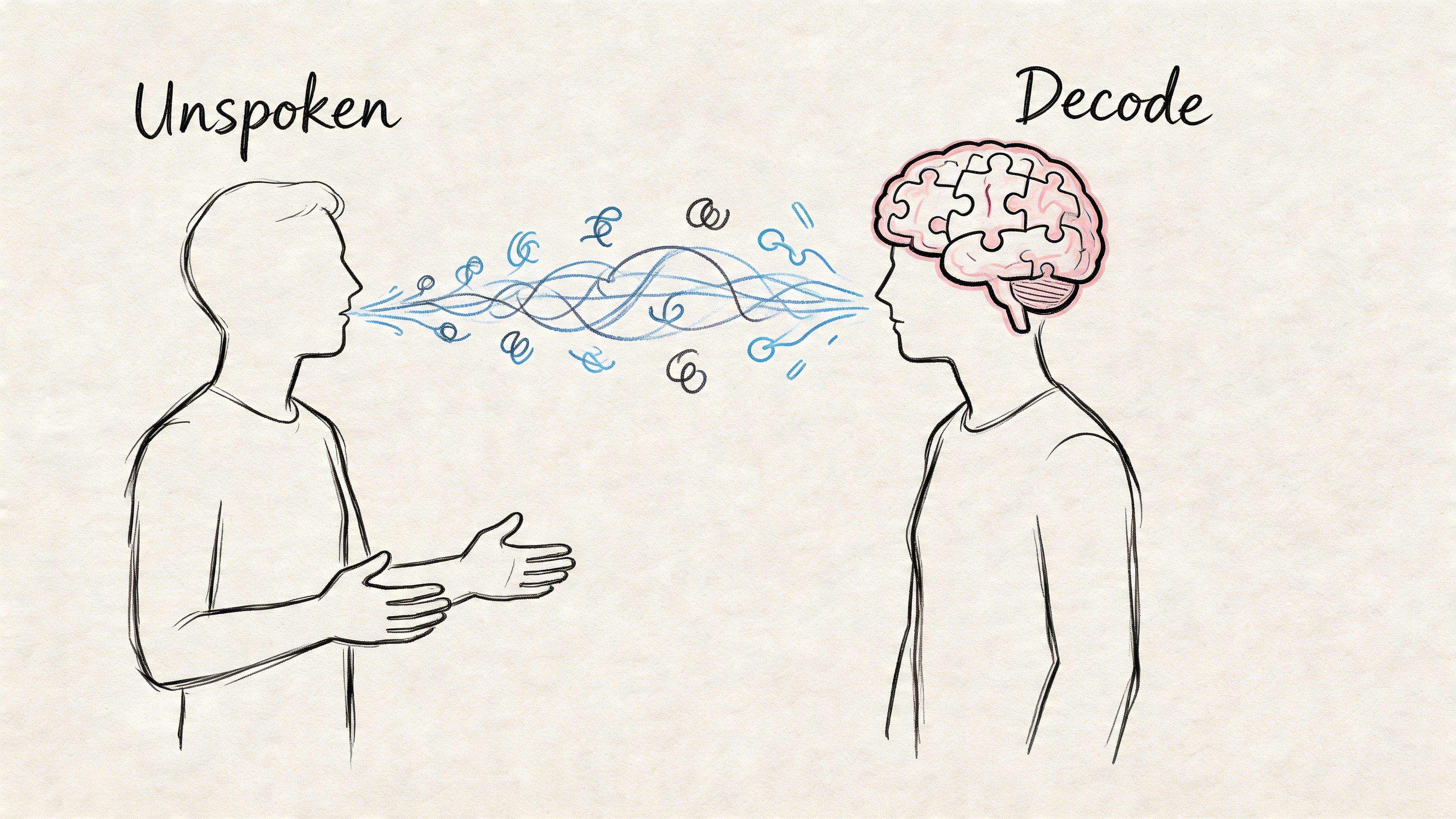
A lot of communication isn't spoken directly. That's the part many people don't say out loud when they give advice.
They say "read the room," but they don't explain how. They say "pick up on the vibe," as if tone, implication, sarcasm, and hierarchy arrive with subtitles. For many neurodivergent people, they don't.
What other people call intuition is often decoding
Some brains process social cues quickly and automatically. Other brains do it more deliberately, more slowly, or with less confidence. That doesn't mean you lack empathy or insight. It means you may need to decode signals that other people take for granted.
That decoding can include:
- Tone matching: Is this person joking, annoyed, rushed, or inviting discussion?
- Subtext reading: Are they making a request, hinting, criticizing, or just venting?
- Body language interpretation: Does crossed arms mean discomfort, cold temperature, distraction, or anger?
- Timing decisions: Is now the right moment to ask a question, clarify, or set a boundary?
When advice ignores that effort, it can feel shaming. It assumes the social code is visible to everyone in the same way.
Finding everyday conversations exhausting? tonen can help.
tonen offers conversation scripts, Reply Helper, Perspective Helper, Debrief, Phone Call Mode and Calm Kit. Start with 21 free scripts on iPhone. Optional Premium unlocks more features.
Download on the App StoreAvailable on iOS.
Generic tips often miss neurodivergent reality
A lot of mainstream communication advice focuses on habits like eye contact, active listening, or confidence. Those can matter, but they don't address brain-based differences in social processing.
> "Read the room" is only useful advice if the room is readable.
Why this becomes exhausting
Manual decoding adds delay. Delay creates self-doubt. Self-doubt raises anxiety. Anxiety makes decoding harder.
A simple exchange can turn into an internal loop:
1. "What did they mean by that?"
2. "Am I overreacting?"
3. "If I ask, will I seem rude?"
4. "If I don't ask, will I miss something important?"
That loop is draining because the conversation keeps moving while you're still trying to translate it.
If you regularly get stuck on mixed signals, the guide to interpreting a social situation can help you sort possibilities without jumping straight to the harshest conclusion.
This is another answer to why is communication so hard. Many conversations rely on hidden code, then blame people who ask for clearer instructions.
When Emotions Hijack the Conversation
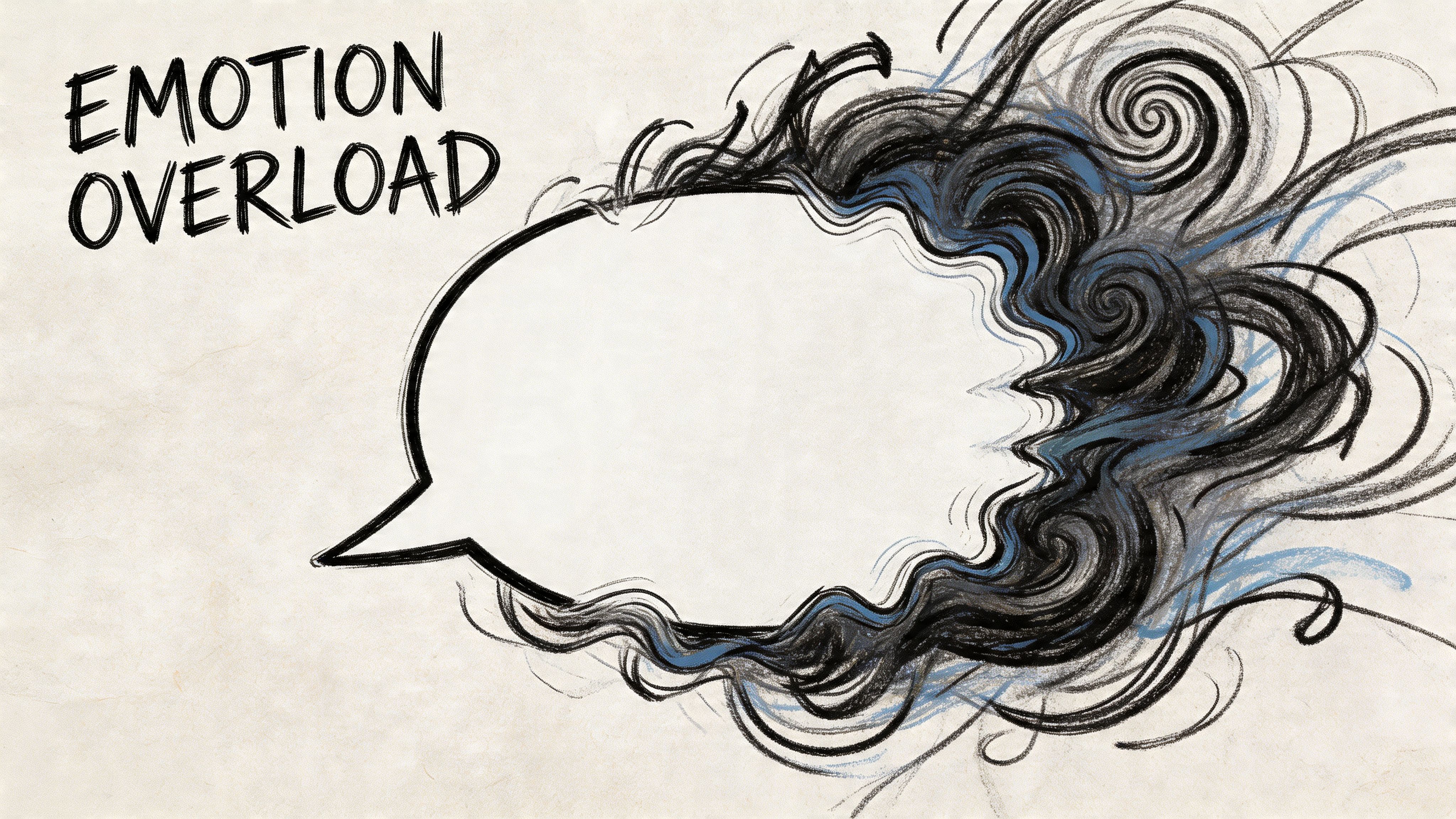
You might know what you want to say before a conversation starts. Then the other person's tone shifts, your chest tightens, and your words disappear.
That's not laziness. It's not immaturity. Often, it's your threat system stepping in.
What it looks like in real life
A manager says, "Can we talk?" Your brain starts scanning for danger. By the time the conversation begins, part of you is already bracing. You miss details. You answer too fast or not at all. Later, alone, the perfect response appears.
Or a partner says, "Why are you being so defensive?" Now you're no longer discussing the original topic. You're trying to prove your intent, manage their reaction, and keep yourself from shutting down.
Why words vanish under stress
When emotion spikes, your brain shifts resources toward protection. That can show up as freezing, fawning, going blank, talking too much, crying, or becoming temporarily nonverbal.
Common signs include:
- Losing access to language: You know there's a thought in there, but you can't retrieve it.
- Hearing less accurately: The other person keeps talking, but your brain only catches fragments.
- Overexplaining: You try to repair the moment with more words, which can create more confusion.
- Shutting down: Silence becomes the only way to stop overload from getting worse.
> Strong emotion can turn communication from a skill problem into a nervous system problem.
Why this gets misread
Other people may call this avoidance, overreaction, or lack of maturity. Sometimes it's overload. The outside behavior looks interpersonal, but the inside experience is physiological.
That's especially hard if you already carry fear of being misunderstood. Then each difficult conversation includes two conversations at once: the one happening in the room, and the one happening inside you.
If this pattern feels familiar, the article on emotional dysregulation in adults gives language for what happens when feelings flood your ability to respond.
When you understand this layer, you stop asking, "Why can't I just say it?" and start asking a kinder question: "What condition does my brain need in order to speak clearly?"
Navigating External Barriers and Unfair Expectations
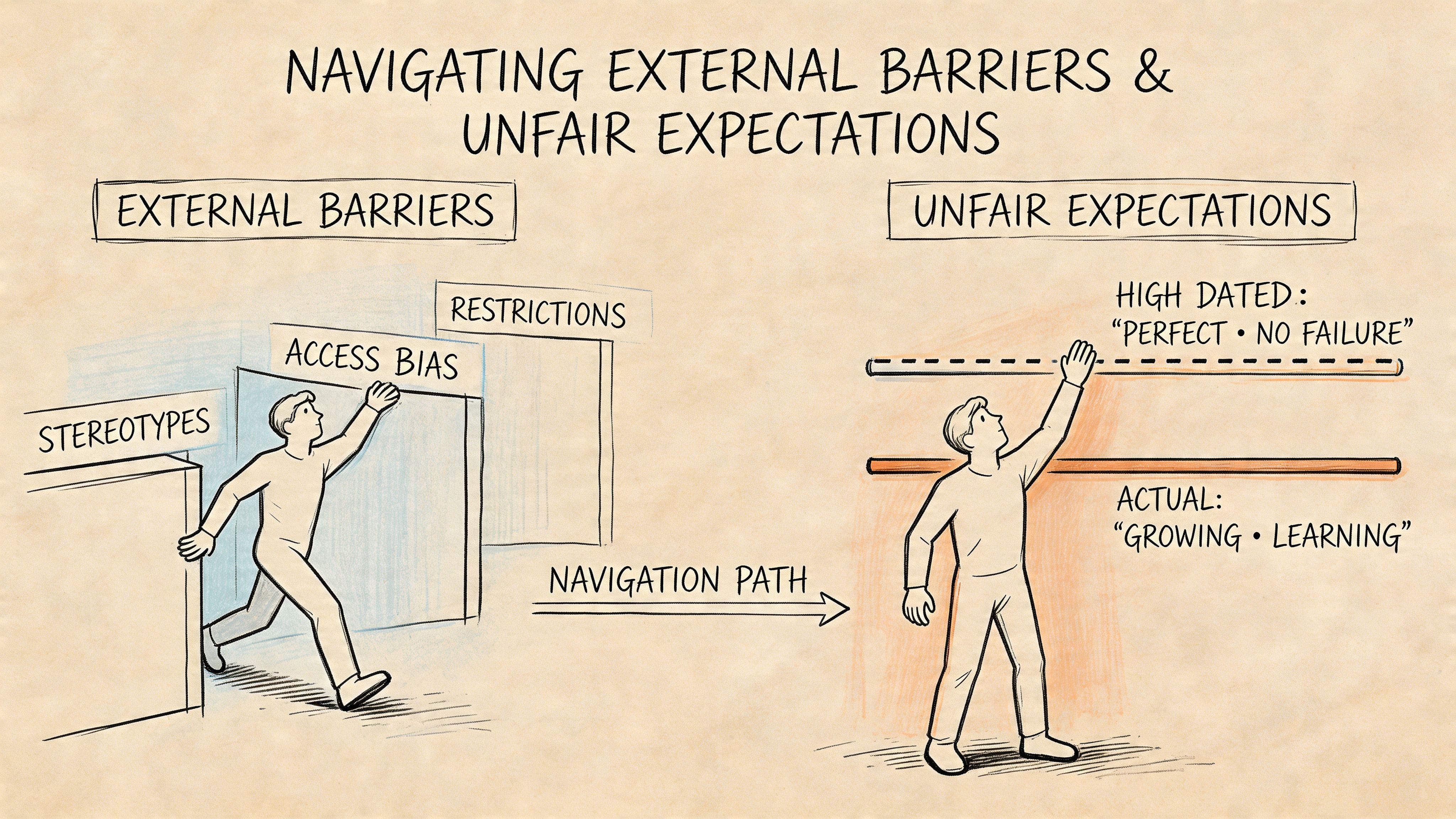
Sometimes the problem is not your skill. It's the room, the culture, and the rules other people pretend are neutral.
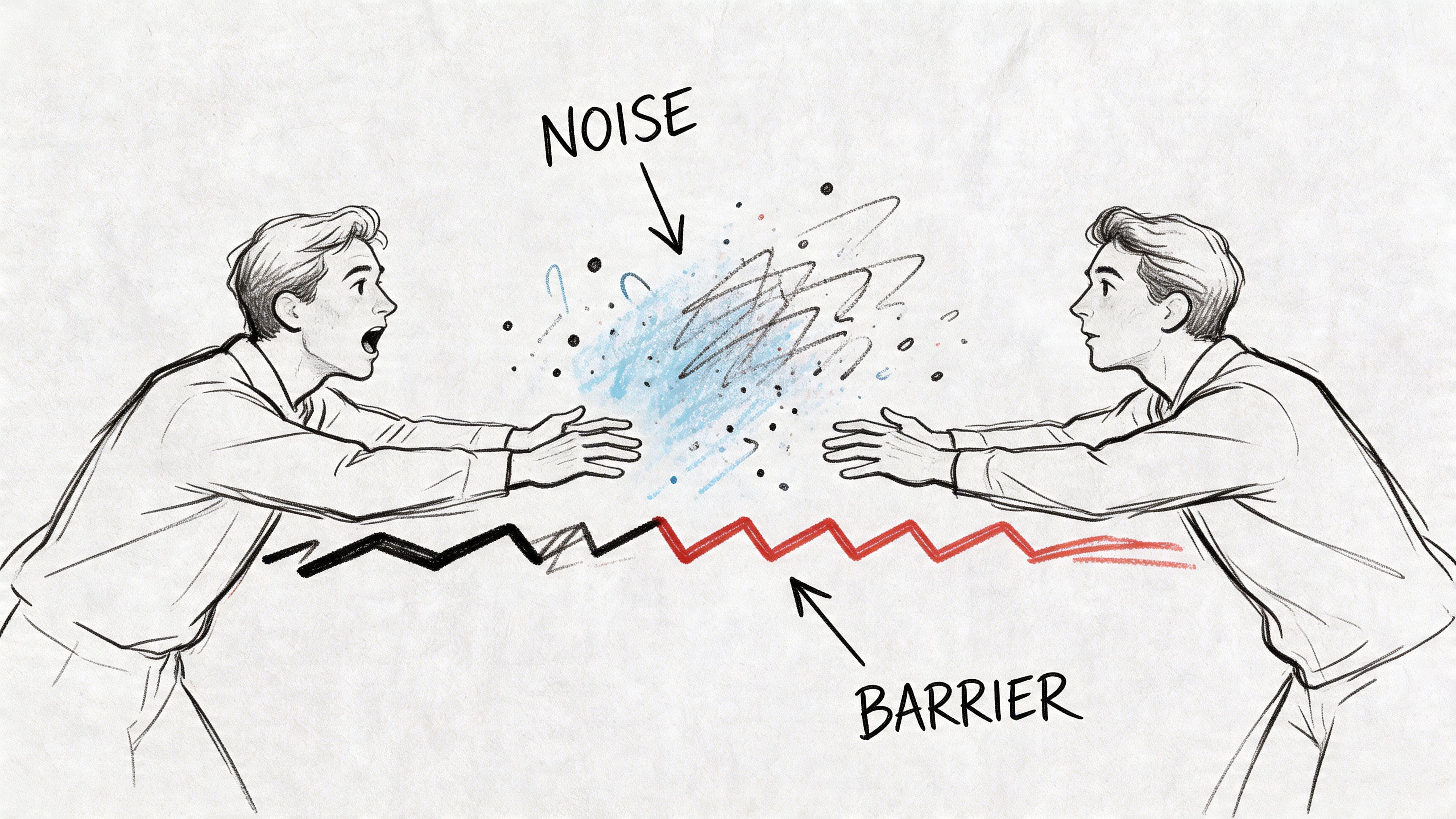
A noisy café, a fast-moving meeting, a family group chat full of subtext, or a workplace where only confident-sounding people get heard can all make communication harder before you even open your mouth. Many neurodivergent people enter conversations already spending energy on sensory filtering, timing, and self-protection.
The environment shapes the outcome
External barriers often look "normal" to people who aren't struggling with them.
- Interruptions break focus
A thought that took effort to build can disappear fast when someone cuts in.
- Sensory noise drains attention
Bright lights, overlapping voices, and notifications can reduce your ability to process speech.
- Power dynamics limit honesty
It's harder to ask clarifying questions when the other person grades you, manages you, or has an emotional hold on you.
- Unwritten norms reward performance
Some settings value speed, certainty, and polished tone more than actual understanding.
Systems create miscommunication too
That points to a bigger issue. People often treat miscommunication as an individual flaw when it's partly created by systems that punish clarification and reward guesswork.
A short comparison makes this clearer:
| Setting | Hidden expectation | Likely impact |
|---|---|---|
| Workplace meeting | Respond quickly and confidently | Slower processors may seem less prepared than they are |
| Family conflict | Know what people "really mean" | Direct communicators may get blamed for missing subtext |
| Text messaging | Infer tone without cues | Neutral wording may be read as cold or rude |
> Context check: If you communicate better in calm, structured, low-pressure settings, that isn't proof you're "bad at communication." It's evidence that environment matters.
Silence is not always simple
When conversations go poorly, people may withdraw, delay, or shut down. That response can come from overwhelm, protection, resentment, or learned helplessness. If this shows up in close relationships, breaking the silence on stonewalling offers a useful lens for understanding what silence can mean and when it becomes harmful.
This is an important part of why is communication so hard. Many environments demand a narrow style of speaking, then blame anyone who needs more clarity, more time, or more structure.
Practical Tools That Work With Your Brain
Understanding the problem helps. Having concrete support helps more.
If communication is hard because of bandwidth limits, hidden social code, emotional overload, and rigid environments, then useful tools need to address those exact points. Generic advice rarely does. "Just be direct" doesn't help if your brain freezes. "Just be empathetic" doesn't help if you're trying to decode mixed signals in real time.
Match the tool to the problem
Different communication challenges need different supports.
- For word-finding problems
Use written drafts, saved phrases, or short scripts before difficult conversations.
- For tone uncertainty
Try rewriting the same message in a few styles, such as more direct, warmer, firmer, or softer, then choose based on context.
- For social ambiguity
List at least two possible interpretations before deciding what someone meant.
- For overwhelm
Pause first. A regulated nervous system usually communicates more clearly than a flooded one.
What practical support can look like
One option is tonen, which was built for neurodivergent communication support. Its Scripts Library offers conversation scripts across work, family, health, education, and social situations. Each script includes a few lines to try, an opt-out line, an ask-for-support option, and four tone choices: Direct, Warm, Firmer, and Softer.
That setup maps neatly onto the problems many people face:
| Problem | Helpful feature |
|---|---|
| Going blank mid-conversation | Prepared scripts reduce retrieval pressure |
| Worrying your tone will land wrong | Tone choices let you adjust phrasing deliberately |
| Getting stuck on what someone meant | Perspective support can generate gentler interpretations |
| Feeling flooded before replying | Calming tools can help you regulate before sending anything |
For rehearsal, choose a script, adapt the words and read them aloud yourself if that is useful. You can also practise with someone you trust. Rehearsal lowers uncertainty. When your brain has seen a phrase before, it often becomes easier to access under pressure.
If you want examples of how to shape a message before sending it, the guide for help wording a message is useful even if you're just trying to build your own personal script bank.
Keep the goal small and real
You do not need to become flawless at conversation.
A better target is:
1. Understand your pattern
Do you struggle most with timing, tone, recall, or overwhelm?
2. Reduce live processing demands
Fewer moving parts means fewer crashes.
3. Use supports early
It's easier to prepare before overload than during it.
4. Prefer clarity over performance
Being understood matters more than sounding effortlessly smooth.
That's where many people finally get relief. They stop trying to communicate the "normal" way and start communicating in ways their brains can sustain.
Toward Clearer Kinder Communication
If you've kept asking why is communication so hard, the deepest answer is that communication sits at the intersection of brain processing, emotion, environment, and social expectation. Any one of those can complicate a conversation. When several hit at once, even simple interactions can feel huge.
That's especially true for neurodivergent people. You may be doing extra translation work that nobody else can see. You may be recovering from interruptions, decoding subtext, managing sensory strain, or trying to speak through a stress response. None of that means you're failing.
What usually helps isn't forcing yourself to act more neurotypical. It's building conditions where communication becomes more legible and less punishing. That can mean slower pacing, more written communication, clearer boundaries, rehearsed language, or tools that reduce guessing.
> Clearer communication often begins with self-compassion. If a conversation is hard for you, there's usually a reason.
You don't need to win every interaction. You need enough understanding, enough structure, and enough support to say what you mean without losing yourself in the process.
If you want practical support for real conversations, tonen offers a neurodivergent-friendly way to prepare messages, adjust tone, rehearse responses, and regulate overwhelm with less pressure.