Finding the right app for autism can be a total game-changer. These tools offer powerful, on-the-spot support for communication, social skills, and managing those moments when everything feels like too much. Think of them as a personalized guide in your pocket—giving you a script for a tough conversation, a safe space to practice an interaction, or a calming sensory experience when you feel overwhelmed.
How an App for Autism Can Build Confidence
An app for autism can act as a digital bridge, connecting the gap between knowing what to do and actually feeling confident enough to do it.
For many of us who are neurodivergent, social situations can feel like a test we never got the study guide for. These apps are that study guide. They help demystify the social cues and conversational flows that don't always come naturally.
They create a structured, predictable environment where you can build skills without the real-world pressure of immediate judgment or misunderstanding. This isn't just about learning rules; it's about building genuine self-assurance.
By offering tools for practice, preparation, and in-the-moment support, these apps empower you to engage more fully in daily life. The real goal is to lower the cognitive load and anxiety that so often come with social interactions.
The Growing Role of Digital Support
The importance of these digital tools is clear when you look at how quickly they're being adopted. Digital tools for autism spectrum disorder (ASD) are part of a market valued at over USD 2.3 billion in 2024. That number is projected to climb to over USD 4 billion by the mid-2030s.
This massive growth shows just how critical digital support is becoming in the world of ASD care. For more on this trend, you can explore detailed insights on the autism intervention software market.
This isn't just a tech boom; it's driven by the real-world benefits people are experiencing. Instead of replacing human connection, these apps are designed to make it easier. They can help with all sorts of daily challenges, making tough situations feel much more manageable.
Some of the key benefits often include:
* Reduced Social Anxiety: Having scripts and practice modes helps you prepare for conversations, which can seriously lower stress levels.
* Improved Communication Clarity: Tools that help you formulate thoughts or choose the right tone can prevent misunderstandings with family, friends, and colleagues.
* Enhanced Emotional Regulation: In-app calming features offer a discreet way to manage sensory overload or overwhelming feelings, especially in public.
* Increased Independence: By providing reliable support, these apps help you navigate situations on your own, fostering a sense of autonomy and capability.
> An effective app doesn't just teach skills; it provides a reliable safety net. Knowing you have a tool in your pocket to help you through a difficult moment is incredibly empowering and can be the key to trying new things.
Ultimately, the right application can be a powerful ally. By providing consistent, accessible, and personalized support, it helps users build practical skills and—just as importantly—the confidence to use them.
While these apps are excellent supplementary tools, they often work best alongside comprehensive strategies like those found in our guide to social skills training for adults.
Essential Features That Actually Make a Difference
The best tools aren't just flashy tech; they share a core DNA designed with neurodivergent brains in mind. Knowing what to look for helps you separate a genuinely helpful app for autism from a digital gimmick.
These are the building blocks that provide structured support, lower anxiety, and build real-world confidence. They transform a simple app into a powerful personal ally. Let's break down what actually moves the needle.
Social Scripts and Conversational Roadmaps
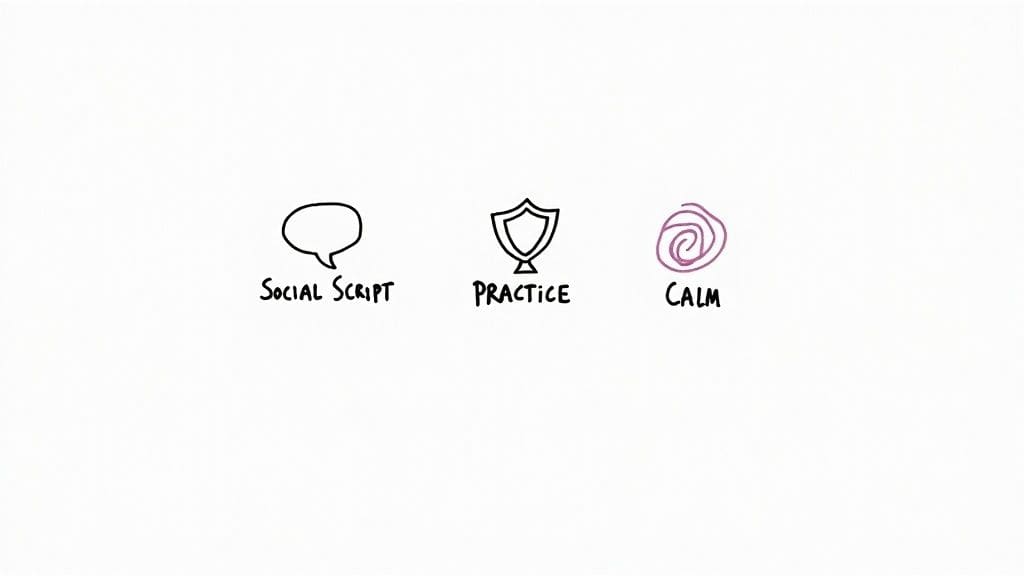
Think of Social Scripts as conversational roadmaps. They give you clear, ready-to-use phrases for navigating common situations that can otherwise feel like a minefield—things like small talk at work, setting a boundary, or making a phone call to book an appointment.
Instead of feeling completely lost for words, you have a solid starting point. A quality app will offer a library of scripts you can adapt to your own communication style, so you can sound authentic, not robotic. This is a fundamental feature in any truly useful support tool.
> The goal of a social script isn't to make you sound like everyone else. It's to give you the foundation you need to communicate your own thoughts clearly and confidently, reducing the mental energy it takes to participate in social interactions.
For those who want to dig deeper, there are many digital communication tools for autism that expand on these ideas, offering different ways to build conversational skills.
Practice Modes and Safe Rehearsal Spaces
Practice Modes offer a safe, judgment-free zone to rehearse conversations before they actually happen. It's like a flight simulator for social interactions—you can try out different approaches, tones, and phrases without any of the real-world consequences.
This feature is incredibly valuable for dialing down the anxiety around high-stakes events like a job interview or a difficult conversation. It lets you build muscle memory for social situations, making the real thing feel far less intimidating. You can walk in feeling prepared, not ambushed.
Calming Tools for Emotional Regulation
Many autistic and neurodivergent people experience sensory overload or intense emotions. Integrated Calming Tools provide immediate, discreet support right when you need it most. These aren't just generic mindfulness exercises; they are designed for quick, in-the-moment relief.
Some of the most common and effective calming tools include:
* Guided Breathing Exercises: Simple, timed breathing patterns to help regulate your nervous system when it starts to spin out.
* Visual Stims: Engaging and soothing animations or patterns that can help with focus and reduce that feeling of overwhelm.
* Grounding Techniques: Prompts that guide you to focus on your physical senses, anchoring you in the present moment.
Looking for apps designed for autism? tonen can help.
tonen gives you 188+ conversation scripts, tone guidance and calming tools — designed for autistic adults, ADHD and social anxiety. Try it free for 7 days.
Download on the App StoreiOS only. Android coming soon.
These features make an app a true support system, helping you manage challenges as they arise. They are essential for turning a good app into a great one.
Who Benefits Most from These Digital Tools
While we often use the umbrella term "app for autism," the reality is these tools support a whole spectrum of people, each with their own unique goals and hurdles. It's this adaptability that makes them so powerful, offering the right kind of support at just the right time.
For autistic adults, these digital tools can feel like a lifeline, especially at work. They help decode the unspoken rules of office small talk, offer a framework for nerve-wracking performance reviews, and build confidence for team meetings. An app with scripts and a private practice mode can take the edge off the social anxiety that so often holds people back in their careers.
This support extends well into personal life, too. These apps can help you set boundaries with family, navigate the sensory chaos of a social gathering, or just find the right words to start a conversation. It's all about fostering independence and letting you engage with the world on your own terms.
Support for Teens and Young Adults
Teens with ADHD or social anxiety also get a huge amount of value from these apps. The structured, private space of an app is the perfect place to practice crucial social skills without the real-world fear of saying the wrong thing. It's a safe sandbox for building the foundations they'll need in adulthood.
Imagine a teen who's terrified of giving a class presentation. With an app, they can rehearse their speech, practice answers to questions they might get, and use built-in calming tools to manage their nerves. It turns a nightmare scenario into something they can actually handle.
> These apps function as a personal coach, providing repeatable, low-pressure practice that helps build social and emotional muscle memory. The goal is to make challenging situations feel more predictable and less overwhelming.
To see how this fits into the bigger picture, it's helpful to explore resources for understanding autism and schooling.
Who Else Can Benefit
A high-quality app for autism often ends up helping a much wider group of people—folks who might not be autistic but face similar communication challenges.
* Individuals with social anxiety: They can use practice modes to rehearse for specific events, like parties or networking functions, which helps dial down that pre-event stress.
* Introverts: These apps can provide scripts for situations that drain social energy, making necessary interactions more efficient and less taxing.
* Parents supporting neurodivergent teens: They can use the app alongside their child to model and practice communication strategies together, turning it into a collaborative tool.
The real strength of this technology is how it molds to the user. Whether it's an autistic adult climbing the career ladder or a teen just trying to find their footing, the right tool offers practical, genuinely helpful support. For adults looking for more specific solutions, exploring a range of apps for autistic adults can be a great next step.
How To Choose The Best App For Your Needs

With so many apps out there, picking the right one can feel like a job in itself. The trick isn't to find the most popular tool, but the one that genuinely fits your brain and your life. It's about finding a support system that clicks, not just another piece of software to manage.
Let's break down a practical way to sort through the noise and find something that will actually help.
The absolute first thing to look at is usability. Does the app feel calm and intuitive when you open it? An interface cluttered with confusing menus, jarring colors, or unexpected sounds can create more stress than it solves. You'll know a good one when you see it—it feels like a supportive partner, not another puzzle you have to figure out.
Evaluating Key Criteria
Beyond a clean look, a few other things are non-negotiable for finding a safe and genuinely useful tool. Taking a moment to check these points can save you from downloading something that's unhelpful or, even worse, insecure. A little method goes a long way here.
Here are the core areas to dig into:
* Privacy and Security: Where is your data going? A trustworthy app will have a clear, easy-to-read privacy policy. Look for apps that do their processing on your device instead of sending your personal notes and conversations to the cloud. Your private thoughts should stay private.
* Evidence-Based Design: Was this app built on solid ground? The most effective tools are often rooted in established principles, like Cognitive Behavioral Therapy (CBT) or proven social communication models. Check the developer's website. Do they mention working with clinicians, researchers, or autistic people? That's a very good sign.
* Customization and Flexibility: Can you make it yours? Neurodiversity means that a one-size-fits-all approach is doomed to fail. A great app lets you tweak scripts, adjust sensory settings, and personalize the whole experience. That adaptability is what makes a tool go from "okay" to "I can't live without this."
> When you're comparing options, remember this: the best app is the one you will actually use. Always lean toward the tools that feel comfortable, secure, and truly aligned with what you want to achieve.
Sorting through these details for different tools can get complicated. For parents weighing their options, this guide to comparing online learning programs offers a great framework that can be adapted for evaluating support apps, too.
To make this process even more straightforward, you can use a simple checklist to keep track of your findings as you compare different apps.
App Evaluation Checklist
This checklist helps you systematically compare apps based on the criteria that matter most. Rate each factor on a scale of 1 (poor) to 5 (excellent) to get a clearer picture of which tool is the best fit.
| Evaluation Criteria | Questions to Ask | Rating (1-5) |
|---|---|---|
| Usability & Sensory Experience | Is the interface clean and intuitive? Is it free of sensory overload (e.g., loud sounds, flashing colors)? | |
| Privacy & Security | Is the privacy policy clear? Does the app process sensitive data locally on my device? | |
| Evidence-Based Design | Is the app based on recognized principles (CBT, etc.)? Was it developed with expert or community input? | |
| Customization & Flexibility | Can I personalize settings, scripts, or features to match my needs and preferences? | |
| Developer Support & Updates | Does the developer offer support? Is the app updated regularly to fix bugs and add features? |
Using a structured approach like this turns a vague search into a clear decision-making process. It helps you move past the marketing and focus on whether an app will genuinely work for you.
Ultimately, choosing the right support tool is a personal decision. By focusing on usability, privacy, evidence, and customization, you can confidently pick a tool that provides real, meaningful support. If your primary goal is building conversational confidence, taking a closer look at different communication apps for autism can give you even more specialized options to consider.
Putting Autism Support Apps into Action

It's one thing to talk about these apps in theory, but where do they actually fit into daily life? Let's move from the abstract to the practical. These tools are designed to provide real, in-the-moment support that can make a huge difference in managing stress and building genuine confidence.
Think about preparing for a job interview. The pressure is on, and it's easy for your mind to go blank. Instead of just spinning in anxiety, you could use an app's practice mode to rehearse your answers to common questions. It's a low-stakes way to build conversational muscle memory.
Or, picture this: you're in a noisy supermarket. The lights are buzzing, the sounds are clashing, and you can feel a meltdown approaching. This is where an app with calming tools becomes a discreet lifeline, guiding you through a quick breathing exercise right there in the aisle.
A Practical Example with tonen
The tonen app is a perfect example of these principles in action. It's built around a library of over 188 social scripts for situations that can feel impossible, from navigating work meetings to handling family gatherings. You can privately rehearse conversations in its practice mode, getting you ready for the real thing.
Where tonen really shines is with its AI-powered features. It gives you real-time feedback and suggestions, helping bridge that frustrating gap between knowing what you want to say and actually saying it with confidence. The entire focus is on making conversations smoother and less of a drain on your social battery. Exploring different tools for developing autism conversation skills can give you even more strategies to use alongside an app like this.
> The real power of an app like this is its immediacy. It's a structured support system that's right there when you need it, empowering you to handle social challenges with less anxiety and more control.
Where These Apps Are Gaining Traction
The availability and design of an app for autism are also shaped by what's happening globally. Right now, North America is the biggest player, holding about 59% of the market share in 2024, largely thanks to its strong healthcare infrastructure and early adoption.
But the fastest growth is actually happening in Europe and the Asia-Pacific region as digital access and awareness expand. This really influences how apps are developed and used. You'll often see North American and European schools and clinics integrating these tools into their support systems more quickly, showing just how essential they're becoming worldwide.
Common Questions About Apps for Autism
It's completely normal to have questions when you're looking into an app for autism. This kind of tech is becoming more common, but figuring out its real-world purpose, whether it's backed by actual science, and how it fits into a bigger support plan is key.
Let's cut through the noise and get straight to the answers for the questions people ask most often. Getting clear on this stuff helps you move from just being curious about these tools to feeling confident you're picking the right one.
Are These Apps a Replacement for Therapy?
No, and it's a really important distinction to make. These apps are best thought of as supplementary tools, not replacements for a human therapist. Think of an app like a personal trainer you can access anytime to practice the skills your therapist or coach is helping you build.
They're designed to reinforce what you learn in sessions. For example, you could practice a tricky conversation between appointments or use a calming tool to get through an overwhelming moment at the grocery store. This kind of consistent, on-demand support can actually speed up your progress.
> These apps provide an accessible way to build confidence consistently. They fill the gaps between therapy sessions, making skill development a continuous part of daily life rather than something that only happens once a week.
While they don't replace therapy, they can make it much more effective. Some research has shown that apps designed for home use, like those helping with motor skills, can reduce the burden on families by offering flexible, evidence-based support without needing constant trips to a clinic.
How Can I Tell if an App Is Based on Evidence?
This is a great question. Distinguishing a well-designed tool from a simple game comes down to looking for transparency from the developers. The best app creators work with clinicians, researchers, and—most importantly—autistic people themselves.
When you're checking out an app's website or the "About" section in the app store, look for a few clues:
* Mentions of Evidence-Based Practices: Do they talk about proven methods like Cognitive Behavioral Therapy (CBT), social skills training models, or other established strategies?
* Expert Collaboration: Do they list any clinical advisors, therapists, or university partners who helped create the app?
* Community Input: Do they mention that they actually worked with autistic adults or families to shape the features and make sure it's genuinely useful?
Be wary of any tool that makes huge promises without showing its work. Genuine tools are built on a solid foundation of research and lived experience, and their creators are usually proud to share that.
Can Adults Benefit from These Apps?
Absolutely. While a lot of the early apps were focused on kids, we're now seeing a wave of powerful tools designed specifically for autistic teens and adults. These apps get into the more complex social situations that come with being a grown-up.
Modern apps can help with challenges unique to adult life:
* Workplace Communication: Figuring out how to navigate team meetings, ask for clarification without feeling awkward, or handle a performance review.
* Professional Networking: Getting ready for an industry event or an informational interview.
* Dating and Relationships: Finding the right words for those difficult or intimate conversations.
Features like AI-driven conversation practice and discreet, in-the-moment emotional regulation tools are geared toward adult users. They offer support that grows with you, recognizing that building social confidence is a lifelong journey.
What Is the Typical Cost of These Apps?
The cost really runs the gamut, depending on how complex the app is. Some of the simpler tools might be free or have a small, one-time price, which is great for just trying out a basic concept.
More advanced apps, especially the ones that use AI to give you personalized feedback, usually work on a subscription model. This allows the developers to keep updating the app, adding new features, and providing support. A lot of these subscription apps offer a free trial period, which is the best way to see if a tool is a good fit for you before pulling out your wallet.
When you're looking at the price, think about the value it's offering. Consider the depth of the features, the quality of the user support, and whether the app's whole approach lines up with your goals. The right tool is an investment in your own well-being and confidence.
If you're ready to see how a dedicated app can support your communication goals, tonen offers a practical and private way to build skills. With a library of social scripts, a safe practice mode, and in-the-moment calming tools, it's designed to help you navigate conversations with less stress. Start your 7-day free trial today.
Frequently asked questions
This guide covers app for autism: empowering communication and social skills with practical, neurodivergent-friendly strategies—clear steps, scripts where useful, and ways to reduce anxiety or overload rather than vague "be confident" advice.