Learning how to handle conflict in relationships can feel utterly exhausting, especially if you're neurodivergent. The key is to shift from reactive arguments to proactive communication by preparing before conversations, using clear "I" statements, and agreeing on a "pause" signal to prevent emotional overwhelm. For neurodivergent individuals, this means creating structure and predictability to navigate disagreements with more confidence and less anxiety. Instead of just "talking it out," which can trigger sensory overload or a shutdown, this guide provides a practical toolkit with concrete, actionable strategies that work with your neurotype, not against it.
An unexpected argument can easily trigger sensory overload, emotional flooding, or a complete shutdown. The standard advice completely misses the point for those of us with autism, ADHD, or social anxiety. It's like being told to run a marathon when you haven't even been shown how to tie your shoes.
This guide is different. We're skipping the generic tips and focusing on building a practical toolkit for navigating disagreements with more confidence and less anxiety.
The goal isn't to get rid of conflict—that's a normal, even healthy, part of any partnership. It's about transforming it from something you dread into a real opportunity for connection and understanding.
Your Guide to Calmer Conversations and Stronger Bonds
Shifting your approach from reactive arguments to proactive communication is the single most powerful thing you can do. It means preparing before a conversation starts, knowing your sensory and emotional needs, and using language that is clear and direct.
Instead of letting a simple disagreement spiral out of control, you can learn to hit the pause button, use techniques to calm your nervous system, and go into a discussion with a single, clear objective.
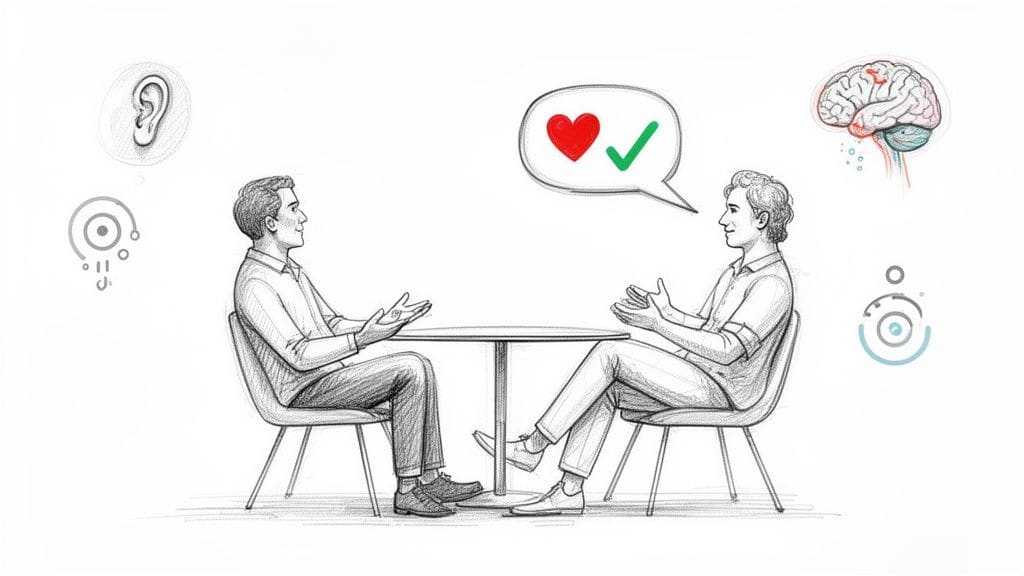
Why a Proactive Mindset Is a Game-Changer
Moving from a reactive to a proactive mindset is the cornerstone of healthier conflict resolution. When we're reactive, we're on the defensive. We misunderstand things, emotions escalate, and nobody feels heard. A proactive strategy, on the other hand, is all about planning, setting intentions, and using tools to keep the conversation from derailing.
This shift is especially powerful if you're neurodivergent.
This table breaks down the core mindset shift needed to handle disagreements more effectively.
Mindset Shift From Reactive to Proactive Conflict Handling
This is a quick overview of the core mindset changes that make all the difference, especially when you're navigating neurodivergent needs.
| Reactive Approach (What to Avoid) | Proactive Strategy (What to Do Instead) |
|---|---|
| Jumping into discussions unprepared and emotionally charged. | Planning the conversation with a single, clear goal in mind. |
| Getting defensive and blaming the other person. | Using "I" statements to express your feelings and needs. |
| Letting the conversation spiral into multiple unrelated topics. | Sticking to one specific issue at a time. |
| Pushing through even when feeling overwhelmed or flooded. | Agreeing on a "pause" signal to take a break and calm down. |
| Ending the argument with no clear resolution or next steps. | Creating a follow-up plan to prevent the same issue from repeating. |
Making this mental switch isn't about being perfect; it's about giving yourself the structure and predictability you need to feel safe during difficult conversations.
Building Your Conflict Toolkit
Throughout this guide, we're going to stock your toolkit with everything you need for this new approach. You'll learn how to:
- Prepare Before You Talk: Define one clear objective for your discussion. This is key to preventing it from turning into a laundry list of past grievances.
- Use Specific Communication Tools: Master "I" statements and active listening techniques that are adapted for neurodivergent communication styles—no mind-reading required.
- De-escalate and Co-regulate: Learn to spot the early signs of overwhelm in yourself and your partner and use a "pause button" before emotions hijack the conversation.
- Follow Up and Set Boundaries: Create actionable plans so you're not having the same fight over and over, and learn to establish boundaries that are clear, kind, and respectful.
You can practise one small change at a time: make a specific request, listen to the answer and agree a next step.
Every small step you take toward calmer, more structured communication is an investment in a stronger, more resilient partnership. By learning a new way to handle disagreements, you're not just solving a problem—you're nurturing the long-term health of your relationship.
Prepare for the Conversation Before It Begins
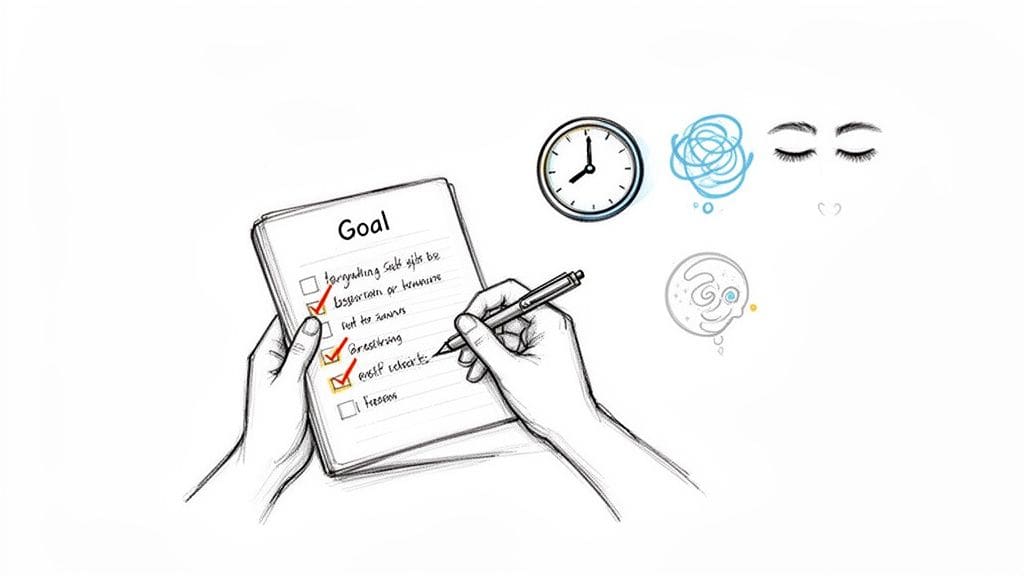
One of the most effective ways to handle conflict in relationships is to do the work before a single word is ever spoken. For so many of us, getting pulled into an unexpected, high-stakes conversation feels like an ambush. It's a fast track to sensory overwhelm or a full-on cognitive shutdown.
Doing some prep work beforehand gives you a sense of control and a stable foundation to stand on. This isn't about scheming to "win" an argument. It's about setting yourself up for a conversation where you can actually be heard and avoid getting derailed by emotional flooding.
Figure Out Your One Core Objective
Before you even think about what to say, ask yourself one critical question: What is the single most important thing I need to resolve here?
Conflict often feels like a giant, tangled ball of yarn full of past grievances, hurt feelings, and unspoken needs. If you have ADHD, your brain might be tempted to pull on every single one of those threads at once.
Don't do it. Your goal is to pick one clear, specific, and achievable objective for this one conversation. Trying to solve everything at once is a recipe for getting completely overwhelmed.
What does a clear objective actually look like?
- Vague: "We have to talk about the chores."
- Clear: "I need us to agree on a fair and predictable way to handle grocery shopping and cooking each week."
- Vague: "You're always late."
- Clear: "I need us to make a plan for being on time to important family events. When we're late, I feel anxious and disrespected."
This single objective becomes your anchor. When the conversation starts to drift—and it probably will—you can gently guide it back to the core issue. It keeps the discussion from turning into a free-for-all about every frustration you've ever had.
Use Self-Regulation Strategies First
Walking into a tough conversation when your nervous system is already buzzing is like trying to have a heart-to-heart in the middle of a fireworks display. It just won't work.
Before you engage, give yourself at least 15-20 minutes to self-regulate. Research shows that being physiologically calm is essential for effective problem-solving. When you're calm, you can think. When you're flooded, you're just in survival mode.
> A critical requirement for all stages of problem-solving to be effective is the capacity for both partners to be emotionally calm enough to stay present, think, and work through the issue at hand. Developing this skill can help ensure that learning and increased understanding are the outcomes.
Try these pre-conversation calming techniques:
- Notice your surroundings: If it feels useful, name a few things you can see or feel. Skip uncomfortable sensory prompts.
- Breathe gently: Let your breathing settle at a comfortable pace without forcing deep breaths or breath holds.
- Choose comfortable sensory support: Hold a familiar object or move somewhere quieter if you want to.
These aren't just fluffy "self-care" tips. They are practical tools for managing the body's stress response, which is often much more intense for autistic people or those with sensory processing sensitivities.
Create a Simple Script
The fear of your mind going blank or saying the absolute wrong thing is real. For those with social anxiety or autism, scripting can be a game-changing accommodation. This isn't about being robotic; it's about building a safety net so your working memory isn't overloaded trying to find the "right" words in a stressful moment.
If you want to dive deeper into this, our article on talking through difficult topics has more great strategies.
Your script doesn't need to be a long monologue. Just focus on a few key phrases:
1. Your Opening Line: This sets the tone. For example: "I'd really like to talk about how we manage our finances together. I've been feeling stressed about it, and I want to figure out a solution as a team."
2. Your Key "I" Statement: This clearly states your feelings and your needs. For instance: "I feel overwhelmed when our weekend plans change at the last minute. I need more predictability to manage my energy."
3. Your Desired Outcome: This brings it back to your core objective. For example: "My goal here is for us to create a shared calendar so we're both on the same page and know what to expect."
Having these simple phrases ready frees up your brainpower to actually listen to your partner, instead of getting stuck inside your own head. Preparation is easily the most overlooked—but most critical—step in learning how to handle conflict in relationships in a healthy way.
Struggling with conflict in relationships? tonen can help.
tonen offers conversation scripts, Reply Helper, Perspective Helper, Debrief, Phone Call Mode and Calm Kit. Start with 21 free scripts on iPhone. Optional Premium unlocks more features.
Download on the App StoreAvailable on iOS.
Navigate the Discussion with Clear Communication Tools
When you're right in the middle of a tough conversation, even the best preparation can fly out the window. That in-the-moment stress is real. This is where having a few solid, practical tools in your back pocket makes all the difference, especially when you're figuring out how to handle conflict in relationships.
Think of this section as your toolbox for the discussion itself. These are concrete techniques designed to prevent spirals and help both of you actually feel heard. They're specifically chosen to lower the cognitive load that can easily lead to a shutdown or emotional flooding, making the whole dialogue feel more accessible and productive.
Master the "I" Statement
The "I" statement is a classic for a reason, but it's often taught in a way that feels robotic or even passive-aggressive. The real goal is simple: talk about your feelings and needs without pointing fingers. It shifts the conversation from what they did to how it landed with you.
For neurodivergent folks, this tool is gold because it lets you be direct without being perceived as blunt or critical. It helps you get your point across clearly while softening the delivery.
Scenario: The endless disagreement over chores.
- Instead of: "You never help with the dishes. It's so unfair." This is a "you" statement, and it's practically an invitation for a defensive argument.
- Try this: "I feel overwhelmed and unsupported when I see the sink full of dishes after a long day. I need us to share that responsibility." This is undeniable—it's your feeling and your need.
Adapt "I" Statements for Your Brain
Let's be real, generic scripts don't always cut it. You can and should tweak "I" statements to fit your specific neurotype.
- For ADHD Challenges (Staying on Topic): "I'm feeling my thoughts start to race, and I'm worried I'll lose track of my point. I need to stay focused on how we can create a schedule for chores."
- For Autistic Communication Styles (Directness): "I need to be direct to make sure I'm being clear. I feel stressed when our shared spaces are messy. Can we make a clear, visual chart for who does what?"
If this approach resonates, you might find our guide on communication tools specifically for autism useful for a deeper dive.
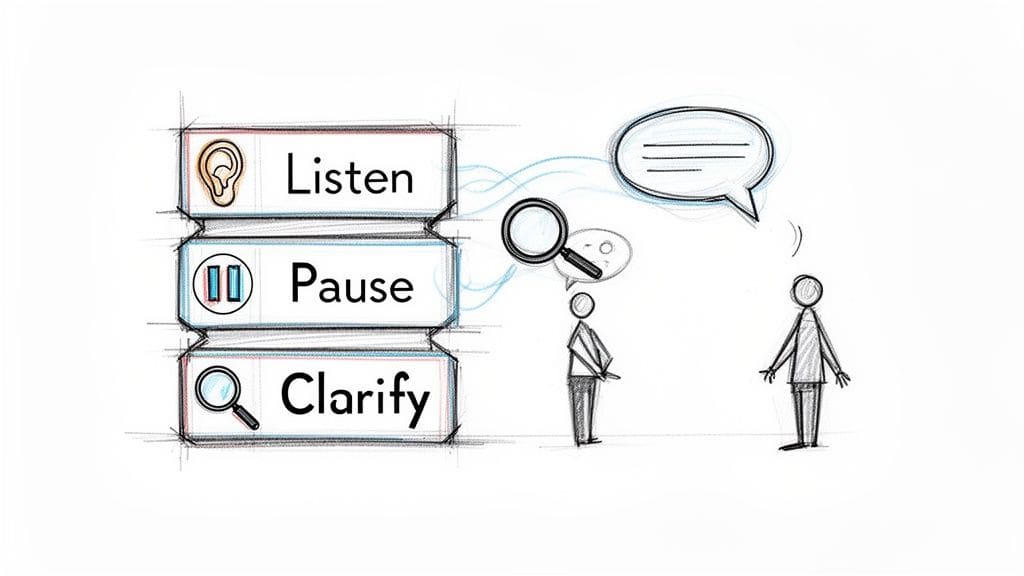
Use the Listen, Pause, and Clarify Framework
Active listening isn't just about being quiet while waiting for your turn to talk. It's about genuinely trying to understand. For neurodivergent brains, processing verbal information in real-time can be a heavy lift.
The Listen, Pause, and Clarify framework breaks it down into manageable chunks.
1. Listen: Give them your full attention. Try to tune into the core message, not just the individual words.
2. Pause: Before you jump in, just take a breath. That tiny gap is enough to stop a reactive reply in its tracks and give your brain a beat to process.
3. Clarify: This is the most important part. Repeat back what you think you heard to make sure you've got it right.
Put It Into Practice
Let's see what this framework looks like when the stakes are high.
Scenario: A disagreement over social plans.
- Partner: "You always say you don't want to go out with my friends. It feels like you don't even care about them."
- You (Listen): You hear their frustration and the real hurt underneath—the feeling that you don't care.
- You (Pause): You take a silent beat. No immediate defense.
- You (Clarify): "What I'm hearing is that when I turn down invitations, it makes you feel like I don't value your friends. Is that right?"
This one move does so much. It validates their feelings and gives you a chance to respond to their actual concern, not just what you assumed they meant. It's a foundational skill for learning how to handle conflict in relationships without making things worse.
Introduce the "Pause Button"
Sometimes, no matter how good your tools are, things get too heated. Your nervous system takes over. This is where a pre-agreed "pause button" can be a relationship-saver. It's a signal—a word, phrase, or gesture—that either person can use to call for a time-out.
This isn't about storming off. It's a collaborative tool for co-regulation.
How to set it up:
- Agree on a Signal: Choose something neutral like, "Let's pause," or "I need a break."
- Set a Timeframe: Decide on a specific time, like 15 or 20 minutes. This isn't an indefinite walk-off.
- Define the Break's Purpose: The break is for calming down—not for stewing, rehearsing your next point, or building a case.
It's vital to learn evidence-based ways to speak up without guilt to foster clear communication. The "pause button" is one of the kindest boundaries you can set, protecting both of you from saying things you'll later regret. Building these safety nets is what learning how to handle conflict in relationships is all about.
De-Escalate When Things Get Heated
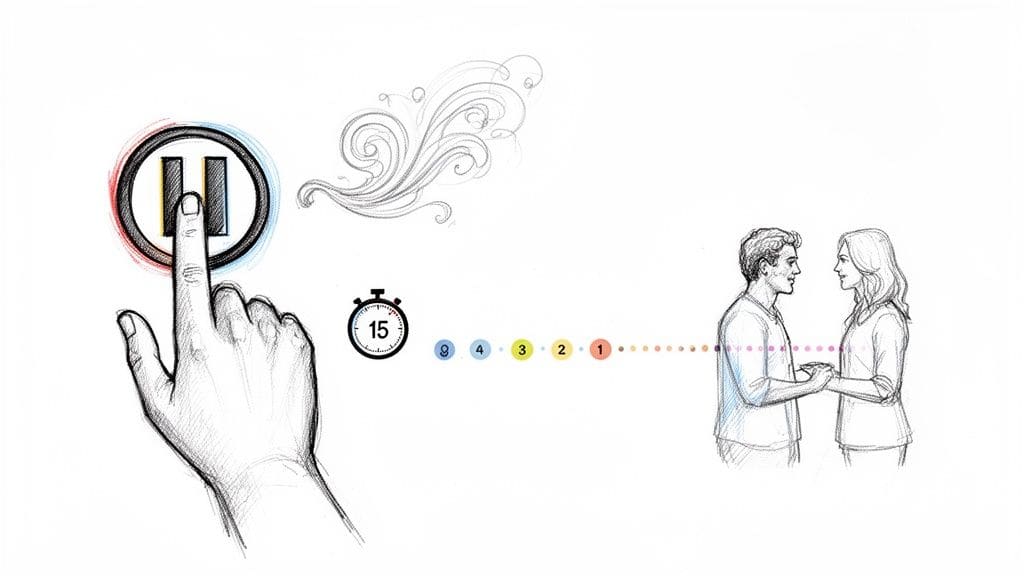
Even with the best preparation, emotions can boil over. Knowing how to handle conflict in relationships means having a plan for when things get intense.
De-escalation isn't about surrendering or ignoring the problem. It's a crucial skill for preventing emotional flooding—that awful state where your thinking brain checks out and your fight-or-flight response takes over. This is your practical guide to hitting pause, calming your nervous system, and coming back to the conversation without reigniting the fire.
The first step is learning to spot your own signs of overwhelm. These are the physical and mental red flags that your system is hitting its limit. Catching them early lets you act before you're completely flooded.
Recognize Your Overwhelm Cues
Think of these as your body's early warning system. They're unique to you, and recognizing them is a critical self-advocacy skill. Your cues will be different from your partner's, so self-awareness is everything.
What might these look like?
- Physical Sensations: A racing heart, tightness in your chest or throat, ringing in your ears, or feeling suddenly hot or cold.
- Mental Changes: Thoughts speeding up, your mind going totally blank, or an intense urge to just end the conversation at any cost.
- Behavioral Urges: The impulse to physically withdraw (shut down), pace the room, or raise your voice.
As soon as you notice these signs, it's time to call for a break. This isn't running away; it's a mature, necessary step to keep the conversation productive.
How to Call a Time-Out Respectfully
Calling a pause isn't the same as stonewalling. The difference is the intention and the communication. A respectful time-out is a collaborative move made to protect the relationship.
The key is to use a pre-agreed phrase and set a clear timeframe. An indefinite break can feel like abandonment, so be specific.
Here are a few scripts you can adapt:
- "I'm starting to feel overwhelmed and I need to pause. Can we take 15 minutes and then come back to this?"
- "My brain is shutting down, and I can't process what you're saying right now. I need a short break to calm down."
- "I really want to solve this with you, but I'm too activated. Let's take 20 minutes apart and then try again."
> Research confirms that physiological soothing is essential for effective problem-solving. A 20-minute break allows your body to return to a more relaxed state, making it possible to think clearly and re-engage constructively instead of reacting out of pure emotion.
Use Your Break for Active Calming
What you do during the time-out is just as important as calling it. The goal is active self-regulation, not just stewing in anger or rehearsing your next argument. This is a crucial skill for anyone wanting to truly understand how to regulate emotions under pressure.
Pick a calming strategy that works for your specific sensory profile.
- Deep Breathing: The 4-7-8 breath is powerful. Inhale for 4 seconds, hold for 7, and exhale slowly for 8. This directly activates your body's "brake pedal"—the parasympathetic nervous system.
- The 5-4-3-2-1 Grounding Method: Name 5 things you see, 4 you can touch, 3 you can hear, 2 you can smell, and 1 you can taste. This pulls your attention out of the emotional storm and back into your physical environment.
- Sensory Reset: Do something that you find genuinely soothing. This could be listening to calming music, using a weighted blanket, or doing a few simple stretches.
When the break is over, re-engage gently. A great way to start is by thanking your partner for respecting the pause. Then, calmly restate your original, single objective. For example, "Thanks for taking that break with me. I'm ready to come back to figuring out a plan for our weekend schedule."
This focused return keeps you from slipping right back into the emotional heat that triggered the break in the first place.
Create a Follow-Up Plan and Set Lasting Boundaries
Getting through the immediate disagreement is a huge win, but the real work—the part that actually changes things for the better—is what you do next. Without a solid follow-up plan, you're basically just setting a timer for the same argument to happen all over again.
This final step is all about turning that one successful conversation into a lasting solution. It's how you reinforce that you're a team, not opponents.
The first move is simple: quickly summarize what you both agreed on. This makes sure you're on the same page and cuts down on future misunderstandings, which is a common pitfall when one or both partners interpret things very literally. A quick recap locks the resolution into place for both of you.
Build a Simple, Actionable Plan
Now it's time to turn that agreement into a concrete plan. This doesn't need to be some complicated, multi-page document. In fact, simpler is almost always better. The goal is to create a clear, tangible system that tackles the root of the problem head-on.
Let's say the conflict was about the mental load of figuring out what to eat every night.
- The Problem: One person is completely overwhelmed by having to make the dinner decision every single day.
- The Plan: "How about on Sunday afternoons, we spend 15 minutes together looking at recipes and making a dinner plan for the week? We can write it on the kitchen whiteboard so we both know what's coming up."
This plan is specific, it's visual, and it has a clear timeline. It completely removes the daily guesswork and anxiety that was causing the friction. For anyone with ADHD or executive function challenges, an external system like this can be an absolute game-changer. It gets the task out of your head and into the world.
Define and Communicate Your Boundaries
Think of boundaries as the invisible guardrails that keep your relationship feeling healthy and safe. They aren't about pushing someone away; they're about communicating what you need to feel respected.
This can be one of the toughest parts of learning how to handle conflict in relationships, especially if you struggle with social anxiety or have a history of people-pleasing. The key is to be kind but firm.
> Boundaries aren't selfish. They are a necessary form of self-advocacy that teaches others how to treat you. When you communicate them clearly, they build trust and stop resentment from quietly poisoning the partnership.
Here are a few scripts for setting boundaries gently but clearly:
- For Interruptions: "I really want to hear your thought, but I need to finish mine first so I don't lose it. Can you let me finish?"
- For Raised Voices: "I start to shut down when voices get loud. I need us to speak calmly, or I'm going to need to take a break from this conversation."
- For Unsolicited Advice: "I know you're trying to help, but right now I just need you to listen, not offer solutions."
Setting boundaries is a skill, and you get better with practice. For a deeper dive, our guide on how to set boundaries with friends has a lot of principles that apply just as well to romantic partnerships.
How to Respond When a Boundary Is Tested
The real test of a boundary comes when it gets pushed. How you respond in that moment is everything. Your job is to stay calm and consistent.
Imagine you've set a boundary about not having serious arguments over text, but your partner sends a fiery message.
- Instead of: Firing back a reply and getting sucked into a text war.
- Try This: "I care about what you're saying, and I want to talk about it. But I can't do it over text. Let's talk in person tonight when we can both give it our full attention."
This response validates their feelings while gently but firmly holding the line. Every single time you do this, you reinforce the boundary and teach your partner that you mean what you say. It's an act of respect for yourself and for the relationship.
Still Have Questions? Let's Talk Through It.
Navigating conflict is a messy, human process, and it's completely normal to have questions when you try to apply these strategies to your own life. Let's tackle some of the most common roadblocks, especially those that pop up for neurodivergent folks.
Think of this as a troubleshooting guide to give you a bit more clarity and confidence when you get stuck.
What If My Partner Is Unwilling to Try These Strategies?
This is a tough one. You can't force someone to change, but you can change your own approach.
Start by modeling the behavior yourself without any expectation that they'll do the same. Use clear "I" statements to talk about your own experience. You could try saying, "I feel really overwhelmed when our arguments get loud, and I'd like to try something different so we can actually hear each other."
Introduce one tiny, low-stakes change. Maybe it's agreeing on a non-verbal "pause" signal when things get too intense. If they're still resistant, it's okay to gently point out that the way you're currently handling conflict isn't working for you and is causing you real distress.
> A respectful and effective way to phrase this is: "When our disagreements escalate, I shut down and can't hear you. My goal is to find a way for us to talk so I can stay present and we can solve this together."
If you're still at a standstill, it might be time to bring in a professional. A therapist who understands neurodiversity can create a neutral space and offer tools that help you both communicate without the emotional baggage.
How Do I Handle Conflict If I Have Alexithymia?
When you struggle to identify or name your feelings (alexithymia), trying to use emotion-based language can feel impossible. The good news is, you don't have to.
Shift your focus from abstract emotions to concrete, physical sensations and your underlying needs. This is a brilliant workaround that skips the need for emotional labels and gets straight to the point: what's happening in your body, and what do you need to change?
You don't need a perfect emotional vocabulary to communicate effectively.
Here's what that looks like in practice:
- Instead of "I feel anxious," you could say, "My chest feels tight, and I need some space right now."
- Instead of "I feel dismissed," try, "I notice I'm stuck on this point. I need to know you hear my concern about the schedule."
This is a perfectly valid and powerful way to communicate your internal state. It's about being clear, not emotionally poetic.
What Should I Do If My Partner Calls My Scripts Robotic?
Oof. That can sting. This kind of feedback usually comes from a neurotypical expectation that all emotional expression should be spontaneous. The best way to address this is to have a conversation about it outside of a conflict, when you're both calm.
Explain that scripts aren't about being unfeeling; they're a tool that helps you process your thoughts and communicate clearly. Frame it as a necessary support that prevents you from getting overwhelmed and shutting down. It's how you show up for the relationship.
You could say, "I know it can sound formal, but planning my words helps me stay engaged with you instead of getting overwhelmed. It's how I can show up best for our partnership and make sure I say what I really mean." This reframes it from a perceived flaw into what it actually is: a deliberate act of care.
Feeling overwhelmed by social conversations is common, but you don't have to navigate it alone. tonen is a mobile app designed to help you communicate with less stress. With a library of scripts, a Perspective Helper to reframe situations, and a Calm Kit for when things get intense, tonen provides the practical tools you need. Build your confidence and find your words at https://usetonen.com.