Learning how to set boundaries at work is the key to protecting your energy, preventing burnout, and maintaining a healthy work-life balance. The most effective way to do this is by first identifying your personal limits (like your working hours or capacity for extra projects), then clearly and calmly communicating those limits to colleagues and managers using simple "I" statements, and finally, consistently holding those boundaries even if you face pushback. It's less about building walls and more about drawing a clear, kind line in the sand that enables you to do your best work sustainably.
If you're feeling stretched thin, that's your first clue: your boundaries need a tune-up. It might be the constant ping of late-night emails, a calendar packed with back-to-back meetings, or a coworker who always interrupts your focus time. These little things add up, slowly chipping away at your personal life until there's not much left. By 2026, knowing how to draw that line won't just be a wellness trend—it'll be a core survival skill for your career. This guide will show you how with practical, concrete steps.
Your Quick Guide to Setting Workplace Boundaries
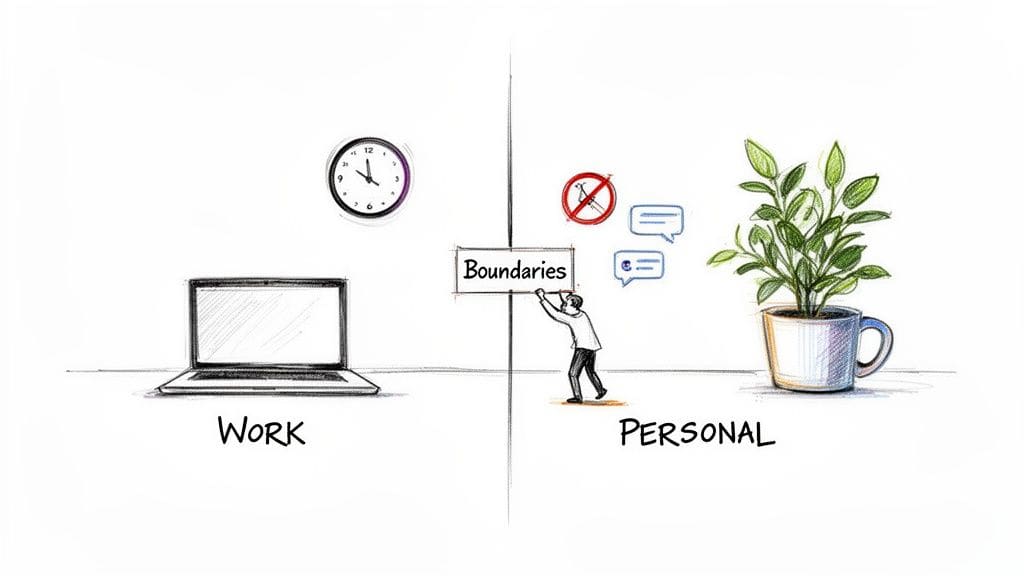
This isn't about being difficult or refusing to be a team player. It's about setting the conditions you need to do your best work. When you're proactive about it, you create a more predictable and respectful environment for everyone involved. A great first step is to get a clear picture of where you are right now; you can even assess your personal burnout risk to see which areas need the most attention.
Why Boundaries Matter More Now Than Ever
The whole "quiet quitting" trend threw a spotlight on a massive shift in work culture. It was never really about slacking off; it was about self-preservation. People started setting firm limits instead of constantly going above and beyond their job descriptions.
A LendingTree study found that among the 30% of US workers who see themselves as quiet quitters, 57% said their work-life balance got better because of it. For parents with young kids, that number shot up to 65%. It's solid proof that setting limits has a direct, positive impact on your life.
This guide will show you how to set those boundaries with practical, concrete steps. We'll cover:
* Pinpointing Your Limits: How to identify the exact moments and situations where your energy and time are being drained.
* Communicating with Clarity: Using pre-planned scripts to take the stress out of the conversation—a game-changer, especially for neurodivergent folks.
* Holding Your Ground: Learning to stay consistent with your boundaries, even when you get pushback.
Taking back control of your work life has a huge ripple effect on your well-being. When you consistently protect your time and energy, you cut down on the chronic stress that leads to burnout. If you want to dive deeper into that connection, you might find our other resources on https://usetonen.com/blog/mental-health-at-work really helpful.
Ultimately, the goal is to build a work routine that works for you—one that honors your needs without compromising your professionalism.
Define Your Limits Before You Ever Say a Word
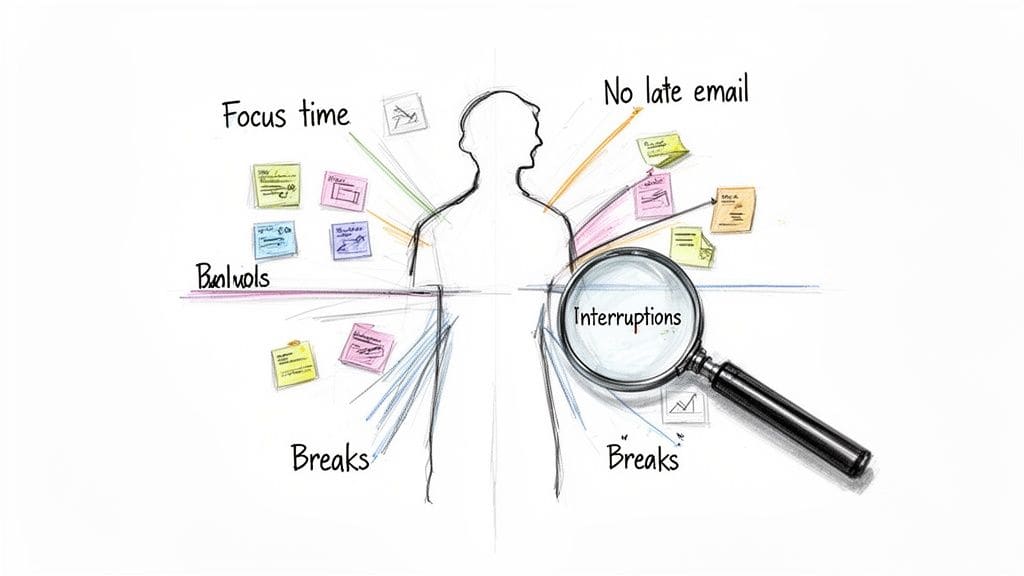
Here's something that might sound counterintuitive: the most powerful boundaries aren't built in a conversation. They're built in your own head first.
Before you even think about talking to a colleague or manager, you need to get crystal clear on your own limits. This internal work is the non-negotiable first step in learning how to set boundaries at work that actually stick. It's about figuring out what you truly need to stay productive and sane, so you can communicate those needs with real confidence.
The goal is to move past vague feelings like being "overwhelmed" or "always busy." Those feelings are valid, but they aren't actionable. We need to get specific. Think of yourself as a detective investigating your own workday to find the real culprits draining your energy.
Pinpoint the Exact Moments of Friction
Start by paying close attention to the small, recurring things that make you feel frustrated, resentful, or on the fast track to burnout. Often, it's not one big event but a series of tiny paper cuts that do the most damage. Keeping a simple log on your phone or in a notebook for a few days can be incredibly revealing.
What are you looking for? Think about common scenarios like these:
* The Never-Ending Task: That "small favor" you agreed to has quietly ballooned into a multi-hour commitment every week.
* The Constant Interrupter: A well-meaning coworker who pops by your desk for "just a quick question" multiple times a day, shattering your focus.
* The After-Hours Ping: Your manager sends emails or Slacks late at night, creating unspoken pressure to be "on" 24/7.
* The Impossible Deadline: You're consistently handed projects with timelines that assume you don't need to eat lunch or have a life outside of work.
Just identifying these specific situations is a huge first step. For neurodivergent professionals, this kind of proactive planning is especially powerful because it reduces the cognitive load of having to react to unexpected social demands in the moment.
Draw Your Personal Boundary Map
Once you've named the pain points, you can start defining what is and isn't okay for you. Think of this as your "personal boundary map." It's not a formal document you have to share; it's a mental framework you build for yourself. This is a critical part of figuring out how to set boundaries at work in a way that feels authentic to you.
> A boundary isn't about trying to change someone else. It's about deciding what you will and won't allow in your own space to protect your well-being and integrity.
To build your map, get really honest with yourself. For each pain point you identified, ask yourself a few clarifying questions:
* "What's the ideal outcome here?" (e.g., "I want to be able to log off at 5:30 PM without feeling a wave of guilt.")
* "Where can I be flexible?" (e.g., "I can take a truly urgent call after hours, but I can't be the go-to person for routine questions at night.")
* "What is a hard 'no' for me?" (e.g., "I am not available for work-related DMs on weekends. Period.")
This internal clarity is your secret weapon. When you're grounded in exactly what you need and why it's important, you're not going into a conversation to pick a fight. You're simply stating your professional needs. That shift changes everything.
Crafting Your Message with Scripts and Tone
Knowing what your boundary is is one thing. Actually saying it out loud to a colleague or manager is a whole different challenge. So much of the anxiety comes from not knowing what words to use.
The good news is, you don't have to improvise under pressure. The words you pick and the tone you use are just as important as the boundary itself, and having a plan for them can turn a tense moment into one of professional clarity. For many of us, especially in the neurodivergent community, having a few pre-planned scripts is a game-changer for reducing that in-the-moment panic.
The goal isn't to be aggressive. It's about being clear, kind, and firm. Mastering this communication piece is a huge part of learning how to set boundaries at work effectively.
Frame Your Needs with "I" Statements
One of the most effective, non-confrontational ways to state a boundary is by using "I" statements. This simple reframing shifts the entire focus of the conversation. Instead of sounding like you're accusing the other person of doing something wrong, you're simply stating what you need to do your job well.
It feels collaborative, not combative.
* Instead of: "You're giving me too much work."
Need help setting limits at work without guilt? tonen can help.
tonen gives you 188+ conversation scripts, tone guidance and calming tools — designed for autistic adults, ADHD and social anxiety. Try it free for 7 days.
Download on the App StoreiOS only. Android coming soon.
* Try: "My plate is full right now, and I need to focus on my existing priorities to do them well."
* Instead of: "You keep interrupting me."
* Try: "I need 30 minutes of uninterrupted focus time to finish this report. Can we connect after that?"
This isn't just about being polite; it's a smart strategy. It makes it much harder for someone to argue with your capacity or your needs, and it keeps the conversation centered on finding a productive path forward.
For more practical examples, we put together a full guide with additional scripts for setting clear boundaries in all sorts of work situations.
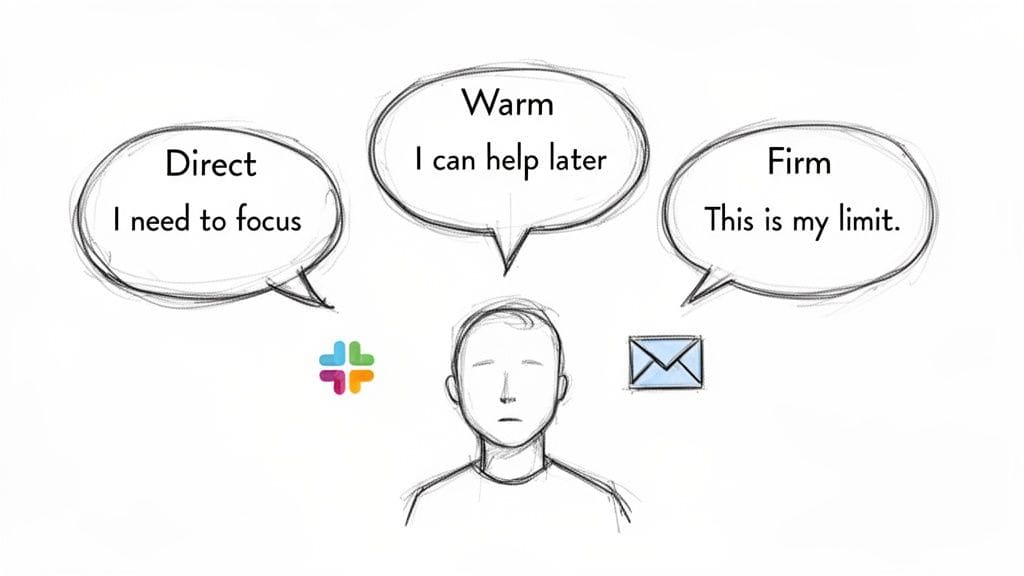
Choose Your Tone: Direct, Warm, or Firmer
There's no single "right" tone for setting a boundary. The best approach depends on your relationship with the person, the context, and whether this is the first time you've had to say something.
Think of it as having a few different communication modes you can switch between.
* Direct: Clear, professional, and straight to the point. This is perfect for everyday requests and setting initial expectations. It's neutral and efficient.
* Warm: Friendly, soft, and collaborative. This works best with colleagues you have a good rapport with. It softens the message while still being perfectly clear about your needs.
* Firmer: Still professional, but with zero ambiguity. This tone is reserved for when a boundary has been tested or ignored more than once.
> A boundary isn't a threat; it's a statement of what you need to be effective and well. The tone you choose helps convey that your goal is to protect your work and well-being, not to create conflict.
Boundary-Setting Scripts For Common Work Scenarios
To make this more concrete, here are a few scripts you can adapt. Notice how a few small word changes can completely shift the tone from warm and collaborative to direct and firm.
| Scenario | Direct Script | Warm Script | Firmer Script |
|---|---|---|---|
| A colleague adds a last-minute task. | "I can't take this on right now. My focus is on finishing the X project." | "I'd love to help, but my plate is full with the X project right now. Could we check back in tomorrow?" | "As I've mentioned, my priority is the X project. I cannot add anything else to my workload right now." |
| A manager asks you to work late again. | "I'm not available to work past 5:30 PM today." | "I need to stick to my planned hours today to stay on track for the week. I can pick this up first thing tomorrow." | "I need to maintain my 5:30 PM log-off time. This is a boundary I need to hold to avoid burnout." |
| You're being interrupted in a meeting. | "I'd like to finish my point." | "Great point. If it's okay, I'd just like to quickly finish my thought before we move on." | "I need to finish what I was saying." |
| Getting after-hours messages. | "I'm offline for the evening, but I'll review this tomorrow morning." | "Thanks for sending this over! I'm offline now but will get back to you on it during my work hours tomorrow." | "To protect my non-working hours, I do not respond to messages after 6 PM. I will address this in the morning." |
Having a few of these in your back pocket makes it so much easier to respond confidently when you're put on the spot. You can adjust the language to sound like you.
Time to Rehearse: Practice and Pushback
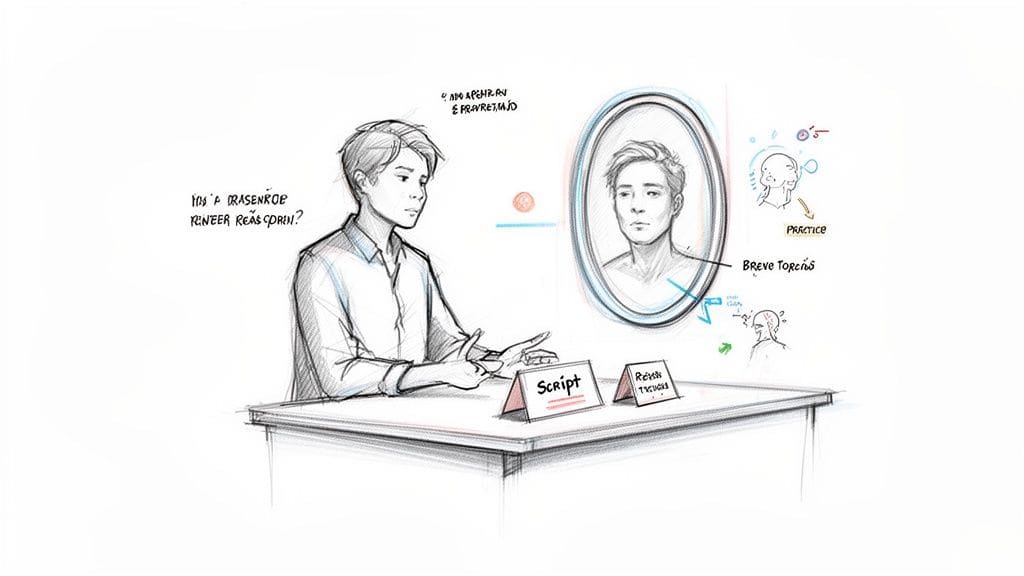
Knowing the right words is a great start, but true confidence comes from being able to say them calmly when you're actually on the spot. This is where rehearsal becomes your superpower.
Practicing what you plan to say builds a kind of muscle memory for your mouth and your mind. It makes the words feel less foreign and dials down the anxiety that can spike in confrontational moments. This is a critical step for anyone learning how to set boundaries at work, but it's an absolute lifeline for neurodivergent folks, since an unexpected reaction can be especially dysregulating.
Practice in Private to Build Your Confidence
Your first step is simple: say the words out loud. Just to yourself. Find a private space—your car during lunch, an empty office, or your bathroom mirror—and run through your script.
Pay attention to how it feels. Does it sound like you? The point isn't to become a script-reading robot. It's to internalize the core message so you can deliver it with quiet confidence, even if your heart is pounding. For a closer look at these techniques, our article on how to practice conversations to reduce anxiety has even more strategies.
> Rehearsal isn't about memorizing a perfect script. It's about grounding yourself in your message so you can stay clear and steady when a real situation kicks off.
Get Ready for Pushback
Let's be real: people don't always love new boundaries. You might be met with surprise, a guilt trip, or even frustration. Having a plan for these reactions is what separates a boundary that sticks from one that crumbles.
When someone tests your limit, your only job is to calmly restate it. Think of it as the "broken record" technique. You don't need to JADE (Justify, Argue, Defend, or Explain). You just repeat the core boundary, simply and firmly.
Have a few of these phrases ready to go for when someone doesn't take "no" for an answer:
* When they try a guilt trip: "I understand this timing is frustrating, but my focus is committed to other priorities right now. I need to hold that boundary."
* If they act surprised or confused: "I'm protecting my focus time in the mornings to get my deep work done. That's why I need to wait until after 3 PM to connect on this."
* When they just keep pushing: "Like I said, I'm not available for this right now. My answer is still no."
The key is to stay steady. Don't get pulled into a debate. You've stated your need, and now you're simply holding that line with respect. This consistency is everything—it shows you're serious about protecting your well-being.
Knowing When to Escalate and Involve Others
So, you've tried setting the boundary. You've been clear, you've been consistent, and you've even handled some pushback. But what happens when it's just not working? When your best efforts are consistently ignored, it's time to move beyond one-on-one conversations.
Knowing how to escalate is a crucial part of learning how to set boundaries at work without burning out. It can feel really intimidating, but think of it this way: escalation is just a formal, structured process to get support when direct communication isn't enough. It's not about getting someone in trouble; it's about protecting your well-being and your ability to do your job.
Having a plan for this gives you a sense of control back. It stops you from feeling stuck or helpless when repeated boundary violations start impacting your focus, performance, or mental health.
Document Everything Objectively
Before you even think about talking to a manager or HR, your first job is to create a clear, factual record of what's been happening. This is so important. Without documentation, it's just your word against theirs. A written log transforms a vague, frustrating situation into a measurable pattern of behavior.
This doesn't have to be complicated. Just start a simple log in a private document or notebook. For each time your boundary was crossed, jot down:
* The date and time: Be as specific as you can.
* What happened: Describe the event factually. Stick to what happened, not how you felt about it. For example, "Alex sent three Slack messages after 7 PM regarding the Q3 project," not "Alex was being annoying again."
* Who was involved: List the names of anyone present.
* Your response: Detail how you restated your boundary. For example, "I did not respond until the next morning at 9:15 AM."
* The outcome: Note their reaction or if the behavior simply continued.
Make sure to save any relevant emails, Slack DMs, or project management comments. This paper trail shows you've made a good-faith effort to solve the problem yourself before asking for help. Your objective evidence is your strongest asset.
Framing the Conversation With Your Manager or HR
When you're ready to escalate, how you frame the issue makes all the difference. The key is to present it as a professional issue that impacts work, not a personal complaint. This positions you as a proactive problem-solver and makes your manager an ally.
For instance, instead of saying, "Alex keeps interrupting me and I can't get anything done," try framing it around a business outcome: "I'm having trouble meeting my deadlines for the Q3 project because of frequent interruptions. I've tried to resolve it directly a few times, but it's still impacting my workflow, and I'd love your advice on how to handle it."
This approach isn't about tattling; it's about identifying a barrier to your performance and asking for help to remove it. It can be really helpful to learn how to advocate for yourself effectively in these moments to make sure your message lands clearly and professionally.
> Email Template for Escalation:
>
> Subject: Following up on a workflow issue
>
> Hi [Manager's Name],
>
> I'm writing to ask for your guidance on a workflow challenge. I've been experiencing consistent interruptions that are impacting my ability to focus on my key priorities, specifically [Project Name].
>
> I have attempted to address this directly by [mention your actions, e.g., 'scheduling focus time,' 'speaking with the colleague'] on [mention dates]. However, the issue continues, and it's affecting team productivity.
>
> Could we schedule a brief chat to discuss a solution? I am committed to finding a way forward that supports our team's goals.
>
> Thank you,
> [Your Name]
This kind of structured, professional approach is crucial. If your situation does lead to a more formal process, it's also smart to understand how companies typically handle these things. Getting a sense of their perspective on what to do when an employee files a formal complaint can give you valuable insight into what to expect.
Common Questions About Setting Boundaries at Work
Even with a solid plan, the real-world moments where you actually have to say the words can bring up a lot of fear and second-guessing. Those "what if" scenarios can be paralyzing.
You're not alone in feeling this way. Learning how to set boundaries at work is a skill, and like any skill, it involves troubleshooting. Let's walk through some of the most common tricky situations and exactly how to handle them.
What if My Boss Gets Angry When I Set a Boundary?
This is a big one, and the fear is completely valid. The most important thing you can do in this moment is stay calm and refuse to match their energy. A manager's angry reaction doesn't automatically mean your boundary is wrong or that you have to give in.
Instead, hold your ground calmly and professionally. Repeat your point using "I" statements that keep the focus on your workload and your commitment to doing good work.
* You could say: "I understand this is urgent. To make sure I can deliver high-quality work on my existing priorities, I can't take this on right now."
If their reaction feels unprofessional or crosses a line, it's really important to document it later. Just a quick note for yourself with the date, time, and what was said. If this becomes a pattern, that documentation is exactly what you'll need for a confidential chat with HR.
How Do I Set Boundaries Without Feeling Guilty?
Guilt is a powerful feeling, and it usually comes from a good place—that desire to be helpful and reliable. The trick is to reframe what a boundary actually is.
> Setting a boundary isn't an act of rejection; it's an act of self-preservation. You are protecting your energy so you can be a sustainable and effective contributor for the long haul. Burnout doesn't help anyone on your team.
Start small to build your confidence. Set one low-stakes boundary, like not checking email for the first 30 minutes of your day. Each time you stick to it, give yourself credit. As you start to feel the positive impact on your focus and well-being, that feeling of guilt will naturally start to fade.
Can I Set Boundaries if I'm New to a Job?
Yes, and honestly, it's one of the best times to do it. It's so much easier to establish healthy work patterns from day one than to try and reset expectations six months down the line. In 2026, this kind of proactive self-management is a huge sign of a self-aware and valuable employee.
You can set boundaries as a new hire in completely professional ways:
* When given multiple tasks, ask clarifying questions about which one is the top priority.
* Politely decline requests that are clearly way outside your job description.
* Be consistent with your start and end times right from the beginning.
Frame these actions as part of your commitment to doing your new job well. For example, saying, "As I'm still getting up to speed, could you help me understand which of these tasks is the highest priority?" shows responsibility, not resistance. For more on this, check out our guide on how to decline a work request politely while keeping your work relationships strong.
Ready to set boundaries with confidence and clarity? tonen gives you the scripts, tone options, and practice tools to communicate your limits effectively at work. Download the app today and start your 7-day free trial.
Frequently asked questions
This guide covers how to set boundaries at work: your 2026 guide to protecting your peace with practical, neurodivergent-friendly strategies—clear steps, scripts where useful, and ways to reduce anxiety or overload rather than vague "be confident" advice.