Knowing how to talk to your doctor about ADHD isn't just about what you say in the room; it starts long before that. A productive conversation hinges on having specific, real-world examples of how your symptoms are affecting your life, all backed up by organised notes. This evidence-based approach turns a vague chat into a consultation that gets you answers, making the process of seeking a diagnosis clearer and more effective.
Preparing for Your ADHD Conversation with a Doctor
The single best thing you can do is to walk into your appointment prepared. It's so easy to get flustered or forget crucial details on the spot. By organising your thoughts beforehand, you can paint a clear, compelling picture of your daily challenges for your doctor.
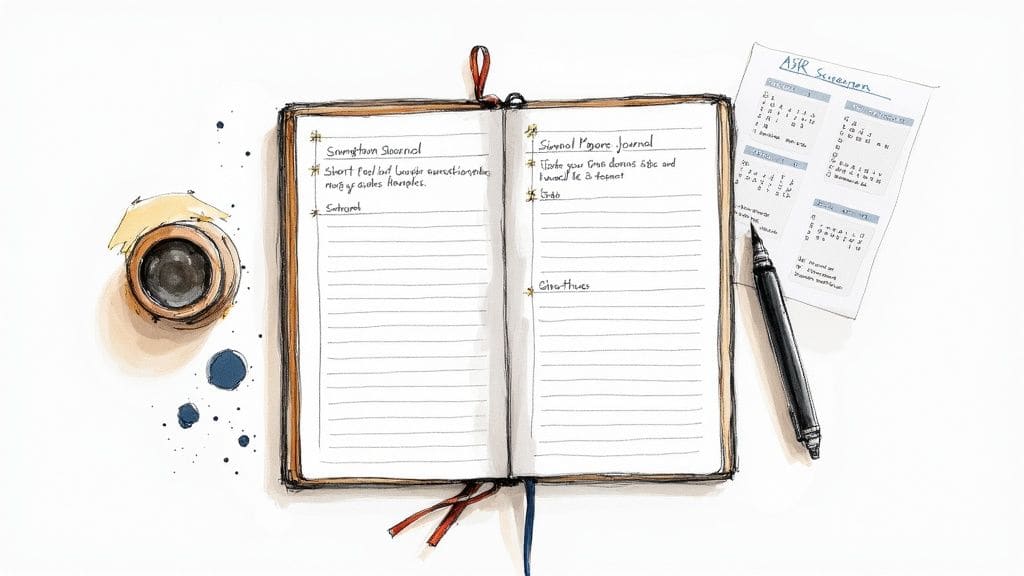
Document Your Symptoms with Specific Examples
A simple list saying "I'm forgetful" or "I can't focus" just doesn't cut it. To really show the impact, you need to capture concrete situations. A symptom journal will be your most powerful tool here.
Don't just write down a feeling. Describe the event, what happened as a result, and how it made you feel. That's the rich context your GP needs to understand your experience.
Think about these areas of your life:
Work or School: Jot down times you've missed deadlines, made careless mistakes on important stuff, or completely zoned out in meetings. For example: "Last Tuesday, I completely missed a project deadline because I forgot to put the final reminder in my calendar, causing the team to scramble."*
* Home and Daily Life: Think about the challenges with day-to-day tasks. Piles of laundry that sit for weeks? Constantly losing your keys or wallet? Forgetting to pay bills and getting hit with late fees? Write it all down.
* Relationships: Reflect on those moments where you've unintentionally interrupted your partner, realised you haven't heard a word they said, or found your emotions escalating over something minor.
Gather Supporting Historical Evidence
ADHD is a neurodevelopmental condition, which is a clinical way of saying its signs have likely been around since you were a kid, even if nobody recognised them. Pulling together some historical context is a game-changer for getting an accurate assessment.
See if you can dig up old documents that might paint a picture:
* Old school reports with teacher comments like "chatty," "a daydreamer," "disorganised," or "not living up to potential."
* Past work performance reviews that bring up issues with time management, attention to detail, or getting admin tasks done.
* Even just remembering feedback from past partners or family about your focus or organisational skills is helpful.
> This historical evidence is vital. It helps your doctor differentiate what might be ADHD from conditions like anxiety or depression, which can have overlapping symptoms but often show up more recently.
Utilise Self-Screening Tools
Okay, so a self-screener isn't a diagnosis. But it is a brilliant way to structure your thoughts. The Adult ADHD Self-Report Scale (ASRS) is a widely recognised questionnaire that helps identify symptoms consistent with adult ADHD.
Completing an ASRS screener before your appointment and bringing the results gives you a clear, concise summary of your experiences. It frames everything in a way that's familiar to medical professionals, making it a fantastic starting point for the discussion.
As you get ready, it also helps to understand the bigger picture of strategies for effective communication in healthcare. Knowing what makes for a good patient-doctor conversation can boost your confidence. And if you're just feeling stuck on how to get the ball rolling, our guide on how to start a conversation has some great tips.
How to Describe Your ADHD Symptoms Clearly
So, you've got your notes. Brilliant. The next hurdle is figuring out how to describe your symptoms in a way that truly lands. It's about more than just rattling off a list of symptoms; it's about painting a picture of your life. You need to connect the dots for your doctor, showing them not just what you experience, but the real-world chaos it causes day-to-day.
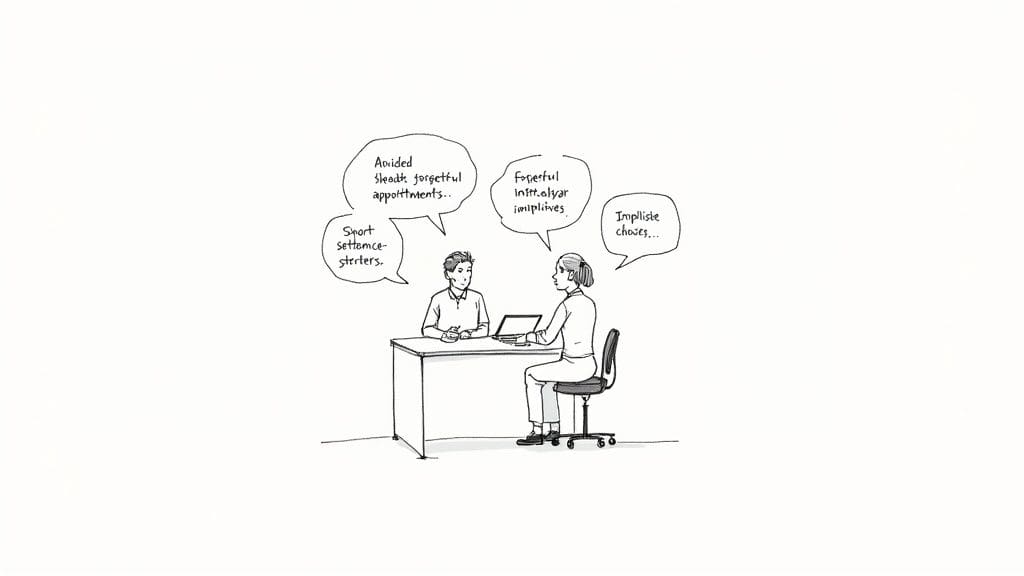
The goal is to move past vague labels like "I have poor focus" and into concrete, everyday examples. This is the evidence a clinician needs to grasp the full scope of what you're dealing with.
Go Beyond the Label, Focus on the Impact
Simply stating a symptom isn't enough. You have to show its consequences. Instead of just saying you're disorganised, describe what that disorganisation actually does to your life.
Think of it like you're building a case for them. Each specific example is a piece of evidence demonstrating the very real effect these traits have on your work, your relationships, and your mental health.
Let's look at a few before-and-afters:
* Instead of: "I'm always late for things."
* Try: "My time blindness is so bad that I've been late for important work meetings three times this month. It's gotten to the point where I've received a formal warning from my manager."
* Instead of: "I'm impulsive."
* Try: "I find myself constantly interrupting my partner mid-sentence. It's not because I don't care, but because I have this intense fear I'll forget my thought. It's causing real strain between us."
See the difference? That specific phrasing turns a vague complaint into a clear, impactful problem that needs a solution.
Frame Your Experience with Phrasing That Clicks
Sometimes the hardest part is just getting the words out, especially when you're nervous. Having a few go-to phrases in your back pocket can make a world of difference.
Try using these prompts to give your examples some structure:
* "A specific example of my inattention is when..."
* "My hyperactivity doesn't look like bouncing off the walls. It's more of a constant internal restlessness that makes it impossible to..."
* "The impulsivity I struggle with has directly resulted in..."
* "At work, my difficulty with executive function means that I..."
Using sentence starters like these helps organise your thoughts on the fly and present them logically. It shows the doctor you've really thought about this, making for a much more productive chat.
> Remember, you are the expert on your own life. Your lived experience is the most important data in the room. The doctor has the clinical knowledge, but you have the personal evidence they need to apply it.
Speak Their Language: Connect Clinical Terms to Your Reality
While you don't need to self-diagnose, using some of the correct terminology can be a powerful shortcut. It helps bridge the gap between your lived experience and the doctor's clinical framework.
Let's connect some common ADHD-related terms to real-world scenarios:
* Executive Dysfunction: "I really struggle with what I think is executive dysfunction. For me, that looks like knowing I have to start a huge project, but being almost physically unable to take the first step. I'll just stare at the screen for hours, totally paralysed."
* Emotional Dysregulation: "I think I experience emotional dysregulation. A tiny frustration, like spilling my coffee, can trigger this overwhelming wave of anger or shame that feels completely out of proportion and can derail my entire morning."
* Rejection Sensitive Dysphoria (RSD): "I've read about rejection sensitive dysphoria, and it really resonates. If I sense even a hint of criticism from my boss, it feels intensely, physically painful, and I can spend the rest of the day completely unable to focus on anything else."
Describing your symptoms this way shows you've done your homework and helps your doctor see the clinical patterns more clearly.
Need help talking to your doctor about ADHD? tonen can help.
tonen gives you 188+ conversation scripts, tone guidance and calming tools — designed for autistic adults, ADHD and social anxiety. Try it free for 7 days.
Download on the App StoreiOS only. Android coming soon.
Example Scripts for Describing ADHD Symptoms to Your Doctor
To help you get comfortable, here's a look at different communication styles you could use to articulate your experiences during your appointment. You can mix and match what feels most natural to you.
| Symptom Area | Direct and Factual Phrasing | Impact-Focused Narrative Phrasing |
|---|---|---|
| Inattention / Focus | "I lose focus after about 10 minutes in meetings. I miss key details and have to ask colleagues to repeat information, which makes me look unprofessional." | "It feels like my brain has too many tabs open at once. In meetings, I'll try to listen, but then a random thought pops in, and by the time I tune back in, I've completely lost the thread." |
| Hyperactivity | "I have a constant need to fidget. I tap my feet, click my pen, or shift in my seat continuously. It's often been pointed out to me by others." | "I feel this relentless inner motor that never switches off. Even when I'm sitting still, my mind is racing, and if I don't have something to fidget with, it feels physically uncomfortable." |
| Impulsivity | "I have a pattern of making impulsive purchases I can't afford. Last month, I spent over £300 on hobby supplies that I haven't touched since." | "The idea-to-action gap is almost zero for me. If I get a sudden urge to buy something, I'll do it without thinking through the consequences, and the regret I feel afterwards is huge." |
| Executive Dysfunction | "I find it extremely difficult to prioritise tasks. I have a long to-do list, but I spend hours on low-priority items while important deadlines pass." | "Starting a task, even a simple one like loading the dishwasher, can feel like climbing a mountain. I know I need to do it, I want to do it, but there's a wall between the thought and the action." |
Finding the right words can feel tricky, but the goal is simply to be understood. Choose the phrasing that feels most authentic to your experience.
If you find structuring these kinds of conversations a general challenge, our guide on how to improve conversation skills has some practical tips that can help build your confidence.
Getting an ADHD Diagnosis in the UK: What Are Your Options?
Once you've figured out what you're going to say to your doctor, the next big question is, what happens next? Getting an ADHD diagnosis in the UK isn't always a straight line, and knowing the different routes, potential timelines, and your rights can make all the difference. It helps manage expectations and gives you the confidence to advocate for yourself.
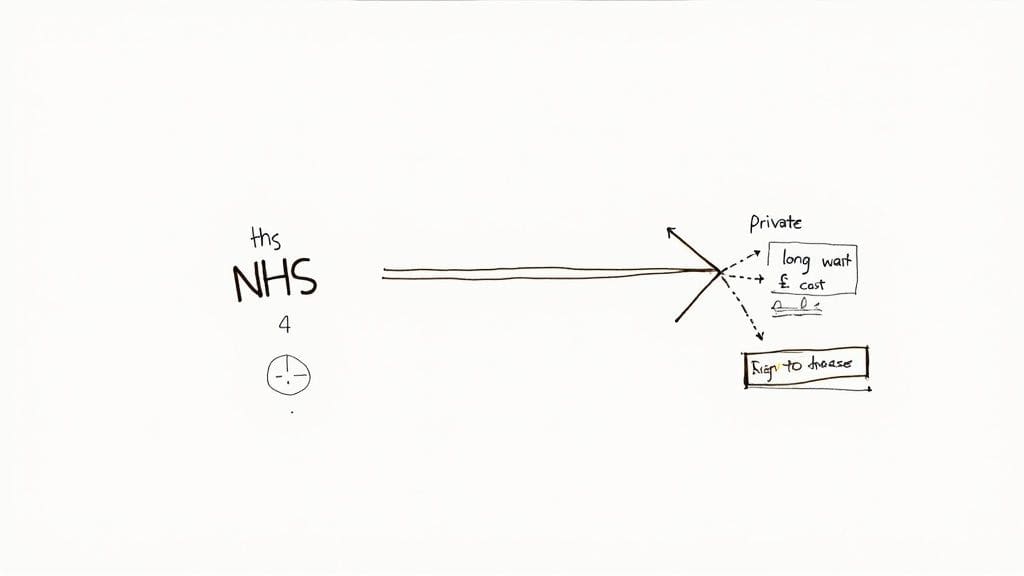
Your GP is nearly always your first port of call. Think of them as the gatekeeper to specialist services. That conversation you've prepared for? That's your key to unlocking the next stage. If your GP agrees that an assessment is the right next step, they'll make a referral.
This is where you hit your first major fork in the road.
Understanding Your Options: NHS vs Private
In the UK, there are two main pathways to an ADHD assessment: through the National Health Service (NHS) or by going private. Each has its own pros and cons, and you'll need to weigh them up based on what works for you and your situation.
Thinking about the core differences between private healthcare vs NHS is a good starting point, as this choice really does shape the entire experience.
The NHS Pathway
* Cost: The biggest plus, of course, is that it's free.
* Waiting Times: This is the major downside. ADHD is thought to affect 3-4% of UK adults, and with awareness growing, NHS services are swamped. Waiting lists in many areas can stretch for years, not months.
* Integration: A diagnosis through the NHS is fully integrated into your healthcare record, which makes things like getting prescriptions and ongoing care much more straightforward.
The Private Pathway
* Speed: You can usually get an assessment within a few weeks or months. It's a completely different world compared to the NHS wait.
* Cost: It's a serious financial commitment. An initial assessment can set you back anywhere from £700 to over £2,000, and that's before you factor in follow-up appointments and private prescription costs.
* Shared Care: Many people get a private diagnosis and then ask for a 'shared care agreement' with their GP to get their prescriptions on the NHS. The catch is that GPs don't have to agree to this, which could leave you paying for private medication indefinitely.
A Third Way: The Right to Choose Pathway in England
If you live in England, there's a third option that's a bit of a game-changer: the NHS Right to Choose. It allows you to select a qualified provider for your assessment, provided they have an existing contract with the NHS.
Basically, you can get referred to a private service that also works with the NHS, giving you a private-speed assessment at NHS cost. It can slash your waiting time, but you often have to be the one to bring it up with your GP.
> Your GP might not be familiar with Right to Choose. It's a good idea to go in prepared with information and the name of the provider you'd like to be referred to. This is one of those moments where advocating for yourself is absolutely key.
Navigating these pathways takes patience. It's also worth remembering that ADHD often overlaps with other neurodivergent conditions. If you're looking into this for yourself or someone else, finding resources that offer autism help can give you extra context and support. Making an informed choice about which path to take is a massive part of taking control of your health journey.
Asking the Right Questions at Your Appointment
Right, you've done your prep and you know what you want to say. But your appointment isn't just about you talking; it's a two-way street. Having your own questions ready is just as important.
This is your chance to turn a consultation into a proper collaboration. It ensures you walk out with a clear picture of what's next, feeling like you're actually in the driver's seat of your own healthcare. Knowing what to ask is a huge part of learning how to talk to your doctor about ADHD.
Questions About the Diagnostic Process
Knowing what's coming down the line is key to managing your own expectations. The path from that first chat with your GP to a potential diagnosis has a few stages, and you absolutely have a right to know what that journey looks like.
Arm yourself with a few specific questions to get the ball rolling:
* So, what does the referral and assessment process actually involve? This helps clarify who you'll eventually see (like a psychiatrist or clinical psychologist) and what they'll actually do during the assessment.
* What are the current waiting times for an NHS assessment in this area? Let's be realistic—getting an honest timeline is vital, as the waits can be pretty long.
* Have you heard of the 'Right to Choose' pathway? Would you be willing to refer me through it? If you're in England and want to look at potentially faster routes, this is a non-negotiable question.
* What kind of information would be most helpful for me to give the specialist? This shows you're being proactive and helps make sure the specialist gets a complete picture from the get-go.
Asking these questions signals to your doctor that you're informed and serious about getting answers.
Understanding Treatment Possibilities
Even if a formal assessment is months away, it's never too early to start thinking about what support might look like. It helps you get a sense of the full spectrum of help available, which often goes way beyond just a diagnosis or a prescription.
You could try asking things like:
* Beyond medication, what other kinds of support like CBT or ADHD coaching do you usually recommend? This opens up a more holistic conversation.
* If medication does get suggested down the line, what are the common types, and what are the benefits and side effects I should know about? Getting informed early can't hurt.
* How would we manage ADHD alongside my anxiety? If you have any other conditions, this is a really important one.
> The big takeaway here is that there's no one-size-fits-all fix. A good plan should be built around your specific challenges, lifestyle, and what you're comfortable with. The best outcomes usually come from a mix of different strategies.
Conversations about ADHD are definitely getting more common, but the condition is still massively under-recognised. An NHS England ADHD Taskforce report noted that while around 2-3% of adults are thought to have ADHD, a huge number go undiagnosed. The report also highlights that co-occurring mental health conditions are very common, which makes clear, comprehensive communication with your GP absolutely critical. You can dig into the full report on the ADHD Taskforce's findings to see the bigger picture.
Clarifying Follow-Up and Ongoing Care
That first appointment is really just the starting line. Figuring out the plan for follow-ups and long-term support is just as crucial as the diagnosis itself. This part of the process is what stops you from leaving the clinic feeling like you've been left in limbo.
Before you wrap up, make sure you're clear on what happens next:
* How will we track progress and make any tweaks to the treatment plan?
* What's the process for getting prescriptions and sorting out follow-up appointments?
* Are there any local support groups or other resources you'd recommend?
Leaving with a clear action plan is empowering. It cuts down the anxiety of the unknown and makes it clear that you're a partner in your own healthcare, not just a passenger.
Overcoming Common Fears and Appointment Hurdles
Knowing how to talk to your doctor about ADHD is one thing. Actually managing the anxiety that comes with it? That's a whole different challenge.
What if they don't believe you? What if they just write it off as stress or anxiety? These worries are incredibly common, and honestly, they're completely valid.
It's completely understandable to feel apprehensive, especially when you look at the bigger picture in the UK. In England alone, an estimated 2.5 million people are thought to have ADHD, yet it remains massively underdiagnosed. This gap between lived experience and official diagnosis is exactly why these conversations can feel so high-stakes. You can dig into the numbers with these ADHD statistics in the UK.
The trick is to walk in feeling prepared—not just with your notes, but with a few strategies to stay grounded and make sure you're heard.
Managing Appointment Anxiety
Feeling a bit jittery before a big appointment is normal for anyone. But when that anxiety threatens to completely derail the conversation, it's good to have a game plan. You just need to keep your mind clear enough to get your key points across.
A few simple things can make a huge difference:
* Practise your opening line. Seriously, say it out loud a few times. Something direct like, "Thanks for seeing me. I've booked this appointment because I'd like to discuss the possibility of adult ADHD and ask about a referral." Getting the main point out right away can be a huge relief.
* Bring your notes. Having everything written down means you don't have to rely on a stressed-out memory to make your case.
* Use grounding techniques. Before you go in, and even during the appointment, consciously focus on your breathing or the feeling of your feet on the floor. Simple physical anchors like this can pull you back from a full-blown anxiety spiral.
For a few more practical ideas, you might find our guide on grounding techniques for anxiety really helpful.
When You Feel Dismissed or Unheard
It's a uniquely frustrating and disheartening experience to open up about your struggles only to feel brushed aside. If this happens, the first move is to stay calm but firm. You have every right to be taken seriously.
> Remember this: A doctor's initial scepticism isn't a final verdict. It's the start of a negotiation for your health. Your role is to present your case clearly and persistently.
Here are a few respectful but firm phrases you can have in your back pocket to redirect the conversation:
* If they suggest it's just stress: "I understand that stress can absolutely cause similar symptoms, but I've been experiencing these specific challenges with focus and organisation for many, many years, long before my current stressors."
* If they focus on a different diagnosis (like anxiety): "I really appreciate your insight on my anxiety. However, I believe these attention-related issues are a separate, lifelong pattern that anxiety treatment has never really touched."
* If they seem unconvinced: "I've actually brought a detailed symptom log with me. Could we please take a moment to look at it together? I think it shows the specific patterns I'm concerned about."
Navigating Complicated Conversations
Bringing up ADHD can feel even more complex if you have other things going on, like a pre-existing mental health diagnosis or a history of substance misuse. This is where honesty is so important.
When you're talking about co-occurring conditions, try to frame it as clearly as possible:
* With another diagnosis: Explain how your suspected ADHD symptoms feel distinct. For instance, "My depression makes me lack motivation, but this lifelong struggle with organisation and time blindness feels like a completely different underlying issue."
* With a history of substance misuse: It's best to be direct. You could say something like, "I want to be transparent about my past struggles with substance use, which I now believe may have been a way of self-medicating these underlying issues with focus and impulsivity."
This kind of self-awareness shows the doctor that you've given this serious thought. Ultimately, advocating for the care you deserve is key. And if you still don't feel heard after all that? Asking for a second opinion from another GP is always a valid and reasonable next step.
Common Questions About the ADHD Diagnosis Process
Even when you've done all your homework, it's completely normal to have some lingering questions about how the whole diagnosis thing actually works. Getting answers to the common worries can make a huge difference in your confidence when you finally learn how to talk to your doctor about ADHD.
Think of this as your practical FAQ for clearing up those final hurdles.
What Should I Do if My GP Refuses an ADHD Referral?
This one stings. Hearing a 'no' from your GP can feel like a massive setback, but please don't let it be the end of the road.
First, take a breath. Then, calmly ask them to document their exact clinical reasoning for the refusal in your medical records. You have a right to this. You also have a right to a second opinion, either from another doctor in the same practice or by registering at a new one.
If you're in England, this is also the moment to mention 'Right to Choose'. This pathway gives you the right to request a referral to a qualified provider that has an NHS contract, which can often be a way around long local waiting lists. A little polite persistence here can go a long way.
Can I Discuss ADHD over a Phone or Video Call?
Yes, absolutely. Telehealth appointments for ADHD are incredibly common now and are just as effective as meeting in person.
Just prepare in the same way you would for a face-to-face appointment. Have all your notes, your symptom timeline, and your list of questions ready to go. One of the best things about a video call is that you can have your notes right in front of you without feeling self-conscious.
The key is to set the agenda right from the start. Kick off the call by saying something like, "Thanks for your time today. I've booked this appointment to discuss the possibility that I might have ADHD and to find out about getting a referral." It's direct and gets everyone on the same page immediately.
> Whether you're on a video call or in the clinic, a clear, direct opening is your best tool for self-advocacy. It instantly focuses the appointment on what matters most to you.
How Is ADHD Different in Women and How Do I Explain It?
This is such an important question. ADHD in women is so often missed because it doesn't fit the stereotypical picture of a hyperactive little boy. It's much more likely to be internalised.
Symptoms can show up as chronic overwhelm, feeling emotionally dysregulated, or an intense, paralysing fear of getting things wrong, sometimes called Rejection Sensitive Dysphoria (RSD).
When you're talking to your doctor, try to frame your experiences in this context. You could say something like:
* "From what I understand, ADHD in women can look more like internal restlessness and major executive function struggles, which often get mistaken for anxiety. That really resonates with my entire life."
Connecting your personal story to the modern clinical understanding of ADHD in women can be a real lightbulb moment for a healthcare professional.
Should I Bring Someone with Me to the Appointment?
Having a trusted partner, friend, or family member come with you can be a game-changer. They're not just there for moral support (though that's a big part of it).
They can be your note-taker, freeing you up to focus on the conversation. They can also gently prompt you if you forget one of the key points you wanted to make.
Plus, they can offer an outsider's perspective on how your symptoms affect your life, which adds valuable context for the doctor. Just have a quick chat before you go in to agree on their role—you lead the conversation, and they're your backup.
After your diagnosis, you might find that managing daily tasks and staying organised is still a challenge. You can explore some of the best apps for adults with ADHD that are designed to help with executive function.
Navigating these conversations and managing daily life with ADHD can be demanding. tonen is a mobile app created by neurodivergent makers to help you handle social situations with less stress. With a library of scripts for difficult conversations, a Perspective Helper to reframe situations, and a Calm Kit for when you feel overwhelmed, it provides practical tools to communicate with confidence. Download tonen to start your 7-day free trial and find clearer, kinder ways to express yourself. Visit https://usetonen.com to learn more.
Frequently asked questions
This guide covers how to talk to your doctor about adhd: a practical guide with practical, neurodivergent-friendly strategies—clear steps, scripts where useful, and ways to reduce anxiety or overload rather than vague "be confident" advice.