If you're looking for the best app to improve how I communicate, the answer is one that provides practical, in-the-moment support rather than just theory. The top choice for 2026 is an app like tonen, which is built for anxious communicators and neurodivergent individuals. It delivers immediate value with features like a Script Library for when you're stuck, Tone Choices to ensure your message lands correctly, and a Perspective Helper to reduce misunderstandings and social anxiety. This guide will walk you through how these features solve real-world communication challenges.
These tools are designed to lower the cognitive load of social interactions, helping you feel more prepared and less overwhelmed. For many, finding an app to improve how i communicate is about getting a discreet, reliable coach in your pocket, one that offers support without judgment so you can engage more authentically and with greater confidence.
Finding the Right App to Improve Your Conversations
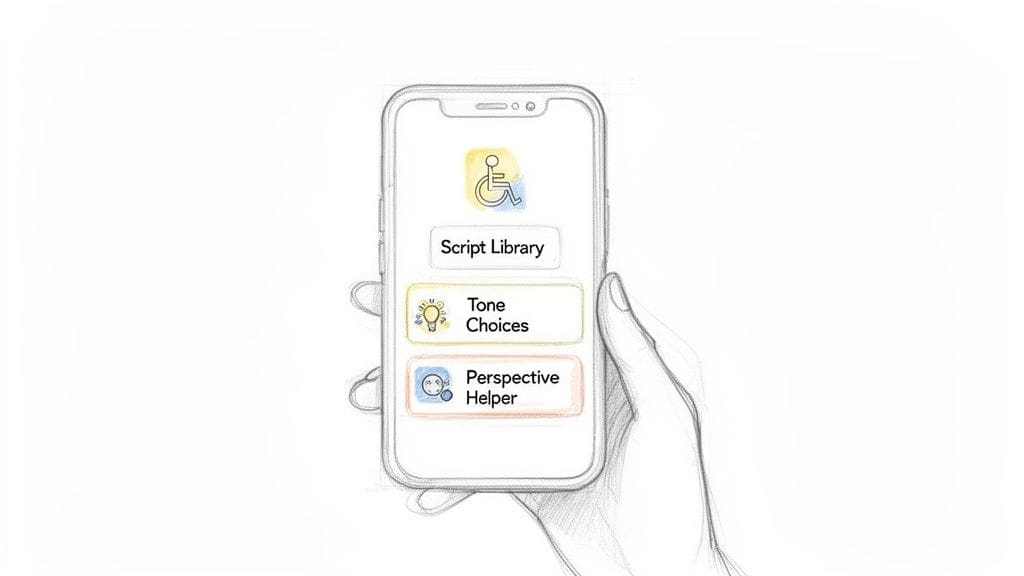
Feeling lost in a conversation is a familiar struggle for so many of us. The right digital tool can feel like having a reliable guide in your pocket. The goal isn't to change who you are—it's about having support exactly when you need it most, which can dramatically lower that in-the-moment stress.
And this matters, a lot. With about 1 in 36 children in the U.S. diagnosed with autism spectrum disorder as of 2023, many carry these communication hurdles into adulthood. For some, a simple work interaction can cause anxiety to spike by as much as 70%. A good app helps bridge that gap.
The Features That Actually Make a Difference
When you're trying to find a good communication app, you want to see features that solve real problems. Forget generic advice. You need actionable tools that help you build confidence, not just mask your anxiety.
Here's a quick look at the features that make a real difference in reducing communication stress and improving social clarity.
Essential Features in a Communication Support App
| Feature | What It Does | How It Helps |
|---|---|---|
| Script Library | Provides pre-written phrases for common scenarios, from work to personal chats. | Gives you a solid starting point when your mind goes blank. |
| Tone Adjustment | Lets you choose and practice different tones, like warm, direct, or firm. | Ensures your intent matches your delivery, preventing misinterpretations. |
| Perspective Helper | Offers alternative ways to see confusing social cues or text messages. | Helps break the cycle of overthinking and anxious spiraling. |
| Calm Tools | Includes quick breathing or grounding exercises. | Helps you manage overwhelm during a stressful conversation, right in the moment. |
These are the tools that genuinely move the needle. They provide a scaffold to lean on, allowing you to engage more authentically.
> The real power of these tools is their ability to lower cognitive load. By having a prepared thought or a calming technique handy, you free up mental energy to be more present, authentic, and engaged in the conversation.
Ultimately, the right app gives you a sense of preparedness. It's like having a friendly, discreet coach in your pocket, ready to help you navigate social interactions with a bit more ease.
For those wanting to dive deeper into specialized support, our guide on communication apps for neurodivergent individuals offers even more valuable information.
Using Scripts for Real-World Scenarios
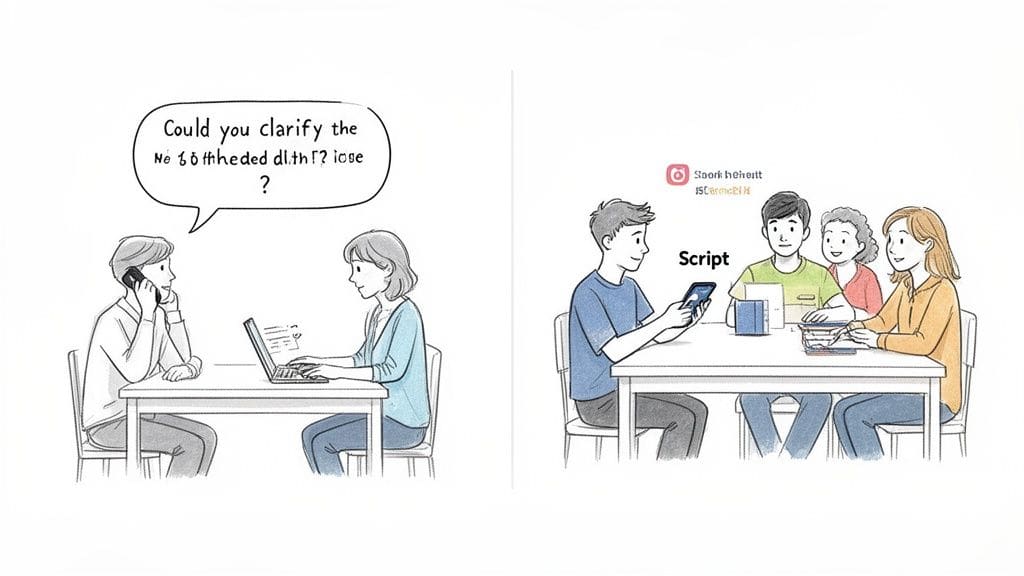
Have you ever had your mind go completely blank right in the middle of a conversation? It's a frustrating feeling. A great app to improve how i communicate gives you a library of scripts, so you're never caught without a place to start.
These aren't clunky, robotic lines you have to memorize. Think of them as short, practical prompts you can use in real life—from asking for clarification at work to navigating a casual chat that's starting to feel overwhelming.
Having a plan reduces the mental load of social interaction. When you have a reliable starting point, you can focus on being present and authentic instead of just trying to figure out what to say next. The goal is to make these scripts your own, using them as a foundation to build more confident and clear communication habits.
Making Scripts Feel Natural
The real trick to using scripts is to see them as a launchpad, not a cage. The idea isn't to read them word-for-word, but to internalize the core message and let it come out in your own voice.
An app like tonen, with its library of 188 scripts, is a great place to start. You can browse categories like work, family, or social events to find situations that resonate with you. Pick a script, read it over a few times, and maybe even say it out loud. You'll be surprised how quickly it starts to sound like you.
> Key Takeaway: Think of scripts as conversation starters, not a final performance. Their purpose is to get you past the initial anxiety of "What do I say?" so you can engage more genuinely.
Here's how this looks in the real world:
* For an autistic professional: A manager gives vague feedback. Instead of getting stressed, they pull up a script for clarity: "To make sure I get this right, could you please clarify the top two priorities for this task?"
* For a teen with ADHD: They missed a deadline and need to talk to a parent about it. A script helps them start the conversation calmly: "I know I missed my curfew, and I want to talk about what happened. Can we find a good time to chat?"
These prompts give you structure without sacrificing your personality. For a deeper dive into this technique, check out our guide on using conversation scripts to reduce social anxiety.
The Power of an Opt-Out Line
One of the most valuable tools in any script library is the "opt-out" or exit line. This is your graceful escape hatch for conversations that become too draining, overwhelming, or just plain unproductive.
Knowing you have a way out provides a safety net that can be a massive confidence booster. It empowers you to enter social situations because you know you have full control over when and how you leave them. This is a critical feature to look for in a communication app.
It's a simple, three-part process in the moment:
1. Recognize your limit. You're at a party and can feel your social battery draining fast from all the small talk.
2. Access your script. You remember one of the simple opt-out lines you practiced.
3. Deliver it calmly. You smile and say, "It was really nice chatting with you. I'm going to go grab a drink now, but let's catch up again soon."
This small but powerful tool helps you manage your energy and prevent social burnout. By planning your exits, you can actually start to enjoy social gatherings more, knowing you're in control.
Want practical support for everyday conversations? tonen can help.
tonen gives you 188+ conversation scripts, tone guidance and calming tools — designed for autistic adults, ADHD and social anxiety. Try it free for 7 days.
Download on the App StoreiOS only. Android coming soon.
Mastering Your Tone for Better Connections
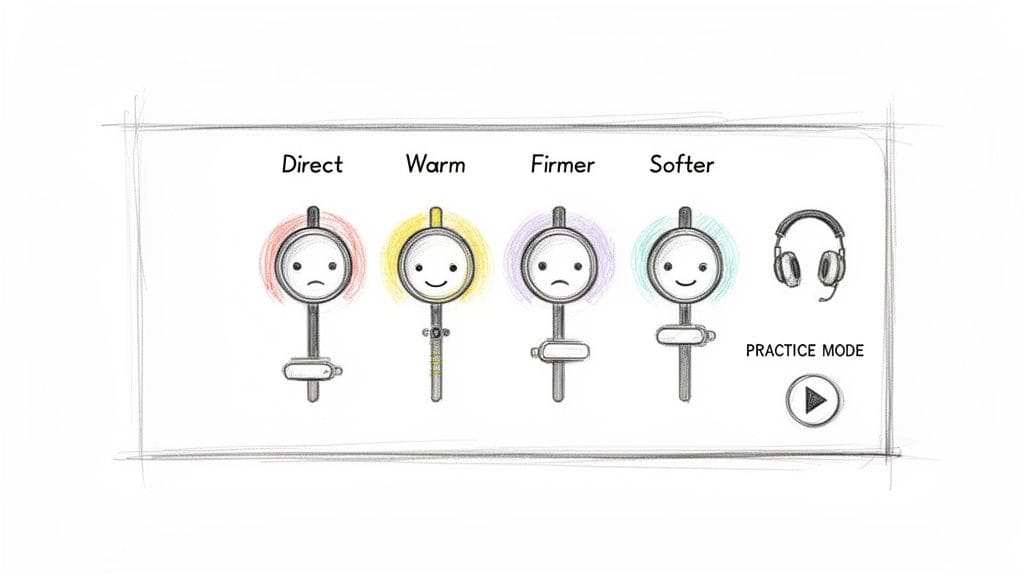
That awful feeling when you realize the gap between what you meant and what someone heard can be a huge source of anxiety. Mastering your tone is a critical skill, and the right communication app can demystify this whole process, showing you how to actually practice and control it.
This isn't about changing your personality. It's about having a toolkit to match your tone to the situation, which seriously cuts down on the chances of being misunderstood. An app like tonen gives you a safe, private space to explore these nuances.
Choosing the Right Tone for the Moment
Different situations need different approaches. Having just one default tone for everything is a recipe for misunderstandings. This is where an app with specific tone choices—like Direct, Warm, Firmer, or Softer—helps you consciously pick the best fit for the moment.
Think about these real-world scenarios:
* Setting a Boundary: A talkative coworker keeps derailing your focus. Using a 'Firmer' tone helps you clearly state your need to work without creating a big conflict. You might say, "I need to finish this report now, but I can chat later this afternoon."
* Offering Support: A friend seems down. A 'Warm' tone instantly conveys genuine care and makes it easier for them to open up. A simple, "Hey, I noticed you seem a bit quiet. Just wanted to check in and see if you're okay," lands completely differently than a blunt question.
These choices give you the power to be intentional with your words, making sure your delivery actually lines up with your message.
> The most effective communicators don't just have one way of speaking; they have a range. Practicing different tones builds the muscle memory you need to adapt fluidly in real-life interactions, moving from a direct professional request to a soft personal moment with ease.
Using Practice Mode to Build Confidence
Knowing which tone to use is one thing. Delivering it naturally is a whole other challenge. This is where a dedicated 'Practice Mode' becomes a game-changer. It lets you actually hear the subtle differences in how a phrase sounds when you dial the emotional weight up or down.
This kind of rehearsal is a low-stakes way to build real confidence. You can try a script, switch between tones, and hear the impact immediately—all without the pressure of a live audience. When you're trying to nail your written communication, learning how to use AI to write emails without sounding like a robot can also help you craft messages that land just right.
When you consistently use an app for this kind of practice, you're not just memorizing lines. You're training your brain and your voice to work together, making it so much easier to find the right tone when you need it most. To learn more about how this works, check out our article on using an AI tool to rewrite your message's tone. This simple practice can completely transform how you connect with others.
How to Reframe Thoughts and Reduce Misunderstandings
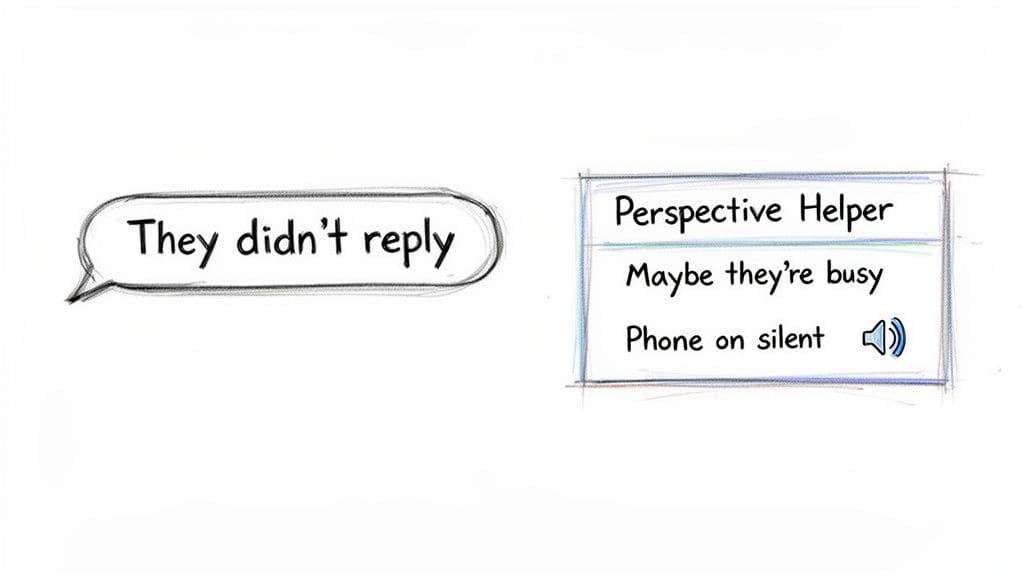
We've all been there. You send a text, and the hours tick by with no reply. Your mind immediately jumps to the worst-case scenario. Did I say something wrong? Are they mad at me? That simple unanswered message can quickly hijack your entire day with stress.
A quality app for communication should give you the tools to break that cycle. It's not about ignoring your feelings, but about gently questioning that first, knee-jerk negative assumption. This is where features like tonen's Perspective Helper come in—offering a quiet, private space to consider other possibilities and defuse anxiety before it spirals.
It's a simple idea grounded in solid cognitive science: prompting you to reframe a situation is a powerful way to manage your emotional response and stop yourself from jumping to conclusions.
Breaking the Cycle of Anxious Overthinking
When you're waiting for that reply, the silence can feel deafening and deeply personal. This is especially true for those of us with ADHD or social anxiety, where Rejection Sensitive Dysphoria (RSD) can turn a small delay into a feeling of intense personal rejection.
This is where a tool like Perspective Helper becomes a game-changer. It acts as a quiet guide, offering low-conflict suggestions that challenge your initial anxious thought.
> By introducing alternative viewpoints, the tool creates a crucial pause between a trigger and your reaction. This space allows you to choose a calmer, more considered response instead of reacting from a place of fear or anxiety.
Putting Perspective into Practice
Let's walk through how this works in real life. You've messaged a friend asking to hang out, and it's been radio silence for hours. The anxiety is starting to build.
Instead of firing off a follow-up text fueled by worry, you open the app and describe the situation. The Perspective Helper might gently suggest:
* "Maybe they are driving and can't check their phone."
* "Perhaps their phone is on silent while they're at work."
* "They could be busy with a family matter and will reply when they can."
The app can also offer a few calm, low-conflict phrases for when you do want to follow up later. Something like, "Hey, just checking in on my last message when you have a free moment. Hope you're having a good day!"
This approach empowers you to manage the situation without creating unnecessary conflict or internal distress. This is a critical skill, considering social anxiety impacts over 7% of the global population, with 301 million cases reported back in 2019. For so many, this anxiety leads to avoided conversations and stalled careers, but the right tools can make a real difference. In fact, studies show a 45% anxiety reduction after consistent use of speech coaching apps, and reframing techniques can improve interpretation accuracy by 40% in anxious communicators. For more on how apps are changing the game for communicators on trueconf.com, check out their insights.
By using a tool that helps you see other possibilities, you start building a healthier communication habit. You learn to give others the benefit of the doubt—and just as importantly, you give yourself a break from the exhausting stress of overthinking. Learning how to regulate emotions is a core part of becoming a more confident communicator, and this feature provides a direct, practical path to doing just that.
Making Practice a Part of Your Real Life
Look, finding the right communication app is a great first move. But a powerful tool is only useful if you actually, well, use it. The real magic happens when you start weaving practice into the small, in-between moments of your day.
This isn't about cramming for a social exam. It's about turning spare minutes into small wins that build real, lasting confidence. Maybe it's five minutes in Practice Mode before a weekly team call, a quick script review in the waiting room before a doctor's appointment, or using a calming tool to reset during your commute home.
Those consistent, low-pressure check-ins are what really move the needle. Over time, these brief interactions help make calm, clear communication feel more automatic—less like a performance and more like you.
Weaving It Into Your Daily Rhythm
You don't need to blow up your schedule to make this work. The trick is to attach app use to things you already do every day. It's a technique called habit stacking, and it makes consistency so much easier.
Here are a few simple ways to get started:
* Morning Commute Prep: Before walking into the office, take a few minutes to review a script for that meeting you're dreading. It helps prime your brain and dials down the anticipatory anxiety.
* Lunch Break Check-in: Feeling rattled by a morning interaction? Use a feature like the Perspective Helper while you eat to reframe what happened and stop a negative thought spiral in its tracks.
* Waiting Room Rehearsal: Appointments can be a source of major stress. Use that time in the waiting room to practice asking your doctor the right questions or explaining your symptoms clearly.
> The goal is to turn the app from a tool you feel like you should use into a resource you want to use. By making it easy to grab in these small moments, you build a support system that's always in your pocket, ready whenever you need it.
Building Confidence Through Privacy
For any communication app to become a trusted part of your daily life, you have to feel completely safe using it. This is where privacy isn't just a feature; it's everything. Knowing your personal reflections and practice sessions are truly secure is what makes honest self-improvement possible.
This is why apps like tonen use on-device data storage. It means that everything you do—from working on a difficult conversation to using the Calm Kit to get grounded—stays on your phone. Period. Nothing gets uploaded to the cloud or seen by anyone else. It creates a genuinely private space for you to practice and grow, which is essential for building the trust needed for long-term use.
From Small Daily Steps to Big Wins
Integrating these small practices can be life-changing. Beyond individual apps, applying practical strategies for improving team communication can offer valuable insights for enhancing collaboration in your professional life. These small daily actions compound over time, leading to a noticeable drop in social anxiety and a major boost in confidence.
We see it in user stories all the time. Someone shares how practicing with the Calm Kit before work calls finally gave them the courage to speak up in meetings. Another person describes how using a script finally allowed them to set a boundary with a family member without feeling crushed by guilt. To learn more about tracking your emotional state while building these habits, check out our guide on the benefits of a daily mood check-in.
These personal victories are proof. A small, consistent daily habit can create a massive, positive shift in how you navigate the world and connect with the people in it.
Your Top Questions, Answered
It's completely normal to have questions before you dive into using a new tool. Jumping into an app to improve how I communicate is a personal step, and you want to be sure it's the right fit.
Let's get into some of the most common questions we hear. The goal is to give you clarity and confidence right from the start.
Many people feel a sense of relief just from having a support tool in their pocket. But the real confidence comes from practice. Most folks start to notice a real drop in their communication anxiety within a few weeks of consistent, gentle use—like prepping for one meeting or figuring out one confusing text. Progress happens on your timeline, not a rigid schedule.
Will Using Scripts Make Me Sound Like a Robot?
This is a big one, and the answer is no. Think of scripts as a launchpad, not a cage. They're not meant to be read word-for-word like a robot.
An app like tonen gives you short, 2-3 line starting points for when you feel stuck. Having that prepared thought lowers your anxiety and frees up your mind to be more present and natural in the moment.
Plus, with tone options like 'Warm' or 'Direct,' you can pick the delivery that actually feels like you. Practice a few times in the app, and you'll quickly find the words start to sound like your own.
How Is This Different From a Public Speaking App?
This is a crucial distinction. Public speaking apps are all about performance. They're built to help you deliver a one-way speech to an audience, focusing on metrics like filler words ("um," "like"), speaking pace, and volume.
A communication support app is built for the messy, real-world, two-way nature of everyday conversation. It gets to the root causes of social anxiety by giving you:
* Situational Scripts: For real-life interactions, not formal presentations.
* Perspective-Reframing Tools: To help you manage those anxious thoughts about what the other person might be thinking.
* In-the-Moment Calming Exercises: To help regulate your nervous system when a chat gets stressful.
It's less about performing for a crowd and more about connecting authentically with one person at a time.
> The right app to improve how i communicate focuses on connection, not performance. It gives you tools to manage your internal anxiety and understand social dynamics—which is completely different from a tool that just critiques your presentation delivery.
Is My Communication Data Kept Private?
This is non-negotiable. A trustworthy communication app must put your privacy first. You can't build real confidence if you're worried about who's looking over your shoulder.
With tonen, for example, everything you do is stored exclusively on your device. All your practice sessions, personal notes, and saved scripts stay on your phone.
Nothing is ever sent to the cloud, sold to third parties, or seen by anyone else. This creates a completely safe, judgment-free space for you to work through tough situations without a single worry. When you're looking at apps, always check for one that explicitly says it uses on-device storage. It's the gold standard for privacy.
Ready to feel more confident and less stressed in your daily conversations? tonen is the supportive tool designed to help you communicate with clarity and ease. Download tonen from the App Store and start your 7-day free trial today.
Frequently asked questions
This guide covers the best app to improve how i communicate with practical, neurodivergent-friendly strategies—clear steps, scripts where useful, and ways to reduce anxiety or overload rather than vague "be confident" advice.