The best apps for neurodivergent communication are those that lower the cognitive load of social interactions, provide practical tools like scripts, and help manage social anxiety. Top-rated apps like tonen offer pre-written scripts, tone adjustments, and a "Calm Kit" for overwhelm. Other essential tools include Augmentative and Alternative Communication (AAC) apps for non-speaking individuals and social skills trainers for practicing in a low-stakes environment. These technologies empower users by providing on-demand support to help them communicate more effectively and with less burnout.
For many in 2026, a leading choice is tonen, an app built from the ground up by a neurodivergent creator. It comes packed with over 188 pre-written scripts, tone options like Direct, Warm, and Softer, a Perspective Helper, and a Calm Kit for when you get overwhelmed. This guide will explore the top categories of these apps, helping you find the right digital support for your specific needs.
The Best Neurodivergent Communication Apps at a Glance
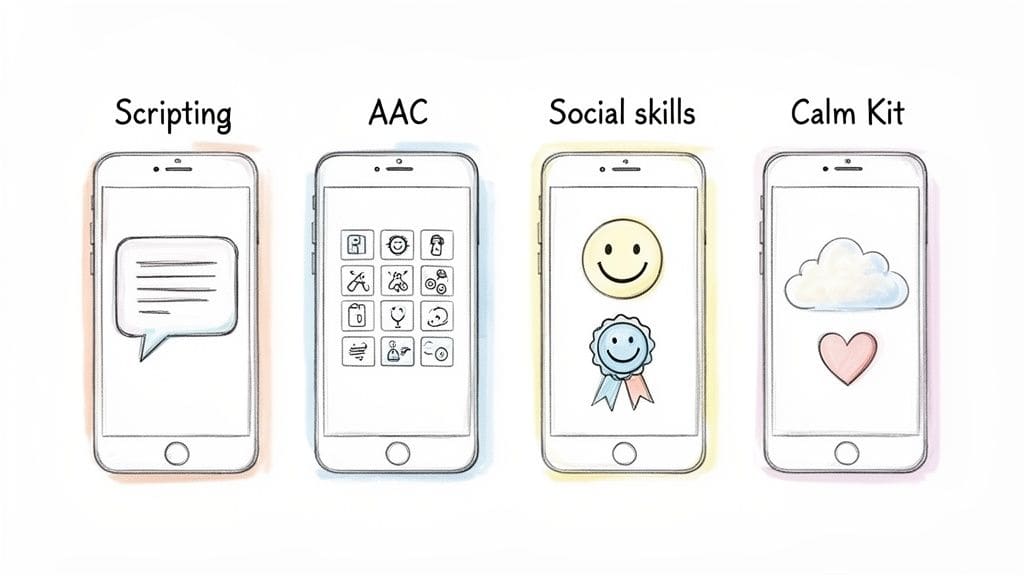
Let's be honest: navigating social interactions can be exhausting for autistic adults, people with ADHD, or anyone dealing with social anxiety. The best apps for neurodivergent communication act as a digital scaffold, helping you bridge communication gaps, state your needs clearly, and cut down on social burnout. They offer practical, on-demand support, right from your phone.
These tools aren't meant to make you "normal." Instead, they provide a framework to help you communicate more effectively and with less of the exhaustion that so often comes with it. From planning a tough conversation at work to practicing social cues in private, these apps are about giving you the power to engage on your own terms.
The Growing Need for Digital Support
The demand for these tools isn't just a feeling; it's backed by some serious numbers. The global market for mental health apps designed for neurodivergent people—including those that help with communication challenges in autism and ADHD—is exploding.
Valued at $1.15 billion in 2025, this sector is on track to hit a staggering $3.66 billion by 2032. This growth is being driven by rising awareness and more people getting the diagnoses they need. You can dig into the numbers yourself in this detailed industry analysis of the neurodiverse mental health app market. This surge shows just how badly tools like conversation scripts and social aids are needed to make daily life more manageable.
> For many of us, the problem isn't a lack of desire to connect. It's the sheer cognitive and emotional energy it takes to navigate unspoken social rules. The right app can dramatically lower that barrier, making connection more accessible and a lot less draining.
Understanding the Main App Categories
To help you figure out what might work for you, we can break down the available tools into a few key types. It's a good idea to see which category best fits your needs, as some people find a combination of them works best.
To give you a quick snapshot, here's an overview of the main categories of communication apps you'll find on the market in 2026.
Top Neurodivergent Communication App Categories for 2026
| App Category | Primary Function | Best For |
|---|---|---|
| Scripting & Prompting | Provides pre-written phrases and conversation structures. | Individuals who get stuck finding the right words, especially under pressure. |
| AAC (Augmentative & Alternative Communication) | Facilitates expression using symbols or text-to-speech. | Non-speaking, semi-speaking, or unreliably speaking individuals. |
| Social Skills & Regulation Trainers | Teaches social cues and self-regulation in a private, low-stakes environment. | People who want to practice social mechanics and emotional regulation techniques. |
Each of these categories serves a very different purpose, so let's dig into what each one actually does.
* Scripting & Prompting Apps: These are your conversation toolkits. They give you pre-written phrases and dialogue starters for all kinds of situations, from professional emails to personal chats. They're a lifeline for anyone who struggles to find the right words on the spot.
* Augmentative and Alternative Communication (AAC): These apps are primarily designed for non-speaking or semi-speaking people. They use symbols, pictures, or text-to-speech technology to help users express their thoughts, needs, and ideas clearly.
* Social Skills & Regulation Trainers: Think of these as a private rehearsal space. They often use games and interactive exercises to help you practice recognizing social cues, understanding emotions, and learning self-regulation techniques without the pressure of a live audience.
How We Chose the Best Communication Support Apps
To put together a list of recommendations that's actually useful, we didn't just glance at feature lists. We dug deep, using a strict set of criteria built around real-world neurodivergent needs and experiences.
Our whole approach was to filter out the flashy gimmicks and focus on what provides genuine, practical support. This way, you know our guide to the best apps for neurodivergent communication is based on what truly works for our community, not just what a marketing team thinks is cool.
A top priority for us was finding tools that actively reduce cognitive load. With 10-20% of the population being neurodivergent, many of us struggle with executive function, and a cluttered, confusing app is more of a burden than a help. We specifically looked for clean, intuitive designs that you can start using right away without a massive learning curve.
Our Core Evaluation Pillars
We organized our review around four key pillars. Every app was measured against these standards to keep our comparisons fair and consistent.
* Practical Support Features: We gave the most weight to features that offer direct, in-the-moment assistance. This means things like customizable scripts, options to adjust your tone, private practice modes, and built-in tools to help manage anxiety.
* Privacy and Security: This was non-negotiable. Your private thoughts and conversation plans should stay private. We heavily favored apps that process and store all your data on your own device, not on company servers.
* Accessibility and Design: It's critical that these apps are usable for everyone. We looked for essential accessibility features for apps like resizable text, high-contrast modes, and full screen reader compatibility.
* Pricing and Transparency: No hidden fees or confusing subscription models. We looked for clear, fair pricing, noting whether an app offered a free trial, a one-time purchase, or a subscription, and we only considered those with transparent business practices.
> We believe the best technology empowers you without adding another complicated system to manage. An app should feel like a supportive friend, not another chore.
This structured process allows us to stand behind our recommendations. If you're looking for support tailored specifically to autism, you might find it helpful to read our detailed breakdown of a dedicated communication app for autistic individuals and see how it stacks up against these criteria.
Ultimately, our goal is to cut through the noise and highlight the most effective and empowering tools available today.
Apps for Scripting and Conversation Prompts
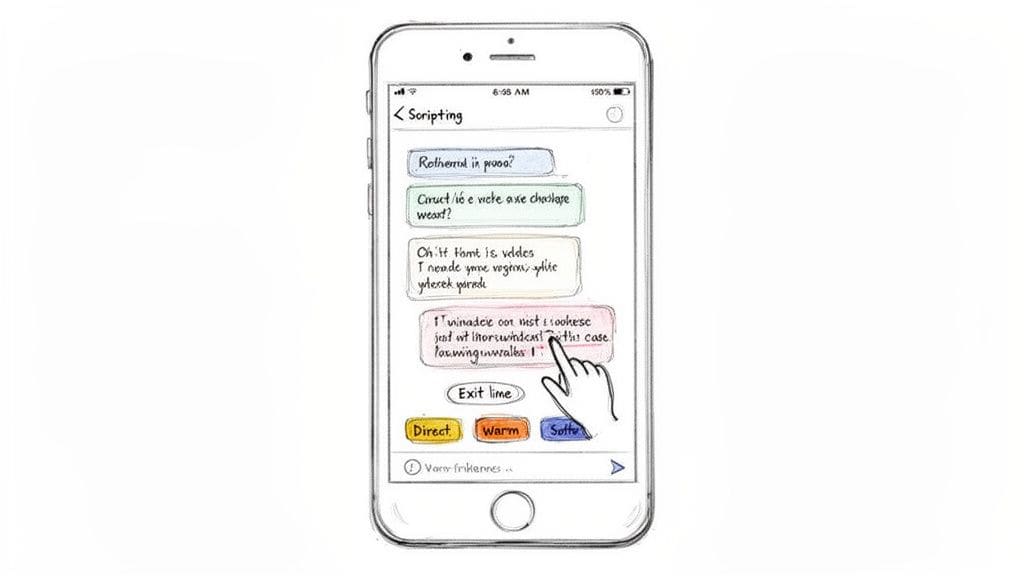
If you've ever had your mind go completely blank right in the middle of a conversation, you know how stressful it can be. Scripting apps are built for exactly that moment. This category of tool is designed to reduce the enormous mental effort of social interaction by offering a library of pre-written phrases and prompts for all kinds of situations.
The goal isn't to make you sound robotic. Far from it. Think of these tools as a supportive framework—a starting point that frees you from the anxiety of searching for the "right" words. It lets you focus your energy on the actual interaction, not on the desperate hunt for what to say next.
How Scripting Apps Empower Users
At their core, scripting and prompting tools solve a major challenge for many neurodivergent people: translating what you're thinking and feeling into clear, external communication. They work by giving you structured language that you can then adapt to your own voice and situation.
The best apps in this category usually include a few key features:
Looking for communication tools made for neurodivergent brains? tonen can help.
tonen gives you 188+ conversation scripts, tone guidance and calming tools — designed for autistic adults, ADHD and social anxiety. Try it free for 7 days.
Download on the App StoreiOS only. Android coming soon.
* Extensive Script Libraries: A solid collection of prompts for situations at work, school, home, and in your social life.
Customization Options: The ability to edit, save, and personalize scripts so they sound like you*.
* "Opt-Out" Lines: Graceful phrases for exiting a conversation when you feel overwhelmed or simply need to leave.
* Tone Adjustments: Options to tweak the feel of a message, from direct and firm to warm and gentle.
This space is growing fast for a reason. The ADHD apps market alone, which frequently includes social management tools, hit $2.22 billion in 2025 and is on track to reach $4.71 billion by 2030. This boom is directly linked to the number of people looking for private, on-demand support for navigating conversations. You can explore more insights about the ADHD apps market on TheBusinessResearchCompany.com.
> Having a script doesn't make the conversation less authentic. It frees up your brain to be more present and authentic during the conversation, because you're not spending all your energy just trying to formulate a sentence.
By providing a reliable starting point, these specific tools help lower the barrier to entry for difficult or stressful interactions. For a deeper look at how these tools are structured, you might find our guide on creating and using conversation scripts for social situations helpful.
Exploring Augmentative and Alternative Communication (AAC) Apps
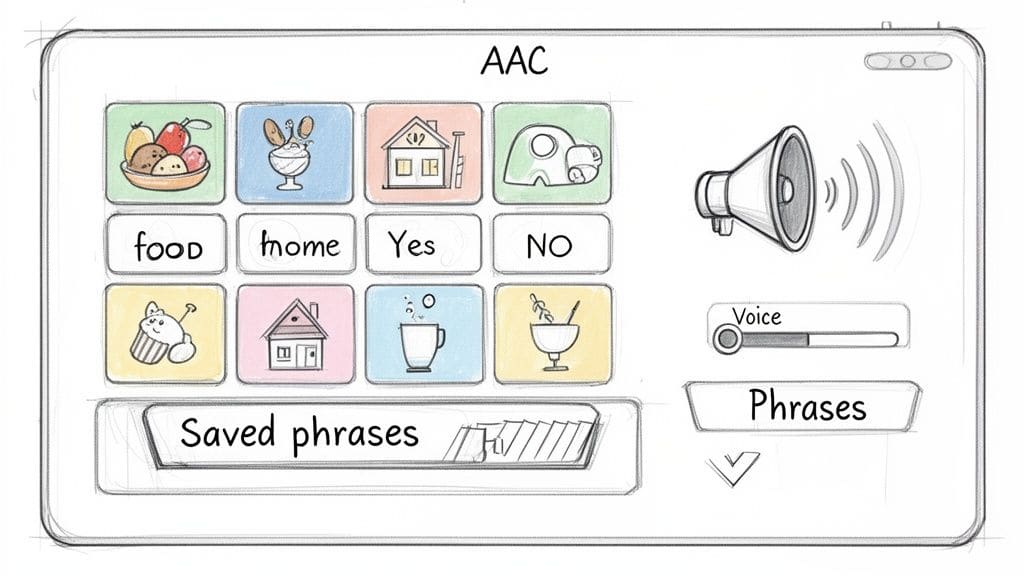
Augmentative and Alternative Communication (AAC) apps are designed to give a voice to anyone who is non-speaking, semi-speaking, or unreliably speaking. These powerful tools can turn a standard phone or tablet into a full-featured communication device, closing the gap between what a person wants to say and their ability to say it out loud.
At their core, they let a user choose symbols or type out words, and the app speaks the message. This allows for fluid, real-time conversations. For many, these tools aren't just helpful—they're fundamental for daily interaction, independence, and self-advocacy.
Symbol-Based vs. Text-to-Speech Functionality
The biggest difference between various AAC apps comes down to how a person builds their message. Getting this distinction is the first step to finding a tool that actually works for the individual.
* Symbol-Based AAC: These apps use pictures, icons, or dedicated symbols (like SymbolStix) to stand for words and ideas. You tap a series of pictures to build a sentence. This approach is often a great fit for people who find processing images easier than spelling or typing, as it can lower the cognitive effort needed to communicate.
* Text-to-Speech (TTS) AAC: Built for literate users who are comfortable with typing, these apps use a keyboard interface. You type what you want to say, and the app speaks it for you. The best TTS apps include features like word prediction and saved phrase lists to make communication much faster and more efficient.
> The best AAC tool is one that feels so intuitive it almost disappears. The technology should never get in the way of the person's personality and message shining through.
For example, on a symbol-based app, someone might tap the symbols for "I want" + "apple" + "please." On a TTS app, a user could type out, "Can we talk about the project deadline?" and save it to a "Work" folder for quick access in their next meeting. Many modern apps actually offer a hybrid approach, letting users blend symbols and text as needed.
Some people also find it helpful to use their AAC app in combination with a scripting tool. While AAC is fantastic for creating novel sentences on the fly, a scripting app can help prepare for more complex social situations or challenging conversations. If that blended approach sounds useful, you can learn more about finding the right communication app for autistic users that supports these different needs.
Apps for Social Skills and Emotional Regulation Training
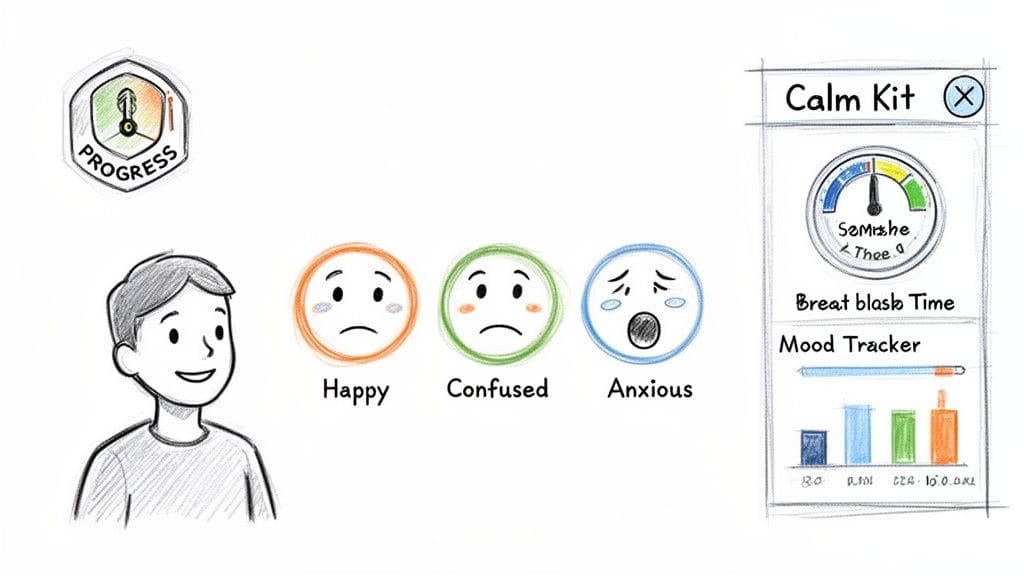
Moving beyond scripts and AAC, another critical type of app for neurodivergent communication targets the internal skills we need to feel grounded during an interaction. These tools use interactive scenarios and even game-like features to teach social cues, emotional recognition, and self-regulation in a completely private, low-stakes space.
The whole point is to practice in a safe environment, building real confidence for real-world conversations. It's about breaking down overwhelming social mechanics into lessons you can actually manage.
For example, an app might use video clips to show how tone of voice completely changes a sentence's meaning. Or it could offer quizzes to help you get better at identifying emotions from facial expressions. This kind of targeted practice can make you feel more prepared to handle tricky things like sarcasm, idioms, or group dynamics.
Integrating Emotional Regulation and Social Skills
A key feature of the best apps in this category is the connection they make between emotional regulation and communication. Let's be honest—social interactions can be a huge source of anxiety, and that anxiety makes it even harder to communicate the way you want to.
Recognizing this, many of these apps now include built-in tools like mood trackers or digital "calm-down corners."
These features are designed to help you manage overwhelm right when it's happening. A quick breathing exercise or a simple grounding technique can be the difference between a conversation you feel good about and a total shutdown. This integration of tools is what makes these specific apps so powerful—they don't just address the "how" of social skills, but also the "why" behind the struggle. This is a perfect example of how the right assistive technology for communication can support so much more than just the conversation itself.
> The most effective social skills apps don't just teach rules; they build a user's internal capacity to manage the stress of social engagement. This creates a positive feedback loop where less anxiety leads to better communication, which in turn reduces future anxiety.
A Growing Niche for Connection
The need for this kind of low-stakes social practice is obvious when you look at the booming market for neurodivergent social and dating apps. Platforms like Hiki have grown to over 200,000 users by creating safe community spaces for friendship and romance.
When you consider that up to 70% of autistic adults and teens with ADHD also experience social anxiety, it's clear these apps are providing a vital way to connect. For more insight, you can learn about the neurodivergent dating app market on Atypikoo.com.
This trend highlights a core need that social skills apps also address: the deep desire for connection without the overwhelming pressure. For those who deal specifically with this kind of stress, our guide to apps for managing social anxiety offers even more targeted resources.
Comparing Top Apps for Neurodivergent Communication
We've covered a lot of individual tools, and now it's time to see how they stack up side-by-side. Trying to pick the right app can be overwhelming, so we've organized the top contenders into a simple, at-a-glance guide.
This isn't just a list of features. It's a way to quickly see which tool aligns with your specific communication needs—whether you need help scripting professional emails, a robust system for in-the-moment communication, or a way to practice social skills. The goal here is to cut down on the decision fatigue so you can focus on finding what actually works for you.
Feature Comparison of Top Neurodivergent Communication Apps
Here's a breakdown of the leading apps for neurodivergent communication we've reviewed. Think of this table as your starting point for matching a tool to a specific challenge.
| App Name | Primary Function | Key Features | Platform | Pricing Model | Best For |
|---|---|---|---|---|---|
| tonen | Scripting & Prompts | Script library (188+), 4 tone options, Perspective Helper, Calm Kit | iOS | Subscription | Autistic adults, people with ADHD, and those with social anxiety. |
| Proloquo2Go | AAC (Symbol-Based) | Large symbol library (Crescendo), customizable vocabulary, advanced grammar support | iOS | One-Time Purchase | Non-speaking or semi-speaking individuals, especially children and teens. |
| TippyTalk | AAC (Text-to-Speech) | Text-to-speech with natural voices, word prediction, saved phrases | iOS & Android | Subscription | Literate AAC users who prefer typing to communicate their thoughts. |
| SocialCipher | Social Skills Training | Gamified learning, story-based scenarios, emotional recognition practice | Web-based | Subscription | Teens and young adults who want to practice social skills in a fun setting. |
This quick comparison really shows how different tools are designed for very different moments in the communication process.
Key Takeaways from the Comparison
As you can see, there's a clear split between tools built for preparation (like tonen), tools for in-the-moment expression (like Proloquo2Go, a symbol-based AAC app), and tools for skill-building (like SocialCipher for social skills gaming). If you need on-the-spot help crafting a tricky text or a formal email for work, a scripting app offers the most direct and immediate support.
> Choosing an app isn't about finding a single 'magic bullet.' It's about building a personalized toolkit. You might use a scripting app for important emails and a social skills app to practice for an upcoming party.
Ultimately, the best tools are the ones that fit into your life without adding another layer of complexity to manage. Think about your primary challenge—is it planning what to say, or is it expressing yourself in real time? Use this table to point you toward the right starting point for building your own communication toolkit.
How to Choose the Right App for Your Needs
The best app is always the one that actually fits into your life. With so many options out there in 2026, the key isn't finding the one "perfect" tool—it's figuring out your main friction point and choosing a tool that solves for that.
Instead of getting overwhelmed by feature lists, think about building a small, personalized digital toolkit. Let's walk through a few common scenarios to show you how different apps can address specific, real-world challenges.
For Managers Supporting Neurodivergent Employees
If you're a manager who wants to better support a neurodivergent employee, a scripting app is an incredibly practical place to start. We all know that clear, direct communication is essential, but giving feedback can be a major source of anxiety for everyone involved.
A scripting app takes the guesswork out of these moments by providing structured phrases for both constructive criticism and praise. Instead of fumbling for the right words, you could use a script like, "I appreciate the effort you put into the report. For the next version, can we focus on adding more data to section three?" It removes ambiguity and lowers the cognitive load for both of you.
For Parents of a Teen with Social Anxiety
For a parent with a teenager who finds social situations draining, a social skills trainer can be a fantastic resource. Things like school events, group projects, and even casual hangouts can feel like navigating a minefield. These apps offer a private, low-stakes space to practice.
* Scenario Practice: They can rehearse things like how to join a conversation that's already started or what to say at a party.
* Emotional Recognition: Many of these apps have games to help practice identifying emotions from facial expressions or tone of voice.
* Anxiety Management: They often include calm-down tools, teaching skills for managing anxiety in the moment that can be used in the real world.
This kind of focused practice builds genuine confidence by reducing the fear of the unknown. It helps make social settings feel more manageable, and maybe even enjoyable.
For Adults Navigating Workplace Dynamics
As an autistic adult trying to make sense of complex workplace politics, you'll probably find that a single tool isn't enough. The professional world throws a lot of different communication challenges at you.
> The goal isn't to find one app that does everything. It's to assemble a small, trusted set of tools that address your specific friction points—one for emails, another for meetings, and maybe one for self-care.
For example, you might use a scripting tool to draft formal emails or meeting requests, making sure your own communication is crystal clear. At the same time, an app with a perspective helper, like tonen, can be a lifesaver for decoding team dynamics or understanding a colleague's confusing feedback.
This dual approach gives you both a scaffold for your own output and support for processing all the social input. You can learn more about how these tools fit into a broader strategy by checking out our guide on finding a great app for self-care and mental wellness.
Still Have Questions About Neurodivergent Communication Apps?
It's completely normal to have a few lingering questions when you're looking at tools like these. The journey to feeling more confident in conversations is a personal one, and you want to be sure you're choosing the right support.
Let's tackle some of the most common things people ask about privacy, effectiveness, and how to introduce these apps in a way that feels supportive, not critical.
Is My Data Private When Using These Apps?
This is a big one. The fear of your private thoughts or practice conversations ending up on a company server is completely valid, and you're right to be cautious.
The best apps, like tonen for scripting and prompts, are built with on-device processing. This means everything—your notes, custom scripts, and conversation history—stays on your phone. It's never sent to the cloud or seen by anyone else. Think of it as a private digital notebook.
Not all apps are created equal, though. Before you download anything, always skim the privacy policy. Look for phrases like "on-device storage" or "local processing." Be wary of apps that demand a lot of personal data or permissions just to function. A clear, easy-to-find policy is a great sign that the developers respect your privacy.
How Can I Introduce a Communication App to My Teen?
Introducing an app to a teen needs a gentle, collaborative touch. The goal is to frame it as an empowering tool they can choose to use, not a fix for something that's "broken."
The key is to take the pressure off. Start by exploring it together without any agenda. You could say something like, "I saw this app that helps people get their thoughts together before a tricky conversation. Want to check it out with me? No big deal if it's not your thing."
Focus on features they might actually find useful. Maybe it's a "calm kit" to manage anxiety before a class presentation, or a practice mode for a part-time job interview. Let them lead the way and emphasize that it's just another tool for their toolkit, like a calculator or a planner—there if they need it, no big deal if they don't.
Can These Apps Replace Therapy or an SLP?
No. It's important to be clear about this: these apps are powerful supplementary tools, not replacements for professional guidance from a therapist or a Speech-Language Pathologist (SLP). With up to 20% of the world's population being neurodivergent, technology is a fantastic way to offer support, but it can't replicate human expertise.
> These apps are at their best when they're used to practice and reinforce the strategies you learn in therapy, or to provide that in-the-moment support right when you need it. They're brilliant for rehearsing skills, lowering anxiety, and preparing for a specific event.
The most effective approach is almost always an integrated one. In fact, many therapists and SLPs now recommend specific apps to their clients. This combination of expert-led strategies and on-demand digital support creates a robust and practical system for building real communication confidence.
Ready to communicate with less stress and more clarity? tonen was created by neurodivergent makers to help you handle conversations with confidence. With a rich library of scripts, tone adjustments, and a calming kit, it's designed to support you right when you need it. Try it free for 7 days and see the difference it can make. Explore tonen today and find your voice.
Frequently asked questions
This guide covers the ultimate guide to apps for neurodivergent communication with practical, neurodivergent-friendly strategies—clear steps, scripts where useful, and ways to reduce anxiety or overload rather than vague "be confident" advice.