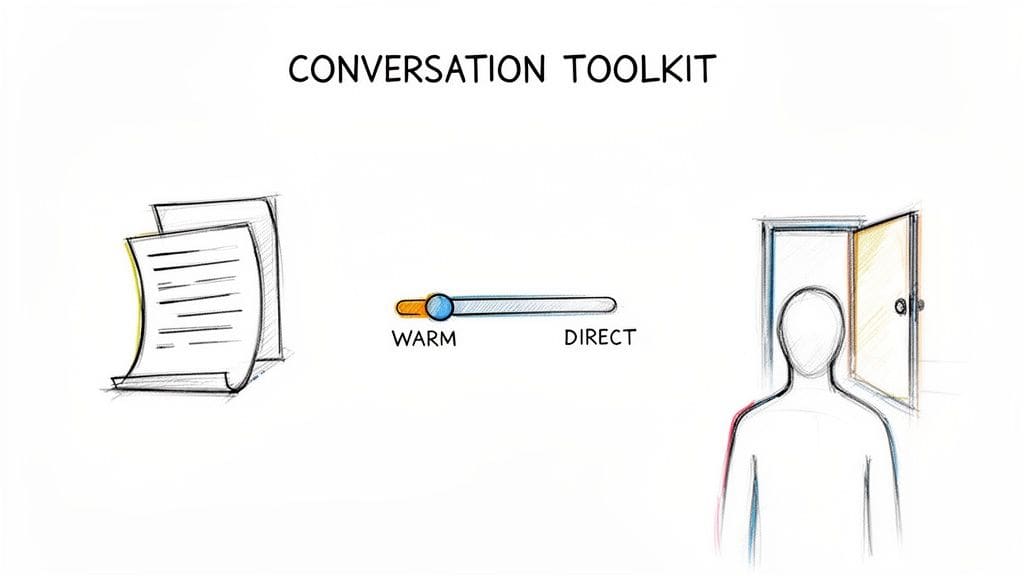
For many of us, the key to better social interactions isn't trying harder—it's lowering the intense cognitive load that comes with them. This guide offers immediate autism conversation help you can start using today by building a practical "conversation toolkit." The most effective method involves three core strategies: preparing for conversations with adaptable scripts, understanding how to consciously adjust your communication tone, and always having a reliable exit strategy. This approach provides a solid foundation, giving you more control and reducing anxiety from the start.
Quick Strategies for Less Stressful Conversations
Trying to navigate a casual chat at work or a family dinner can feel like you're trying to decode a foreign language in real-time. This is a daily reality for millions on the autism spectrum, where even simple conversations can trigger intense stress.
For autistic adults and neurodivergent teens, this isn't just a feeling. Studies show up to 70% experience social anxiety during interactions, which often leads to isolation and burnout.
The Global Burden of Disease Study 2021, published in The Lancet, estimated that 61.8 million people worldwide—or about one in every 127 individuals—were autistic that year. These numbers show just how widespread the need for practical support really is.
Building Your Conversation Toolkit
Instead of trying to guess all the unspoken social rules under pressure, a toolkit gives you a dependable framework to rely on. Think of it as having a set of pre-approved tools for different jobs, which immediately helps lower your anxiety.
This proactive approach to autism conversation help focuses on three core areas. Let's break them down.
Here's a quick look at how these three pillars work together to form your toolkit. It's a simple framework designed to give you a sense of control and reduce the mental energy spent on social mechanics.
Your Conversation Toolkit at a Glance
| Strategy | What It Is | Why It Helps |
|---|---|---|
| Adaptable Scripts | Pre-planned phrases for common situations, like small talk or asking for help. | You never have to start from a blank slate, which drastically cuts down on in-the-moment anxiety. |
| Tone & Style Adjustment | Learning to consciously choose your communication style (e.g., warm, direct) to match the situation. | It helps ensure your message lands as intended, preventing common misunderstandings and misinterpretations. |
| Reliable Exit Strategies | A simple, pre-planned "out" line to end a conversation gracefully when your social battery is low. | It removes the fear of getting "trapped," protecting your energy and preventing social burnout. |
Having these tools ready means you can focus less on how to talk and more on the person you're actually talking to. This preparation is what makes interactions less draining and, hopefully, more rewarding.
Why This Approach Works
This toolkit approach is all about empowerment. It shifts the dynamic from reactive stress to proactive control, allowing you to engage on your own terms.
By preparing these elements, you dramatically reduce the mental energy spent on the mechanics of the conversation. This frees you up to be more present and engaged. It's a game-changer.
For a deeper look into effective communication, resources like this guide on How to Support Someone with Autism can offer valuable perspectives for you and your supporters.
Many of these same preparation techniques are also incredibly helpful for anyone looking to manage social anxiety. If that sounds like you, be sure to check out our related guide for more social anxiety conversation tips. These foundational strategies provide the support needed to build confidence, one interaction at a time.
How to Prepare for Social Interactions
The most successful conversations often start long before a single word is spoken. For many of us, showing up and hoping for the best is a recipe for anxiety. Proactive preparation, on the other hand, can dramatically lower the stress of social events.
This is where you build a solid foundation. Think of it not as creating a rigid script, but as assembling a personal toolkit. Having a plan gives you a sense of control in what can feel like an unpredictable situation, and it seriously reduces the mental load of figuring everything out in the moment.
Create a Simple Conversation Plan
A plan isn't about memorizing lines word-for-word. It's more like a flexible guide with a few key talking points you can fall back on. Before you go, just take a minute to think about the context. Is it a weekly team meeting? A big family party? Or just a casual coffee with one friend?
Based on that context, you can jot down a few ideas:
* Likely Topics: What's probably going to come up? (e.g., work updates, family news, weekend plans).
* Your Contributions: What's one thing you might want to share about your life that feels relevant and safe?
* Predictable Questions: What are you almost certain to be asked? (e.g., "How have you been?", "What are you working on?").
> Having a few pre-planned answers for common questions is one of the most effective ways to lower social stress. It's not about being inauthentic; it's about reducing the processing power needed to formulate a response from scratch under pressure.
Use Scripting Tools and Rehearsal
For more specific situations, a dedicated scripting tool can be a game-changer. The tonen app, for example, has a Scripts Library full of ready-to-use lines for work, family, and social scenarios that give you a great starting point. You can find more ideas in our complete guide to using autism conversation scripts.
Once you have a couple of phrases, rehearse them out loud. This step is so important. Saying the words helps build muscle memory, making your responses feel more natural and easier to grab when you need them. It's the difference between knowing a fact and knowing how to use it.
Plan for Your Sensory Needs
Good preparation isn't just about the words. It's also about making sure you're as physically comfortable as possible. This is essential autism conversation help that's often overlooked.
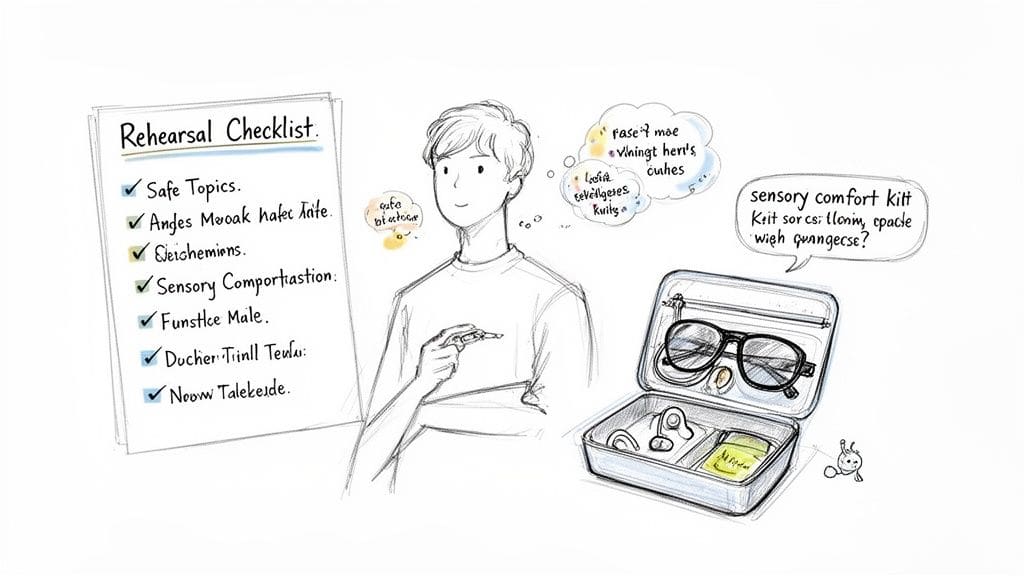
Thinking about your sensory needs ahead of time is just as crucial as planning what you'll say. Before you head out, consider the environment you're walking into and pack a small "sensory kit" with a few things that help you regulate.
Your kit might include:
* Noise-canceling earbuds or discreet earplugs
* Sunglasses if you're sensitive to bright lights
* A familiar, calming scent on a piece of cloth
Finding conversations overwhelming or exhausting? tonen can help.
tonen gives you 188+ conversation scripts, tone guidance and calming tools — designed for autistic adults, ADHD and social anxiety. Try it free for 7 days.
Download on the App StoreiOS only. Android coming soon.
* A quiet fidget tool you can keep in your pocket
By planning for both the conversation and your sensory comfort, you're setting yourself up for a much better and more successful experience.
Navigating Conversations in Real Time
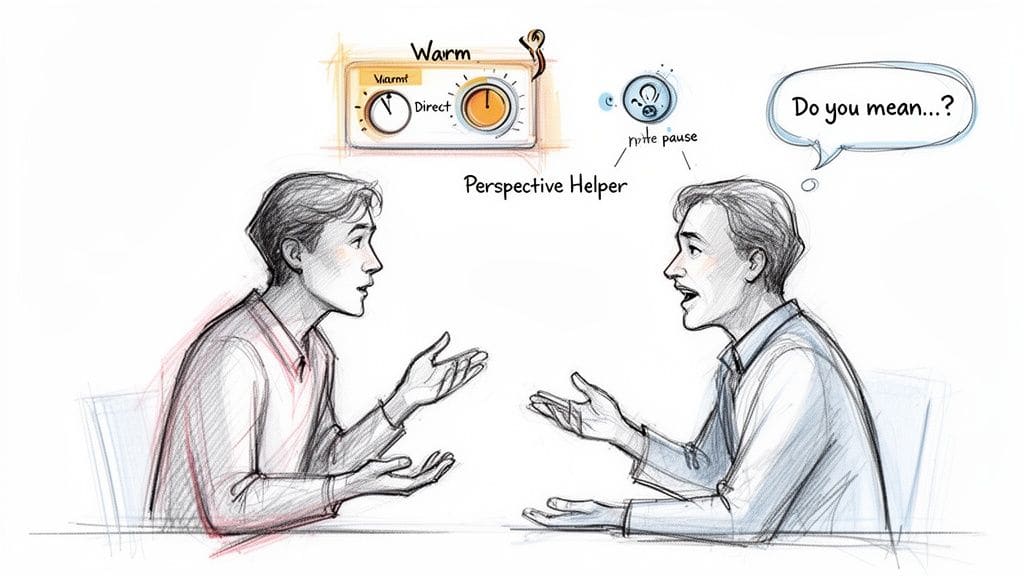
Preparation is a huge part of feeling confident, but what happens once you're actually in the conversation? The best in-the-moment autism conversation help is about staying grounded and feeling like you're in control, not just reacting.
This means having a few mental tools ready to go. Think of them as your on-the-spot toolkit for managing your reactions, listening without getting overwhelmed, and knowing how to leave when your social battery starts to run low. It's not about being perfect; it's about being prepared.
Adjusting Your Tone and Style
The way we say something can change everything. It's often just as important as the words we use. Learning to consciously adjust your tone is a game-changer for avoiding misunderstandings that can drain your energy.
Instead of having one default way of speaking, picture a slider you can move between different modes. For example, a crisp, Direct tone might be the clearest way to set a boundary at work. But when you're talking about something sensitive with a family member, a Warm or Softer tone will likely get a much better reception. Simply being aware of these options gives you so much more control.
Using the Perspective Helper Technique
It's so easy to spiral when someone says something unexpected or that feels critical. The "Perspective Helper" is a mental trick you can use to hit pause and look for other explanations before you react.
Before jumping to the worst-case scenario—that they're being rude or judging you—ask yourself a few quick questions:
* Could they just be stressed or having a bad day that has nothing to do with me?
* Is it possible I misunderstood what they really meant?
* Is there a more generous, positive way to interpret their words?
> This simple pause is a powerful tool. It defuses your own anxiety and stops you from reacting based on a single, potentially negative assumption. It gives you the space to respond thoughtfully instead of defensively.
As a community, we've seen awareness of autism grow dramatically. Diagnosis rates went from roughly 1 in 2,000 in the 1980s to 1 in 127 globally by 2021, which includes an estimated 61.8 million people. Yet social conversation challenges remain a core, under-addressed barrier for many of us, which helps explain why 60-70% of autistics also experience social anxiety. You can read more about global autism statistics and their impact to see just how widespread this need is.
Neurodivergent-Friendly Active Listening
So much traditional advice on "active listening" focuses on trying to read subtle, ambiguous body language. For many of us, that's exhausting and just not reliable. A much more accessible approach is to focus on the actual words being said.
Instead of trying to decode every facial expression, try these more concrete methods:
* Clarifying Questions: "So, if I'm understanding you correctly, you're saying..."
* Reflective Summaries: "It sounds like you felt frustrated when that happened."
* Asking for Specifics: "Could you give me an example of what you mean by that?"
These strategies keep you fully engaged in the conversation without forcing you to interpret non-verbal cues that may not even mean what you think they mean. If you want to build your confidence in this area, you can also explore tools that offer a structured way to practice. Using an app provides a safe space for conversation practice without real-world pressure, giving you the resources needed for real-time success.
Managing Overwhelm and Social Burnout
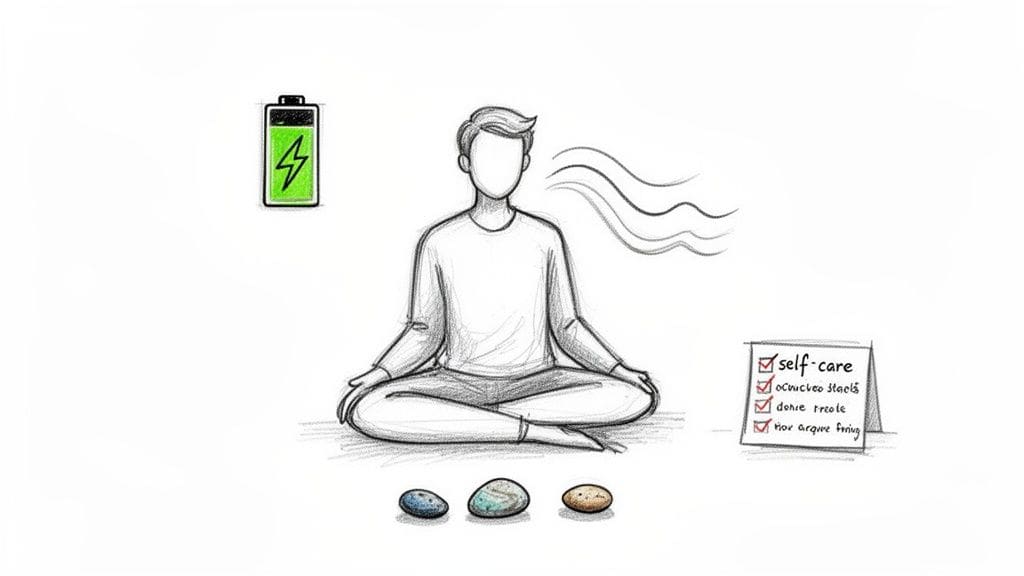
Socializing is work. For many of us, the real effort doesn't end when the conversation does; it's the mental and sensory processing that continues long after we've walked away.
The best autism conversation help recognizes that what you do after an interaction is just as important as how you prepare for it. Learning how to recover effectively is a non-negotiable skill for preventing social burnout and protecting your well-being.
Immediate Calming Techniques
When you feel that familiar wave of overwhelm creeping in, having a few discreet, go-to techniques can be a lifeline. These aren't complicated. They're simple, physical actions you can do anywhere to help regulate your nervous system without drawing attention to yourself.
You can try a few simple grounding exercises:
* The 5-4-3-2-1 Method: Silently name five things you can see, four things you can physically feel (the texture of your sleeve, your feet on the floor), three things you can hear, two things you can smell, and one thing you can taste.
* Pressure Points: Gently but firmly press your thumb into the palm of your other hand for a few seconds. The subtle physical sensation can pull your focus away from spinning, anxious thoughts.
* Box Breathing: Inhale for four seconds, hold for four seconds, exhale for four, and then pause for four. This simple rhythm forces your breathing to slow down, sending a direct calming signal to your brain.
> Remember: The goal isn't to magically erase the overwhelm. It's to give yourself an anchor in the present moment so you can regain a sense of control and make a clear decision about what to do next.
Recognizing Your Social Battery
Just like your phone, your social battery has a finite charge. Learning to recognize its early warning signs is a critical skill for avoiding a full shutdown or burnout. These signals are completely unique to you.
Do you start to feel:
* Like all the sounds in the room suddenly got louder?
* A prickle of irritation or frustration?
* A powerful, undeniable urge to be alone?
* Like it's getting harder to find your words or form a clear thought?
These are all signals that your battery is draining. Honoring them isn't a failure; it's an act of self-preservation. It is absolutely okay—and necessary—to end a chat or decline an invitation to protect your energy. Understanding these personal cues is a core part of effective support for autistic communicators.
Post-Interaction Reflection with Self-Compassion
After a tough conversation, it's so easy to get stuck in a self-critical loop, replaying every perceived misstep. This isn't helpful. It just digs the hole of social anxiety even deeper.
Instead, try a more structured and compassionate approach.
Ask yourself what went well, even if it feels small. Did you use one of your scripts? Did you manage to set a boundary? Did you successfully use an exit line when you felt your energy dip? Acknowledging your wins, no matter how minor they seem, is how you build confidence for next time.
For more strategies, you can learn what to do when feeling overwhelmed in our detailed guide.
While individual strategies are a great starting point, a dedicated app can be a real game-changer. It takes all those separate techniques—scripting, tone practice, self-care—and brings them together into a single, structured tool right on your phone.
The real magic of an app like tonen is that it's designed to have a low cognitive load. Instead of juggling a dozen mental checklists during a conversation, you have one reliable partner to lean on. It's about making support accessible when you need it most.
A huge factor here is who's building the tool. When apps are created by neurodivergent makers, they're built from a place of deep, personal understanding. The features aren't based on what neurotypical people think we need; they're designed to solve the actual, practical problems we face with social communication.
How an App Integrates Support
Think of an app as a central hub for all your conversational needs. It connects the dots between preparing for, navigating, and recovering from social interactions.
Scripting & Tone: Instead of just jotting down scripts, an app can show you those same words with different tone options, like Direct or Warm. This lets you practice not just what to say, but how* you want it to come across.
* In-the-Moment Support: Ever get stuck on a comment someone made? A "Perspective Helper" feature can offer alternative ways to interpret what they said, stopping a negative thought spiral before it even begins.
* Post-Conversation Care: If you're feeling overwhelmed after a chat, a built-in "Calm Kit" with grounding exercises is just a tap away. It makes self-regulation immediate and totally discreet.
This kind of integrated system dramatically reduces the mental energy it takes to navigate social situations. For a deeper look at how different platforms are approaching this, it's worth exploring solutions like Parakeet AI, which also focuses on communication assistance.
Privacy and Real-World Use
Trust is everything, especially when you're working with personal thoughts and scripts. That's why data privacy is non-negotiable. With an app like tonen, all your conversations and personal scripts stay right on your device. Nothing is ever uploaded to the cloud. They are your tools, for your eyes only.
> The goal is to build confidence and clarity. Anonymized stories from users show how they've used the app to set boundaries without feeling rude, prepare for meetings with less anxiety, and have clearer, more direct conversations with family. This kind of focused autism conversation help makes a tangible difference.
If you're curious about how this might work for you, seeing the features in action is often the best way to know if a tool is the right fit. You can explore more about how a purpose-built communication app for autism provides structured support.
Still Have Questions About Conversation Supports?
It's completely normal to have questions when you start using tools to help with conversations. The idea can feel a little strange at first, and you might wonder if you'll still sound like you.
Let's tackle some of the most common concerns. The goal here is to get rid of any lingering doubts so you can feel confident using these strategies to make your life easier.
Will Using Scripts Make Me Sound Robotic or Inauthentic?
This is a big one, and it's a totally fair question. The point of using a script is to give yourself a reliable launchpad, not to turn you into a robot reciting lines. Think of it as a safety net that lowers the intense stress of having to find the perfect words on the spot.
When you're not scrambling for words, you free up so much mental energy. You can actually focus on listening and being present in the conversation. A good tool will even offer tone options—like Direct, Warm, or Softer—so you can pick the wording that feels true to you. Over time, you'll find yourself naturally adapting the scripts into your own voice. They become a tool for authenticity, not a barrier to it.
How Do I Handle Conversations That Aren't in a Script Library?
No script library on earth can cover every single situation you'll ever run into. This is where you start shifting from just using the scripts to building the underlying skill for yourself.
For example, using a feature like a "Perspective Helper" isn't just about one conversation; it teaches you a process. It walks you through how to break down a new or unexpected social problem, consider different angles, and brainstorm your own responses. The real goal isn't just to memorize lines, but to learn how to create your own scripts for any situation life throws at you.
> The real power comes from learning the framework behind the scripts. As you practice, you're not just preparing for one conversation; you're developing a lifelong skill for clearer communication. Finding additional resources, like the perspectives in a book such as We're Not Broken: Changing The Autism Conversation by Eric Garcia, can also broaden your understanding.
What If I Forget My Script in the Moment?
Forgetting what you planned to say is completely normal, especially when you're feeling social pressure. It happens to everyone. This is exactly why practicing beforehand is so helpful—it builds that crucial muscle memory.
More importantly, always have a simple backup phrase ready to go. Something straightforward like, "Sorry, I lost my train of thought for a second," or "Can you give me a moment to process that?" works perfectly. This one little line buys you time and instantly lowers the pressure to be perfect. Often, that's all you need to find your footing and get right back on track.
Ready to feel more confident and less stressed in your daily conversations? tonen is the supportive partner that helps you prepare, practice, and navigate interactions with ease. With an extensive Scripts Library, a Perspective Helper, and a Calm Kit for overwhelm, you have all the tools you need in one discreet, neurodivergent-led app. Start your free 7-day trial today and discover a new way to communicate. Download tonen on the App Store.
Frequently asked questions
This guide covers your practical guide to autism conversation help with practical, neurodivergent-friendly strategies—clear steps, scripts where useful, and ways to reduce anxiety or overload rather than vague "be confident" advice.