The best communication tools for autistic adults are those that reduce cognitive load and empower self-advocacy, ranging from high-tech Augmentative and Alternative Communication (AAC) apps to simple, low-tech aids like scripting notebooks and communication cards. The most effective solutions, like the tonen app, often blend features like pre-written scripts, tone modulation, and private practice modes to make social interactions less stressful. Finding the right tool isn't about "fixing" how you communicate; it's about discovering what works for you and finding alternative paths for expression that honor your neurotype and energy levels.
Your Guide to Autistic Communication Tools
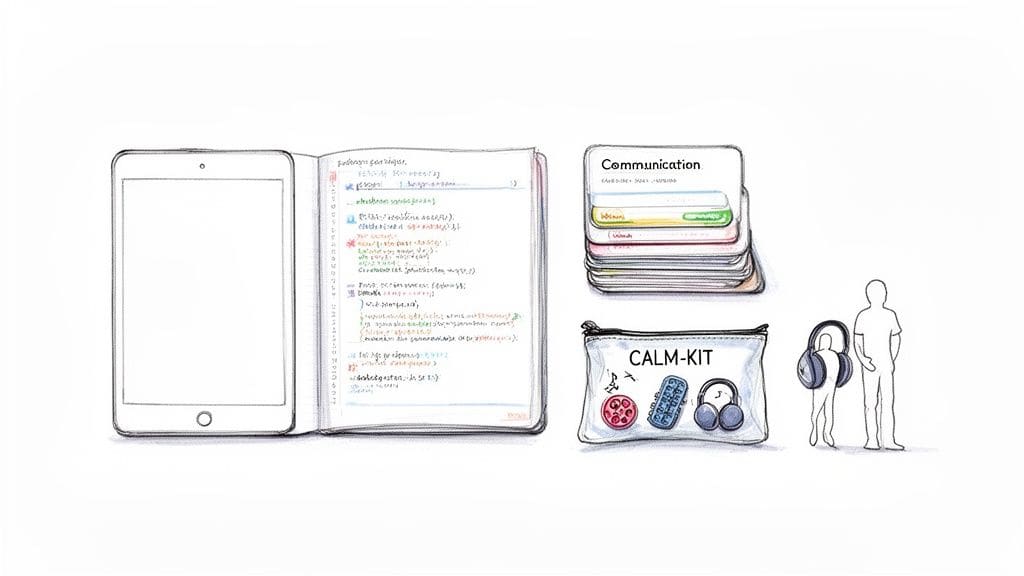
Communication is about so much more than just the words we use. It's about feeling understood, connecting with people, and being able to clearly state our needs and ideas. For many of us, neurotypical communication can feel like trying to solve a puzzle without all the pieces, which leads to exhaustion, anxiety, and constant misunderstandings.
This is where communication tools for autistic adults come in. They aren't meant to force you into a different communication style. Instead, they offer alternative paths for expression that honor your neurotype and energy levels.
The goal is to find a support that works for your life. That might be an app that helps you find the right tone for a tricky work email or a simple card that lets you leave a loud party without feeling rude.
Understanding the Communication Gap
The need for these tools isn't just a feeling; it's backed by real challenges. One study found that 25% or fewer of autistic adults diagnosed in childhood reach average or above-average scores in communication as a practical life skill. This shows that these difficulties often stick around well into adulthood.
And it's not just an issue for those of us who are non-speaking. Even among autistic adults with fluent spoken language, 46% screen positive for developmental language disorder. This points to a hidden struggle where the words might come out, but understanding all the nuances underneath them can be incredibly difficult.
> The real problem usually isn't a lack of desire to connect, but a fundamental mismatch in communication styles. The right tool acts as a translator across that gap, helping to clarify intentions and dramatically reduce the mental effort of social interaction.
A Spectrum of Support
The world of communication aids is incredibly broad, which is a good thing. It means there's a wide range of options, each suited for different situations, preferences, and energy levels. It's crucial to remember that there is no one-size-fits-all answer here.
A really effective strategy often involves using a mix of different tools. To help you get a sense of what's out there, here's a quick look at the main categories.
#### Quick Guide to Communication Tool Categories
| Tool Category | Primary Use Case | Best For |
|---|---|---|
| High-Tech Solutions | Expressing complex thoughts, real-time conversation support. | AAC apps, AI assistants, and text-to-speech software. |
| Low-Tech Aids | Providing structure, managing social anxiety, and quick requests. | Scripting notebooks, visual schedules, and communication cards. |
This table gives you a starting point, but the real magic happens when you start combining these tools to build a personalized support system. For example, you might use a high-tech app for work meetings but rely on a low-tech scripting notebook to prepare for a casual coffee chat.
This guide will walk you through the full range of options, from high-tech AAC to simple visual aids. We'll explore the various autism support resources available to help you find options that can make your work, social life, and relationships feel more manageable and genuinely rewarding.
High-Tech Tools: Digital Apps and AAC Devices
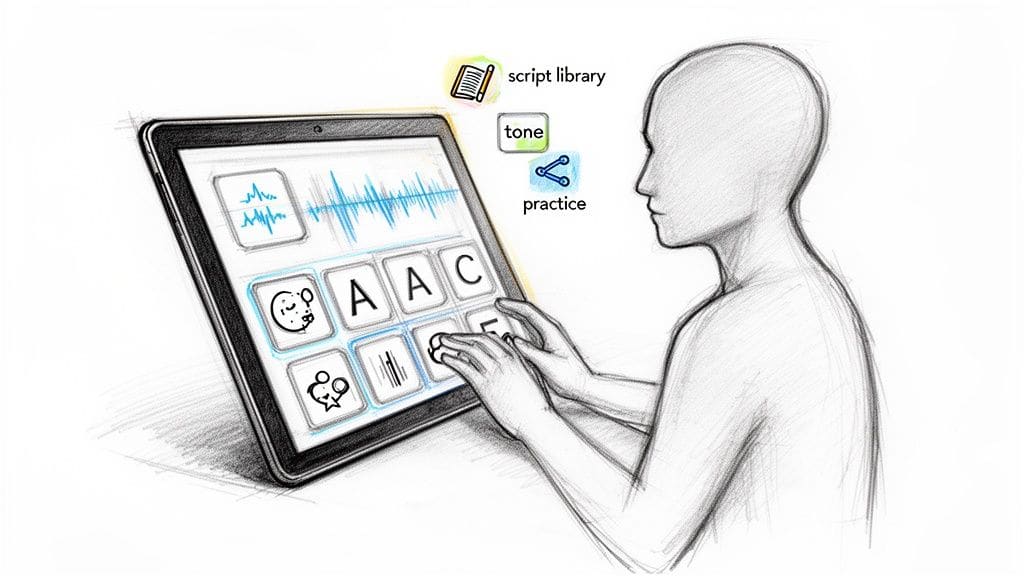
The explosion of digital tools has completely changed the game for communication support. The world of assistance now stretches from simple text-to-speech apps all the way to sophisticated Augmentative and Alternative Communication (AAC) devices. This shift lines up perfectly with what many of us prefer.
It's not just a feeling; research backs this up. Autistic adults often find computer-based communication far more comfortable than our neurotypical peers. We tend to spend more time on digital platforms and see them as a genuinely positive way to connect and find support. You can discover more research about this trend from Drexel University. These text-based tools give us a way to sidestep the immense pressure of verbal conversation—a crucial option when communication challenges are a lifelong reality.
Types of Digital Communication Tools
Digital solutions aren't one-size-fits-all. They vary widely, and knowing the main categories helps you zero in on what might actually work for your specific needs.
* Text-to-Speech (TTS) Apps: These are exactly what they sound like. If you're comfortable typing but can't—or just don't want to—speak in a given moment, these tools are a lifesaver. You type your message, and the device says it for you. Simple as that.
* Symbol-Based AAC: Often seen as just for kids, many modern symbol-based apps are now designed with adults in mind. They use pictures or icons to build sentences, which can be a huge help for anyone who finds text-based communication difficult or tiring.
Scripting and Tone Modulation Apps: These newer tools tackle the more subtle, nuanced parts of social interaction. They offer libraries of pre-written scripts for common scenarios—like a doctor's visit or a team meeting—and some even let you adjust the tone* of the message. For those looking for even more support in their writing, an AI writing assistant can be a fantastic way to fine-tune emails and other documents for clarity and style.
> The best digital tools go beyond just getting words out. They address the root causes of social fatigue. Things like private practice modes, social-perspective helpers, and clean, low-clutter interfaces are designed to lower cognitive strain and make communication feel safer and more authentic.
What Makes a Digital Tool Actually Work
A truly effective digital tool for an autistic adult isn't just about a long list of features; it's all about the experience of using it. A clean, uncluttered interface with a low cognitive load is absolutely essential. It has to reduce sensory overload, not add to it.
Customization is also a huge deal. The ability to add your own phrases, tweak voice settings, and organize things your way is what makes a tool feel like it's truly yours.
More and more, modern apps are focusing on preparation and rehearsal. Many now include practice modes where you can run through a conversation privately, building real confidence before you have to do it for real. Our guide to the best apps for neurodivergent people dives deeper into options that really prioritize these user-first designs.
Ultimately, the best communication tools for autistic adults are the ones that empower you to communicate entirely on your own terms.
Low-Tech Aids and Everyday Strategies
While slick digital apps offer incredible support, some of the most dependable communication supports don't require a charger. These everyday strategies need no batteries and no internet connection, making them foolproof aids for cutting through in-the-moment stress to clearly express your needs.
Their simplicity is their superpower. You get straightforward support without the risk of a dead battery, a frozen screen, or a distracting interface that adds to your cognitive load.
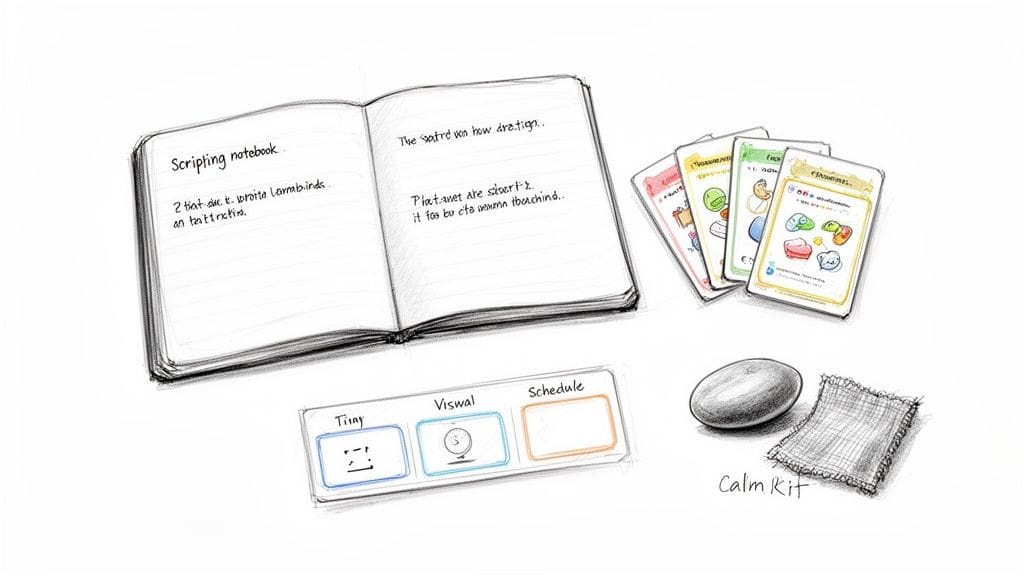
These tools aren't a step backward from technology; they are the bedrock of a solid support system. A simple scripting notebook, for instance, can be a private space to pre-write and rehearse phrases for common interactions, like ordering coffee or making a phone call. That little bit of prep work can make the actual event so much less overwhelming.
Practical Low-Tech Communication Aids
Low-tech aids are all about giving you control and taking the pressure off of having to perform verbally. They're easy to customize, easy to carry, and always there when you need a way to get your point across.
* Communication Cards: These are small, portable cards with pre-written messages. They let you express a specific need quickly and without verbal gymnastics, like "I need a quiet moment" or "I am feeling overwhelmed."
* Scripting Notebooks: This is just a personal journal where you can map out entire conversations or just jot down key phrases. It helps you organize your thoughts and practice what you want to say, building real confidence for when you're face-to-face with someone.
* Visual Schedules and Planners: Using a physical planner or a whiteboard to map out your day provides structure and predictability. Knowing what's coming next reduces anxiety around transitions and helps you mentally budget your energy for upcoming social demands.
Looking for tools designed for autistic communication? tonen can help.
tonen gives you 188+ conversation scripts, tone guidance and calming tools — designed for autistic adults, ADHD and social anxiety. Try it free for 7 days.
Download on the App StoreiOS only. Android coming soon.
These simple items work so well as communication tools for autistic adults because they are tangible, predictable, and completely under your control.
Integrating Strategies for Full Support
The real magic happens when you start combining these low-tech aids into a single, cohesive strategy. One of the most effective methods is creating a "Calm Kit," which is just a personal collection of items that help with sensory grounding and emotional regulation during stressful interactions.
> A Calm Kit might include a smooth stone, a small piece of textured fabric, noise-reducing earplugs, and a few essential communication cards. Having these items on hand gives you a discreet way to manage sensory input while still having a tool to express your needs if talking becomes difficult.
Let's say a conversation suddenly becomes too intense. You could subtly use a grounding object from your kit while simultaneously showing someone a card that says, "Can we pause for a minute?" This approach tackles both your internal sensory experience and your external communication needs at the same time.
For more ideas on identifying and managing those big feelings, you can explore a feelings wheel with our helpful PDF guide. By blending these simple strategies, you create a reliable safety net that can make navigating social situations far less draining.
What to Look for in a Communication Tool
When you're looking for a communication tool, it's easy to get lost in feature lists and marketing hype. But for autistic adults, the "best" tool isn't the one with the most bells and whistles. It's the one that actually reduces your mental load, not adds to it.
The right tool should feel like an extension of your own mind—intuitive, clear, and completely under your control. It needs to prioritize a clean interface, deep personalization, and practical features that solve real-world problems, like figuring out tone or rehearsing a tricky conversation. And above all, it must be a private space, where your thoughts and data belong only to you.
Low Cognitive Load Interface
A confusing or cluttered app is an instant non-starter. A truly helpful tool must have a low cognitive load, which is just a technical way of saying it's simple, clean, and doesn't make your brain work overtime to use it. This is absolutely critical for preventing sensory overload, especially when you're already stressed.
Think of it like the difference between walking into a quiet, organized library and a chaotic, loud marketplace. One space lets you think clearly; the other creates immediate stress. A well-designed tool should feel like that library—calm, orderly, and easy to navigate when you need it most.
Customization and Personalization
The ability to make a tool your own is non-negotiable. One-size-fits-all solutions just don't work for something as deeply personal as communication. You need something that adapts to you, not the other way around.
Look for key customization features like:
* Personal Vocabulary: The power to add, save, and organize your most-used words and phrases is essential.
* Adjustable Settings: You should be able to change things like voice type, speech speed, and even the app's color scheme to match your sensory preferences.
* Saved Scripts: The ability to create and store custom scripts for your recurring situations—from work meetings to family dinners—is a game-changer.
This level of control ensures the tool becomes a true partner in your communication.
> The core principle is agency. An effective tool hands you the reins, letting you tailor every aspect to fit your unique communication style and needs. It becomes an extension of your own voice, not a generic substitute.
Practical Support Features
Beyond the basic setup, certain features provide immense practical support for navigating the complexities of social interaction. Many modern tools are incorporating design principles that make them more adaptive, and it can be helpful to know about the essential features of chatbot technology that are becoming standard, as many of these user-focused ideas apply here too.
Features like tone control, for instance, are incredibly valuable. They let you adjust how your message is delivered—whether you need to sound direct, warm, or firm. This helps bridge the gap when you worry your intended meaning might get lost in translation.
Another powerful feature is a private practice mode. This gives you a safe, judgment-free space to rehearse conversations, building real confidence before you have them with another person. You can see exactly how these elements work in our breakdown of what makes an effective autism communication app. These are the types of features that make a genuine, real-world difference.
Using Your Tools in Real-World Situations

Knowing about all these different tools is one thing, but actually using them when you're feeling stressed or overwhelmed is where the real change happens. This is about moving from theory to practice.
Think of these aids as a bridge in high-stakes moments—like a work review, a tense family discussion, or a loud social event. They give you a clear path forward, helping you reduce stress and say what you mean. This section is a practical playbook for exactly how to use them.
These tools are more than just a convenience; they are a proven way to counter the isolation and anxiety that can come with communication differences. And it's a myth that Augmentative and Alternative Communication (AAC) hinders speech. In fact, the National Autistic Society confirms that the right tools actually boost independent communication and can even support spoken language.
Scenario 1: Navigating a Performance Review
A performance review is the definition of a high-pressure situation where you need to be clear and advocate for yourself. This is a perfect time to pull out a scripting tool to get your key points down ahead of time, so you can stay on track when you're feeling the pressure.
Let's say you need to talk about your workload. Before the meeting, you could use a scripting app to draft and practice a few statements.
* Goal: Request a more manageable workload.
* Tool: A digital scripting app or even just a simple notebook.
* Sample Script (Direct Tone): "I'm proud of my contributions. To maintain this quality, I need to discuss adjusting my current workload to a more sustainable level."
* Sample Script (Softer Tone): "I'm really enjoying my work here and want to keep doing my best. Could we look at my project list together to ensure I can give each one the focus it deserves?"
Having these prepared takes so much of the in-the-moment anxiety out of the equation and makes sure your needs get heard.
Scenario 2: Setting a Boundary with Family
Setting boundaries with people you love can be incredibly emotionally charged. A simple, low-tech communication card or a pre-saved phrase on your phone can help you state your needs clearly without needing a long, draining explanation.
> Using a tool to set a boundary isn't about creating distance; it's about preserving the relationship by preventing burnout and misunderstanding. It provides a clear, kind way to protect your energy.
Imagine a family gathering is getting way too overstimulating.
* Goal: Gracefully exit an overwhelming situation.
* Tool: A communication card or a text-to-speech app.
* Card/App Message: "I'm feeling overstimulated and need a quiet moment. I'll be back in a little while."
This approach is direct but gentle. It communicates exactly what you need and gives you permission to take care of yourself, which is absolutely essential for making social situations more sustainable.
How to Choose and Test the Right Tool for You
Picking the right support isn't about finding the "best" tool—it's about finding the best tool for you. This is a deeply personal process, not a one-size-fits-all solution. The goal is to find something that feels less like a clunky device and more like a natural extension of your own mind.
The best support should be intuitive, reduce stress, and genuinely fit your personality. Getting there involves a bit of upfront work: figuring out what you actually need, doing some research, and then putting a few options to the test in the real world.
Don't be afraid to experiment. You might try several apps before one clicks, or you might find that a combination of different tools creates the perfect support system.
Start with a Personal Communication Audit
Before you even open an app store or browse a website, pause and take a moment for self-reflection. It's tempting to jump straight into the options, but answering a few honest questions first will give you a clear roadmap.
This little audit will help you filter out the noise and focus on features that will make a real difference in your day-to-day life.
Ask yourself:
* What are my biggest friction points? Is it finding the right words when I'm under pressure? Is it decoding social subtext? Or is it just the sheer anxiety of starting a conversation?
* Where do I struggle the most? Get specific. Think about work meetings, small talk at a party, navigating a difficult conversation with a loved one, or advocating for your needs.
* What's my primary goal here? Are you trying to reduce social burnout? Do you want to feel more confident and prepared? Or is it about being able to state your boundaries more clearly?
Your answers are your filter. They'll help you immediately spot which tools are relevant and which ones are just distractions.
Research and Use Free Trials
Once you have a clearer picture of your needs, it's time to see what's out there. Look for reviews and feedback from other autistic adults—their lived experiences are worth more than any marketing copy.
Most modern digital communication tools for autistic adults offer a free trial period. Use it.
> A free trial is your chance to test-drive a tool without any commitment. Use that time to see if the interface feels simple and calming, or if it just adds another layer of stress.
During your trial, don't just play around with the features. Test the tool in both low-stakes situations (like drafting an email to a friend) and more stressful ones (like preparing for a performance review). For a deeper look at what makes an app truly effective, you can explore our guide to finding the right communication app for autism.
This kind of hands-on evaluation is the only way to know for sure if a tool will be a true ally in your communication journey.
Still Have Questions About Communication Tools?
It's completely normal to have a few lingering questions. The journey to finding the right support is a personal one, filled with its own unique challenges and victories. Let's tackle some of the most common things people ask when they start exploring these tools.
Will Using an AAC or Scripting App Make My Verbal Skills Worse?
No, that's a common and understandable fear, but it's a misconception. Research consistently shows that using Augmentative and Alternative Communication (AAC) doesn't get in the way of speech. In fact, for many of us, it can actually support spoken language.
Think of it this way: these tools reduce the immense pressure and cognitive load of trying to find the right words in real-time. By lowering that anxiety, you free up mental energy, which can make it easier to speak when you want to. They are a support, not a replacement.
Are These Tools Only for Non-Speaking Autistic Adults?
Not at all. While some AAC devices are absolutely essential for non-speaking or minimally speaking individuals, a huge range of communication tools for autistic adults are designed specifically for those of us who are fully verbal.
Many of us speak fluently but still struggle with things like social nuances, communication anxiety, or figuring out the "right" tone under pressure.
> Scripting apps, tone helpers, and social story tools were created to address these exact challenges. They make social interactions less draining and more successful for verbal communicators.
How Do I Introduce a Communication Tool at Work?
Bringing up a tool at work is a powerful act of self-advocacy, and you can frame it in a way that feels positive and professional. The key is to focus on a shared goal, like ensuring clarity and effectiveness.
For example, you could say: "To make sure my communication is always clear and effective, I sometimes use an app to help organize my thoughts before meetings. This helps me contribute my best work."
For digital communication, you might request that important instructions are sent via email, explaining that you process written information best. When you focus on the mutual benefit—better work, fewer misunderstandings—the conversation usually goes very smoothly.
Ready to reduce communication stress with a tool designed by neurodivergent makers? The tonen app offers scripts, tone control, and a private practice mode to help you navigate conversations with less anxiety. Find clarity and confidence by starting a 7-day free trial on usetonen.com.
Frequently asked questions
This guide covers the ultimate guide to communication tools for autistic adults with practical, neurodivergent-friendly strategies—clear steps, scripts where useful, and ways to reduce anxiety or overload rather than vague "be confident" advice.