1. Conversation Starters for Introverts: Ask Open-Ended Questions About Interests
As one of the most effective conversation starters for introverts, asking open-ended questions about interests invites deeper dialogue and reduces small talk stress. This method shifts focus from yes or no replies to personal stories. It's ideal for autistic adults, ADHD teens and people with social anxiety who value meaningful exchange.
What It Is and How It Works
Ask questions that require more than a yes or no answer.
This conversation starters for introverts strategy:
- Puts the spotlight on the other person's passion
- Creates space for detailed stories
- Encourages authentic connection through shared curiosity
Examples
- Instead of "How was your weekend?" ask "What was a highlight of your weekend and why?"
- Rather than "Do you like books?" ask "What was the last book that really stuck with you and why?"
- Instead of "Do you travel?" ask "What's one place you've visited that surprised you?"
Actionable Tips
- Listen actively and use short affirmations like "That sounds amazing"
- Ask 1–2 follow-up questions based on details without rapid-fire style
- Share a related personal experience to deepen connection
- Take mental notes on topics to revisit in future chats
- Adapt your wording to reduce sensory triggers in loud or crowded settings
- Consider which conversation starters for introverts best fit the setting
Why Use This Approach
- Reduces anxiety by focusing on shared interests
- Feels more genuine compared to standard small talk
- Builds rapport quickly with minimal pressure
Learn more about Ask Open-Ended Questions About Interests on usetonen.com.
2. The 'Three Things' Connection Method for Conversation Starters for Introverts
The 'Three Things' Connection Method is a structured conversation starters for introverts approach that helps reduce social anxiety by pinpointing three shared interests, experiences, values, or observations. This method gives introverts a clear framework to follow so they can initiate dialogue without the usual overwhelm.
What It Is and How It Works
This conversation starters for introverts technique involves:
- Observing the other person's surroundings or behavior
- Identifying one obvious commonality, one less obvious link, and one personal value
- Stating all three connections in a single, friendly sentence
By naming three points of overlap you create instant familiarity and reduce uncertainty.
Examples
- At a work event: "I saw you smiling at the dog photo, we both went to Stanford, and we seem to prefer quieter networking areas."
- In class: "We share the same major, we both grabbed coffee before lecture, and we're both interested in sustainable fashion."
- With a neighbor: "You garden too, we both have lilies, and we both enjoy weekday morning walks."
Actionable Tips
- Observe carefully before approaching to spot accurate commonalities
- Start simple with one obvious fact then add subtler details
- Use shared points as springboards rather than conversation endpoints
- Stay authentic – avoid forcing connections that feel false
- Practice in low-pressure settings to build confidence
Why Use This Approach
- Lowers anxiety by focusing on shared ground
- Makes conversation feel genuine and structured
- Ideal for neurodivergent people who prefer clear social scripts
Learn more about The 'Three Things' Connection Method on usetonen.com
3. Conversation Starters for Introverts: The Observation and Comment Technique
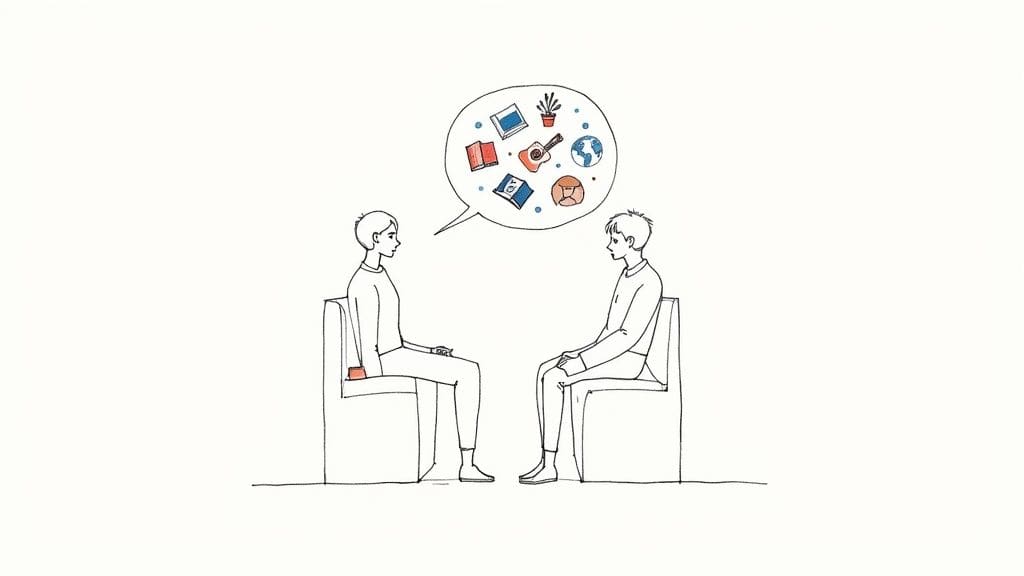
The Observation and Comment Technique is a low-pressure conversation starter that helps introverts engage naturally. By making neutral observations about your surroundings, you can invite deeper dialogue without direct personal questions. This approach to conversation starters for introverts feels organic and reduces anxiety about awkward silences.
What It Is and How It Works
This method involves:
- Noticing something neutral or positive in the environment
- Sharing a genuine, non-judgmental comment
- Waiting briefly for the other person's reaction before asking a follow-up
It mirrors natural conversation flow and shifts focus off personal interrogations.
Examples
- At a bookstore: "That cover art is vibrant. Are you a fan of this author?"
- At an event: "This venue has great lighting. Have you attended something here before?"
- In class: "That assignment seems long. How are you planning to tackle it?"
Actionable Tips
- Always choose positive or neutral observations
- Pause after your comment to allow comfortable silence
- Follow up with a question that shows real interest
- Avoid filling every gap; let the chat breathe
- Match your tone and volume to the environment
Why Use This Approach
- Reduces pressure compared to direct personal questions
- Encourages genuine curiosity and rapport
- Feels more authentic for autistic adults or people with social anxiety
- Builds confidence through small, observable details
Learn more about The Observation and Comment Technique on usetonen.com.
Need conversation starters that feel natural? tonen can help.
tonen gives you 188+ conversation scripts, tone guidance and calming tools — designed for autistic adults, ADHD and social anxiety. Try it free for 7 days.
Download on the App StoreiOS only. Android coming soon.
4. Conversation Starters for Introverts: The 'Would You Rather' Framework
As one of the most playful conversation starters for introverts, the 'Would You Rather' Framework uses hypothetical choice scenarios to prompt discussion without requiring personal vulnerability. This method invites laughter and insight by focusing on fun dilemmas instead of intimate details. It's perfect for autistic adults, ADHD teens and people with social anxiety who appreciate low-pressure engagement.

What It Is and How It Works
The 'Would You Rather' Framework:
- Presents two contrasting options in a single easy question
- Encourages explanation of preferences without deep personal disclosure
- Shifts focus from personal history to creative thinking
Examples
- Would you rather have the ability to fly or become invisible?
- Would you rather travel to the past or the future?
- Would you rather read the book or watch the movie adaptation?
Actionable Tips
- Mix lighthearted and deeper scenarios for a balanced flow
- Always ask why after each answer to explore values
- Share your own pick first to model open dialogue
- Tailor questions to the other person's hobbies and passions
- Rotate custom scenarios instead of using generic prompts
- Use a gentle tone to reduce sensory stress in busy areas
- Note favorite responses to revisit and show you remember details
Why Use This Approach
- Reduces social anxiety by avoiding direct personal disclosure
- Gives introverts control over how much they reveal
- Builds rapport through shared laughter and perspective
- Adapts easily to casual or formal settings
Learn more in our conversation starters for introverts guide on Usetonen.
5. Conversation Starters for Introverts: The Preparation and Knowledge Strategy
As one of the most reliable conversation starters for introverts, the Preparation and Knowledge Strategy helps you feel informed rather than anxious. This method transforms uncertainty into confidence by researching event themes, attendee backgrounds, or topics in advance. It's ideal for autistic adults, ADHD teens, and people with social anxiety who thrive when they arrive prepared.
What It Is and How It Works
Research details about your next gathering or meeting before you walk in.
This conversation starters for introverts approach:
- Provides ready-made talking points
- Shifts focus from improvisation to genuine interest
- Reduces the fear of awkward silences
- Builds rapport through thoughtful questions
> "Preparation is the secret weapon that turns introversion into quiet confidence in social settings."
Examples
- Before a networking event, review LinkedIn profiles and note shared school or club connections
- At a conference, read speaker bios and prepare 2–3 thoughtful questions on their work
- Ahead of a class social, learn classmates' majors and hometowns to ask specific questions
- At a book club, draft comments on key passages and related themes
Actionable Tips
- Keep notes discreet on your phone instead of visible index cards
- Focus on learning rather than memorizing lists of facts
- Balance preparation with the flexibility to follow organic conversation
- Prepare conversation anchors like fun facts or openers you genuinely care about
- Use insights to ask follow-up questions that deepen dialogue
Why Use This Approach
- Reduces anxiety by turning unknowns into comfort zones
- Lets you lead discussions with informed curiosity
- Strengthens first impressions as someone attentive and engaged
6. Conversation Starters for Introverts: The Compliment and Follow-Up Method
As one of the most effective conversation starters for introverts, the Compliment and Follow-Up Method begins with a genuine, specific compliment about something the other person controls and then follows with a question. This approach makes the person feel seen and naturally shifts the dynamic in your favor. It's ideal for autistic adults, ADHD teens and people with social anxiety who prefer meaningful exchange over small talk.
What It Is and How It Works
This conversation starters for introverts strategy:
- Opens with a specific compliment on ideas, effort or perspective
- Leverages positive reciprocity to lower social barriers
- Invites elaboration immediately with a related question
Examples
- "I really appreciated your perspective in that meeting – what drew you to that angle?"
- "Your presentation style was so clear and engaging. What's your process for preparing?"
- "I loved how you approached that problem. How did you come up with that solution?"
Actionable Tips
- Compliment achievements not appearance for lasting impact
- Be very specific: "You asked three clarifying questions that improved the discussion"
- Deliver with genuine warmth and eye contact
- Follow immediately with a question that shows curiosity
- Match tone to the setting – casual at lunch, professional in meetings
- Pause after your question to give them space to respond
Why Use This Approach
- Reduces anxiety by framing the chat positively
- Creates instant rapport through genuine praise
- Encourages longer, more detailed replies
- Works across social, work or family contexts
Learn more about The Compliment and Follow-Up Method on usetonen.com.
7. Conversation Starters for Introverts: The Shared Experience Commentary
As one of the most intuitive conversation starters for introverts, The Shared Experience Commentary lets you tap into what you and the other person are experiencing right now. By focusing on a shared moment—a presentation, meal, or event—you remove the pressure to come up with original topics and create an immediate connection. This method works well for autistic adults, ADHD teens, and people with social anxiety who appreciate concrete prompts.

What It Is and How It Works
The Shared Experience Commentary means commenting on a mutual reality rather than shifting to unrelated small talk.
This conversation starters for introverts strategy:
- Anchors discussion in the present environment
- Offers an easy springboard for follow-up questions
- Reduces performance anxiety by using obvious common ground
Examples
- At a concert: "This song is amazing. Are you a fan of this artist?"
- During a delayed flight: "Well, this is taking longer than expected. Do you travel often?"
- At a restaurant: "This dish tastes incredible. Have you been here before?"
- In a workshop: "That exercise really changed my perspective. What did you think?"
Actionable Tips
- Express genuine reaction first, then invite their view
- Keep questions open-ended: ask "How did that feel?" rather than yes/no
- Use their response to branch into related topics
- Gauge their engagement level and adjust depth
- If chat stalls, return to the shared moment as an anchor
Why Use This Approach
- Creates instant rapport through mutual experience
- Minimizes the need to invent new subjects
- Feels natural for introverts who process surroundings first
- Helps maintain focus and reduce social overwhelm
Learn more about this grounding technique in our detailed guide on The Shared Experience Commentary.
8. Conversation Starters for Introverts: The Question Permission and Vulnerability Strategy
Conversation starters for introverts thrive on authenticity and trust. The Question Permission and Vulnerability Strategy gives you and your partner permission to dive into deeper dialogue sooner. By prefacing queries with a genuine signal like "I know this might be a weird question but…" you set clear expectations and invite openness.
What It Is and How It Works
This conversation starters for introverts strategy:
- Signals self-awareness and honesty before a personal question
- Creates a permission structure that reduces anxiety
- Appeals to thoughtful or introspective people
- Accelerates meaningful connection by acknowledging depth early
Examples
- "I know this might be a weird question but what's something you've learned about yourself recently that surprised you?"
- "This might be too personal for a first conversation but I'm curious what you're working through right now?"
- "I tend to ask deeper questions than small talk allows, would you rather discuss your weekend or what brings you joy lately?"
Actionable Tips
- Acknowledge unconventionality genuinely, not as an apology
- Match your vulnerability level to their comfort signals
- Lead with a brief self-disclosure about your question style
- Watch body language to gauge openness
- Reserve for casual settings with time for a genuine chat
- Use sparingly to keep authenticity high
Why Use This Approach
- Reduces pressure by clearing social expectations
- Builds rapport quickly with minimal small talk
- Encourages thoughtful responses and self-reflection
- Helps introverts feel more in control of pacing
Learn more about The Question Permission and Vulnerability Strategy on usetonen.com
8-Point Comparison: Conversation Starters for Introverts
| Technique | 🔄 Implementation Complexity | ⚡ Resource Requirements | ⭐📊 Expected Outcomes | 💡 Ideal Use Cases | Key Advantages |
|---|---|---|---|---|---|
| Ask Open-Ended Questions About Interests | 🔄🔄 (moderate: listening & follow-ups) | ⚡⚡ (attention, some observation) | ⭐⭐⭐ — Deeper, substantive responses; strong rapport | 💡 One-on-one, small groups, when you know or can spot interests | Encourages storytelling; reduces pressure to generate topics |
| The "Three Things" Connection Method | 🔄🔄 (structured but needs pattern-finding) | ⚡⚡ (observation or light research) | ⭐⭐ — Solid rapport; multiple conversation threads | 💡 Networking events, classes, mixers | Clear framework; builds familiarity quickly |
| Observation and Comment Technique | 🔄 (low: simple to execute) | ⚡ (minimal — situational awareness) | ⭐⭐ — Low-stakes entry; variable depth | 💡 Public spaces, events, casual encounters | Neutral, natural opener that invites voluntary sharing |
| The "Would You Rather" Framework | 🔄 (low — playful format) | ⚡ (none to minimal) | ⭐⭐ — Fast levity; reveals preferences and humor | 💡 Casual social gatherings, icebreakers, groups | Fun, low-pressure way to prompt explanations |
| Preparation and Knowledge Strategy | 🔄🔄🔄 (high: prep and synthesis) | ⚡⚡⚡ (time, research, notes) | ⭐⭐⭐ — Confident, informed dialogue; perceived competence | 💡 Professional networking, conferences, seminars | Converts preparation into credible conversation anchors |
| Compliment and Follow-Up Method | 🔄🔄 (moderate: specificity required) | ⚡ (low — observation skill) | ⭐⭐⭐ — Positive engagement; often strong reciprocity | 💡 Meetings, presentations, one-on-one introductions | Warm, trust-building opener that encourages elaboration |
| Shared Experience Commentary | 🔄 (low) | ⚡ (low) | ⭐⭐ — Natural flow; easy follow-ups when material exists | 💡 Events, workshops, meals, shared activities | Immediate common ground; anchors conversation to the present |
| Question Permission & Vulnerability Strategy | 🔄🔄🔄 (high: timing & calibration) | ⚡ (low but needs social courage) | ⭐⭐⭐ — Rapid deep connection; selective effectiveness | 💡 One-on-one, retreats, creative/intellectual gatherings | Accelerates authenticity; filters for like-minded respondents |
Putting Prompts into Practice
Now that you've explored these conversation starters for introverts, it's time to put each prompt into action. Practicing your favorite lines in low-pressure moments will help you internalize confidence and reduce anxiety. Whether you're headed to a work meeting or a family gathering the strategies below will make your next interaction smoother.
> "Small rehearsals lead to big social wins."
Rehearse and Personalize
- Choose 2–3 prompts from the list—such as the 'Three Things' Connection Method or the Observation and Comment Technique—and repeat them aloud.
- Record yourself or use a mirror to refine tone and pacing.
- Swap out nouns or details to reflect your actual interests so each script feels authentic.
Track Your Wins
- Keep a simple log in a notebook or app with date, context, and which conversation starter for introverts you used.
- Note one thing that went well and one small improvement for next time.
- Celebrating tiny victories builds momentum and eases social anxiety.
Adapt for Your Context
- At work: use the Preparation and Knowledge Strategy before a big meeting by researching a topic and listing 3 thoughtful questions.
- With family: apply the Shared Experience Commentary—refer to a recent gathering or holiday tradition to spark genuine engagement.
- In new classes: try the Question Permission and Vulnerability Strategy by prefacing a question with "May I ask…?" to respect personal space.
Use Tone Variations
- Friendly: "I noticed you're reading [book title]. How are you liking it?"
- Curious: "What's one thing you'd recommend from your hometown?"
- Supportive: "I admire how you handled that project. Can I ask what motivated you?"
- Rotate tones to find the style that feels most comfortable and effective for your personality.
Build Gradually
- Start in low-stakes settings like brief chats in line at the coffee shop.
- Gradually introduce prompts into longer conversations as you grow more at ease.
- Pair a starter with a graceful exit line—such as "I have to run, but thanks for sharing"—to control your engagement time.
By systematically practicing these conversation starters for introverts and tracking progress you'll transform each interaction from daunting to doable. The key insights—rehearsal, adaptation, tone control, and self-reflection—are your toolkit for building deeper connections and boosting confidence. Remember that every small step forward adds up to lasting change.
Ready to make these prompts part of your everyday routine? Keep experimenting, stay curious, and celebrate each breakthrough. You have all the tools you need to turn simple questions into meaningful conversations.
Call to Action
Ready to save and rehearse these conversation prompts in one place? Try tonen for free to customize, practice, and track your favorite scripts. Visit tonen and start building confidence today!
Frequently asked questions
This guide covers 8 effective conversation starters for introverts to try with practical, neurodivergent-friendly strategies—clear steps, scripts where useful, and ways to reduce anxiety or overload rather than vague "be confident" advice.