If you're reading this right before a hard text, meeting, family talk, or check-in with a teacher or doctor, the fastest way to get better at communication is not to learn one perfect social style. It's to build a personal toolkit. That toolkit should include a few repeatable micro-skills, a small set of scripts you can say under stress, a way to adjust tone for context, and a plan for what to do when your brain starts to overload.
For a lot of neurodivergent people, communication gets framed as performance. Make more eye contact. Sound warmer. Be less blunt. Read the room faster. That advice usually increases masking, not clarity. A better approach is simpler and more humane: reduce cognitive load, prepare before the conversation, and use supports that help you say what you mean without burning yourself out.
Your Guide to Better Communication Without Masking
A lot of people think they need to become more polished to communicate well. What they often need instead is more support before, during, and after conversations. That matters even more if you freeze when put on the spot, miss hidden meanings, or lose access to your words when you're stressed.

Existing communication accessibility frameworks often miss what neurodivergent people need. As explained in this discussion of accessible communication for underserved communities, many systems focus on general disability access but not on supports like structured scripts, tone modulation, and script preparation for high-stakes conversations.
What works better than trying to act normal
The people I see make the most progress usually stop chasing vague goals like "be more confident." They switch to concrete ones:
- Know your patterns: Notice where you communicate well, where you shut down, and what drains you.
- Use micro-skills: Practice one small behavior at a time, such as paraphrasing or asking for a pause.
- Prepare scripts: Keep short phrases ready for boundaries, clarification, follow-up questions, and exits.
- Match tone to context: The same message can land very differently depending on whether you need directness, warmth, softness, or firmness.
- Plan for overload: If you know your early warning signs, you can intervene before the conversation fully derails.
> Practical rule: Better communication is often less about spontaneity and more about having fewer decisions to make in the moment.
A lot of readers also need clarity on support itself. If you're deciding whether you need emotional healing work, practical skill-building, or both, understanding the differences between therapy and coaching can help you choose the right kind of help for what you're dealing with.
Communication without pretending
Masking can make you seem smoother in the short term, but it often costs too much. If you're constantly editing your face, tone, timing, and body language all at once, you have less bandwidth left for the message itself. That's one reason many neurodivergent adults feel "bad at communication" when they are overloaded.
If that pattern feels familiar, this piece on what masking in autism can look like in daily life gives useful language for the gap between appearing functional and feeling exhausted.
You do not need a single correct style. You need a communication setup that lets you be clear, safe, and real.
Start by Understanding Your Communication Profile
Before you try to fix anything, get specific about how you already communicate. Many have been told they're either "good" or "bad" communicators, which isn't useful. Communication is situational. You might be excellent in writing, shaky in group conversation, very clear in conflict, and completely lost in small talk.
That's a profile, not a flaw.
Map the situations, not your worth
Start with real contexts instead of personality labels. Ask yourself:
- Where do I communicate best: Text, email, one-to-one conversation, structured meetings, voice notes, planned calls?
- Where do I struggle most: Unplanned chats, conflict, authority figures, group settings, emotional topics, noisy places?
- What happens in my body: Do you go blank, talk too fast, overexplain, interrupt, dissociate, fawn, shut down, or get irritable?
- What helps: Time to prepare, written follow-up, direct questions, less eye contact, clear agendas, fewer people, more processing time?
Write your answers like field notes. Keep them plain. "I lose track when two people interrupt each other." "I do well when I know the purpose of the conversation." "I can advocate for someone else faster than I can advocate for myself."
Name your strengths without minimizing them
A lot of neurodivergent people can list twenty communication problems and zero assets. That creates a lopsided picture. Your strengths are part of the toolkit.
Common strengths include:
- Directness: You often say the actual thing instead of circling it.
- Precision: You notice missing details, contradictions, and ambiguity.
- Loyalty: People may trust you because you mean what you say.
- Depth: You can have meaningful, specific conversations instead of empty filler.
- Pattern recognition: You may catch social patterns after the fact and learn from them quickly.
> Some communication problems are really translation problems. You know what you mean. The other person hears a tone, timing choice, or level of detail you didn't intend.
Confusion often starts. If your words are clear to you but land badly, the issue may be delivery, pacing, context, or mismatch in assumptions.
Look for recurring friction points
Patterns matter more than isolated bad days. Scan the last few weeks and notice repeats.
A short self-inventory might look like this:
| Situation | What happened | My likely trigger | What I needed |
|---|---|---|---|
| Team meeting | I stayed silent until it was too late | Fast turn-taking | A note or script ready in advance |
| Family call | I snapped when asked too many follow-ups | Feeling cornered | A boundary phrase and a pause |
| Doctor visit | I forgot half my concerns | Stress and time pressure | Written notes I could read from |
If you've spent years wondering why this feels harder than it "should," this explanation of why communication can feel so hard may help you put language around the mismatch between your processing style and common social expectations.
Build from the real starting point
Don't build your toolkit around your most polished self. Build it around your stressed self. The useful question isn't "How do I communicate when everything is ideal?" It's "What support lets me stay clear when I'm tired, rushed, confused, or emotionally activated?"
That answer becomes your baseline. Once you know your profile, skill-building gets much easier because you stop practicing for an imaginary version of yourself.
Develop These Essential Communication Micro-Skills
Individuals don't get better at communication by trying harder in every conversation. They improve by practicing a few small moves until those moves become easier to access under pressure. Three matter a lot: listening in a way that reduces confusion, speaking in a structure that helps people follow you, and setting boundaries before resentment takes over.
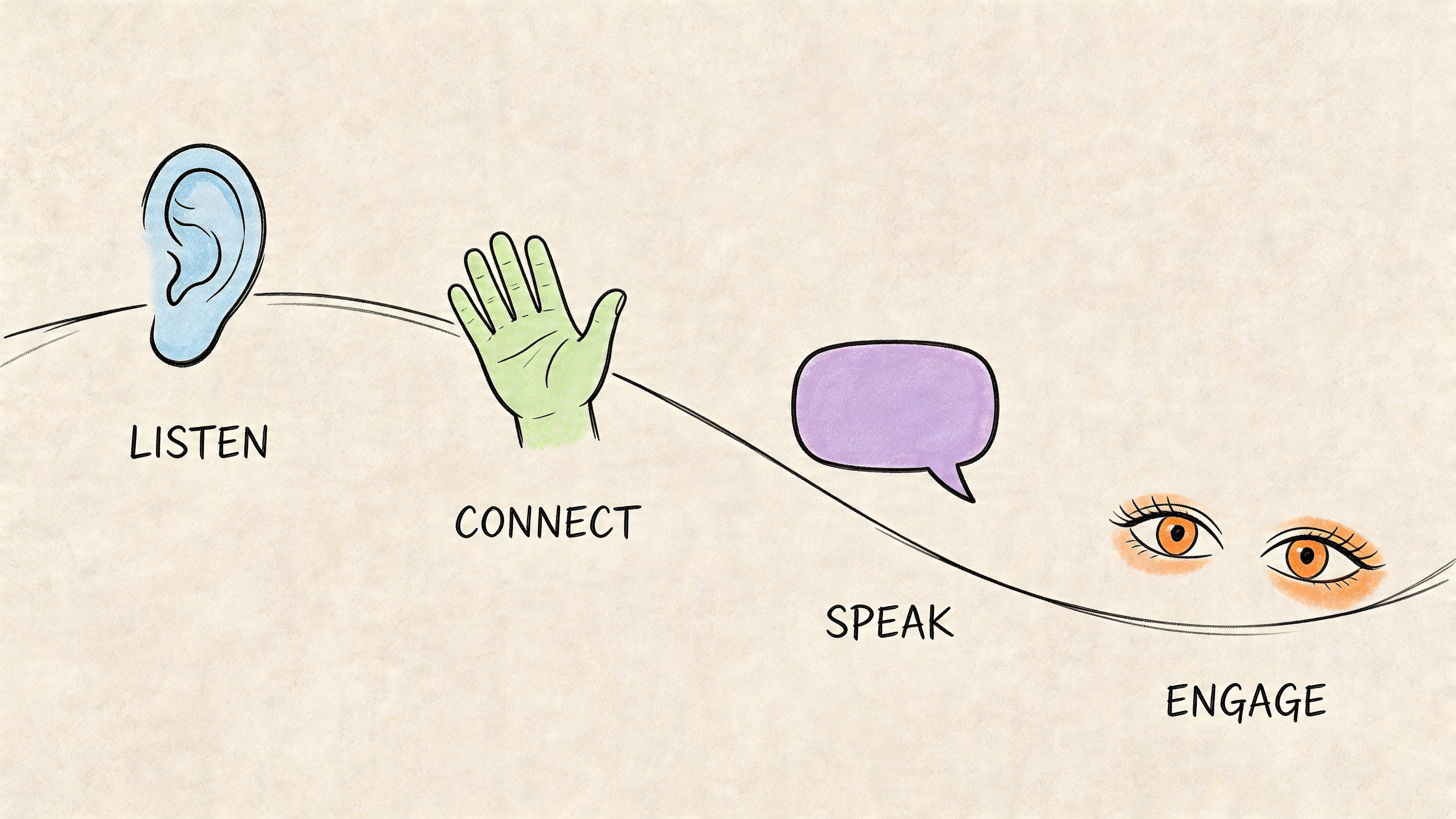
Listen for the point, not every detail
Many neurodivergent people struggle with active listening for opposite reasons. Some focus so hard on details that they lose the main point. Others get distracted by tone, facial expression, background noise, or the pressure to look engaged.
Try phrases like:
- Paraphrase: "So what I'm hearing is that you want the draft earlier, not that the whole idea is off."
- Clarify scope: "When you say soon, do you mean today or this week?"
- Check priority: "What matters most here, speed or detail?"
If you only practice one listening habit, practice paraphrasing one key point per conversation. It buys you time and it lets the other person correct the meaning before the interaction drifts.
> When you miss a cue, repair beats pretending. A quick "I think I missed part of that, can you say it another way?" usually works better than guessing.
Use a speaking structure when your thoughts scatter
A lot of people with ADHD, autism, anxiety, or processing differences know the feeling of having a full internal answer and no usable path to say it out loud. The fix is not "be more articulate." The fix is structure.
One low-effort structure is Point, Reason, Example.
Point
Say the main thing first.
"I can do that, but I need the deadline in writing."
Reason
Give one short reason.
"If the plan changes verbally, I'm more likely to miss a step."
Example
Offer one concrete illustration only if needed.
"Last week I started the earlier version because I didn't realize priorities had changed."
This keeps you from circling, apologizing, or burying the ask under too much context.
For readers in leadership roles or client-facing jobs, some of the same clarity habits show up in executive communication skills training, especially around concise delivery and audience awareness. The title sounds corporate, but the underlying principle is useful anywhere: make your message easier to receive.
Want to communicate more clearly with less stress? tonen can help.
tonen offers conversation scripts, Reply Helper, Perspective Helper, Debrief, Phone Call Mode and Calm Kit. Start with 21 free scripts on iPhone. Optional Premium unlocks more features.
Download on the App StoreAvailable on iOS.
Set boundaries with short language
Boundary-setting often breaks down because people think they need a perfect explanation. They don't. Long explanations invite debate, especially with people who benefit from your confusion.
Use short, plain lines:
- Time boundary: "I can't talk about this well right now. I can revisit it later."
- Information boundary: "I'm not ready to share more detail."
- Task boundary: "I can help with part of this, but not all of it."
- Sensory boundary: "I need a quieter place to keep following this."
- Pacing boundary: "Please slow down. I want to answer accurately."
Here's the trade-off. Softer boundaries may feel kinder, but they can sound optional. Firmer boundaries reduce ambiguity, but some people may read them as abrupt. Neither is automatically wrong. Match the language to the stakes and the relationship.
A tiny practice loop that actually helps
Don't try to master all three skills at once. Pick one for a week.
1. Choose one behavior: paraphrase, Point-Reason-Example, or one boundary phrase.
2. Use it once a day: low-stakes first.
3. Write one line after: What worked? What felt awkward? What wording would be easier next time?
That's how you get better at communication in a way that sticks. Not by becoming socially flawless, but by making a few useful responses easier to reach when your brain is under load.
Build Your Library of Rehearsable Scripts and Tones
Most communication anxiety is not just fear of people. It's fear of not having language fast enough. Your brain is trying to process the room, the meaning, the possible consequences, and your own body state all at once. A script library lowers that load.
Scripts don't make you robotic. They make you less stranded.
Start with the moments that repeatedly go bad
Don't begin with every possible scenario. Start with the conversations that keep knocking you sideways.
Good candidates are:
- Starting a conversation
- Asking for help
- Buying processing time
- Saying no
- Correcting a misunderstanding
- Leaving a conversation politely
- Asking someone to change how they're speaking to you
Your scripts should be short enough to remember and flexible enough to adapt. If a line is too polished, you probably won't use it.
One practical place to get ideas is a bank of conversation scripts for everyday situations. Even if you rewrite every line, seeing examples can reduce the blank-page effect.
One message, different tone
That doesn't mean you need to sound different all the time. It means you need options.
Here's what that looks like in practice.
Example Script with Different Tones: Setting a Boundary
| Tone | Script Example |
|---|---|
| Direct | I'm not available for that conversation right now. |
| Warm | I want to respond thoughtfully, and I'm not able to do that right now. Can we come back to it later? |
| Firmer | I've already said I'm not discussing this today. Please stop pushing. |
| Softer | I'm a bit overloaded, so I need to pause this for now. |
Notice that the core message stays the same. What changes is the cushion, force, and social framing.
Include opt-out lines and support lines
A useful script library has more than opening lines. It also needs exits and backup.
Try keeping these two categories ready:
- Opt-out lines
- "I need to step away and think before I answer."
- "I'm done with this conversation for now."
- "I need a break. I'll follow up later."
- Ask-for-support lines
- "Can you stay with me while I say this?"
- "If I lose track, can you help me come back to the main point?"
- "Can you summarize what you heard me say, so I know I was clear?"
> Prepared language doesn't reduce authenticity. It reduces the panic of inventing language while stressed.
Keep the library small and editable
You do not need a giant database in your head. Start with five scripts you'll use this month. Save them in your notes app, on paper, or in a dedicated tool. Revise them after real conversations. If a line makes you cringe when you read it, change it. If it sounds like someone else's personality, it won't help you when pressure hits.
The strongest script libraries are living documents. They get simpler over time. They sound more like you. And they give you something reliable to reach for when your words disappear.
Create Safe Practice Routines and Manage Overwhelm
Even a strong script is hard to use if your nervous system is already flooded. Practice matters because communication is partly a thinking task and partly a state-management task. If you only prepare words and ignore overload, you'll still lose access to those words when stress spikes.

Rehearse in private first
It is common to expect oneself to practice in live conversation. That's like deciding your first driving lesson should happen on a crowded highway. Private rehearsal is easier on the brain.
A low-pressure practice routine can be:
1. Pick one scenario: asking for clarification, declining an invite, speaking up in a meeting.
2. Read your script out loud: not just in your head.
3. Try two tone versions: maybe one warmer, one firmer.
4. Repeat until the line sounds usable: not perfect, usable.
5. Stop early: practice works better when you end before you're fried.
If you want more structure for this kind of rehearsal, practice conversations for anxiety can help you turn vague fear into repeatable drills.
Learn your early signs of overload
Conversation overwhelm rarely appears out of nowhere. There are usually clues.
You might notice:
- Cognitive signs: losing words, forgetting your point, hearing but not processing
- Body signs: heat, nausea, shaky hands, clenched jaw, shallow breathing
- Behavior signs: overexplaining, going mute, laughing when upset, agreeing too fast, wanting to flee
Write down your personal signs while calm. In the moment, recognition is easier if you've already named them.
Build a calm kit for conversations
A calm kit is a short list of actions that help you stay oriented enough to choose your next move. Keep it boring and practical.
Examples:
- Breath reset: inhale for 4, hold for 7, exhale for 8
- Grounding: press your feet into the floor and name five things you can see
- Body scan: unclench jaw, drop shoulders, loosen hands
- Time request: "I need a minute to think"
- Exit line: "I can't continue this well right now"
One tool option for this is tonen, which includes script preparation, script rehearsal with different tones, and a Calm Kit with breathing, grounding, body-scan, and safe-place tools. That kind of setup can be useful if switching between preparation and regulation in one place helps you stay organized.
> If your brain is flooded, the goal is not to win the conversation. The goal is to regain enough stability to choose what happens next.
Make repair part of the routine
Sometimes you'll still freeze, ramble, or shut down. That doesn't erase the progress. Communication gets easier when you assume repair is allowed.
A repair message can be short:
- "I didn't say that clearly. Let me try again."
- "I got overwhelmed and went blank."
- "I need to follow up after I've had time to process."
That's not failure. It's a skill.
Adapting Your Skills for Work Family and Social Life
A communication toolkit only becomes useful when you can adjust it to the room you're in. The same direct sentence that helps at work might escalate a family argument. The same soft wording that preserves peace with a friend might create confusion in a medical appointment. Context changes the cost of being vague, blunt, detailed, or delayed.
Work needs clarity and containment
At work, people usually need fast context, a clear ask, and a predictable next step.
Compare these two versions:
| Context | Less effective | More effective |
|---|---|---|
| Deadline concern | "I'm kind of confused about what's happening with this." | "I can do this, but I need the final priority confirmed before I start." |
| Meeting interruption | Silence, then frustration later | "I want to finish my point, then I'm happy to hear your view." |
| Feedback to coworker | "That didn't work for me." | "When the plan changed in chat, I missed it. Next time, please tag me directly." |
The stronger version isn't colder. It's easier to act on.
If meetings are hard, bring written prompts. If verbal processing is hard, send a follow-up message confirming what you heard. If tone gets misread, trim extra explanation and make the request more visible.
Family often needs boundaries more than perfect wording
Family communication has history packed into it. People hear the current sentence and ten older ones at the same time. That's why "gentle" can still blow up and "honest" can still feel impossible.
Here are common trade-offs:
- More explanation: can feel loving, but may invite arguing
- Less explanation: protects energy, but may be called rude
- Immediate response: reduces uncertainty, but can lead to reactive answers
- Delayed response: gives processing time, but some relatives may push harder
A usable family script might be:
"I know this matters to you. I can talk about it for ten minutes, but I'm not able to keep going if the conversation turns into pressure."
That line gives care, a time frame, and a limit.
If you're navigating emotionally loaded caregiving conversations, how to discuss care with an elderly parent offers practical language for staying respectful while still saying difficult things clearly.
Social life needs lighter entry points
Friendships and casual social spaces often reward ease, but that doesn't mean you need to become effortlessly spontaneous. Usually you just need lower-stakes openers and exits.
Try these comparisons:
| Social moment | High-pressure version | Lower-pressure version |
|---|---|---|
| Joining a chat | Waiting for the perfect moment | "Can I jump in on that?" |
| Making plans | "We should hang out sometime" | "Want to grab coffee next week?" |
| Leaving early | Disappearing or overexplaining | "I'm heading out, but I'm glad I came." |
Social communication improves when the script is small enough to survive nerves.
Healthcare and education need explicit self-advocacy
These settings often punish vagueness because the other person is making decisions based on limited information. If you need accommodations, more processing time, written instructions, or a slower pace, say that plainly.
Useful lines include:
- "I understand better when instructions are written down."
- "I need a little more time to answer accurately."
- "Please ask one question at a time."
- "I want to make sure I'm following. Can you summarize the next step?"
The key difference here is that politeness matters less than accuracy. If the point is your health, learning, or access, clarity wins.
To get better at communication across settings, keep the core message stable and adjust only the tone, detail, and firmness. You don't need a different personality for each part of your life. You need a flexible way to express the same real needs.
Your Path to More Authentic Communication Starts Now
You do not need to become smoother, louder, more charming, or more neurotypical to communicate well. You need support that makes it easier to access your words, your boundaries, and your thinking when it counts.
That's why the most useful path is usually the least flashy one. Know your communication profile. Practice a few micro-skills until they feel reachable. Keep scripts for the situations that repeatedly knock you off balance. Use tone on purpose instead of hoping people will somehow hear your intent. Build an overwhelm plan before you need it.
Keep the goal realistic
A lot of communication advice implicitly promises social ease. That's not the standard to chase. A better standard is this:
- You can say what you mean more often
- You can recover more quickly when a conversation goes sideways
- You can protect your energy without disappearing
- You can ask for what you need with less panic
That is real progress.
> Authentic communication isn't saying everything immediately. It's having tools that help you say the true thing in a way your nervous system can handle.
Start smaller than you want to
Pick one action this week.
| If this is your struggle | Start here |
|---|---|
| Going blank | Write one two-line script for asking for time |
| Rambling | Practice Point-Reason-Example once a day |
| Misreading tone | Rewrite one message in two different tones |
| Shutting down | Prepare one exit line and one repair line |
If you want help turning vague thoughts into clearer language, this tool for saying things clearly is a practical next step.
You can get better at communication without building your whole life around performance. You can do it by building a toolkit that respects your brain, lowers pressure, and gives you language you can effectively use.
If you want one place to keep scripts, test different tones, rehearse privately, and use calming tools when conversations start to spiral, tonen is built for that kind of real-world support.