You want help sending messages without anxiety because the hard part is not writing words. It is managing the spiral that starts before, during, and after you draft them. The most effective approach is simple in principle: decide what the message needs to do, choose a tone on purpose, use a script instead of composing from scratch, regulate your body before you hit send, and stop treating every text like a personality test. That combination lowers cognitive load, which matters even more if you are autistic, have ADHD, live with social anxiety, or tend to freeze when tone feels unclear.
If you are staring at a draft right now, do less, not more. Cut the message to one purpose. Use one clear ask. Add one line that softens or clarifies tone if needed. If your nervous system is already activated, pause and ground before editing again. That is the core of real help sending messages without anxiety. Not forcing confidence. Building conditions where sending becomes easier.
That Feeling When You Can't Hit Send
You read the message once. Then again. Then you change one word, delete it, put it back, add an emoji, remove the emoji, and wonder if the whole thing sounds cold, needy, rude, confusing, or too much.
That freeze is familiar to a lot of people, but it can hit especially hard when ambiguity already drains you. Texting strips out facial expression, voice, timing, and context. Your brain has to fill in the blanks, and anxious brains usually fill them in badly.
A useful place to start is naming what is happening. This is not laziness or overdramatic behavior. It is often a mix of uncertainty, rejection fear, and nervous-system activation. A 2019 RescueTime study found that phone pickups happen very frequently after putting the device down, which helps explain the checking loop that can intensify texting stress, as described in Psych Central's overview of text anxiety.
For some people, that loop looks like this:
- Drafting and redrafting: trying to prevent every possible misunderstanding
- Checking repeatedly: looking for a reply, then feeling worse when there is none
- Reading tone into silence: assuming delay means disapproval
- Avoiding send altogether: because unsent feels safer than uncertain
If that pattern sounds familiar, why people overthink texts so intensely may feel uncomfortably accurate.
> Tip: If your thumb is hovering, stop editing for a moment and ask one question: "What does this message need to accomplish?" Anxiety loves open-ended drafts. Clear purpose shrinks them.
The goal is not to become perfectly casual about messaging. The goal is to make sending manageable, predictable, and less loaded.
The Preparation Framework for Anxious Texters
The fastest way to make messaging harder is to open a blank text and hope the right words appear. Preparation works better than improvisation, especially when your brain locks up under social pressure.
Clarify the job of the message
Before you type, decide what this text is for. Most anxious messages get messy because they are trying to do too many jobs at once.
A message usually needs one of these:
- Ask for something
- Share information
- Set a boundary
- Repair a misunderstanding
- Delay a response
- End or pause the conversation
If you do not pick one, you get rambling. Rambling creates more chances to second-guess yourself.
Here is a simple before-and-after:
| Situation | High-anxiety draft | Lower-load draft |
|---|---|---|
| Need to reschedule | "Hey, I'm so sorry, I feel bad about this, today got weird and I might not make it, unless later works, but no worries if not" | "I need to reschedule today. Would tomorrow afternoon work instead?" |
| Need clarification | "Sorry if this is obvious, I may be reading this wrong, but I wasn't sure what you meant" | "I want to make sure I understood. Did you mean X or Y?" |
| Need space | "I'm not upset, just overwhelmed, and I don't want you to think I'm ignoring you" | "I'm overloaded today and may reply later. I'm not ignoring you." |
Shorter is not always kinder. Clearer usually is.
Choose tone before wording
Many people try to "sound right" after writing. That is backward. Pick the tone first, then write to match it.
Useful tone choices include:
- Direct: best when clarity matters more than warmth
- Warm: useful for reassurance, care, or softening brevity
- Firmer: helps when you need a boundary to hold
- Softer: useful when the topic is delicate and the relationship matters
This is especially helpful if you tend to swing between overexplaining and sounding abrupt. The tone decision gives the draft a lane.
A quick self-check:
1. What is the context? Work, friend, family, logistics, conflict.
2. What matters most? Speed, warmth, precision, or firmness.
3. What is my usual stress error? Too long, too vague, too apologetic, too sharp.
If you need help seeing the situation from outside your panic, talking it through before replying can reduce spiraling.
> Key takeaway: Preparation lowers anxiety because it reduces choices. Fewer choices mean less cognitive friction.
Build a pre-send rule
A useful rule is: no editing while emotionally flooded.
When your body is activated, your standards become impossible. Everything starts sounding wrong. Instead, make your process boring and repeatable:
- Draft
- Check purpose
- Check tone
- Remove one unnecessary sentence
- Send, or pause and return later
That is often better help sending messages without anxiety than chasing the perfect wording.
Your Library of Low-Stress Scripts and Graceful Exits
Some messages feel hard every single time. Asking for clarification. Saying no. Following up. Explaining a delay. Setting limits with someone who pushes. In those moments, "just be yourself" is not useful advice.
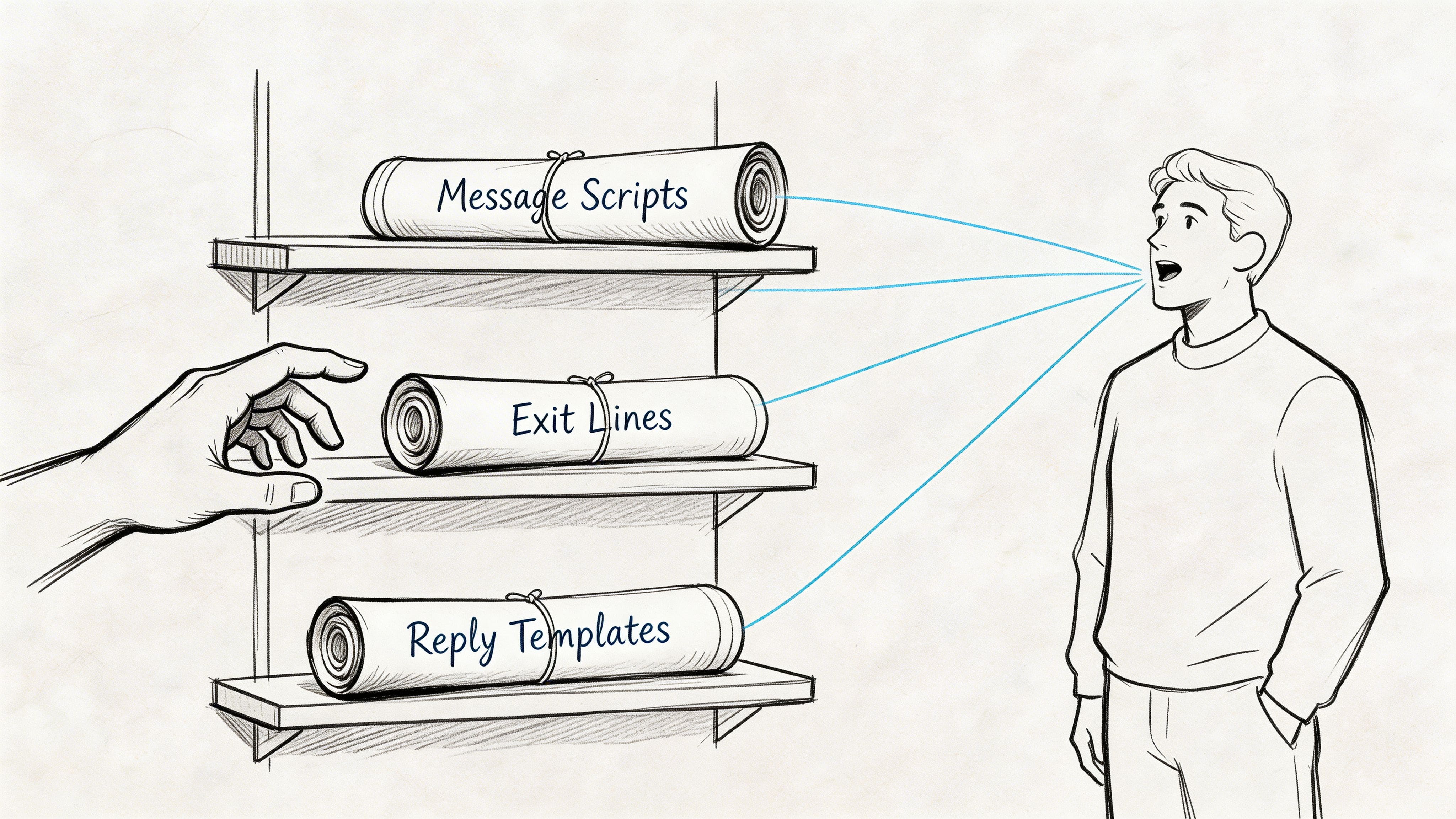
Scripts help because they remove the hardest part, starting from zero.
Why scripts work without making you sound robotic
A script is not a fake personality. It is a starting structure. You still choose the tone, trim the wording, and adapt it to the relationship.
What scripts do well:
- Reduce blank-page panic
- Cut decision fatigue
- Prevent overexplaining
- Make boundaries easier to say
- Give you an exit if the exchange gets too intense
That last point matters significantly. Many people can send the first message. They panic because they do not know how to leave the conversation if it turns awkward, demanding, or emotionally crowded.
Feeling anxious every time you need to send a message? tonen can help.
tonen offers conversation scripts, Reply Helper, Perspective Helper, Debrief, Phone Call Mode and Calm Kit. Start with 21 free scripts on iPhone. Optional Premium unlocks more features.
Download on the App StoreAvailable on iOS.
Examples that lower pressure fast
These are the kinds of phrases worth saving somewhere easy to access.
For work
- "I can get back to you by tomorrow."
- "I want to make sure I understand the request before I answer."
- "I'm at capacity today, so I can do X or Y, but not both."
For friends
- "I want to see you. I need a lower-key plan this week."
- "I'm slow to reply when overwhelmed, but I do care."
- "Can we pick this up later when I have more bandwidth?"
For family
- "I'm not available to talk about this right now."
- "I hear that this matters to you. I need a little time before I respond."
- "I can help with this part, but not the whole thing."
The power of an opt-out line
An opt-out line changes the emotional math of messaging. You stop feeling trapped.
Examples:
- "I'm going to step away and come back later."
- "I don't have the capacity to keep texting about this right now."
- "This would be easier for me to discuss another way."
- "I've said what I can for now."
That is not rude. It is regulated communication.
If you want a bank of examples for common situations, conversation scripts for difficult moments can be useful. One option in this space is tonen, which includes a Scripts Library with conversation scripts, built-in opt-out lines, ask-for-support options, and four tone choices: Direct, Warm, Firmer, and Softer. For someone seeking help sending messages without anxiety, that kind of structure can reduce the amount of original composing required in the moment.
> Tip: Save three scripts you can reuse this week. One for delay, one for boundaries, and one for clarification. Repetition builds fluency.
The point is not to script your whole life. It is to stop wasting your best energy on sentences you have already struggled to invent twenty times before.
In-the-Moment Techniques for Calming Pre-Send Panic
Sometimes the draft is fine and your body still reacts like danger is near. Tight chest. Hot face. Restless hands. Sudden certainty that sending this one text will ruin the relationship, the workday, or your reputation.
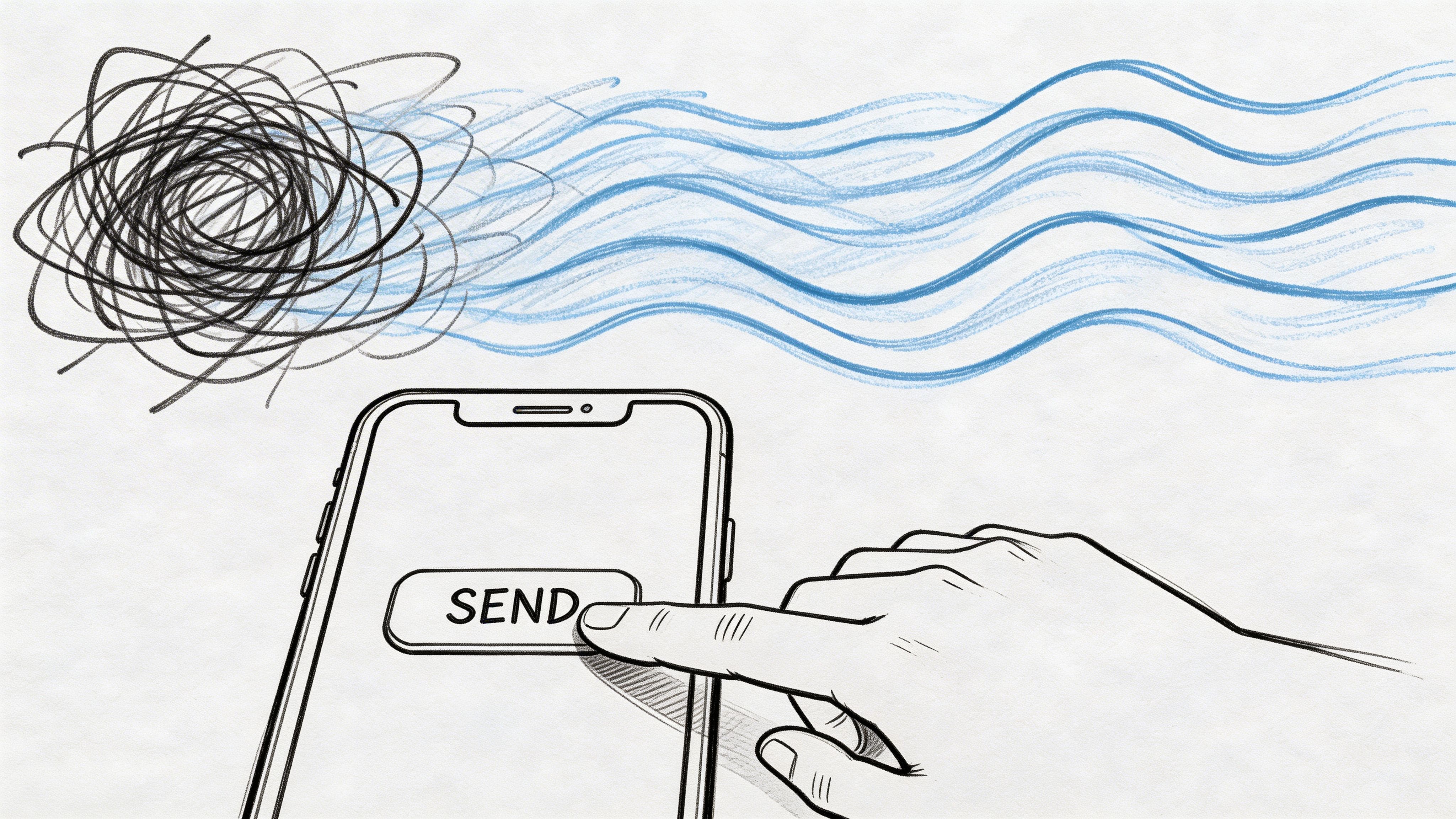
That is not a wording problem. It is a regulation problem.
Use grounding instead of more editing
If your nervous system is activated, more editing usually makes things worse. Grounding interrupts the loop.
Do it exactly as written:
1. Name 5 things you can see
2. Name 4 things you can touch
3. Name 3 things you can hear
4. Name 2 things you can smell
5. Name 1 thing you can taste
This works because it moves attention out of imagined social consequences and back into the physical room.
Keep a tiny pre-send routine
A short routine helps because it gives your body a familiar sequence.
Try this:
- Put both feet on the floor.
- Unclench your jaw.
- Exhale longer than you inhale for a few breaths.
- Read the draft once for meaning, not perfection.
- Ask, "Is this clear enough?"
- Send, or consciously shelve it.
If you need guided prompts, grounding techniques for anxiety before replying or sending can help you avoid inventing a process while distressed.
Know when not to send yet
Delaying is not always avoidance. Sometimes it is regulation.
Use a pause if:
- Your body is in full fight-or-flight
- You are editing compulsively
- You want the message to punish, prove, or force reassurance
- You cannot tell whether the draft is clear or just emotionally charged
At that point, the task is not "send now." The task is "return to baseline, then decide."
> Key takeaway: Calm is not a personality trait. It is often a sequence you can repeat.
This is one of the most practical forms of help sending messages without anxiety because it addresses the part most advice skips. Your body often needs support before your words do.
Navigating the Fear of Judgment and Misinterpretation
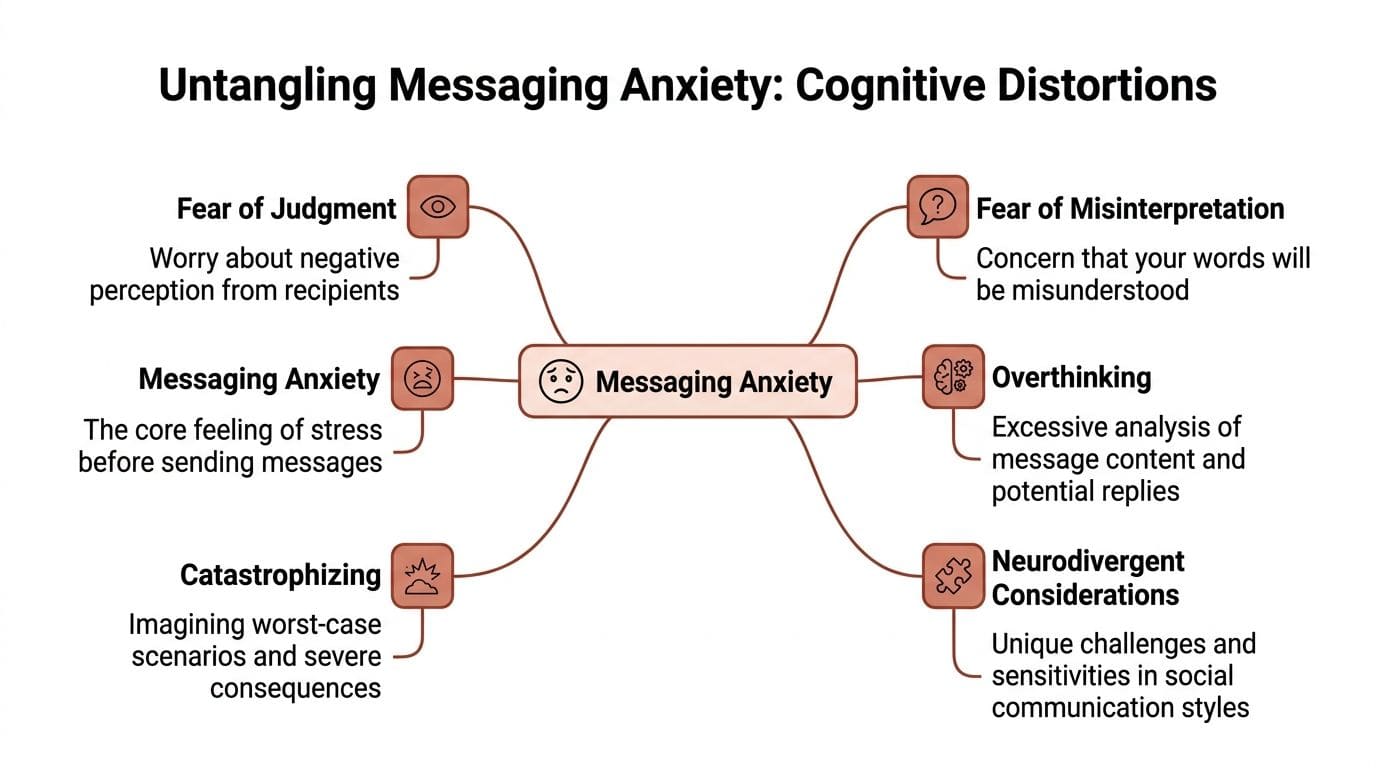
The sharpest part of messaging anxiety is often invisible. It is not the text itself. It is the meaning your mind attaches to sending it.
You are not just asking, "Does this sound okay?" You may also be asking:
- Will they think I am annoying?
- Will this come across as rude?
- Did I ask for too much?
- If they do not reply soon, did I mess something up?
- If I say this directly, will I be judged for it?
The distortion is often the actual problem
A lot of anxious texting follows a predictable pattern. Your brain treats uncertainty as evidence.
A delayed reply becomes rejection.
A short reply becomes irritation.
A neutral reply becomes hidden criticism.
Here, reframing matters. Not fake positivity. More accurate interpretation.
Here is a useful comparison:
| Anxious thought | More balanced thought |
|---|---|
| "They will think I'm difficult." | "I made a clear request. People are allowed to have requests." |
| "That sounded rude." | "Brief does not automatically mean rude." |
| "If they misunderstood me, that means I failed." | "Misunderstandings happen in text. They can be clarified." |
| "No reply means they're upset." | "No reply usually means I do not have enough information yet." |
Reframing for autistic and ADHD communicators
Generic messaging advice often assumes the problem is simple insecurity. It misses the friction.
For autistic people, stress may come from literal interpretation, uncertainty about implied meaning, or pressure to perform the "right" amount of warmth. For ADHD communicators, the hard part may be initiation, working memory, impulsive sending, or rejection sensitivity after the fact.
That means the answer is not always "be more casual." Often it is:
- Make the message more explicit
- State intent instead of hoping tone carries it
- Use fewer layered hints
- Ask directly when something is unclear
- Stop treating ambiguity as a test you must pass
This is one reason advice on clear, effective communication can be useful outside anxiety-specific spaces too. Work norms, clarity, and tone expectations often shape the pressure people feel when they message others. A practical example is this guide to clear, effective communication, especially if your stress spikes in professional conversations.
A better question than "How am I being perceived?"
That question has no finish line. Anxiety can always invent another possibility.
Better questions:
- What did I say?
- Is my request reasonable?
- Did I communicate the key point clearly?
- If they misunderstand, can I clarify?
- Am I trying to prevent every discomfort, or communicate?
> Tip: Replace mind-reading with evidence. If you do not have direct information, you have uncertainty, not proof.
What works and what usually does not
Usually works
- Naming your intent plainly
- Asking clarifying questions
- Using a script when the topic is loaded
- Giving yourself permission to be clear instead of perfectly likable
- Accepting that some discomfort remains after send
Usually does not
- Checking for a reply every few minutes
- Adding extra apologies to control perception
- Using vague wording to avoid seeming blunt
- Reading emotional meaning into punctuation and timing alone
- Sending follow-up texts just to reduce your own uncertainty
A significant shift happens when you stop making "no one can misread me" the goal. A better goal is "I can communicate clearly, and I can handle normal ambiguity."
How to Practice and Build Lasting Confidence
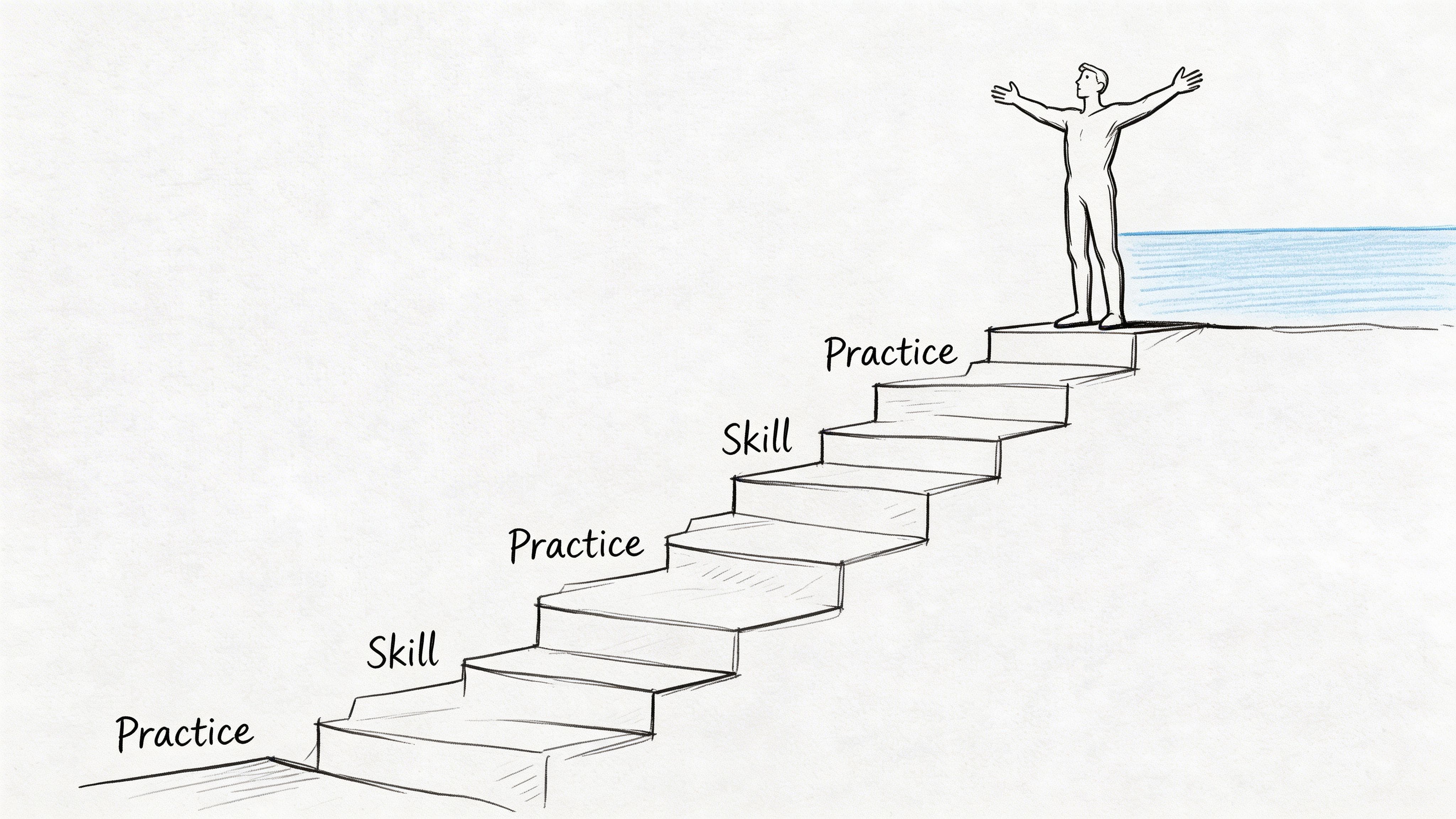
Confidence with messaging rarely appears first. Practice comes first.
That matters because anxious communicators often wait for a high-stakes moment to try a new skill. Then the pressure is enormous, the body is activated, and every sentence feels like it matters too much. Private rehearsal is a better training ground.
Practice beats pressure
Rehearsal works because it changes the task from "perform now" to "learn safely."
That can look like:
- Saving a few message templates you can adapt
- Practicing the same boundary in different tones
- Rewriting one stressful draft into a shorter version
- Reading your message out loud before sending
- Trying the first line only, instead of scripting the whole exchange
The repetition matters. You stop starting from zero every time.
Privacy matters when you are learning
If practice feels observed, judged, or stored somewhere you do not control, many people will avoid it. That is especially true when the draft involves conflict, shame, family dynamics, or work stress.
A script preparation space lowers the stakes. You can experiment, save what works, and come back without feeling exposed. Practicing conversations for anxiety in low-stakes ways is often more effective than waiting until you are already dysregulated.
Build confidence from the ground up
Use a ladder. Start with messages that matter less.
1. Low stakes: confirming a plan, asking a simple question
2. Medium stakes: clarifying a misunderstanding, asking for a change
3. Higher stakes: setting a limit, naming hurt, saying no
You do not need to feel fully calm at each stage. You need enough stability to send, recover, and learn that discomfort is survivable.
If broader emotional work is part of your process, resources on overcoming anxiety and fear can complement communication-specific practice.
The most durable form of help sending messages without anxiety is not one perfect trick. It is a repeatable system: prepare, script, ground, send, recover, and practice again.
If you want a private, low-cognitive-load tool built for this exact problem, tonen offers scripts, tone options, practice, and calming supports designed for neurodivergent communication. It is a practical way to reduce the effort of composing from scratch and make hard messages easier to send.