If you're looking for help with communication skills, the single most effective way to improve is by using structured, practical tools to build confidence. You can get immediate help with communication skills by leveraging conversation scripts to know what to say, practicing your tone of voice to ensure your message lands correctly, and learning grounding techniques to manage anxiety in stressful moments. This approach is far more effective than vague advice, especially for neurodivergent individuals, as it provides a clear, actionable framework for navigating social and professional interactions.
This guide will give you concrete, actionable strategies that actually work. Instead of just telling you what to do, we'll show you how to do it.
Why Communication Is a Learnable Skill, Not an Innate Talent

Many people believe that great communicators are just born that way. This myth can feel especially frustrating if social interactions already cause you stress or anxiety.
But the truth is much more empowering: communication is a set of abilities anyone can develop with focused effort.
Think about it like learning an instrument or a new language. You have to understand the rules, practice specific techniques, and build your confidence over time. This is especially true for neurodivergent individuals who might process social cues differently. Structured methods offer the clarity that generic advice like "just be a good listener" never will.
The Real-World Cost of Communication Gaps
The value of clear communication isn't just about social ease; it's a massive factor in professional success. Poor communication creates tangible problems in the workplace, from missed deadlines to low morale, and these gaps can disproportionately affect neurodivergent professionals who might struggle with unwritten social rules.
| Impact Area | Supporting Data | What This Means for Neurodivergent Individuals |
|---|---|---|
| Career Progression | A Carnegie Institute study found 85% of career success comes from communication skills. | Technical skills alone are not enough. Investing in communication is a direct investment in your career growth. |
| Hiring & Promotions | LinkedIn data shows 93% of employers prioritize communication skills in 2026. | This is a top-line requirement. Demonstrating clear communication can be a key differentiator. |
| Team Productivity | Poor communication costs small businesses an average of $420,000 per year. | Misunderstandings lead to rework and stress. Clear, direct communication prevents these costly errors. |
| Employee Engagement | 74% of employees feel they miss out on company news due to poor internal communication. | Feeling out of the loop can lead to isolation. Strong skills help you advocate for information and stay connected. |
This data paints a very clear picture. Investing in effective communication skills training is not a "soft skill" luxury; it's a core professional competency.
Moving Beyond Vague Tips to Actionable Strategies
For too long, the advice given to neurodivergent people has been frustratingly abstract. This guide is different. We're moving beyond those tired, unhelpful tips to give you concrete, actionable strategies that actually work for neurodivergent minds. Instead of just telling you what to do, we'll show you how to do it.
> The biggest barrier to personal and professional success is often the fear of saying the wrong thing. When you treat communication as a skill, you can break it down into manageable parts—like choosing the right words, practicing your tone, and setting clear boundaries—and it all becomes far less intimidating.
We'll be diving deep into practical techniques you can start using right away:
* Using Communication Scripts: Build a library of phrases you can rely on for common, high-stress situations.
Mastering Your Tone: Rehearse how* you sound to make sure your message lands exactly as you intend.
* Managing Overwhelm: Learn in-the-moment techniques to stay calm, grounded, and present.
* Setting Clear Boundaries: Advocate for your needs and protect your energy without feeling confrontational.
Tools like the tonen app are a fantastic place to start. It gives you scripts and tone guides that let you practice navigating those high-stakes conversations with way less stress and a lot more confidence.
Build Your Confidence with Conversation Scripts

The dread of saying the wrong thing, especially in a high-stakes moment, can be completely paralyzing. If you need help with communication skills, one of the most practical things you can do is prepare with conversation scripts.
This isn't about becoming a robot. It's about building a private library of phrases for common, stressful situations—like asking for a deadline extension or setting a boundary. This approach lowers your cognitive load in the moment, freeing up brain space so you can engage more authentically.
You don't have to start from scratch. You can build on a solid foundation using tools like the tonen app, which has a bank of over 188 prompts for work, health, and social life. The real goal, though, is to make these scripts sound like you, not like you're reading from a teleprompter.
Finding and Personalizing Your Scripts
First, find a base script that matches what you're trying to achieve. Are you declining an invitation? Asking for help? Voicing appreciation?
Once you have a template, it's time to personalize it. This is where you take a generic phrase and make it your own.
For instance, a script might say: "I need to decline this invitation due to a prior commitment." You can adapt this to fit your natural voice:
* More casual: "Thanks so much for the invite! I can't make it this time, but I hope you all have a great time."
* More direct: "I appreciate the offer, but I'm not available that day."
This customization step is what makes the whole thing work. It bridges the gap between a helpful tool and real self-expression, giving you structure without taking away your personality. You can dive deeper into this method and learn how to use conversation scripts to reduce social anxiety and build real confidence.
The Power of Practice and Preparation
Having a script is only half the battle. Practicing it is what actually builds confidence and gives you help with communication skills when it counts.
Rehearsing your personalized phrases out loud helps lock them into your memory, which drastically cuts down on that in-the-moment panic of trying to find the right words. It allows you to focus on listening and connecting instead of just trying to survive the conversation.
> In a job market obsessed with soft skills, 70% of employers worldwide declare communication the most desirable trait for recruits. For many neurodivergent or anxious members of Gen Z, 36% see communication as their biggest development need.
This really highlights why preparation is so valuable. Mastering just a few key scripts can make a massive difference in how you're perceived at work and can ease the pressure of everyday interactions. You can find more insights on why employers prioritize communication skills at CreativeOrgDesign.com.
Ultimately, this kind of strategic prep frees up your mental energy. It makes navigating social situations feel less like a test and more like a skill you can manage.
Master Your Tone and Rehearse for Real Life
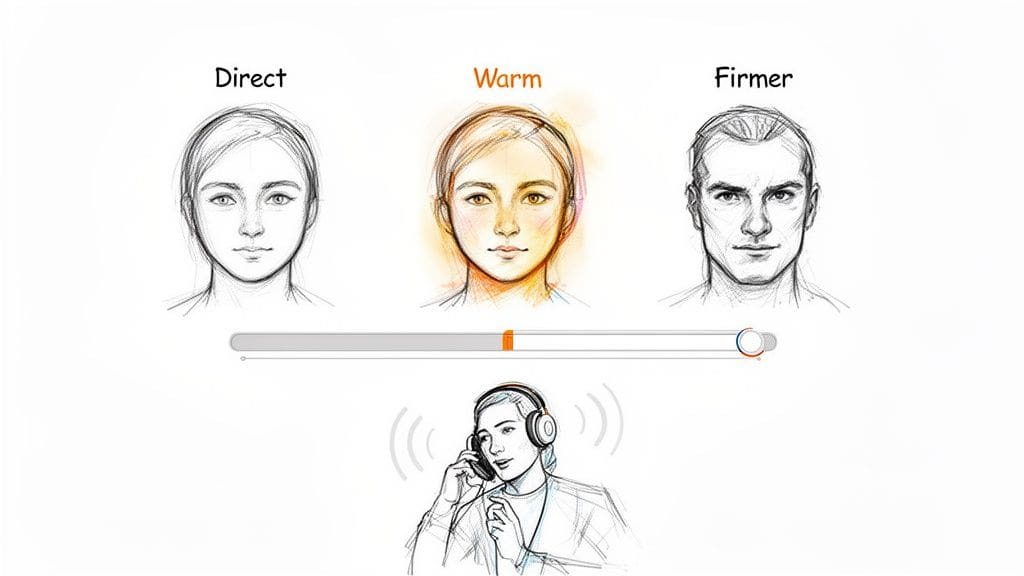
Once you've figured out what you want to say, the next piece of the puzzle is how you say it. Your tone of voice can completely flip the meaning of a sentence, a common pain point for neurodivergent people who need help with communication skills.
Tired of being misunderstood? tonen can help.
tonen gives you 188+ conversation scripts, tone guidance and calming tools — designed for autistic adults, ADHD and social anxiety. Try it free for 7 days.
Download on the App StoreiOS only. Android coming soon.
Getting your tone right isn't about faking an emotion or masking. It's about making a conscious choice to ensure your message lands exactly as you intend, heading off misunderstandings before they can even start. A direct tone is perfect for stating facts clearly, while a warmer tone works wonders for building rapport or supporting a friend.
> How you say something often matters more than what you say. A phrase delivered with a warm, gentle tone can feel supportive, while the exact same words spoken with a firmer tone can establish a critical boundary.
The most effective way to get comfortable with this is to rehearse in private, with zero pressure. This is where tools like the tonen app really shine. Its Practice Mode lets you record yourself and actually hear how you sound, giving you the chance to tweak your delivery until it feels right. This kind of private rehearsal helps you walk into the real conversation feeling prepared, not panicked.
Choosing the Right Tone for Your Conversation
Selecting the right tone isn't just a detail—it's a strategy. Instead of leaving it to chance, you can consciously pick a tone that matches your goal and the social situation.
For example, a "Firmer" tone can be incredibly powerful for reinforcing a boundary that keeps getting ignored. On the other hand, a "Softer" tone is much better for giving someone sensitive feedback without making them feel defensive. If you want a deeper dive on this topic, you might find our guide on how to use an AI tool to rewrite messages with the perfect tone really helpful.
To make this even more concrete, here's a practical guide to help you select an appropriate communication tone based on your goal and the social context.
#### Choosing the Right Tone for Your Conversation
| Tone Choice | When to Use It | Example Scenario |
|---|---|---|
| Direct | Communicating clear, non-negotiable information. | Stating your availability for a meeting: "I am available at 3 PM on Tuesday." |
| Warm | Building rapport, offering support, or making a gentle request. | Checking in on a colleague: "Just wanted to see how you're doing with the project." |
| Firmer | Setting or reinforcing a boundary that has been crossed. | Responding to an after-hours work request: "I'll address this during my work hours tomorrow." |
| Softer | Delivering sensitive feedback or navigating a delicate topic. | Correcting a misunderstanding: "I may not have explained it clearly. Let me try again." |
This kind of structured approach offers invaluable assistance. It turns the abstract idea of "tone" into a practical tool you can pull out of your toolkit every single day. By deliberately choosing and practicing your tone, you gain a massive amount of control over your interactions and dial down the anxiety that comes from feeling unheard or misunderstood.
How to Manage Overwhelm in Difficult Moments

Even with the best preparation, a conversation can suddenly go sideways. You know the feeling—that rising tide of anxiety that makes you want to shut down completely. This is where your in-the-moment toolkit becomes absolutely essential.
The key is having a few different strategies ready to go: grounding techniques to calm your nervous system, a pre-planned exit strategy to reclaim your space, and mental reframing to take the sting out of confusing interactions. These are the practical tools that offer real help with communication skills when you feel your capacity is maxed out.
And this isn't just about feeling uncomfortable. That kind of stress has a massive impact. In fact, poor workplace communication is projected to cost US businesses over $2 trillion in 2026 alone, with stress accounting for 53% of that figure. You can read more about how communication issues impact the workplace on Pumble.com. It's a huge problem, and having effective coping skills is non-negotiable.
Grounding Techniques You Can Use Anywhere
When your mind starts racing and you feel yourself disconnecting, grounding techniques are a lifeline. They pull you out of the anxiety spiral and back into the present moment by focusing your attention on your physical senses.
The best part? They are completely discreet. You can do them in the middle of a meeting or a party, and no one will ever know.
Some of my favorite, go-to techniques include:
* The 5-4-3-2-1 Method: This is a classic for a reason. Silently name five things you can see, four things you can feel (the texture of your sleeve, your feet on the floor), three things you can hear, two things you can smell, and one thing you can taste.
* Box Breathing: Inhale slowly for a count of four, hold your breath for four, exhale for four, and hold again for four. The simple, steady rhythm is incredibly calming for your nervous system.
* Focused Touch: Discreetly press your thumb into your palm, or run a finger along the seam of your pants. The simple physical sensation acts as an anchor.
If you want to build out your toolkit, we have a whole article dedicated to more grounding techniques for anxiety. Having a few of these ready can be a game-changer.
Planning Your Graceful Exit
Knowing you have an escape route is one of the most empowering things you can do for yourself. When you aren't afraid of getting trapped, you can engage more freely, confident that you can leave whenever you need to. That's why pre-planned exit strategies are so crucial.
> An opt-out line isn't a sign of failure; it's a tool for self-advocacy. It gives you control over your energy and allows you to end an interaction on your own terms, preserving your well-being for the next one.
The tonen app was designed with this exact need in mind. Every script includes a built-in "opt-out line" that you can adapt. It might be a simple, professional phrase like, "It was great chatting, but I need to get back to my task now," or a social one like, "I appreciate your time, but I have to run to my next thing."
Reframe Confusing Interactions
Sometimes, overwhelm isn't just sensory—it comes from trying to decipher a confusing interaction. Did they mean that comment in a negative way? Was their tone hostile? This is where a mental tool I call the "Perspective Helper" comes in handy.
When an interaction feels ambiguous or negative, you consciously challenge your first interpretation. Ask yourself: what's a gentler, more neutral way to see this? Maybe they're just having a bad day, or maybe they're just a very direct person. This reframing can stop a negativity spiral in its tracks.
For some, understanding their own cognitive profile through an adult autism assessment can be a huge step in learning to manage this kind of overwhelm. That self-knowledge gives you a clearer map of your own patterns, making it easier to apply techniques like the Perspective Helper and get the support that truly works for you.
Setting Boundaries and Asking for What You Need
Good communication isn't just about finding the right words to say. It's also about protecting your own energy and clearly advocating for your needs. This is a huge, often overlooked, part of what provides real help with communication skills. The most effective communicators aren't just smooth talkers; they're people who can kindly and firmly state what works for them—and what doesn't.
This really comes down to two things: setting boundaries and asking for support. It's about having a few go-to phrases ready for those common moments, like turning down a social event that you know will be draining or pushing back on a work request that comes in after hours. The goal is to be clear, kind, and firm, all at once.
The Art of Setting Clear Boundaries
Let's be honest, setting boundaries can feel really confrontational. It's easy to worry about how the other person might react. But a boundary is just a rule you set for your own well-being, and using scripts can make the whole process feel much less intimidating.
Instead of getting flustered and trying to find the right words on the spot, you can rely on a phrase you've already prepared. This gives you a sense of control and keeps the interaction calm and focused.
Think about these common scenarios and how a simple script can change everything:
* Declining a Social Invitation:
* The situation: A coworker invites you to a loud, crowded happy hour that you know will leave you completely drained.
* The script: "Thank you so much for thinking of me! I won't be able to make it this time, but I'd love to catch up over coffee sometime next week when it's quieter."
* Pushing Back on a Work Request:
* The situation: Your manager messages you at 8 PM with a task that isn't urgent.
* The script: "Thanks for sending this over. I'll review it first thing tomorrow morning when I'm back online."
See how these phrases are polite but completely unambiguous? They state your limit without needing a long, defensive explanation. You can find more practical guidance in our article covering specific scripts for setting boundaries at work and in your personal life.
How to Ask for Support and Accommodations
Knowing how to ask for help is just as important as setting boundaries. Advocating for your needs is a powerful form of communication, but it can also make you feel vulnerable. Again, having a few pre-planned scripts in your back pocket removes so much of that anxiety.
When you can articulate your needs clearly, you help other people understand exactly how to support you. This is another area where a little preparation provides a lot of value.
> Asking for what you need isn't a sign of weakness; it's a sign of self-awareness. It empowers others to support you effectively and creates a more transparent, collaborative environment for everyone.
Take a moment to think about what would genuinely make your day easier, and then practice how you might ask for it.
* To a Manager: "To make sure I deliver exactly what you're looking for, would it be possible to get the project instructions in writing? Having a document to refer back to really helps me stay on track."
* To a Partner or Friend: "I'm feeling a bit overwhelmed right now. Can I have a minute to process before we continue this conversation?"
* Regarding Your Workspace: "I find it much easier to focus with fewer distractions. Would it be okay if I used the quiet room for a few hours to finish this report?"
Using apps like tonen, which have built-in "ask-for-support" options in every script, can make these conversations feel much more accessible. These prepared phrases are there to give you the confidence to speak up for your needs without feeling like you're being difficult.
Your Top Questions, Answered
It's one thing to read about these strategies, but it's another to actually use them. It's completely normal for a few "what ifs" to pop up the second you start putting these ideas into practice.
Let's tackle some of the most common hurdles you might face when you're working to build more confident communication skills.
How Can I Practice Without Feeling Judged?
This is a big one. The fear of getting it "wrong" in a real conversation can be a huge barrier. The key is to create a safe, private space where the stakes are zero and you can experiment freely.
Think of it as a rehearsal before the main event. You could:
* Use a Practice Mode. Find an app that lets you rehearse scripts and different tones all by yourself. Recording your voice and listening back is an incredibly powerful way to find what sounds and feels right to you.
* Role-play with someone you trust. Grab a friend, therapist, or family member who gets it. Let them know you're just trying things out and ask for gentle, specific feedback on what they hear.
This kind of no-pressure practice is what builds the muscle memory you need to feel confident enough to use a strategy when it really counts.
What If the Conversation Goes Off-Script?
This is probably the number one fear, but it helps to reframe the purpose of a script. It's not a rigid cage you have to stay inside. It's a launchpad. Its main job is to get you into the conversation confidently without that initial panic of searching for words.
> A script gives you a solid foundation, freeing up your mental bandwidth to handle unexpected turns. When you aren't spending all your energy on what to say next, you have more capacity to listen and adapt.
If the chat takes a hard left turn, have a simple "bridge" phrase ready. Something like, "That's an interesting point, and to circle back to what I was hoping to discuss..." can gently guide the conversation back. If you're feeling too overwhelmed and your mind goes blank, you can learn more about navigating those moments in our guide on what to say when you don't know what to say.
Will Using Scripts Make Me Sound Robotic?
This is a valid worry, but it's easily solved with one crucial step: personalization. A script should only ever be your starting point, not the final product.
Take a few minutes to swap out words for terms you'd actually use. Rework the sentences until they match your natural speaking style. Then, practice saying it with different tones—like Warm, Softer, or Direct—to find what feels most like you.
The script's real purpose is to remove the cognitive load of word-finding, which ironically lets more of your genuine personality shine through.
What Should I Do If I Misread a Social Cue?
First, know this: misreading a social cue happens to everyone, neurodivergent or not. The game-changer is having a plan for what to do next instead of letting anxiety hijack the moment.
Don't spiral. Instead, just use a simple, collaborative clarifying question. You could say, "I want to make sure I'm understanding correctly, did you mean...?" or "Could you tell me a bit more about that?"
This approach gives you more information while showing the other person you're engaged and truly want to understand them. It's a simple but powerful way to get assistance in real time.
*
Ready to take control of your conversations with less stress? tonen offers a library of over 188 scripts, a private Practice Mode, and in-the-moment calming tools designed for neurodivergent minds. Try tonen for free on the App Store and start building your confidence today.
Frequently asked questions
This guide covers practical help with communication skills with practical, neurodivergent-friendly strategies—clear steps, scripts where useful, and ways to reduce anxiety or overload rather than vague "be confident" advice.