Making friends in high school can feel like an impossible mission, but the actual strategy is pretty straightforward. If you're wondering how to make friends in high school, it boils down to this: find low-pressure social spots that revolve around your interests, use some pre-planned conversation starters to break the ice, and then just be consistent. This guide will show you that friendship is a skill you can build, especially if you're neurodivergent. We're going to focus on turning all that stressful social guesswork into a clear, actionable plan to find your people.
This guide is different. It's not about trying to become a social butterfly or cramming yourself into a mold that just doesn't fit. Instead, it's about giving you practical tools and real strategies to find genuine connections that honor your energy levels and unique way of communicating. The goal is to build a small, meaningful circle of friends who get you for you.
Your Guide to Making Friends in High School
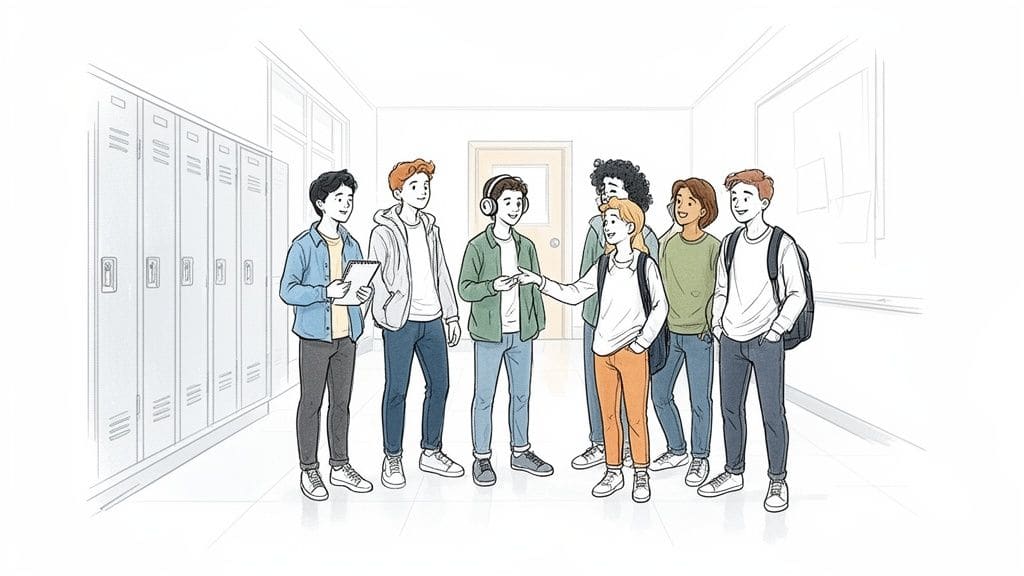
If you're reading this, you're definitely not alone. It can seriously feel like everyone else got a secret memo on how to form a friend group, leaving you on the outside looking in.
This feeling is especially common for neurodivergent teens. The unwritten social rules can seem hopelessly confusing and the thought of making small talk is just draining. But here's the good news: you don't have to change who you are to connect with other people.
Why Small, Meaningful Connections Matter More Than Popularity
Let's get one thing straight: the pressure to be popular is a myth. True friendship isn't a numbers game. It's about finding people you can actually trust and feel comfortable around. Research totally backs this up, showing that most teens have a small, tight-knit support system.
A 2026 Pew Research Center study reveals that about 64% of teens report having between one and four close friends, with only 2% claiming no close friends at all. This shows that for most people, the high school experience is about building a small but vital circle. The same study found that 89% of these teens say they have at least one friend they can lean on for emotional support, which proves that friendships are a cornerstone for getting through these years. You can read more about these teen friendship trends to see the data for yourself.
What this really means is you don't need dozens of friends to have a fulfilling social life. Focusing your energy on finding one or two people who share your interests is a much more effective—and way less exhausting—approach.
A New Approach for Neurodivergent Teens
For a lot of neurodivergent people, the standard advice to "just put yourself out there" completely misses the point. It ignores the real challenges of social anxiety, sensory overload, and the sheer mental effort it takes to decode social cues. This is exactly why having a structured plan makes all the difference.
> Key Insight: Friendship is a skill, not some innate talent you're born with. And like any skill, you can learn and practice it with the right tools—especially tools designed to cut down on social stress and uncertainty.
Here's a quick look at the core strategies we'll be focusing on. Think of it as your action plan to get started.
Quick-Start Friendship Action Plan
| Action Step | Why It Works | Example |
|---|---|---|
| Find Your Place | Puts you in a low-pressure setting based on a shared interest, giving you a natural reason to talk. | Joining the school's board game club or a local coding workshop. |
| Use an Opener | Reduces the anxiety of starting a conversation from scratch by giving you a pre-planned line. | Asking someone at the art club, "That's a cool technique. How did you do that?" |
| Be Consistent | Builds familiarity and turns a one-time chat into a potential friendship through repeated, low-stakes interactions. | Showing up to the same club meeting each week and saying hi to the same person. |
This table breaks down the process, making it feel less like a huge, intimidating goal and more like a series of small, achievable steps.
Our approach focuses on three core areas:
* Finding the Right Environments: Locating places and activities where social interaction is structured and built around stuff you actually care about.
* Starting Conversations with Confidence: Using scripts and pre-planned openers to take the anxiety out of breaking the ice.
* Building Sustainable Connections: Learning how to manage your social energy so you can turn acquaintances into genuine friends without burning out.
By breaking down the process of making friends, you can feel more in control. For instance, if you find social cues challenging, you might be interested in our guide on what neurodivergence means and how it shapes communication.
The whole goal is to give you a toolkit that makes socializing less intimidating. This includes everything from practical conversation scripts to coping mechanisms for when you feel overwhelmed, helping you build the confidence to create the connections you want, completely on your own terms.
Finding Your People in Low-Stress Environments
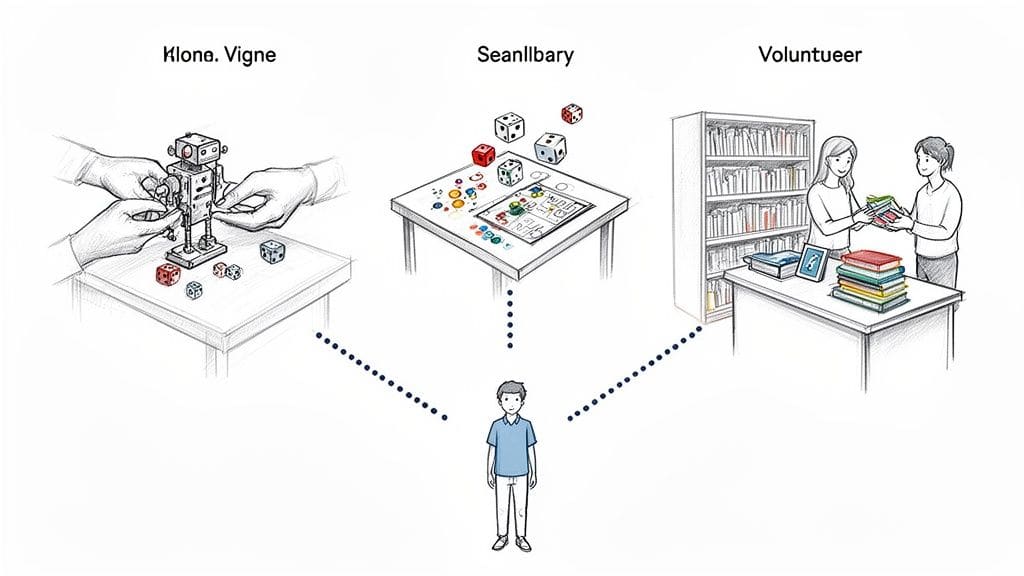
Let's be honest, the generic advice to "just join a club" often falls flat. It misses a critical piece of the puzzle: the type of environment you're in matters more than anything else, especially when social interactions can feel incredibly draining.
The most effective strategy for figuring out how to make friends in high school is to find your people where the pressure is off. This means seeking out structured activities that line up with what you're genuinely passionate about.
These places have a built-in social script. Conversation doesn't have to be forced; it just happens naturally around a shared task or goal. This completely removes the burden of trying to invent small talk out of thin air. You can let your passions do the talking, turning a shared interest into a real friendship.
Why Structured Activities Dial Down the Social Pressure
When you're in a space with a clear purpose, the social rules become much simpler and more predictable. Just think about the difference between a loud, chaotic school dance and a focused robotics club meeting. The dance is an overwhelming storm of unwritten social cues. The robotics club, on the other hand, has a defined task—build the robot.
In activity-focused settings, you already have a topic. You don't need to stress about finding an icebreaker; you can just ask a question about the project at hand. For a neurodivergent brain, this is a game-changer. It shifts the focus from stressful, unstructured socializing to a comfortable, shared activity.
The activity itself becomes the bridge between you and a potential friend. It makes that first step feel so much less intimidating. These low-stress zones are all around you if you know where to look. Even activities like youth sports can be great for discovering a community through youth sports leagues because they provide that essential structure.
How to Spot Your Ideal Low-Stress Zone
So, where are these places? They're anywhere a shared interest provides a natural script for conversation. Instead of just picking a club from a list, think about what you actually love doing.
Here are a few examples of low-stress environments and why they work so well:
* Robotics or Coding Club: The entire conversation is centered on solving a problem. You can ask for help, offer a suggestion, or just work quietly next to someone, building a sense of teamwork without any pressure.
* Board Game or D&D Group: These games have explicit rules and turn-based interactions. The game itself guides the conversation, giving everyone a clear role and something to talk about.
* Art or Creative Writing Club: You can focus on your own project while still being in the company of others. A simple comment like, "I love your technique," is a natural and low-stakes way to start a chat.
* School Band or Orchestra: Rehearsals are highly structured. Everyone is working together toward a shared performance, which builds a powerful sense of camaraderie and support.
* Volunteering (Library, Animal Shelter): These roles often involve quiet, focused tasks. The shared mission of helping out creates a really comfortable and low-pressure way to connect with others.
Find Your Personal "Friendship Zone"
Ready to find your spot? Grab a piece of paper or open a note on your phone and answer these three questions. This will help you pinpoint the kinds of activities where you're most likely to thrive.
1. What topics could I talk about for hours? (Think specific: vintage video games, a certain book series, space exploration, etc.)
2. What activities help me feel calm and focused? (e.g., drawing, organizing things, solving puzzles, building models)
3. What kind of environment makes me feel the least drained? (e.g., a quiet library, a focused workshop, a small group)
Once you have your answers, look for the overlap. If you love solving puzzles and prefer quiet settings, maybe the chess club is a perfect fit. If you're passionate about animals and enjoy calm activities, volunteering at a local shelter could be your spot.
And as you explore these new spaces, you might want more ideas for building confidence. Our guide on social skills activities for teens offers other practical exercises you can try.
Finding your place is the most important step in building friendships. By choosing an environment that plays to your strengths and minimizes social stress, you're setting yourself up for success from day one.
Finding it hard to connect with people at school? tonen can help.
tonen gives you 188+ conversation scripts, tone guidance and calming tools — designed for autistic adults, ADHD and social anxiety. Try it free for 7 days.
Download on the App StoreiOS only. Android coming soon.
Starting Conversations Without the Stress

Let's be honest, that first "hello" is often the hardest part of figuring out how to make friends in high school. To make it less terrifying, the secret is having a simple, low-stakes plan before you even open your mouth. This means using openers that actually fit the situation, thinking about your tone, and—most importantly—always having a pre-planned "opt-out" line so you can leave gracefully if you need to.
Having a playbook of what to say takes all the guesswork and anxiety out of that first moment. Instead of trying to invent the perfect line on the spot, you can walk into any situation with a few trusted phrases ready to go. It's a massive confidence boost.
Beyond Generic Icebreakers
Forget "what's up?" or talking about the weather. The best conversation starters are specific to the moment you're in. They prove you're paying attention and give the other person an easy way to respond.
The goal is to find a shared point of reference—something you're both experiencing right then and there. This immediately forges a small connection. If you're in a group setting planned for 2026 and need something more structured, exploring some fun icebreaker games for parties can also seriously reduce the stress of starting conversations.
Here are a few real-world scenarios with scripts you can adapt:
* After Class: "Hey, I thought that lecture on cell division was super confusing. Did you get what she meant about mitochondria?"
* In the Lunch Line: "The pizza actually looks good today. Have you tried it before?"
* At a Club Meeting: "That's a really cool design you're working on. What inspired it?"
Notice how each one is an open-ended question tied to your shared environment. It's not just a "yes" or "no" question, which invites a real response and helps get a proper conversation going.
Using Scripts to Lower Anxiety
For many neurodivergent teens, the mental energy it takes to script a conversation in real time is completely draining. This is where having pre-planned openers becomes a genuine superpower. It's why tools like the tonen app were created in the first place.
Instead of staring at a blank mental slate, you can use its Scripts Library to find ready-to-use lines for dozens of school situations. Having a few trusted phrases in your back pocket dramatically lowers the barrier to just starting a chat. For even more ideas, our guide on conversation starters for introverts gives you some extra low-pressure options.
> Key Takeaway: Using a script isn't "cheating." It's a smart strategy that frees up your mental energy to actually listen and connect, rather than spending it all just trying to figure out what to say first.
Think of it like using a map in a new city. It doesn't stop you from exploring; it just gives you the confidence to take that first step without the fear of getting lost.
The Power of Tone and Your Exit Plan
The words you choose are only half the battle. How you say them—your tone—matters just as much. Are you trying to be direct and to the point, or are you aiming for a warmer, friendlier vibe?
Apps like tonen help you practice this by letting you choose a tone for your script, such as Direct or Warm. This helps you match your delivery to the moment. For instance, a direct tone might work when asking a quick question in a busy hallway, while a warm tone is better for a relaxed chat in the library.
Just as critical is your "opt-out" line. This is your pre-planned escape hatch. Knowing you have a way to exit a conversation gracefully if it gets awkward or you start feeling overwhelmed removes a huge chunk of social anxiety.
Here are a few simple, effective opt-out lines:
* "Well, I should probably get going to my next class. It was nice talking to you!"
* "I have to go meet up with someone, but maybe I'll see you around."
* "I need to finish this homework before the bell rings, but thanks for the chat."
Having an exit plan gives you a sense of control. It makes trying to start a conversation feel less risky because you know, no matter what happens, you can leave whenever you want. This approach makes learning how to make friends in high school feel less like an overwhelming challenge and more like a manageable skill you can practice.
Turning First Conversations Into Real Friendships
Alright, you've made that first connection. That's a huge win. But how do you keep the momentum going and turn a friendly face in the hallway into someone you can actually count on?
The next step is about thoughtfully following up and showing you're genuinely interested. It's the difference between a one-time chat and building a friendship that feels authentic and lasts way beyond the classroom walls.
From Small Talk to Shared Experiences
The bridge from "classmate" to "friend" is built with small, consistent actions. It all starts when you take the initiative to move the connection outside of where it started. If you only ever talk in history class, the friendship will probably stay there.
The goal is to suggest a low-pressure activity. This gives you both a chance to interact in a new setting without it feeling like a huge, formal event.
* Make it Specific: A vague "we should hang out sometime" is easy to forget. A concrete plan is much easier for them to say yes to because it removes all the guesswork.
* Keep it Low-Stakes: Suggest something brief and casual. This takes the pressure off both of you and makes it feel easy.
> Pro Tip: A specific invitation is so much easier to accept. Try something like, "Hey, I'm grabbing a pizza after school to study for the bio test on Thursday. Want to join?" This is clear, has a defined purpose, and an easy endpoint.
This simple shift changes the dynamic. You're moving from a passive acquaintance to an active friendship in the making. It shows you value their company and want to invest more time in getting to know them. For more on the unique dynamics of friendship, especially for those with ADHD, our guide on ADHD and making friends offers some really helpful perspectives.
Building Lasting Bonds Through Reciprocity
Ever wonder what makes some friendships stick while others just fade away? It often comes down to reciprocity—that mutual give-and-take that shows you both care. It's not about keeping score. It's about creating a balanced connection where both people feel seen and valued.
Research backs this up. The PROSPER study, which followed about 13,000 friendship pairs, found that friendship stability hangs on mutual liking and shared experiences. For neurodivergent students, this means focusing on "low-stakes reciprocity" in structured settings is a powerful strategy. Consistently partnering in a science lab or working together in a club are great examples of this. You can learn more about the PROSPER study findings on friendship and see exactly how it works.
Here are a few simple ways to practice low-stakes reciprocity:
* Remember Small Details: Did they mention a big test or a game they were nervous about? Asking, "Hey, how did your math test go?" the next day shows you were listening and that you care.
* Offer Help: If you see them struggling with a stuck locker or dropping their books, offering a hand is a small act of kindness that goes a long way.
* Share Something: Offer them a piece of gum, a spare pencil, or a snack. These tiny gestures create positive associations and open the door for them to do the same for you later.
These small, consistent efforts are the real building blocks of a strong friendship. They show you're not just looking for someone to talk to—you're willing to be a supportive friend in return. This is the foundation for turning a simple acquaintance into a true, lasting connection.
Managing Social Energy and Handling Rejection
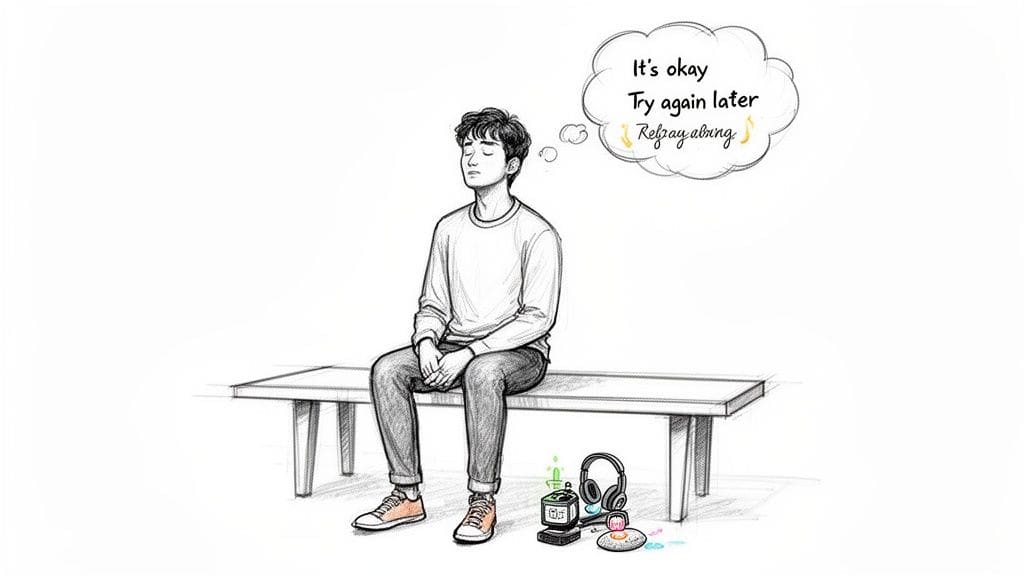
Let's be real: putting yourself out there to make friends is exhausting. It's exciting when things click, but the effort it takes can be incredibly draining, especially for neurodivergent teens. Figuring out how to make friends in high school is as much about protecting your energy as it is about starting conversations.
This section is all about building up your resilience. We'll cover some critical coping strategies for those moments when socializing just feels like too much, or when an interaction doesn't quite go to plan. It's not about trying to avoid every awkward moment—that's an impossible mission. It's about giving you a toolkit to navigate those moments with self-compassion and strength, so you can bounce back and try again.
Protecting Your Social Battery
Think of your social energy like the battery on your phone. Some interactions—like a deep chat about a shared special interest—might actually charge it a little. But many others, especially in a loud, chaotic high school hallway, will drain it fast. The trick is learning to spot when your battery is getting low before it hits zero.
When you try to push through social fatigue, you're on a fast track to burnout. That makes it even harder to connect with anyone later. The real skill is learning to recognize your own personal warning signs. Maybe you get irritable, start zoning out, or find it hard to string a sentence together. Whatever it is for you, spotting it is your cue to act.
> Key Insight: You are never obligated to stay in a social situation that is draining you. Giving yourself permission to leave is a powerful form of self-care and a smart way to manage your energy for the long haul.
When you feel that drain, it's time to make a graceful exit. Having a few lines planned out makes this so much less awkward.
Sample "Graceful Exit" Scripts:
* "It was great chatting, but I need to go get a head start on my homework. See you tomorrow!"
* "I'm feeling a little overwhelmed by all the noise, so I'm going to find a quieter spot. Talk to you later!"
* "I promised myself I'd get some reading done during this break. Great to see you, though!"
These are polite, clear, and don't need a big explanation. They put you back in the driver's seat.
Handling Overwhelm in the Moment
Sometimes, even with the best planning, overwhelm hits like a ton of bricks. Your heart might start racing, your thoughts get jumbled, and your first instinct is just to escape. In those moments, having a quick-access toolkit can make all the difference.
This is exactly why the tonen app includes a Calm Kit. It offers simple, guided exercises you can do discreetly to bring yourself back to the present moment.
* Breathing Exercises: Focus on slow, deep breaths to help calm your nervous system.
* Grounding Techniques: Silently name five things you can see, four you can feel, three you can hear, two you can smell, and one you can taste.
* Safe-Place Visualization: Briefly close your eyes and picture a place where you feel completely safe and calm.
These tools are designed to be used on the spot to dial down anxiety and help you get your footing back. For even more strategies, our article on how to regulate your emotions offers additional techniques for managing those intense feelings.
Reframing Rejection with a Perspective Helper
Here's a hard truth: not every conversation is going to turn into a friendship. That's completely normal for everyone. But when someone gives you a short answer or an interaction feels off, it's so easy for our brains to jump to the worst conclusion: "They hate me. I'm so awkward."
This is where a Perspective Helper, like the one in the tonen app, can be a game-changer. You can describe what happened, and it will offer you gentler, more probable interpretations of the other person's behavior.
For instance, say you tried to chat with someone and they gave a one-word answer before walking away. Your brain might immediately tell you, "I was so weird, they wanted to get away from me." A Perspective Helper might suggest other possibilities:
* "Maybe they were late for class and feeling stressed."
* "Perhaps they're just really shy and didn't know what to say."
* "They might have been distracted by something on their mind that has nothing to do with you."
This simple reframe stops you from automatically internalizing the rejection. It reminds you that other people's actions are very often not about you at all. Developing this mindset is absolutely vital for anyone trying to make friends, because it gives you the resilience to keep putting yourself out there. And that effort pays off in more ways than one—a 2023 systematic review found that teens with more in-school friends often achieve higher GPAs, since shared academic experiences can boost engagement. Read the full research about the academic benefits of friendship to see the data for yourself.
Frequently Asked Questions About High School Friendships
It's completely normal to have a ton of questions about the social side of high school, especially when it feels like everyone else got a rulebook you didn't. Let's tackle some of the most common worries that pop up.
Knowing how to make friends also means knowing how to navigate the awkward or confusing moments. This is your practical guide for those tricky situations, with clear answers to help you build confidence one step at a time.
What If I Try to Talk to Someone and They Don't Seem Interested?
This one stings, and it's so easy to immediately think you did something wrong. But here's the thing: their reaction is almost never about you.
They could be just as shy as you are, completely distracted by a test they just failed, or just having a really bad day. This is a perfect moment to use a tool like tonen's Perspective Helper, which is designed to suggest these exact kinds of alternative, less personal explanations.
The best move is to be polite, give them their space, and try again later or with someone else. Remember, the whole point of practicing is to build your skills and get comfortable, not for every single chat to turn into a lifelong friendship. That's perfectly okay.
How Many Friends Am I Supposed to Have?
There is no magic number. That pressure to have a huge, popular friend group is a total myth. The real goal is quality over quantity.
Research actually shows that the vast majority of teens—around 64%—have a small, close circle of just one to four friends.
> One or two genuine connections, where you can truly be yourself and feel understood, are worth so much more than a large group of surface-level acquaintances. Celebrate the friendships you build, no matter how small your circle feels.
My Teen Is on the Autism Spectrum and Finds Small Talk Difficult. How Can I Help?
Instead of forcing your teen to master small talk, help them lean into their natural strengths by focusing on shared activities. This is a total game-changer.
Encourage them to join a club built around one of their deep interests—maybe a coding workshop, a chess club, or a D&D campaign. In these structured settings, the conversation naturally centers on the activity itself, which completely removes the pressure of coming up with things to say.
You can also help them rehearse at home. Using pre-planned conversation starters from an app like tonen in a low-stakes setting is an amazing way to build muscle memory and confidence for real-world interactions.
Is It Weird to Use an App for Help with Conversations?
Not at all. Think of it like using glasses to see more clearly or a calculator for a tough math problem. Tools like tonen are just supports designed to lower your anxiety in situations that are genuinely challenging.
A lot of people feel social anxiety. Using an app with scripts and practice features is a smart, proactive strategy. It shows you're taking initiative to build your confidence and learn how to make friends on your own terms. That is definitely something to be proud of.
*
Ready to make conversations less stressful? tonen gives you the tools to feel more prepared and confident in any social situation. With a library of scripts, a Perspective Helper, and in-the-moment calming exercises, it's designed to support you. Start your 7-day free trial on the App Store and see how it can help.
Frequently asked questions
This guide covers how to make friends in high school: a practical guide for teens with practical, neurodivergent-friendly strategies—clear steps, scripts where useful, and ways to reduce anxiety or overload rather than vague "be confident" advice.