If you need to say something difficult, do not wait for perfect words. Pick one clear goal, write a two or three line script, choose a tone that fits the relationship, and prepare one exit line in case you get overwhelmed. That simple structure lowers pressure fast because you are no longer trying to improvise clarity, self-protection, and kindness at the same time.
A lot of people freeze before hard conversations. They rehearse every possible reaction, then say nothing. If that is where you are right now, the fix is not "be more confident." It is to make the task smaller. How to say something difficult becomes much more manageable when you separate it into four jobs: decide what matters, script it briefly, practice it out loud, and protect your nervous system during the talk.
Why Difficult Conversations Feel Impossible
You know the feeling. Your chest tightens, your brain starts writing twelve versions of the same sentence, and every version sounds wrong. By the time you could speak, you are exhausted.
That reaction makes sense. Difficult conversations ask you to do several hard things at once. You have to name a need, predict someone else's response, manage your tone, and stay regulated enough to keep going. For neurodivergent people, that load can spike even higher when sensory stress, processing delays, or past bad experiences get added to the mix.
Why your brain stalls
Perfectionism is part of it. Many people think the conversation must come out exactly right on the first try.
Another part is threat detection. If your brain reads conflict as danger, it will push you toward delay, overexplaining, apologizing, or shutting down. None of those responses means you are bad at communication. They usually mean your system is overloaded.
What helps instead
The most useful shift is this. Your job is not to perform perfectly. Your job is to communicate clearly enough.
That is why structure matters so much. A structure reduces decision-making in the moment. It also gives you something to lean on when emotions rise.
> Key takeaway: Hard conversations feel impossible when you try to do everything at once. They get easier when you reduce the task to one goal, one short script, and one backup line.
If conversations often leave you wondering why the interaction suddenly felt tense, this explainer on understanding why things feel off in conversations can help you spot the mismatch earlier.
Prepare Your Mindset and Define Your Goal
Before you script a single sentence, decide what this conversation is for. Most stalled conversations are not stalled because the wording is bad. They stall because the speaker is trying to achieve five outcomes at once.

Pick one primary outcome
Ask yourself, "What do I need from this talk?"
Keep it to one of these:
- Set a boundary
"I need visits planned in advance."
- State a need
"I need quieter space to work."
- Ask for repair
"I need us to address what happened yesterday."
- Request support
"I need more time, clarity, or accommodation."
If you try to seek apology, total understanding, behavior change, emotional closeness, and future guarantees all in one conversation, you will probably leave feeling scattered.
Use a minimum viable outcome
Think smaller than your ideal result. A minimum viable outcome is the smallest useful win.
Examples:
- "I said the thing out loud."
- "I named my boundary without apologizing for having one."
- "I asked for a follow-up instead of forcing myself through shutdown."
- "I clarified one misunderstanding."
That mindset matters because it keeps you from treating anything short of a perfect resolution as failure.
Separate facts from the story in your head
This step is where many people regain traction.
Write down two columns:
| Facts I observed | Story I am telling myself |
|---|---|
| "They interrupted me twice in the meeting." | "They think I am incompetent." |
| "My parent keeps dropping by unannounced." | "They do not respect me at all." |
| "My doctor kept using rushed language." | "They will never listen." |
The facts belong in your script. The story might still matter, but it should not drive your opening line.
> Tip: Start with what happened, what you need, and what would help next. Leave motive-reading out of the first draft.
A related skill is self-advocacy. If that part feels slippery, this guide on how to advocate for yourself more clearly pairs well with this process.
Build Your Scripting Toolkit With Four Tones
Most advice on how to say something difficult acts like there is one correct script. There is not. The same message can land very differently depending on the relationship, power dynamic, and your own bandwidth.
What works better is a small toolkit of tones. Keep every script short. Two or three lines is enough.
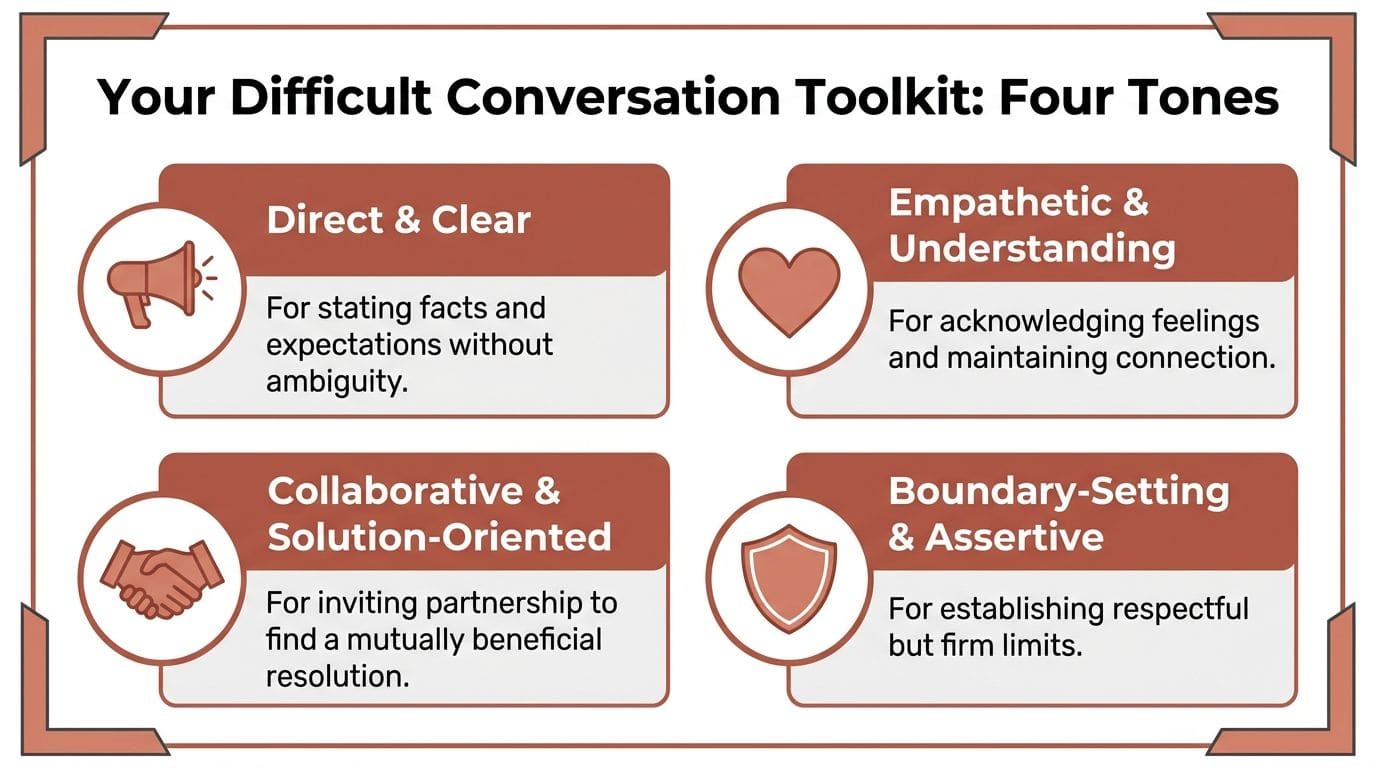
Choose the tone before you choose the words
Here is a simple comparison for one common request.
| Tone | Best For | Example Script (Requesting Quiet) |
|---|---|---|
| Direct | Clear requests, low ambiguity | "I need quiet to focus right now. Please lower the volume or move this conversation to another room." |
| Warm | Close relationships, preserving connection | "I know everyone's talking, and I do not want to be abrupt. I'm getting overloaded, so could we keep it quieter for a bit?" |
| Firmer | Repeated issues, weak boundaries | "I've asked for less noise before. I need this room kept quiet for the next hour." |
| Softer | Sensitive dynamics, high anxiety, tentative start | "Can I ask for something small? I'm having a hard time concentrating with the noise, and quieter would help me a lot." |
Each tone has a job.
Direct
Use this when ambiguity is the main problem. Direct is useful with practical requests, deadlines, accommodations, and people who miss hints.
Sample scripts:
- "I need more processing time before I answer. I'll reply this afternoon."
- "That plan does not work for me. I can do Friday, not Thursday."
- "Please send that feedback in writing."
Direct is not rude. It is often the kindest option when the alternative is confusion.
Warm
Warm works when the relationship matters and you want clarity without sounding cold.
Sample scripts:
- "I care about this, which is why I want to say it clearly. I felt shut out in that conversation."
- "I know you were trying to help. What I need right now is listening, not advice."
- "I want us to be okay, and I also need more notice before plans change."
Firmer
Firmer is for patterns, not first offenses. Use it when you have already hinted, softened, or explained several times.
Sample scripts:
- "I'm not available for surprise calls during work hours."
- "I'm going to leave if the conversation turns insulting."
- "I have answered this already. My decision is not changing."
This tone matters because repeated softness can accidentally teach people that your boundary is optional.
Dreading a hard conversation you know you need to have? tonen can help.
tonen offers conversation scripts, Reply Helper, Perspective Helper, Debrief, Phone Call Mode and Calm Kit. Start with 21 free scripts on iPhone. Optional Premium unlocks more features.
Download on the App StoreAvailable on iOS.
Softer
Softer helps when you are anxious, the topic is delicate, or the other person reacts badly to blunt openings.
Sample scripts:
- "This is a bit hard for me to say, but I want to be honest."
- "I may need a moment to get my words out, so bear with me."
- "I am bringing this up because I want less tension, not more."
Two safety-net lines to always prepare
No matter which tone you choose, add these two lines before the conversation starts.
- Opt-out line
"I want to continue this, but I'm getting overwhelmed. I need a break and can come back to it later."
- Ask-for-support line
"I mean what I'm saying, but I'm struggling to say it smoothly. Please focus on the point, not my delivery."
If you want more examples to adapt, this collection of conversation scripts for work, family, health, and social situations is useful for pattern-matching your own situation.
For relationship-specific communication habits, this piece on how to improve communication in your marriage with practical ways is a helpful companion resource.
Rehearse Your Lines and Manage Anxiety
A script on paper is not the same thing as a script you can say. The gap between those two is rehearsal.

Rehearsal is not performance
Practice is not about sounding polished. It is about building a path your brain can follow when stress narrows your access to language.
If you only think the script, you have not tested it. Say it out loud. Notice where you stumble. Trim long sentences. Replace abstract phrasing with words you would use.
Try one of these low-pressure methods:
- Phone rehearsal
Record yourself saying the lines once. Play it back and cut anything that sounds too long or unnatural.
- Mirror rehearsal
Practice while looking at your reflection so your body gets used to saying the words with a face attached.
- Pet or empty-room rehearsal
If another person feels too activating, rehearse to a dog, a chair, or the kitchen counter.
- One-line cards
Write just the key phrases, not a full speech. This keeps you flexible.
Calm your body before you speak
If your system is already flooded, even a good script can disappear. Regulating first is not avoidance. It is preparation.
Use one or two fast tools:
- Breathing
Inhale slowly, then make the exhale longer than the inhale for a few rounds.
- 5-4-3-2-1 grounding
Name five things you see, four you feel, three you hear, two you smell, and one you taste.
- Shoulder and jaw release
Tension often gathers there first. Drop your shoulders. Unclench your jaw. Uncurl your hands.
- Body scan
Ask, "What feels tight? What can soften by five percent?"
> Tip: Do not wait until panic peaks. Start regulation before the conversation begins, even if you think you are "fine."
Keep a reduced version ready
Stress can wipe out complex wording. Prepare a shorter fallback line that still protects the main point.
Examples:
- Full version: "I want to talk about how meetings have been going because I'm having trouble getting a word in."
Reduced version: "I need more space to speak in meetings."
- Full version: "I appreciate the invitation, but last-minute plans are hard for me and I need more notice."
Reduced version: "I can't do last-minute plans."
If anxiety around speaking is part of the problem, this guide on how to practice conversations for anxiety offers more ways to build comfort privately.
Putting It Into Practice With Scenarios
Real conversations are messy. That is why examples help more than abstract rules. The pattern stays the same in each case: define the goal, choose the tone, draft the script, and keep an opt-out line ready.
Work scenario
A coworker keeps messaging you with "quick questions" that break your focus.
Your goal is not to get them to understand your whole nervous system. Your goal is simpler. You need fewer interruptions.
A direct script might be:
"I work better when I batch questions instead of switching tasks. Please send non-urgent questions in one message, and I'll answer at set times."
If the relationship needs a warmer opening:
"I want to keep helping when I can. I'm losing focus with frequent pings, so it would help if you grouped non-urgent questions together."
Opt-out line:
"I want to answer well, but I'm overloaded right now. I'll come back to this after I finish what's in front of me."
Family scenario
A relative keeps giving unsolicited advice about your schedule, parenting, diet, or social life.
The trap here is getting pulled into defending every choice. Do not do that. State the boundary, not your full case file.
A warmer script could be:
"I know you mean to be helpful. I'm not looking for advice on this right now. What helps most is support without problem-solving."
A firmer version for repeat situations:
"I've said I don't want advice about this. Please stop bringing it up."
Opt-out line:
"I'm not continuing this part of the conversation. We can talk later about something else."
If family conflict patterns are the issue, this article on how to handle conflict in relationships can help you plan around them.
Health scenario
You are in an appointment, you feel rushed, and the language being used about you or your family feels dehumanizing or flattening.
That matters. The AMA notes in this guidance on equity-focused language for patients that dehumanizing terms can increase defensiveness, and that is especially important in settings where neurodivergent people may already be working hard not to shut down. The same source also notes this is relevant for the 1 in 36 US families with an autistic child.
A direct health script:
"I process information better when it is concrete and specific. Please explain the next step in plain language."
A softer version:
"I want to make sure I understand correctly. Could you slow down and go over that one more time in simpler terms?"
If language itself is the issue:
"I would prefer more person-centered wording. I can focus better when the language feels respectful and clear."
Opt-out line:
"I'm getting overloaded and need a pause before we continue."
Social scenario
A friend invites you somewhere, and you want to say no without inventing an excuse.
Many people overexplain here. You do not need a courtroom-grade reason to decline.
A simple warm script:
"Thanks for inviting me. I'm going to pass this time, but I appreciate you asking."
If you want to preserve connection:
"I can't do that plan, but I'd be up for something lower-key another time."
If guilt tends to push you into saying yes first and panicking later, try a processing line instead:
"Let me check my bandwidth and get back to you."
What these examples have in common
Each script does three things:
- Names the issue clearly
- Makes one request or boundary visible
- Protects your capacity with an exit line
That is enough. You do not need to sound elegant. You need to be understandable.
> Practical reminder: The first sentence only needs to open the door. You can clarify the rest once the conversation has started.
What if they react badly or get angry
That reaction is about their regulation, not your worth. You can prepare well and still meet defensiveness.
Focus on what you can control:
- Keep repeating the core point instead of getting pulled into side arguments.
- Use shorter sentences if the energy rises.
- Leave when needed if the conversation becomes unsafe, insulting, or too overwhelming.
A useful line is, "I'm going to pause here. I'm willing to continue when we can both speak respectfully."
How is this different from masking
Masking usually means suppressing yourself to appear acceptable. This approach does the opposite. It helps you communicate your actual needs with less strain.
You are not learning fake lines to erase yourself. You are building support around your real message so your brain does not have to generate everything under pressure.
What if I forget my script in the moment
Expect that possibility. It is common.
That is why a short fallback line matters. If the full version disappears, use the reduced version:
- "I need a minute."
- "That does not work for me."
- "I need to come back to this."
- "My point is that I need more notice."
Those lines are not failures. They are functional communication.
How can I tell if the conversation was successful
Do not grade success only by whether the other person agreed immediately. A better model comes from how technical teams evaluate outcomes. Instead of perfect or failed, use levels. This piece on measuring success with multi-level outcomes offers a useful parallel: complete success, success with minor issues, or failure.
Apply that to conversations:
- Complete success
You said what you meant, stayed fairly regulated, and the other person understood.
- Success with minor issues
You stumbled, needed notes, cried, or took a break, but you still communicated the point.
- Failure for now
You could not say it this time or the conversation became too dysregulating to continue.
That middle category matters. Many hard talks are messy but still worthwhile.
> Key takeaway: Success is not "They reacted perfectly." Success is "I expressed the need clearly enough to make it real."
If you want support turning this into something usable in real life, tonen helps neurodivergent people practice hard conversations with less stress. It offers short scripts for work, family, health, education, and social situations, plus tone options, opt-out lines, script preparation, and calming tools designed for low cognitive load.