Social scripts are simple, pre-planned phrases or short dialogues for specific situations, and they help because they reduce the mental load of figuring out what to say in the moment. In one review of Social Story studies involving 47 students, 51% of outcomes were rated highly effective, 44% ineffective, and 4% questionable, which is a useful reminder that social scripts work best when they are specific, individualized, and used flexibly.
If you're reading this right before a work meeting, a family text reply, or a social event you don't want to overthink, you're not alone. A lot of us know what we mean, but freeze when we need to say it out loud. The problem often isn't having nothing to say. It's having to sort tone, timing, wording, and anxiety all at once.
That's where social scripts can help. They give you a starting line, a middle path, and sometimes an exit. For autistic adults, ADHD teens and students, anxious communicators, and anyone who gets overwhelmed by live conversation, that can mean less pressure and clearer communication. Many public resources still treat scripts like a child-only support, even though research has long included adult participants, including an early study with verbal adults with autism and Down syndrome in this PubMed record on adult social script research.
Your Guide to Social Scripts for Less Stressful Conversations
A social script is usually short. It might be one sentence you use to ask for clarification, one phrase that helps you join a group, or a two-line response for setting a boundary without spiraling.
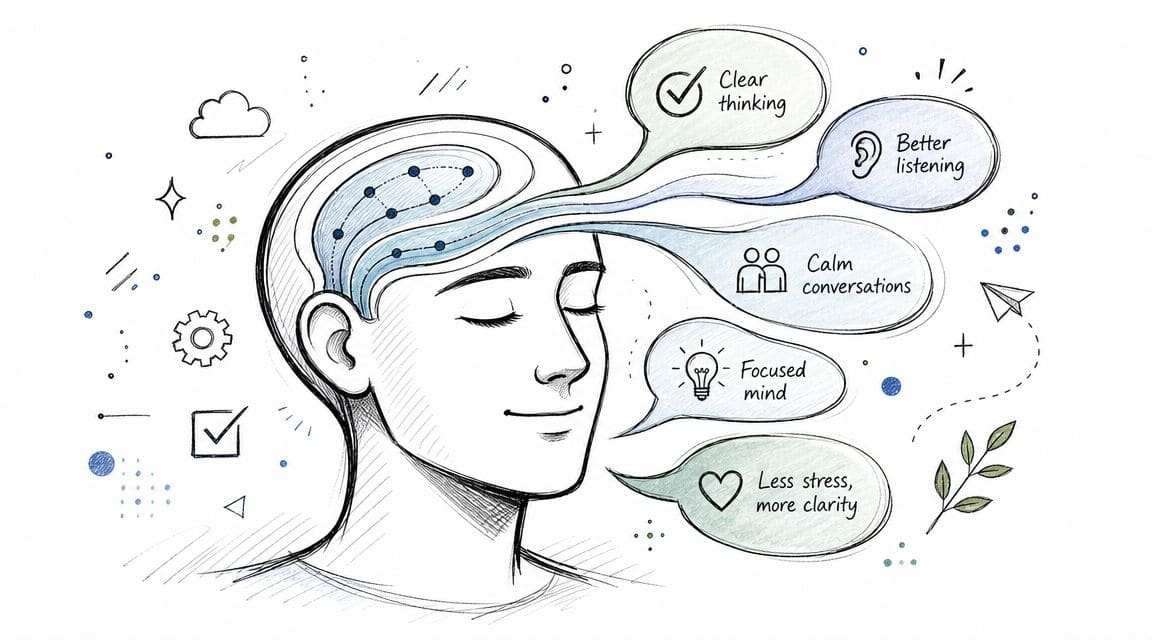
Many adults resist the idea at first because they worry scripts will sound fake. In practice, the opposite is often true. When you aren't scrambling to invent the perfect wording under pressure, you have more room to sound like yourself.
What social scripts actually look like
They don't have to be formal or polished. They can be plain, quiet, and very human.
- At work: "Can you say that another way? I want to make sure I understood."
- With a friend: "I want to come, but I need more notice next time."
- In a medical setting: "I need a minute to think before I answer."
> Social scripts are supports, not performances. You are allowed to use them to make communication easier.
If you want more ready-to-use phrasing for everyday situations, this collection of conversation scripts for everyday communication is a practical place to start.
Why adults often need them too
A lot of adults have learned to "wing it" while paying a high internal cost. You may get through the interaction, then replay it for hours. You may stay quiet because speaking up feels too effortful. You may over-explain because you couldn't find the simple version fast enough.
Social scripts help by giving you structure before the moment gets loud. That matters in adult life, where conversations often involve ambiguity, power dynamics, and fast decisions.
How Social Scripts Reduce Anxiety and Overwhelm
A hard conversation can feel like trying to drive in heavy rain while also reading the map, watching traffic, and keeping your hands steady on the wheel. You are listening, choosing words, reading tone, predicting reactions, and managing your own stress response at the same time. For many of us, that is the point where the mind goes blank, the body speeds up, or the sentence comes out in a way that does not match what we meant.
Social scripts reduce that overload by giving your brain one less job to do in the moment. According to this evidence-informed explanation of social scripts as a cognitive scaffold, scripts can lower cognitive load by holding some of the language for you ahead of time. That matters because the goal is not to sound rehearsed. The goal is to protect enough mental space for you to stay present, notice what is happening, and respond in a way that still feels like you.
Social scripts work similarly to training wheels on a bicycle
Training wheels help a rider practice without carrying the full balance task alone. Social scripts can do the same kind of support in conversation. They hold one piece steady so you can focus on the rest.
Sometimes that one piece is the opening line. Sometimes it is a boundary statement, a pause phrase, or a calm way to end the interaction. A script does not replace judgment or personality. It gives you a starting structure, which is often what disappears first when stress gets loud.
That can lead to a few immediate benefits:
- Less searching: You already have a first sentence available.
- Less guessing: Your main point is clearer before the conversation starts.
- More presence: More of your attention can go toward listening, tone, and adjustment.
> Practical rule: If conversations tend to derail at the beginning, write a script for the first line first. The opening often carries the most pressure.
Why this matters for neurodivergent and anxious communicators
If you have ADHD, autism, social anxiety, or overlapping experiences, conversation can bottleneck fast. You may know what you mean, but not on demand. You may need extra processing time, a clearer structure, or words that help you stay regulated while speaking.
That is where personalized scripts help. They are not rules for hiding your natural communication style. They are tools you can shape around it. You might prefer direct wording, softer wording, more formal wording, or a version that buys you a few seconds to think. All of those can be valid if they help you communicate authentically with less strain.
If relationship repair or boundary setting is one of your harder areas, this guide to assertive communication for relationships offers useful language for saying what you need without escalating conflict.
If anxiety is what keeps blocking the words you already know you want to say, this resource on social anxiety and communication stress can help you sort out the difference between fear, overload, and the message itself.
Building Your Personal Script Library
The most useful scripts are personal. They match your voice, your environment, and the kinds of conversations that drain you fastest. A script that helps one person in a workplace meeting might feel stiff or wrong for someone else.
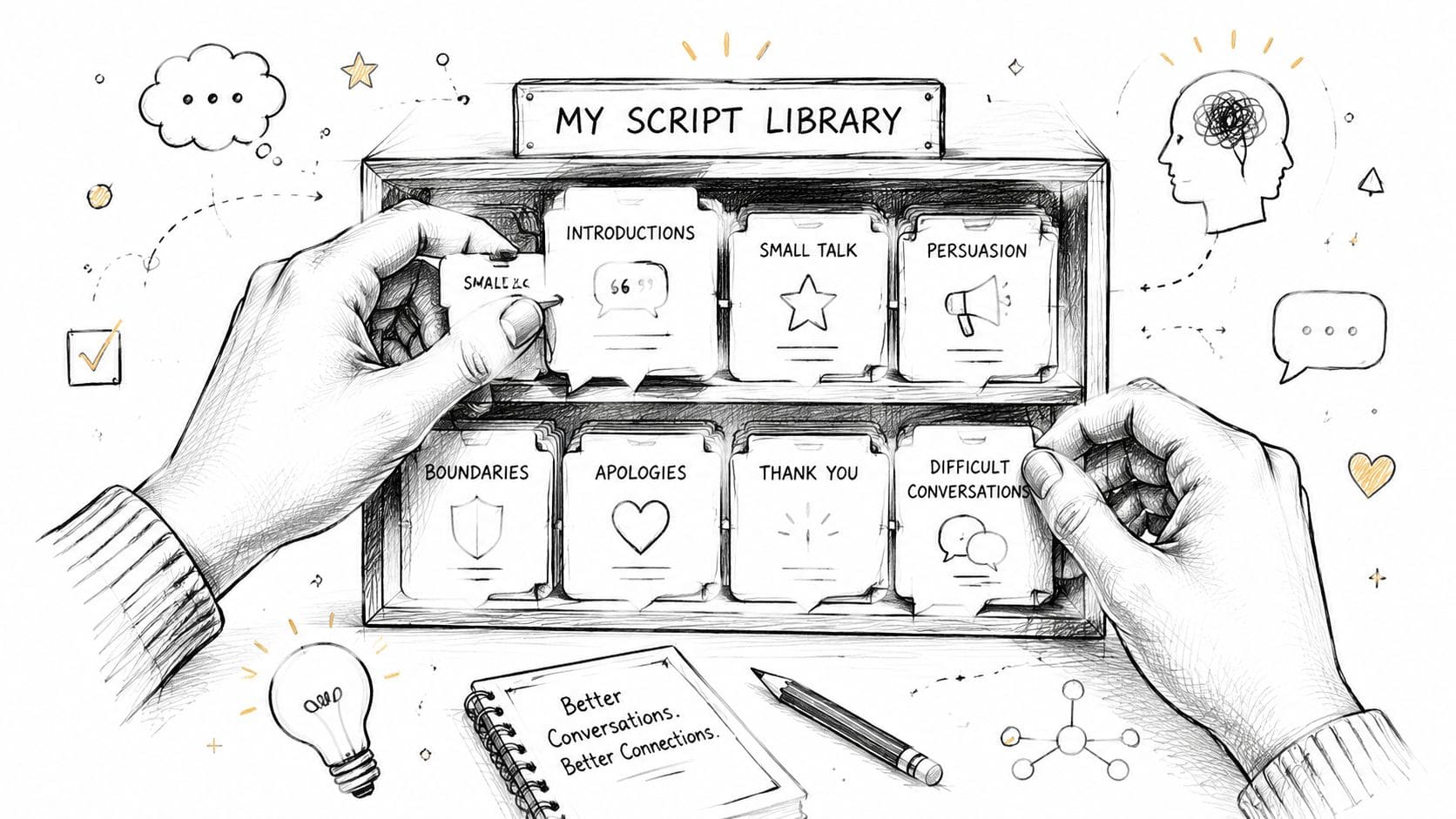
You don't need a huge document. Start with a small library of phrases you can remember and adapt.
Want ready-to-use phrases for hard conversations? tonen can help.
tonen gives you 188+ conversation scripts, tone guidance and calming tools — designed for autistic adults, ADHD and social anxiety. Try it free for 7 days.
Download on the App StoreiOS only. Android coming soon.
Start with one recurring stress point
Choose a situation that repeats. That matters more than choosing the most emotionally intense situation first.
Good starting points include:
1. Asking for clarification at work
2. Saying no without over-explaining
3. Leaving a conversation politely
4. Responding when plans change suddenly
5. Repairing a misunderstanding
When you pick one repeated moment, you can test your script, notice what felt natural, and revise it.
Write the shortest useful version
Keep it brief. Guidance in this Leicestershire social scripts resource recommends that effective scripts stay short, use few directive sentences, and often balance about 3–4 descriptive sentences to 1 directive sentence. That supports flexibility instead of rigid compliance.
In everyday adult use, that often means your script should answer only one question:
What do I need to communicate right now?
Here are examples:
- Clarification: "I want to make sure I understood. Are you asking me to finish this today or this week?"
- Boundary: "I can't talk about this right now. I can revisit it later."
- Exit: "I'm going to step out for a bit, but it was good talking with you."
Build tone variations
Social scripts become usable, rather than robotic, because the same message can be said in a direct, warm, softer, or firmer way.
Try writing three versions of the same idea:
- Direct: "I need more time to think."
- Warm: "I want to give you a thoughtful answer, so I need a little time to think."
- Firmer: "I'm not able to answer that on the spot."
> If one version feels awkward in your mouth, that's useful information. A good script should sound like a sentence you might actually say.
Add an opt-out line
A lot of people forget this part. Scripts are easier to use when they include a way to pause, leave, or ask for support.
Examples:
- Pause: "Can we come back to this in a few minutes?"
- Exit: "I'm going to head out now. Thanks for understanding."
- Support ask: "Can you put that in writing for me?"
If you want ideas specifically for limits and difficult conversations, this guide to scripts for setting boundaries gives useful examples you can adapt.
Organize your library by real life category
A simple note on your phone works. You might sort your library into:
| Category | Examples |
|---|---|
| Work | clarification, deadlines, meetings |
| Family | visits, conflict, overstimulation |
| Friends | cancellations, invitations, misunderstandings |
| Health | appointments, sensory needs, follow-up questions |
That way, you aren't building from scratch every time.
Examples of Social Scripts with Tone Variations
Sometimes the hardest part is hearing how the same message can sound different without changing the goal. Tone matters because adults encounter different power dynamics, relationships, and energy levels.
If family interactions are especially loaded, these neurodiversity-aware boundary strategies for family relationships may help you think through what tone feels safest and most sustainable.
You can also browse more phrase ideas in this library of social script examples for daily life.
Example Scripts and Tone Variations
| Situation | Direct Tone Script | Warm Tone Script | Firmer Tone Script |
|---|---|---|---|
| Asking for clarification on a task at work | "Can you clarify what you want me to prioritize?" | "I want to make sure I get this right. Can you clarify what you want me to prioritize?" | "I need clearer instructions before I can move forward." |
| Setting a boundary with a friend who is often late | "I need us to start on time or reschedule." | "I like seeing you, and I need us to be more consistent about timing." | "If you're running late again, I'll need to leave and try another day." |
| Exiting a conversation at a party | "I'm going to step away now." | "I'm glad we talked. I'm going to grab some air and reset." | "I need to end this conversation now, but take care." |
| Recovering from a misunderstanding | "That's not what I meant. Let me say it more clearly." | "I think I said that awkwardly. What I meant was…" | "I need to correct that before we keep going." |
| Declining an invitation | "I can't make it." | "Thanks for inviting me. I can't make it this time." | "I'm not available, and I won't be able to change my plans." |
> A script isn't better because it's warmer. It's better when it matches your goal, your safety, and your actual voice.
Practicing and Adapting Your Scripts
Writing a script is one skill. Using it under stress is another. Individuals often need a bridge between the two.
The value of scripts shows up when they transfer into everyday life. This summary of script use across settings notes that scripts have been effective from preschool through high school and into vocational settings, including helping people make spontaneous requests for assistance at work. That matters because real life is rarely tidy. We need supports that can travel with us.
Practice in low-pressure ways
You don't need to stage a perfect rehearsal. Short, low-stakes repetition helps more than waiting until you feel fully confident.
Try a few options:
- Say it out loud alone: Read the script while standing, walking, or looking away from the page.
- Record and replay: A voice note can show you whether the wording sounds natural.
- Role-play with one safe person: Ask them to respond in a few different ways so you can practice staying flexible.
Look for adaptation, not memorization
A script is becoming useful when you can change a few words without losing the point. You might start with "I need a minute" and later say, "Give me a second to think." That shift matters. It shows the support is becoming internal rather than fixed.
This guide to practicing conversations for anxiety can help if you want more structure while you rehearse.
> You're not trying to become polished. You're trying to become easier to understand under pressure.
Scripts for Authenticity Not Masking
A common fear is that scripts will make you sound artificial or push you toward masking. That risk is real if scripts are used to force eye contact, suppress natural regulation, or train you to look "acceptable" at the cost of comfort.
A neurodiversity-affirming approach is different. This guidance on neurodiversity-affirming therapy warns against using scripts as a compliance tool that encourages masking. Instead, the most effective scripts support autonomy, safety, and authentic communication. When they're used like training wheels, they can decrease anxiety. When they're used to extinguish difference, they can increase distress.

What affirming scripts sound like
They help you say what you mean. They make room for your boundaries, your processing needs, and your preferred tone.
Examples include:
- Processing need: "I need time to think before I answer."
- Sensory need: "This is a bit much for me right now. I need a quieter space."
- Boundary: "I'm not comfortable continuing this conversation."
Compliance-focused scripts often sound like they were written for someone else's comfort. Authentic social scripts sound like they were written for your access needs and your real relationships.
Frequently Asked Questions About Social Scripts
Will I sound robotic if I use social scripts?
You are more likely to sound like yourself when you have a starting point. A script works like a cue card, not a teleprompter. You can keep the meaning and change the wording so it fits your natural tone, whether that tone is warm, direct, brief, or formal.
Many adults find that a short phrase reduces the pressure to perform in real time. Instead of searching for perfect words while your brain is overloaded, you have a steady first draft you can shape.
Will I depend on scripts forever?
For many people, scripts become a support rather than a permanent crutch. You might read them word for word at first, then shorten them, remix them, or only use them in high-stress situations.
That shift is normal.
It helps to treat scripts the way we treat saved replies or notes on our phone. They are there when we need them. They do not replace your real voice. They help you access it faster, with less stress.
Where can I find reliable pre-made scripts?
Pre-made scripts can be useful when writing from scratch feels like too much. One option is tonen, a mobile app with a large library of concise scripts for work, family, healthcare, education, and social life, along with tone variations, opt-out lines, support requests, private practice tools, and calming exercises.
If you use pre-written scripts from any source, choose ones you can personalize. The best script for you should sound like something you would say on a decent day, not like a customer service template pasted into your life.