Knowing how to talk to people with social anxiety isn't about finding the perfect script; it's about creating a sense of safety, listening more than you speak, and being present. The best approach is to use low-pressure, observational questions to start, actively listen to what they say, and always have a respectful way to end the conversation. This transforms a potentially high-stakes interaction into a gentle invitation for connection. Instead of worrying about filling silence, your goal is to make the other person feel seen and accepted.
This simple shift can change the whole dynamic. The intense pressure to perform is often what triggers anxiety, so removing that pressure is key. This experience is far more common than most people think. Imagine your heart pounding and your mind racing, convinced that everyone is scrutinizing your every move—that's the daily reality for millions. In fact, a 2026 forecast based on current trends suggests that understanding how to navigate these conversations will become an even more critical social skill. This guide will provide practical steps for creating a safe space, preparing for conversations, and handling tricky moments with empathy.
Creating a Safe Space for Conversation

When you're trying to connect with someone who has social anxiety, the goal shifts. It's less about filling every moment with words and more about fostering psychological safety. You want to make the other person feel seen and accepted, not judged or put on the spot.
This simple shift can change the whole dynamic, turning a high-stakes event into a low-pressure exchange.
This experience is far more common than most people think. Imagine your heart pounding, your mind racing, absolutely convinced that everyone in the room is scrutinizing your every move—that's the daily reality for millions. In fact, an estimated 7.1% of U.S. adults, or roughly 15 million people, experienced social anxiety disorder in the past year.
Understanding this is the first step. It's not about having the "right" words, but about creating an environment where the other person feels comfortable enough to find their own. After all, the intense pressure to perform in a conversation is often what triggers the anxiety in the first place.
The Power of Low-Pressure Invitations
A key strategy is to use gentle, open-ended questions that invite sharing without demanding it. Instead of a direct "What do you do for work?"—which can feel like an interrogation—try something observational that you're both experiencing.
* "This is a great event. What brought you here today?"
* "I've been looking forward to trying this food. Have you tried the tacos yet?"
* "It's a bit loud in here, isn't it? Finding a quieter spot is always a relief."
These openers work because they're based on a shared context. This makes them feel less personal and intrusive, offering an easy on-ramp to a conversation without putting anyone on the spot.
> The core principle is to make it easy for the other person to engage or disengage without feeling awkward. A simple, respectful exit is just as important as a warm opening.
Building Your Toolkit for Connection
Before you even enter a social situation, it helps to have a few simple strategies ready. This isn't about scripting the entire interaction, but about creating a safety net so you don't feel panicked if your mind goes blank.
Here's a quick reference table to summarize these foundational techniques.
#### Your Foundational Conversation Toolkit
| Strategy | Actionable Tip | Example |
|---|---|---|
| Use Low-Pressure Openers | Comment on a shared experience or environment. | "This music is great. Do you know who the artist is?" |
| Offer an Easy Exit | Give the other person an out so they don't feel trapped. | "Well, I don't want to keep you. It was nice chatting!" |
| Prepare Go-To Topics | Have 1-2 neutral topics ready (e.g., a popular show, the event itself). | "Did you catch the latest episode of that new series on Netflix?" |
Having these tools in your back pocket can make interactions feel much less daunting. It's about being prepared, not robotic.
For a broader perspective on fostering open dialogue, learning how to talk about mental health with confidence can be incredibly valuable. This skill is vital when connecting with anyone, but especially those navigating anxiety. Ultimately, knowing how to talk to people with social anxiety is about being a considerate and empathetic communication partner.
And if you're looking for more ways to understand social signals, check out our guide on how to make sense of someone's behaviour.
Preparing for a Conversation Before You Even Speak
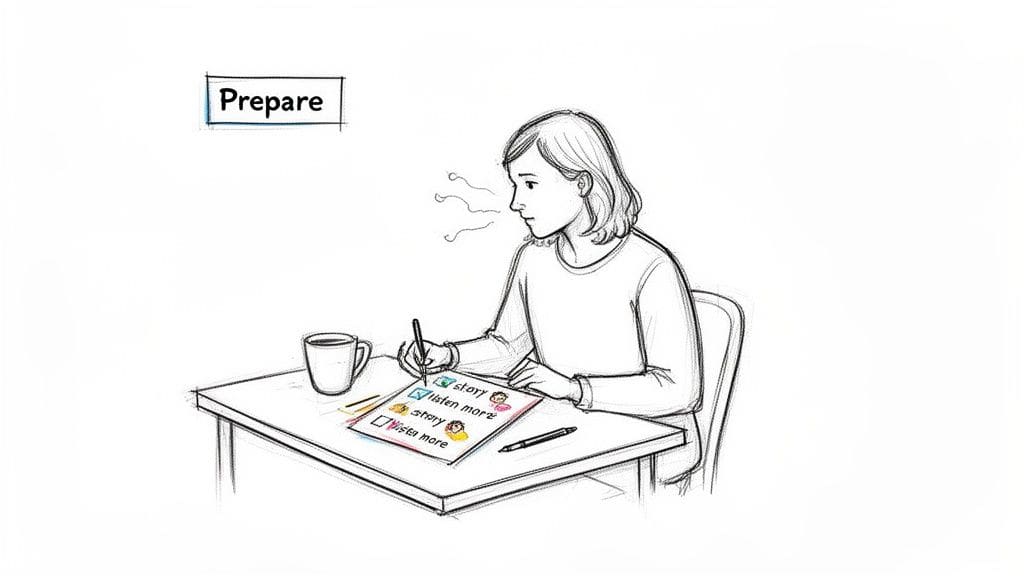
The hardest part of a conversation often isn't the talking—it's the dread that comes before you even say a word. The good news is that the most successful, low-anxiety interactions are built on a foundation you lay long before you speak. This is where you can take back control.
This isn't about memorizing a rigid script you have to follow perfectly. Think of it as building a personal 'conversation toolkit'. By arming yourself with a few safe topics, setting small goals, and knowing your exit strategy from the start, you can lower the stakes and walk into a social situation feeling equipped, not exposed.
Set Small, Realistic Goals
Instead of aiming for some perfect, deep, and witty conversation, give yourself a small, concrete mission. This shifts the entire interaction from a pass/fail test into a simple, low-pressure task. The goal isn't to perform; it's just to take one manageable step.
Your goal could be incredibly simple:
* "My only job is to listen more than I talk."
* "I'll ask one person a question about the event."
* "I will try to share one opinion if it feels right, and that's it."
Setting a micro-goal like "I'll stay for 15 minutes" or "I'll say hello to just one new person" makes the whole event feel less like a mountain to climb. You can always stay longer or talk to more people if you start to feel comfortable, but you've already "succeeded" by hitting your initial mark.
> A successful social interaction isn't measured by its length or depth. It's measured by your ability to manage your own anxiety and engage in a way that feels authentic and comfortable for you.
Brainstorm Safe Conversation Topics
We've all been there: your mind goes completely blank, and the silence feels deafening. The best way to prevent this is to have a few "safe," open-ended topics in your back pocket before you even walk through the door. These are neutral subjects that are easy for almost anyone to talk about without feeling put on the spot.
Think about topics related to your shared environment or common experiences:
* The Venue or Event: "This is a really cool space. Have you been here before?" or "The catering is great. What's the best thing you've tried?"
* Media and Hobbies: "Have you seen any good movies lately?" or "I've been listening to a lot of true-crime podcasts. Do you have any favorites?"
* Future Plans or Dreams: "Are you planning any trips for the upcoming season?" or "If you could travel anywhere, where would you go first?"
These topics work because they act as a bridge, allowing you and the other person to find common ground naturally. Having these ready is like having a conversational safety net. Rehearsing these kinds of questions is also a huge help, and you can learn more about how to practice conversations for anxiety to build that muscle.
Always Pre-Plan Your Exit
Knowing you have a polite way to leave a conversation is one of the most powerful tools for reducing social anxiety. This "escape hatch" makes it so much easier to start a conversation in the first place because you know you aren't trapped.
An exit strategy isn't rude; it's a completely normal part of social mingling. A good exit line is brief, positive, and clear.
Here are a few examples you can adapt for any situation:
| Situation | Exit Line Example |
|---|---|
| At a Party or Mixer | "It was so great chatting with you! I'm going to grab another drink before the bar gets too crowded." |
| At a Work Event | "I really enjoyed our conversation. I see someone I need to catch up with, but let's talk again soon." |
| Any General Setting | "Well, I should let you get back to your friends. It was lovely to meet you!" |
Having these phrases ready removes the fear of awkwardly ending the chat. This simple act of preparation gives you a sense of control that makes the entire experience feel safer and more approachable.
Crafting Your Opening and Matching the Vibe
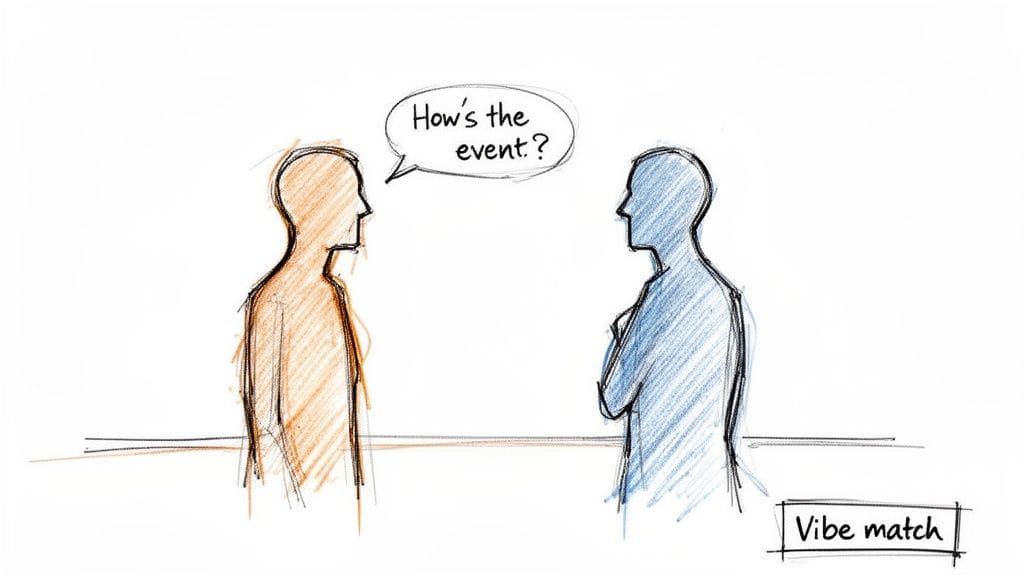
That first minute of a conversation can feel like an impossibly high hurdle. A huge part of knowing how to talk to people with social anxiety is learning how to craft a gentle, low-pressure opening. It's all about inviting a connection, not demanding one.
Beyond that, it's about learning the subtle art of "vibe matching"—taking a moment to read the energy of a person or a room and then mirroring it to build instant comfort.
This approach stops the interaction from feeling like a performance and turns it into a more collaborative exchange. When you focus on creating a natural, shared experience, you quiet the fear of saying the wrong thing and open the door for a real connection. The goal is to help the other person feel at ease, which almost always helps you feel more relaxed, too.
Gentle Conversation Starters
The best openers are almost always observational and rooted in a shared experience. They take the spotlight off the other person and shine it on a neutral, external topic. This creates an easy, non-interrogating way into a conversation.
Just look around. What are you both seeing, hearing, or experiencing right now?
Struggling to navigate conversations with social anxiety? tonen can help.
tonen gives you 188+ conversation scripts, tone guidance and calming tools — designed for autistic adults, ADHD and social anxiety. Try it free for 7 days.
Download on the App StoreiOS only. Android coming soon.
* At a social event: "This playlist is fantastic. I'm always looking for new music."
* In a professional setting: "That was a really interesting presentation. The point about [specific detail] stood out to me."
* While waiting in line: "I love the art on this building. Have you ever noticed it before?"
Starters like these work because they don't force personal disclosure. They give the other person a simple way to agree or add their own observation, which keeps the pressure incredibly low. If you find yourself getting stuck a lot, our guide on what to say when you don't know what to say has a ton of other scripts and ideas.
The Art of Matching the Vibe
The words you choose are only half the battle; your delivery is everything. Vibe matching, or social mirroring, is the simple practice of subtly adjusting your energy, tone, and even body language to align with the person you're speaking to. It's a powerful, non-verbal way of signaling safety and acceptance.
This doesn't mean you have to fake a personality. It's just about being observant and responsive.
* If the person is quiet and reserved: Drop your voice to a softer tone and give them a bit more physical space. Avoid loud, sudden gestures.
* If the group is energetic and laughing: It's okay to be a little more upbeat in your approach. Even a simple smile is a great way to join the energy.
> The essence of vibe matching is just empathy in action. It communicates, "I see you, I'm with you, and I'm not here to overwhelm you." This one simple act can make someone with social anxiety feel worlds more comfortable.
This kind of social attunement is becoming a critical skill. Social anxiety isn't just "being shy"—it's a pervasive fear that can seriously derail lives, and recent studies show it's on the rise. Research published in 2020 across seven countries found that a staggering 36% of people aged 16-29 met the criteria for social anxiety disorder. In the US sample alone, that number spiked to nearly 58%, highlighting a massive need for more compassionate communication. You can read the full research on this global trend to get a better sense of its impact.
Putting It All Together: A Scenario
Let's say you're at a casual work barbecue and see a colleague standing alone near the edge of the patio, looking a bit overwhelmed. Here's how you could put these principles into practice for knowing how to talk to people with social anxiety.
1. Observe First: Notice their body language. Are they looking down, holding their cup in a death grip? They're probably feeling anxious. The vibe is quiet and closed off.
2. Match the Energy: Approach them slowly and calmly. Don't get right in their personal space. Skip the loud, booming "Hey!"
3. Use a Low-Pressure Opener: Pick a neutral, shared topic. Something like, "It's so nice to get out of the office, isn't it? The weather turned out perfect."
4. Listen and Wait: This opener only requires a simple "yeah" or a nod, which gives them control. If they do respond, you can follow up with another gentle, open-ended question. "Have you tried the potato salad? I heard it's amazing."
This whole sequence is designed to be an invitation, not an intrusion. It shows you're a safe and considerate person to talk to, making the interaction feel more like a friendly gesture than a social demand.
Navigating the Flow and Managing Overwhelm
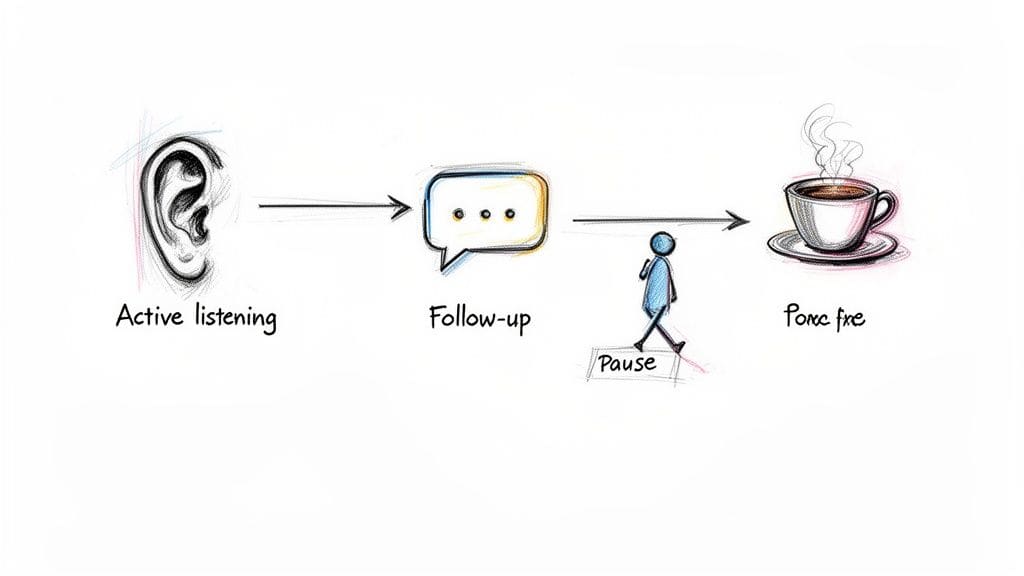
Okay, so you've started the conversation. Now what? This is often where the real challenge begins—keeping it going while that internal storm of anxiety is brewing. The key to learning how to talk to people with social anxiety mid-conversation is to shift your focus from performing to being present.
Instead of viewing it as a test you might fail, think of it as an opportunity to connect. One of the best ways to do this is through active listening. When you genuinely focus on what the other person is saying, you'll find you naturally become less self-conscious and more engaged in the moment.
Here, we'll get into the in-the-moment strategies for staying centered, asking questions that keep the dialogue flowing, and gracefully handling those moments when things feel like too much.
Use Active Listening to Stay Present
Social anxiety loves to trap you inside your own head. You end up replaying what you just said or frantically worrying about the "right" thing to say next. Active listening is the perfect antidote. It forces your focus outward, onto the other person's words, their tone, and what they're communicating.
This isn't just about politely waiting for your turn to speak. It's about being genuinely curious. When you truly listen, you'll find that good follow-up questions often just pop into your head, inspired directly by what they just shared.
Here's what that looks like in practice:
* Gentle eye contact: No need for an intense stare-down. A soft, occasional gaze is all it takes to show you're paying attention.
* Small verbal cues: Simple acknowledgments like "I see," "That makes sense," or "Oh, wow" go a long way. They validate the speaker and show you're following along.
* Paraphrase to confirm: Briefly summarizing what they said ("So, it sounds like you found the project challenging but rewarding?") proves you're engaged and gives them a chance to clarify.
This simple shift turns the conversation from a performance into a partnership. You're no longer just trying to survive; you're actively helping to build a real connection.
Ask Thoughtful Follow-up Questions
Good follow-up questions are the engine of a smooth conversation. They show you're genuinely interested and invite the other person to share more, taking the pressure off both of you. The best ones are open-ended and build directly on what was just said.
Think of it as pulling on a conversational thread.
If they say: "I just got back from a trip to the mountains."
* Instead of: "Was it fun?" (A closed question that gets a yes/no answer.)
* Try: "That sounds amazing! What was your favorite part of the trip?" or "What's one thing that surprised you about being there?"
If they say: "I've been really busy at work lately."
* Instead of: "Oh, that's tough."
* Try: "What kind of projects are you working on that are keeping you so busy?"
> A great follow-up question often starts with "What," "How," or "Tell me more about..." These openers encourage storytelling rather than one-word answers, making the conversation feel much more natural and less like an interview.
Recognize and Respond to Overwhelm
Sometimes, despite your best efforts, a conversation can just feel like too much. Social batteries drain quickly, especially for anyone dealing with anxiety. Knowing how to spot the signs of overwhelm and respond with empathy is a crucial skill for learning how to talk to people with social anxiety.
Look for signs of conversational fatigue, which can include:
* Avoiding eye contact more often.
* Giving shorter, one-word answers.
* Fidgeting or seeming distracted.
* A shift in posture, like crossing their arms or turning slightly away.
When you notice these signs, don't panic or assume you did something wrong. The kindest and most effective response is to offer a gentle "out" or a change of pace. If you're feeling strained yourself, knowing what to do when feeling overwhelmed can give you some great tools for managing it in the moment.
#### Strategies for a Shared Pause
Offering a break is a low-pressure, collaborative way to ease the tension. It validates their feelings (and maybe your own) without making a big deal out of it.
Here are a few phrases you can use to gently shift the energy:
| Situation | Gentle De-escalation Phrase |
|---|---|
| At a party or event | "This has been a great chat! Would you like to grab a drink with me?" |
| In a quieter setting | "Let's take a breather for a second. That was a pretty deep topic." |
| When you need to shift | "On a completely different note, have you seen the dessert table? It looks incredible." |
These tactics aren't about ending the conversation abruptly. They're about shifting the energy. It quietly communicates, "I'm comfortable with a pause," which can be an immense relief for everyone involved. This approach is fundamental to creating a safe interaction, prioritizing comfort over conversational perfection.
How to Politely End a Conversation
Knowing how you'll leave a conversation is just as important as knowing how to start one. We've all been there—the chat is fizzling out, but you're not sure how to make a clean exit without feeling rude or awkward.
The fear of getting trapped can be so overwhelming that it stops you from saying hello in the first place. But mastering a graceful exit is a game-changer. It's your safety net, giving you the confidence to engage because you know you can disengage on your own terms. A polite closing line isn't a failure; it's a normal, healthy part of every single conversation.
The Anatomy of a Graceful Exit
A good exit strategy has three simple parts: it's positive, brief, and clear. You're not making excuses or apologizing. You're just signaling that the conversation has come to a natural close.
* Start with something positive: A genuine comment about the chat shows you were engaged. Something as simple as, "It was so great talking with you," or "I really enjoyed hearing about your project," makes the other person feel good.
* State your next move briefly: You don't need a long, elaborate story. A simple, direct statement is always best.
* End with a warm closing: Finish with a friendly, forward-looking remark. "Enjoy the rest of the event!" or "Hope to see you again soon" works perfectly.
This three-part flow creates a smooth, respectful departure that leaves everyone feeling positive about the interaction.
> Ending a conversation isn't about rejection; it's about transition. By handling it with grace, you show respect for both the other person's time and your own energy limits, which is a cornerstone of healthy communication.
Scenario-Specific Exit Scripts
The "right" way to leave a conversation often comes down to the setting. Having a few go-to lines for different scenarios eliminates that in-the-moment panic of trying to figure out what to say.
Here are a few real-world examples you can adapt for your own use.
#### At a Party or Social Mixer
| Your Goal | Exit Line |
|---|---|
| To mingle more | "It was wonderful meeting you! I'm going to try and mingle a bit more before the night is over." |
| To get a drink or food | "I've really enjoyed our conversation. I'm going to grab another drink, but it was great chatting!" |
| When feeling overwhelmed | "I'm starting to feel a bit drained, so I'm going to find a quieter spot for a minute. It was lovely talking with you!" |
#### At a Professional or Networking Event
Your exit here can actually be a great way to signal future contact, which is often a key goal at these events.
1. Reiterate a key point: "I really appreciate your insights on [topic]. I'll definitely be thinking about that."
2. State your next action: "I see my colleague over there and I need to connect with them before they leave."
3. Offer a future connection (optional): "It was great to finally meet you in person. Let's connect on LinkedIn."
#### At a Family Gathering
Family events can be tricky, but having a polite out is still your right. The goal is to be warm but clear.
* "It's so good to catch up! I'm going to go say hi to Grandma before she gets tired."
* "I'm going to help out in the kitchen for a bit, but it was great to chat!"
Having these phrases ready makes setting social boundaries feel less confrontational and more like a natural part of the flow. For more on this, our post with scripts for setting boundaries offers even more practical language.
Mastering these polite exits is a vital skill for anyone learning how to talk to people with social anxiety, as it builds the confidence and sense of safety needed for every interaction.
Common Questions and Quick Troubleshooting
Even with a solid game plan, conversations have a way of throwing curveballs. This is where we get into the troubleshooting—the specific, in-the-moment hurdles that can trip you up. Think of this section as your practical guide for those "what do I do now?" moments.
We'll tackle some of the most common questions that come up when you're learning how to talk to people with social anxiety. The goal isn't perfection; it's about having a few tools in your back pocket to feel more in control.
What if My Mind Goes Completely Blank?
This happens to almost everyone with social anxiety. It's that awful moment where the 'fight or flight' response kicks in and your brain just… stops. The most important thing to remember is that it feels a thousand times more catastrophic to you than it looks to anyone else.
First, don't panic. Giving yourself permission to pause is a powerful move.
You can even say something light like, "Wow, I just completely lost my train of thought for a second!" This humanizes the moment and can actually break the tension. Then, gently shift the focus back to them.
* "Anyway, you were saying something about..."
* "Tell me more about [whatever their last point was]."
Taking a slow sip of your drink is another fantastic trick. It creates a natural, socially acceptable pause that gives you a few seconds to regroup. The goal is to see the silence as a brief pause, not a personal failure.
How Can I Join a Group Conversation?
Trying to break into a conversation that's already flowing can feel like trying to jump onto a moving train. The key is a low-impact approach that doesn't feel like a jarring interruption.
Start by standing near the group and just listening for a minute or two. This lets you get a feel for the topic and the overall energy of the group.
Wait for a natural lull—a moment of shared laughter or when one person clearly finishes a thought. You can then make eye contact with someone who seems friendly and offer a small smile. Often, that's enough of a non-verbal invitation to be included. Or, you can add a short, relevant comment like, "That sounds amazing, I've always wanted to go there."
> Avoid jumping in during a deeply personal story or a passionate monologue. Your goal is to slide in during the transitions between speakers, not to derail the current momentum. It shows you respect the group's existing dynamic.
How Do I Talk to Someone Who Gives Short Answers?
It's so easy to internalize this and immediately assume you're being boring or awkward. But nine times out of ten, it has nothing to do with you. The other person might be anxious themselves, distracted by something else, or just not in a talkative mood.
Try asking one or two more open-ended questions that require more than a simple "yes" or "no." Instead of, "Did you have a good weekend?" you could try, "What was the most interesting part of your weekend?"
If you still get one-word replies, do not feel obligated to carry the entire conversation. It's perfectly okay to conserve your social energy for interactions that feel more reciprocal. This is a perfect time to use one of your graceful exit lines.
* "Well, it was really nice to meet you. I hope you enjoy the rest of the event."
Politely moving on is an act of self-care. It's a crucial part of knowing how to talk to people with social anxiety—and that includes recognizing when a conversation has naturally run its course.
Should I Tell People That I Have Social Anxiety?
This is a deeply personal decision, and there's no single right answer. For some, disclosing their anxiety is a massive relief. It can feel like taking off a heavy backpack you've been carrying and it gives people context for your behavior.
You could say something simple, like, "Just so you know, I sometimes get quiet in big groups because I have some social anxiety." This can stop people from misinterpreting your quietness as disinterest or rudeness.
However, you are never required to share this information. Many people manage their anxiety privately using the strategies in this guide, and that's perfectly valid too. The most important thing is doing what makes you feel most comfortable and in control of your own story.
If your social anxiety is consistently getting in the way of your daily life or causing you a lot of distress, it's worth understanding when to see a psychiatrist for anxiety for professional support. A mental health expert can offer personalized guidance and treatment options.
Navigating social interactions with anxiety is a skill that gets stronger with practice. Having a tool in your pocket can make all the difference. The tonen app is designed to help you handle conversations with less stress, offering a library of scripts, tone options, and in-the-moment calming exercises. Download tonen and start your free trial at https://usetonen.com.
Frequently asked questions
This guide covers how to talk to people with social anxiety and build connection with practical, neurodivergent-friendly strategies—clear steps, scripts where useful, and ways to reduce anxiety or overload rather than vague "be confident" advice.